World Forestry Day.

Imagine a machine that uses solar energy to remove carbon from the air and turns it into a beautiful, strong and sustainable building material.

Oh wait… that’s what trees are…

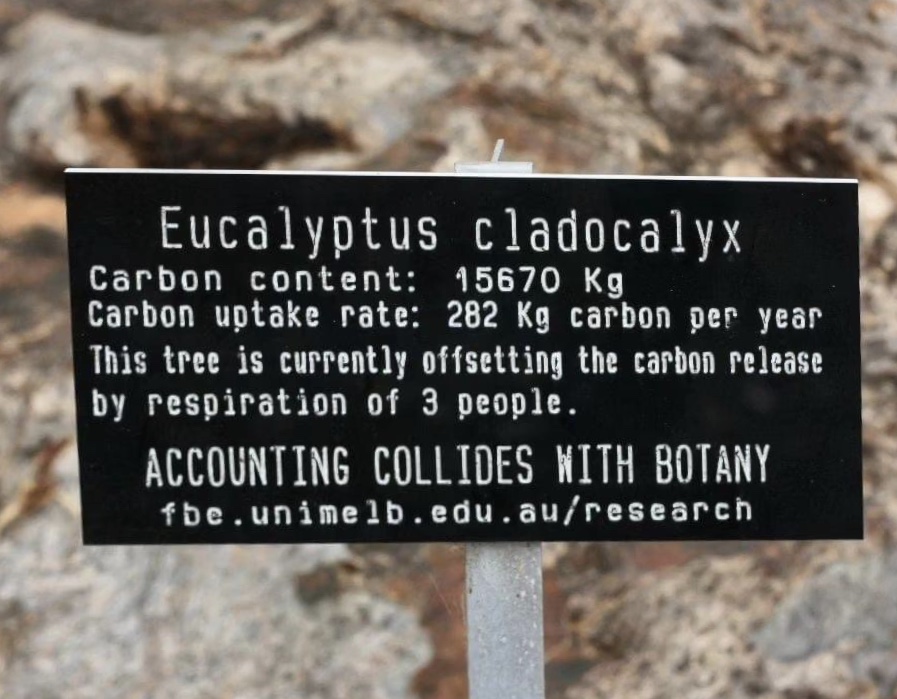
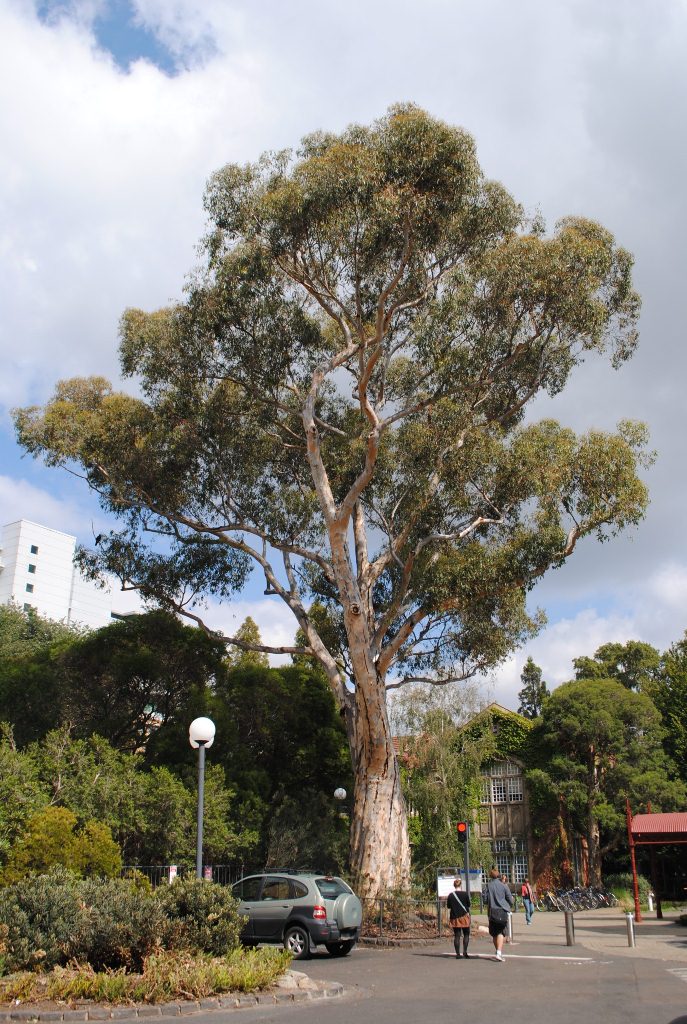
Today is World Forestry Day and what better way to celebrate than to acknowledge this magnificent Sugar Gum (Eucalyptus cladocalyx) which grows in front of the historic School of Botany at the University of Melbourne.

Thought to be over 110 years old, the tree is 25 metres tall and has a diameter over 2 metres.

The bean-counting folks at the Uni calculated that this tree uptakes about 282 kilograms of carbon each year, offsetting the amount released by three people breathing.

The tree has been listed by the National Trust of state significance.

https://trusttrees.org.au/tree/VIC/Carlton/University_Of_Melbourne_156_292_Grattan_Street_5

Melb Uni

Mississippi Quarry – Colquhoun forest.

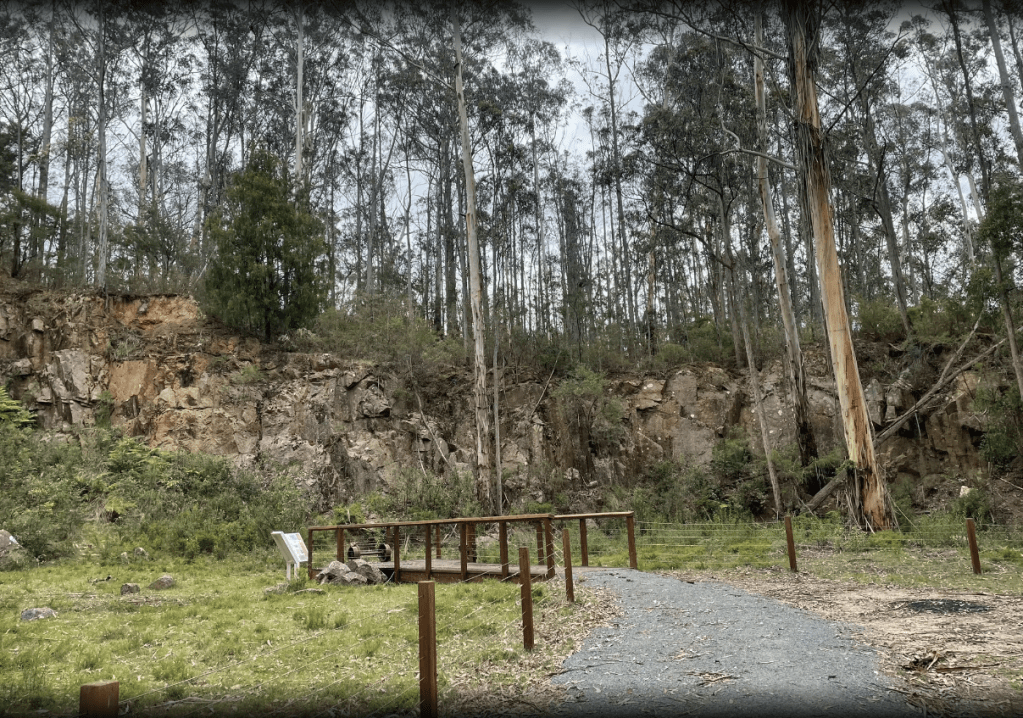
A large granite outcrop at the headwaters of the Mississippi Creek in the Colquhoun State forest, just west of Lakes Entrance, was identified in the early 1890s.

It’s said to be of the same geological formation as the pink granite at Wilsons Promontory, Gabo Island and northern Tasmania.

The beautiful granite will take a high polish and can be used for pillars, casements, sills, steps, or any work that needed a durable and ornamental stone.

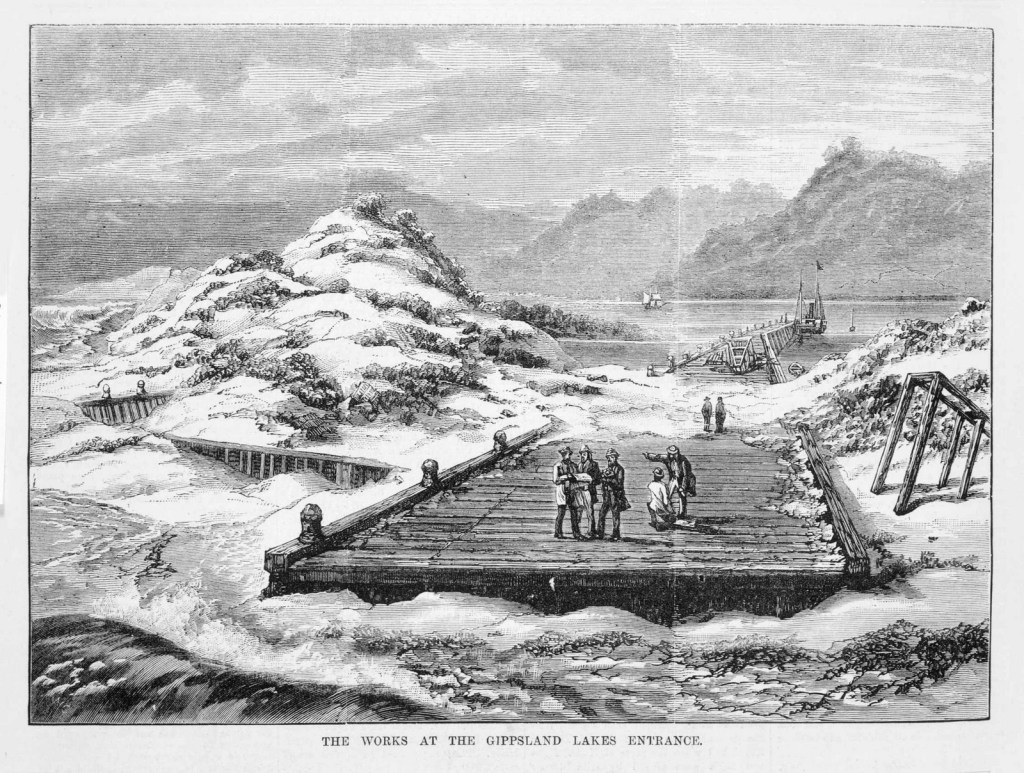
In the years following the goldrush, ships entering the Gippsland Lakes from the southern ocean were subject to the vagaries of shifting sands, floods, winds and tides.

Works began in the 1870s to create an artificial entry and navigable access to the inland lakes system. Two rows of wooden piers were installed on each side of the new entrance and stabilised with stone dropped in between the rows of timber.

But over time, the stone sank into the sand or was displaced by currents and had to be replaced. Teredo worms (termites of the sea) ate what was left of the timbers. Something more permanent was needed for the busy port.

In 1890, a surveyor was sent to take depth soundings of the north arm of the lake and survey the line for a new tramway through the bush to the site of the intended quarries.

Despite the early expectations for the granite in the Mississippi Creek, the stone for reinforcing the piers was brought by ship from Refuge Cove at Wilsons Promontory, and later by bullock dray from a quarry at Wy Yung near Bairnsdale, until at least 1900.

The development of the Mississippi Creek Quarry seems to have begun in early 1904 by local contractors, the Coate Brothers.

Cutting the hard rock used the “hammer and tap” method. Two men took turns with sledgehammers to hit a steel drill held by a third man slowly rotating the drill bit so its didn’t get stuck in the rock. Once the drill was about 2 feet deep into the rock another hole would be started nearby. The holes were then packed with explosives and detonated to crack large blocks of granite from the working face of the quarry. If necessary, the blocks would be drilled and blasted again until they were of a workable size and could be trimmed to shape.

Coate Bros built a 3’6″ gauge steel tramway 13 km through State Forest in 1910 to transport the large blocks of granite, which could weigh as much as 5 tons, to the head of the North Arm near Corner Landing. Rock was then loaded by crane and transported by barge a further 6km to the entrance of the Gippsland Lakes where they had the contract to convert the eastern pier from timber to stone and concrete.

At least one load of 60 tons went on the downhill run per day to the barge landing, but occasionally trucks would derail, and the rock tipped into the bush where they still lay.

Later, some stone was used in Melbourne buildings, the most notable being in 1926 with the Masonic Club in Flinders Street. This use extended the life of the quarry when the civil works at the entrance were complete.

Records indicate that the quarry last operated in 1946 for cartage of some more stone to the eastern wharf at Lakes Entrance. The steel tramway was then salvaged, and the quarry abandoned which became slowly overgrown with scrub and blackberries.

In July 2000, the Federal Government was making money available under the Regional Forest Agreement (RFA) process with “structural adjustment” packages to offset the reduction in sawlogs and corresponding loss of jobs. The Feds were looking for “shovel ready” community projects in East Gippsland.

I’m a keen bike rider and a trail from the Mississippi Quarry to Lakes Entrance had been an idea for a while. I was also the Regional Forest Manager for Gippsland at the time but couldn’t secure funding from the Department.

It all came about in a short phone call, very late one Friday afternoon, when a colleague from Melbourne, Richard Wadsworth, rang looking for projects and about $1M fell into my lap. That’s the way funding bids worked sometimes. I followed up with some paperwork and a formal application the following week, but it was as easy as that…

Some of the cash went on the existing rail trail, while Andrew Sharpe and Rob Stewart from Bairnsdale planned and delivered a new project which included a 5km link up a steep hill to the East Gippsland Rail Trail at the junction with Seaton Track.

Most of the old wooden bridges on the tramway had collapsed and needed to be replaced. Remnants of steel rail line and lumps of stone can be found along the track. New signs and a viewing platform at the quarry were built while some old tramway wheels were salvaged for display and a piece of polished granite is included in the design.

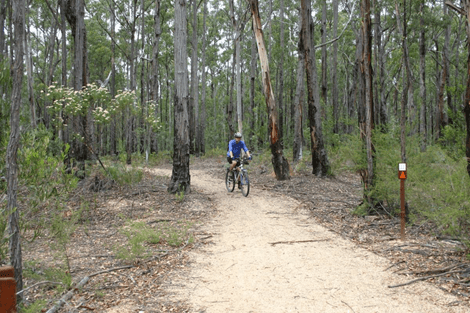
It was initially hoped to reinstate the entire tramline from the quarry to the edge of the water and the barge landing site.  But some of the old route was private land, so the Gippsland Lakes Discovery Trail, as it became known, ran 7 km downhill from the quarry site to the Log Crossing picnic area before diverting on Shire roads a further 13 km to Lakes Entrance.

The project was complex and not finished until 2003.

The trail along Mississippi Creek now links to a network of new mountain bike tracks through the bush.

https://en.wikipedia.org/wiki/Gippsland_Lakes_Discovery_Trail

Ship being towed through an artificial entrance to the Gippsland Lakes. c 1891. Source: SLV
1878. Source: SLV
Australasian Sketcher with Pen and Pencil, 17 December 1884 https://trove.nla.gov.au/newspaper/article/60620119
Lakes Entrance, “The Piers” c 1915
Source: SLV

Wind speed.

Bushfire behaviour is influenced by many factors including temperature, relative humidity (RH), forest type, fuel quantity and fuel dryness, topography and even slope. But wind has a dominant effect on the Rate of Spread (ROS), as well as fire size, shape and direction.

Wind speed can be measured using a variety of anemometers.

This simple hand-held Venitimer was made by Elvometer in Sweeden, probably in the 1960s, and was designed for principally for mariners. Some models have a compass in the handle to measure wind direction.

The small inlet hole on the side is faced towards the wind and air pressure lifts small plastic disk inside.  The upper tube is tapered so that as wind speed increases more air escapes and stronger winds are needed to raise the disk.

Wind speed in MPH is read from the side of the clear plastic tube. The waterproof container has instructions on use and conversion scales.

This example is in the Beechworth museum.

https://en.wikipedia.org/wiki/Anemometer

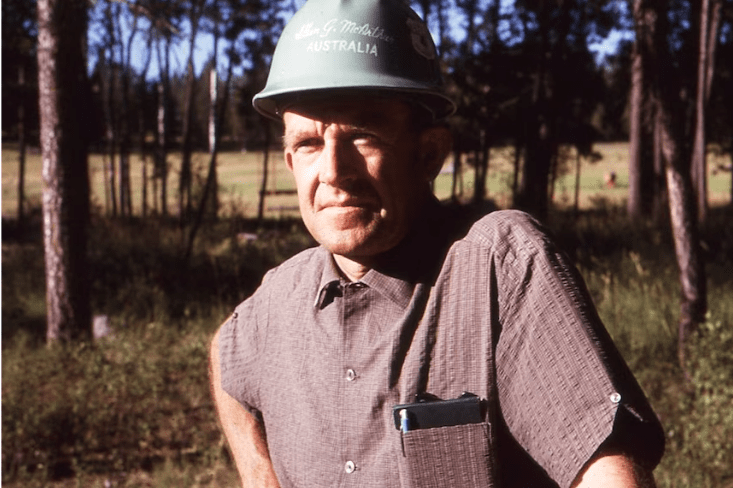
Alan McArthur – bushfire legend.

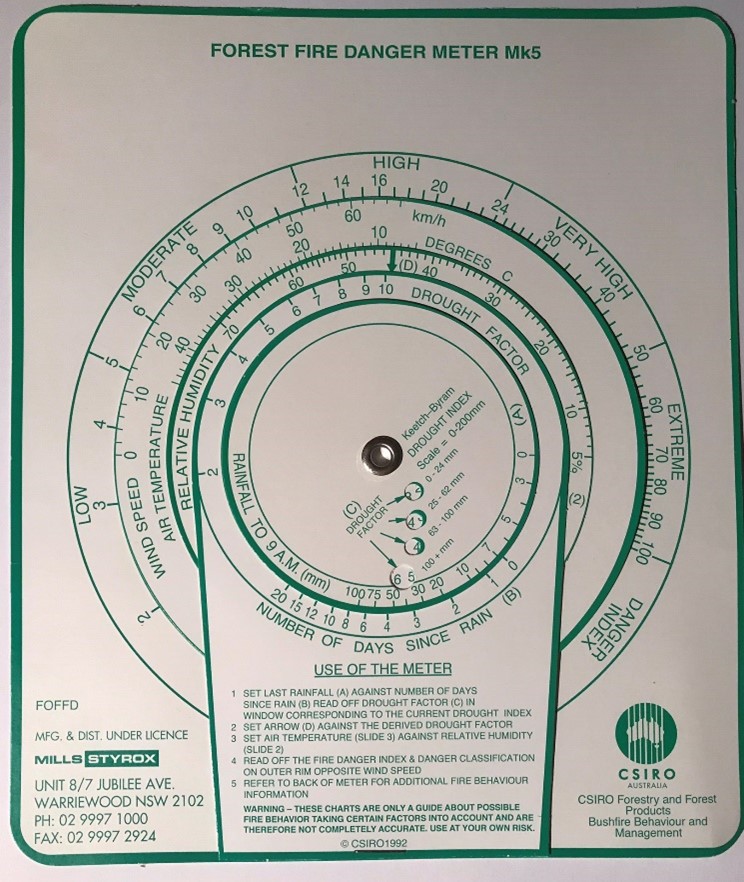
The Forest Fire Danger Index (FFDI) was originally invented by the legendary pioneer of Australian bushfire science, Alan Grant McArthur, during the 1950s and ‘60s.

After studying forest science at the University of Sydney in 1945, and later the Australian Forestry School in Canberra, Alan McArthur worked first in softwood plantations in the Tumut and Orange districts.

In 1951, he was appointed the first full-time fire control officer of the Snowy Mountains and began a lifelong quest to understand the behaviour and control of forest and grassland fires.

Then in 1953, Alan transferred to the Commonwealth Forestry and Timber Bureau in Canberra as a fire researcher. Five years later he was appointed Principal Research Officer in the newly created Division of Forest Research within the Commonwealth Scientific and Industrial Research Organization (CSIRO).

Alan was a very hands-on forester and fire researcher. To gather data, he deliberately lit over 450 experimental fires between 1956 and 1961 under a range of low to moderate weather conditions in the Kowen Forest and Bulls Head Creek area around Canberra. There were other test fires near Traralgon and the Wombat Forest near Daylesford.

For obvious reasons, he wasn’t able to light test fires under extreme weather conditions, so his subsequent fire danger equations needed to be extrapolated.

Much of his raw field data was collected by students from the Australian Forestry School and later the Australian National University where he lectured. Alan used his fit and hardy crew, armed with time stamped rocks, to mark the progress of the test fires and collect the data as well as map fire progression for his meter, a hugely useful improvement in fire prediction at the time.

Alan made thousands of detailed observations of things like wind speed, RH, temperature, cloud cover, rainfall, fuel moisture content, flame height, fire intensity, spotting distance, rate of spread, fuel quantity. He also made subjective assessments of fire suppression difficulty.

Alan published his landmark paper, “Controlled burning in eucalypt forests” in 1962. Leaflet No. 80, as it was known, proved a turning point for forest and fire managers across Australia.

More importantly, Alan was very practical forester and wanted his work to be useful to people in the field, so after several iterations he came up with the now familiar circular slide rule called the Forest Fire Danger Meter (FFDM).  The Mk 4 version first appeared in operational use in 1967.

There is also a grasslands fire danger meter.

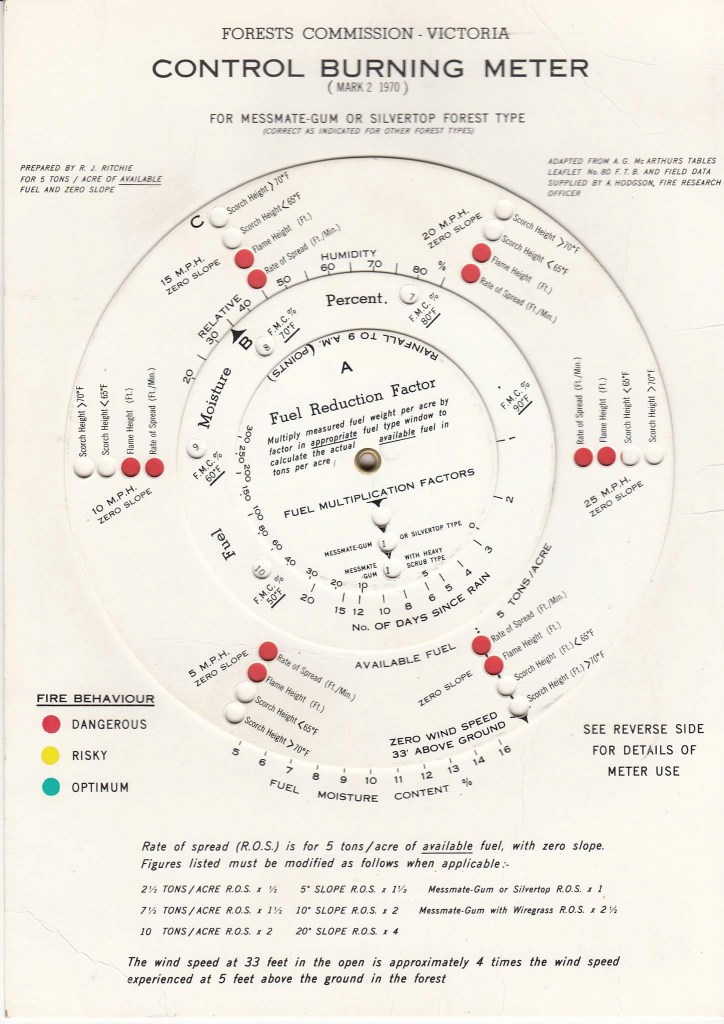
Two Forests Commission staff, Athol Hodgson and Rus Ritchie, built on McArthur’s pioneering work and by applying their own practical experience, developed a modified version in the late 1960s called the Control Burning Meter which was better suited to Victorian forest conditions.

Alan’s research work, in combination with new aerial ignition techniques developed in Western Australia and Victoria, led directly to a rapid escalation of the area of fuel reduction burning, which peaked in Victorian forests 1981 at 477,000 ha.

The FFDI meter uses measurements of dryness, based on rainfall and evaporation together with the Keetch-Bryram Drought Index to calculate a Drought Factor (DF) ranging from 1 to 10.

The Drought Factor is then combined with wind speed, temperature and relative humidity to calculate a FFDI in a range of 0 to 100.

By assessing fuel load (tonnes/ha) and slope, the fire behaviour characteristics such as Rate of Spread (ROS), flame heights and spotting distance can be estimated under a range of fire danger indices.

Most successful firefighting, and indeed fuel reduction burning, occurs when the FFDI is in the “Moderate” range between 5-12. The FFDI rises to “High” between 12-24 and “Very High” between 24 and 50. A day with an index exceeding 50 is considered “Extreme”. (see note below).

Alan used the conditions of the 1939 Black Friday fires as his example to set the upper limits of FFDI at 100.

However, the FFDI went “off the scale” on both Ash Wednesday in 1983 and Black Saturday in 2009. Under these extreme or catastrophic bushfire conditions, the weather rather than fuel load or arrangement, becomes the dominant factor influencing fire behaviour.

But for anyone who has been involved in bushfires they will know that the FFDI has its shortcomings.

  • The original system was only designed for use in forests and grasslands.  But Australia has lots of different types of vegetation such as Mallee heath, woodlands and open savanna, and the FFDI system does not forecast those well.
  • The FFDI meter does not consider all the conditions which have an impact upon fire behaviour such as wind changes and atmospheric stability.
  • The model begins to break down at the extreme end of the scale and small changes to temperature, humidity and wind speed can have a huge influence on the fire danger index.

But no matter what the shortcomings of the FFDI meter, Alan’s scientific legacy is unquestionably huge and has served forest firefighters very well over the decades. New research will refine and develop even better models.

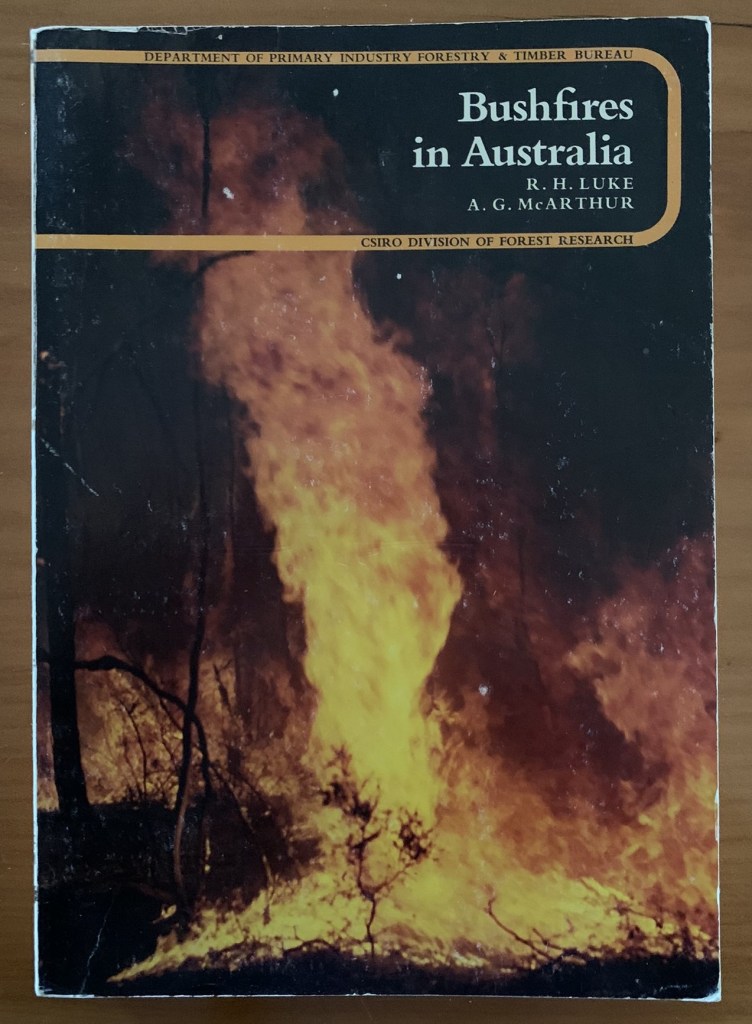
Alan’s seminal book “Bushfires in Australia” was published in 1978 with another forester Robert Henry (Harry) Luke and remains compulsory reading for every bush firefighter. Alan retired from the CSIRO in 1978 and died later that year.

Note: Each State once had their own fire danger ratings, but a new and consistent system was introduced across Australia in 2022.
No Rating (< 12), Moderate – plan and prepare (12-23), High – ready to act (24-49), Extreme – take action now (50-99), Catastrophic – leave early (>= 100).

https://adb.anu.edu.au/biography/mcarthur-alan-grant-10889

There was a noticeable increase in burning across Australian forests after Alan MacArthur’s research work with the CSIRO and his publication of Leaflet No 80 in 1962.
The McArthur Forest Fire Danger Meter (FFDM) first appeared in operational use in 1967 as the Mk 4. Photo: Jack Gillespie.
The FCV Fire Research Branch developed a control burning meter based on Alan McArthur’s models. Version 2 – 1970. Source: Ion Worrell.
Area of prescribed burning in Victoria between 1921–2016. The solid line is the annual area burnt while the dashed line is the 10-year rolling average. The big increase came after leaflet no 80 and the development of aerial ignition techniques using fixed wing aircraft and helicopters. The maximum level of 477,000 was achieved in 1981.Source: Morgan, Tolhurst et al 2019.
https://www.tandfonline.com/doi/full/10.1080/00049158.2020.1739883

Drop chutes.

From the early 1960s, the Forests Commission had pre-season arrangements in place with local aeroclubs and pilots across regional Victoria.

Air observers from FCV districts routinely flew during the summer months in small, fixed-wing aircraft on fire spotting missions and to map fire boundaries.

The information was often needed quickly on the ground or in the control centre and these small chutes were used to drop messages and maps from the reconnaissance aircraft on a low pass above a cleared area like a football field.

About 3-foot long when fully extended, they had a small pouch secured with a press stud for the map or package. The chutes were made from tough canvas with a small, weighted sandbag at one end and a long yellow streamer tail on the other to help direct its fall and locating it on the ground.

Drop chutes were still in common use in the 1980s, but the increased availability of helicopters combined with improved digital data transfer made drop chutes redundant.

This example is in the Beechworth museum.

Update on the Beechworh Museum Collection.

With the money raised from the sale of the FCV lapel pins last year the Forests Commission Retired Personnel Association (FCRPA) engaged Mark Jesser, a professional photographer, from Wodonga.

We recently had a two-day working bee at Beechworth with Leith McKenzie, Andrew Pook, Mark A Webster and myself pulling all the dusty items out of their display cases for the photographer to work his magic.

A total of some 380 museum quality images were taken of about 90 items.

We have created a site with “Victorian Collections” and begun to upload and describe each item so that information is searchable and freely accessible online. But it’s gunna take a while to get this step done.

The future of the museum at Beechworth is still under a cloud but at least this cataloguing project helps to preserve some of Victoria’s rich forest and bushfire heritage.

So, thanks to everyone who purchased the pins.

We hope to eventually get the Altona collection done too.

https://victoriancollections.net.au/organisations/forests-commission-retired-personnel-association-victoria-inc#more-collection

The loss of Longitude and the “Disputed Territory”.

In 1836, the western boundary between colonies of NSW and South Australia, and what was later to become the border of Victoria, was decided as the 141 degree meridian of longitude east of Greenwich.

Three years later in 1839, Charles Tyers transferred from the Royal Navy and was given the task to precisely mark the 141 meridian near the mouth of the Glenelg River at Nelson so that the SA border could be clearly identified on the ground.

But due to inadequate survey equipment he marked the spot too far to the west by two minutes of longitude, or about 2 miles and 4 chains.

For map geeks – one degree of longitude is further subdivided into 60 minutes, and 1 minute of longitude at the equator equals 1 nautical mile which is 1.15 times longer than a regular mile. And a ship sailing at 1 nautical mile per hour is said to be traveling at 1 knot.

Beginning on 28 April 1847, surveyors Henry Wade, and later Edward White, began marking the 279-mile border between Victoria and South Australia with blazed trees, mounds of earth and piles of stone beginning at Tyers survey mark on the coast and heading north. They had a remarkable and arduous journey and finally reached the Murray River on 7 December 1850.

But there were lingering doubts about the accuracy of border and another survey 1868 with better equipment confirmed it to be in the wrong location.

The surveying error is most apparent when pondering the odd kink in the junction of the three states (Vic, SA and NSW) near Mildura.

The South Australian Government wanted the border shifted back to its true position, but Victoria was having none of it.

The error resulted in more than 75 years of a protracted legal arguments between South Australia and Victoria over what was called the “Disputed Territory”.

The matter went to the Australian High Court in 1911 and finally to the Privy Council in London in 1914. South Australia lost the argument and forfeited more than 500 squares miles of land to Victoria.

If you look carefully at the plantation maps near the South Australian border at Rennick you can see evidence of the Disputed Territory and roads which run in a north-south direction along the 141 degree meridian. The Forests Commission began establishing pines on the other side of the disputed line in about 1940.

Main Image: “Surveyors” by colonial artist S T Gill (1865). National Gallery Victoria

https://en.wikipedia.org/wiki/South_Australia%E2%80%93Victoria_border_dispute

Plantation boundaries run north-south between the 141 meridian and the disputed SA border. Source: Google maps

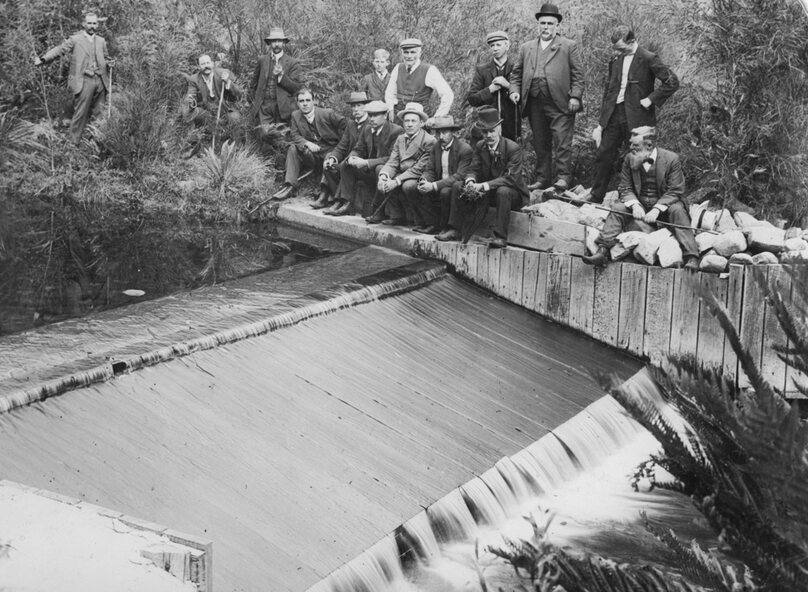
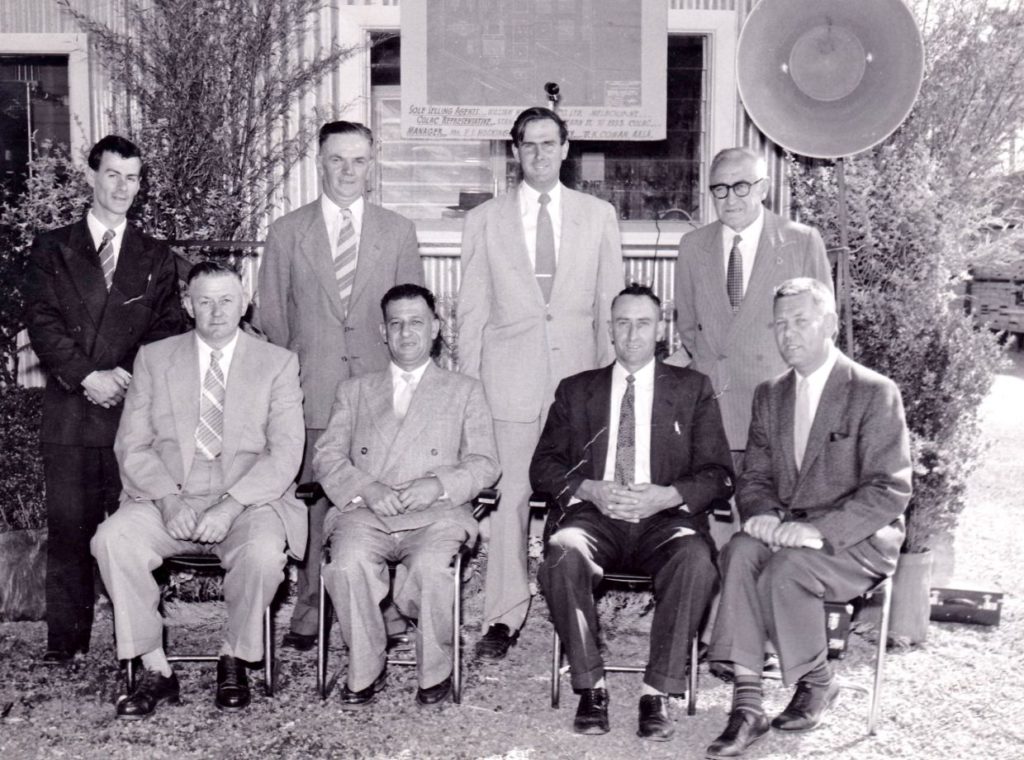
Christian’s Mill – Wombat Forests.

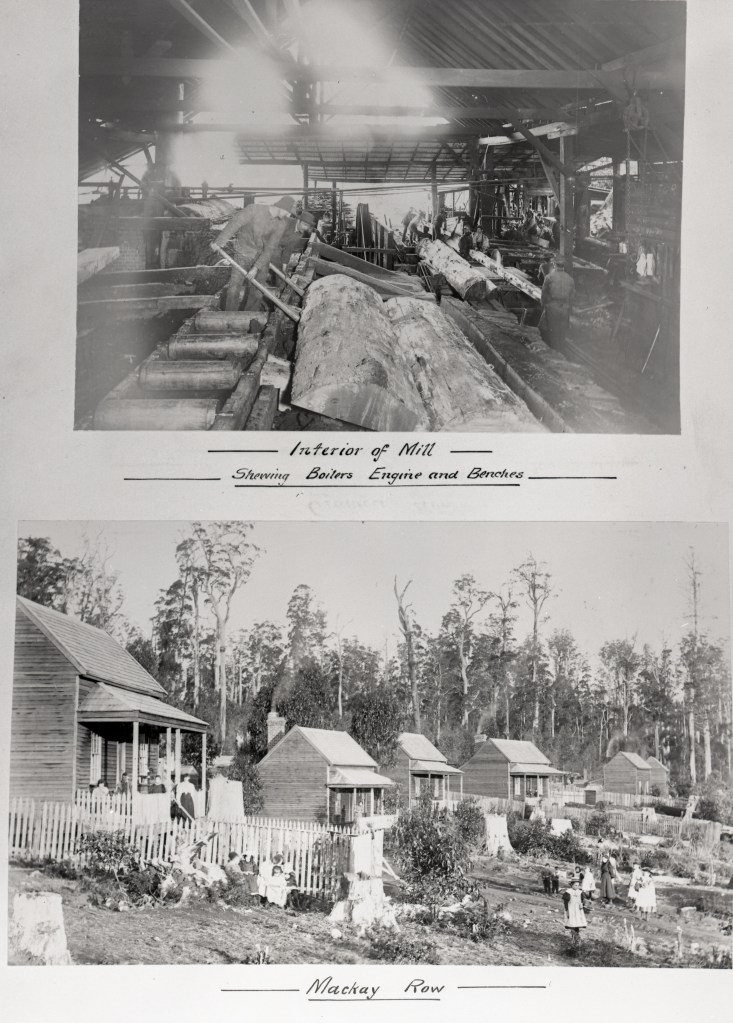
William Christian arrived in Melbourne in 1850 and worked as a pattern maker in a foundry. But like many others he was soon drawn by the lure of the goldfields. After a few unsuccessful years of trying his luck, William ended up in Woodend in 1868 and started a couple of successful sawmills in the Wombat forests at East Trentham.

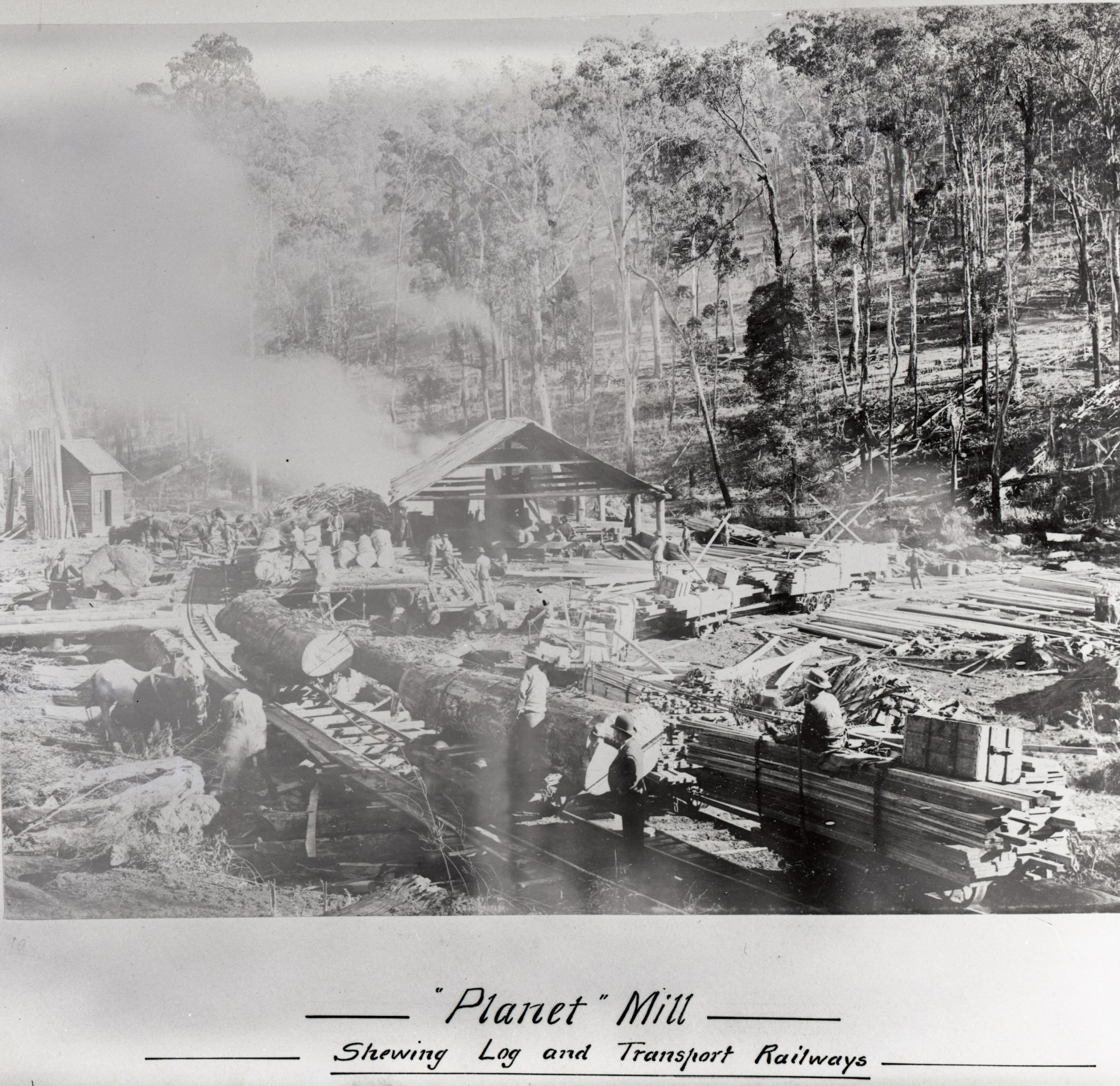
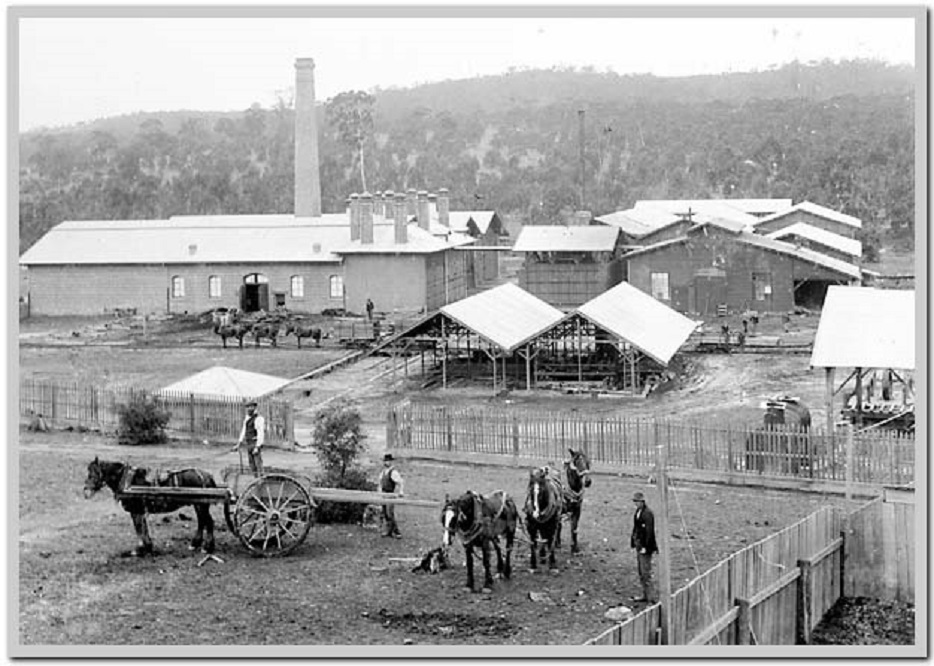
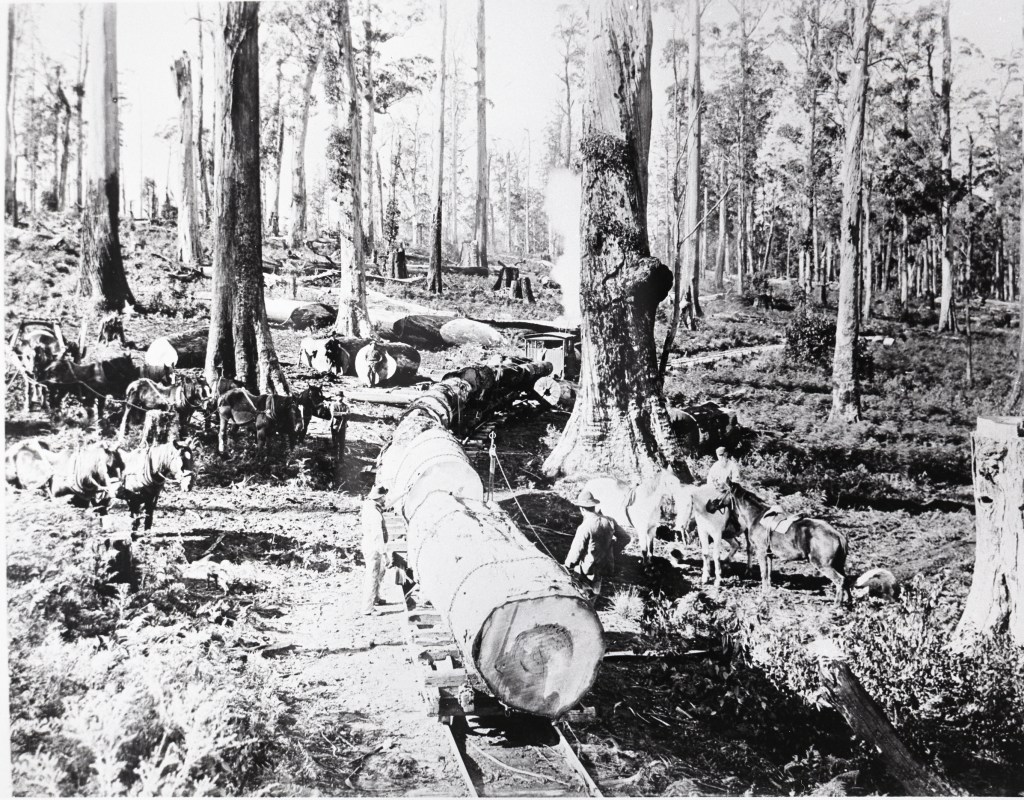
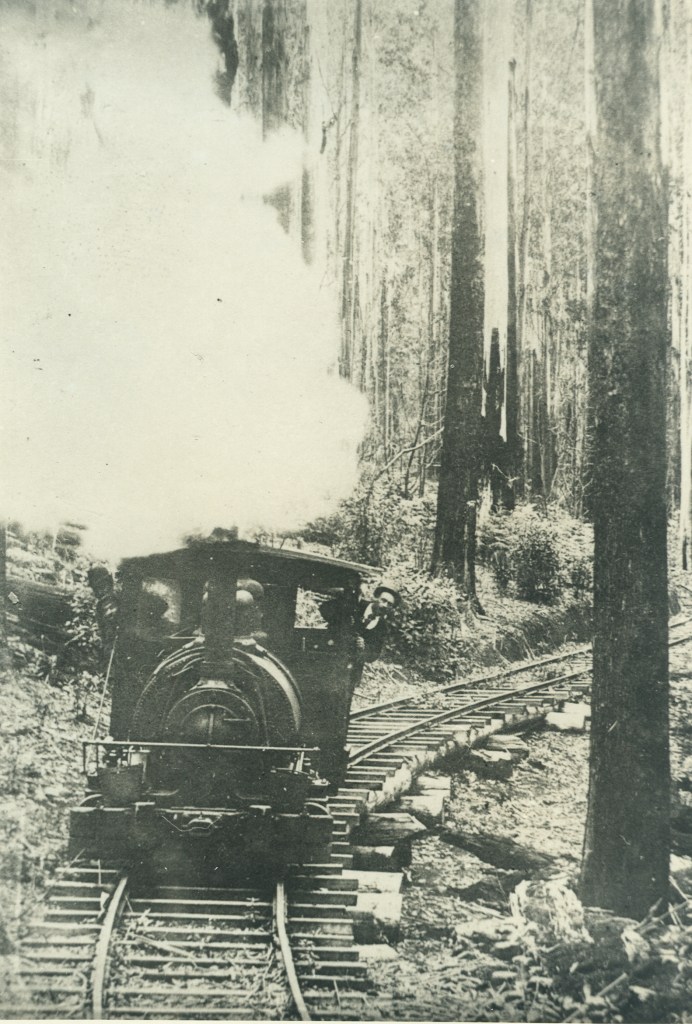
Timber harvesting for sawlogs had commenced in the Wombat forests in the 1850s to serve the goldfields of Ballarat and Bendigo. At its peak output in 1878 some 138,000 cubic metres of sawn timber was produced from more than up to 190 mills using an extensive network of timber tramlines.

But the rampant scale of wasteful and unsupervised timber harvesting where only the best trees were taken, combined with poor regeneration, resulted in the Wombat forests being officially described in the fourth progress report of the Royal Commission in 1899 as a “ruined forest”.

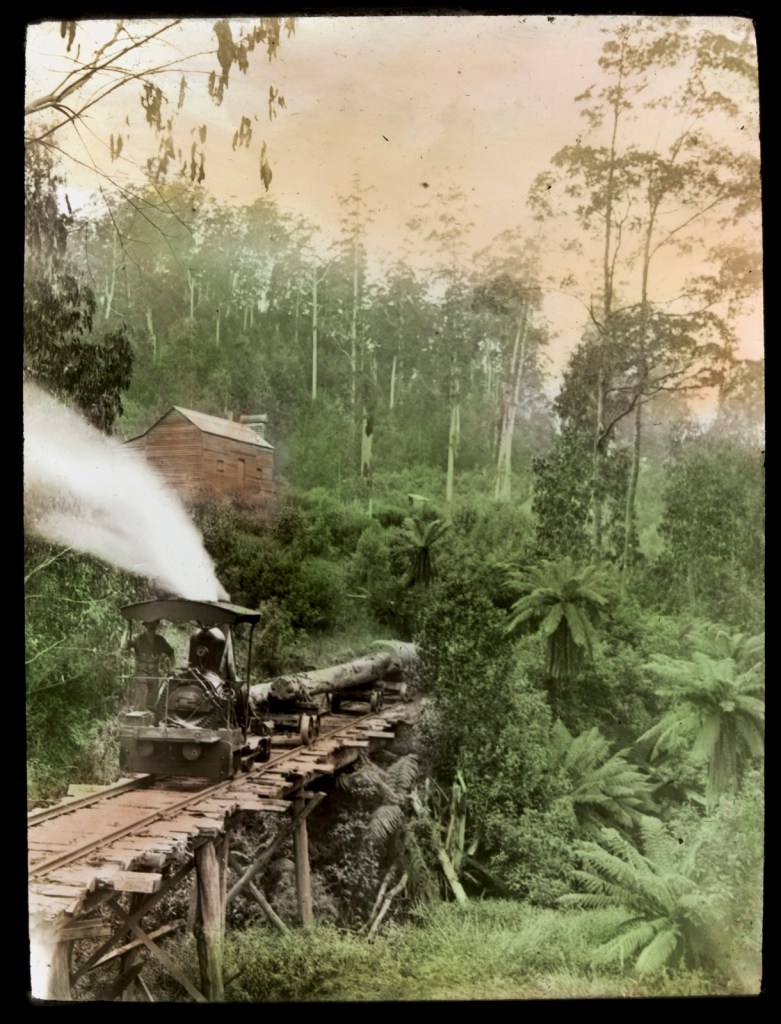
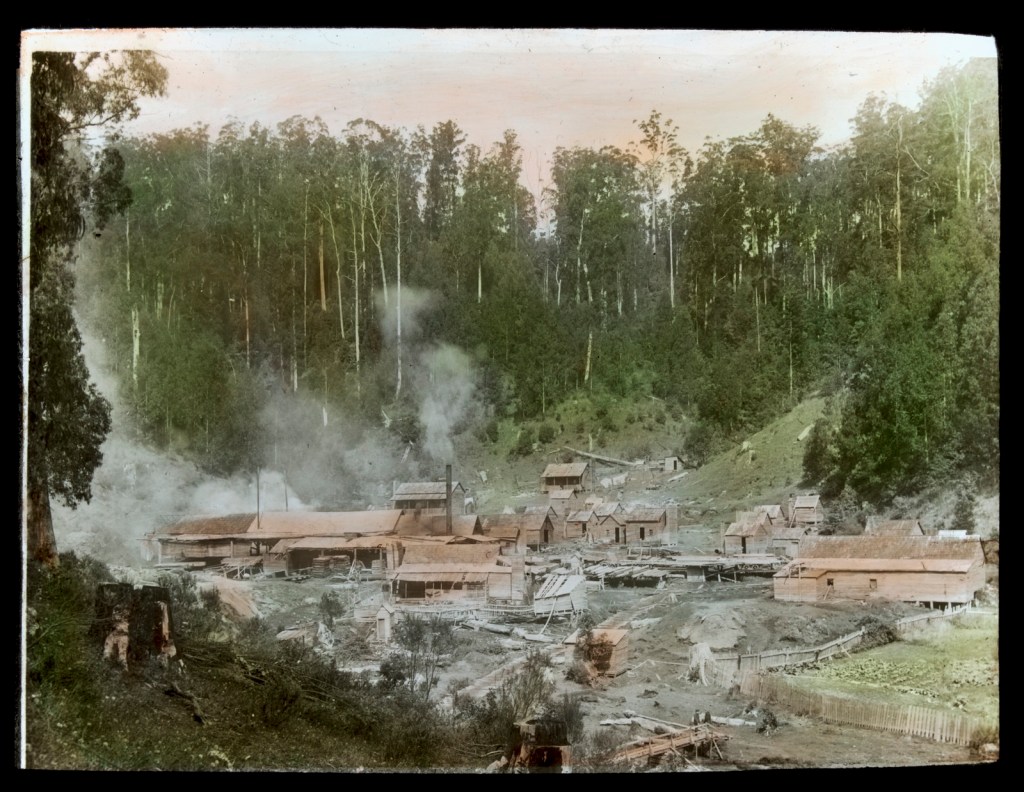
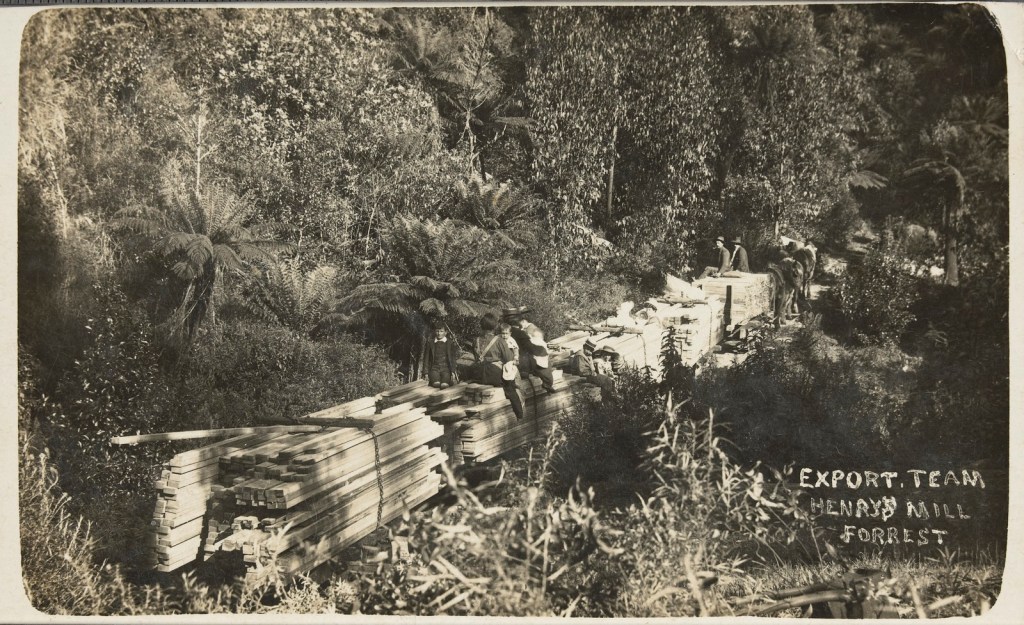
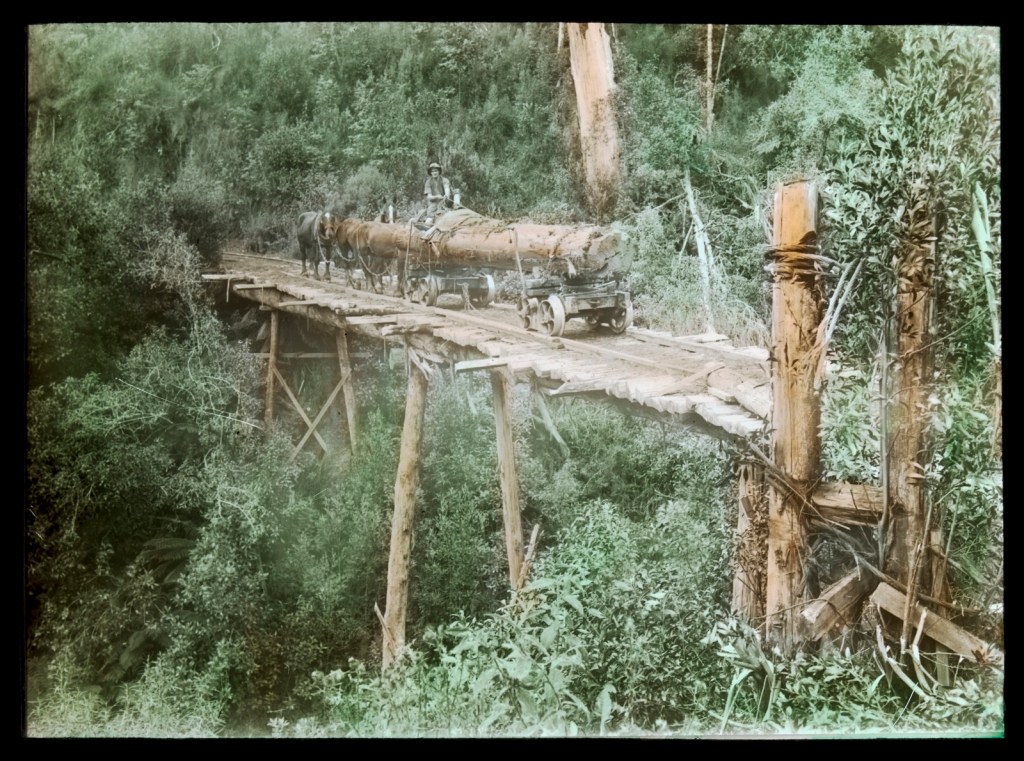
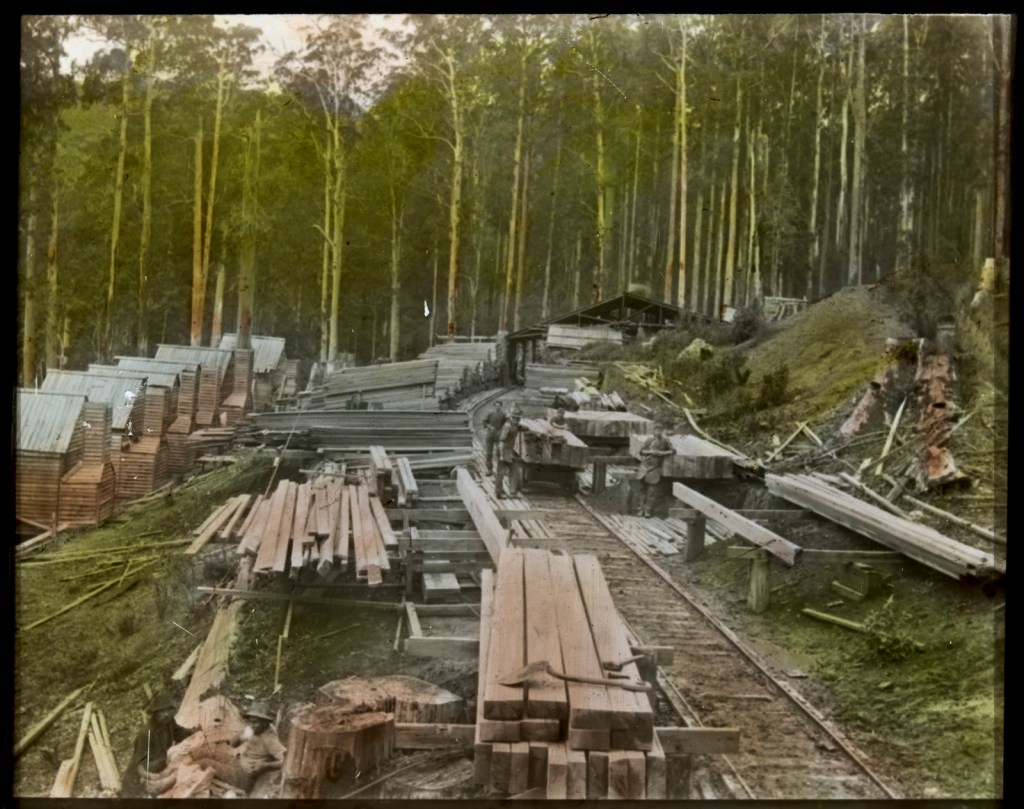
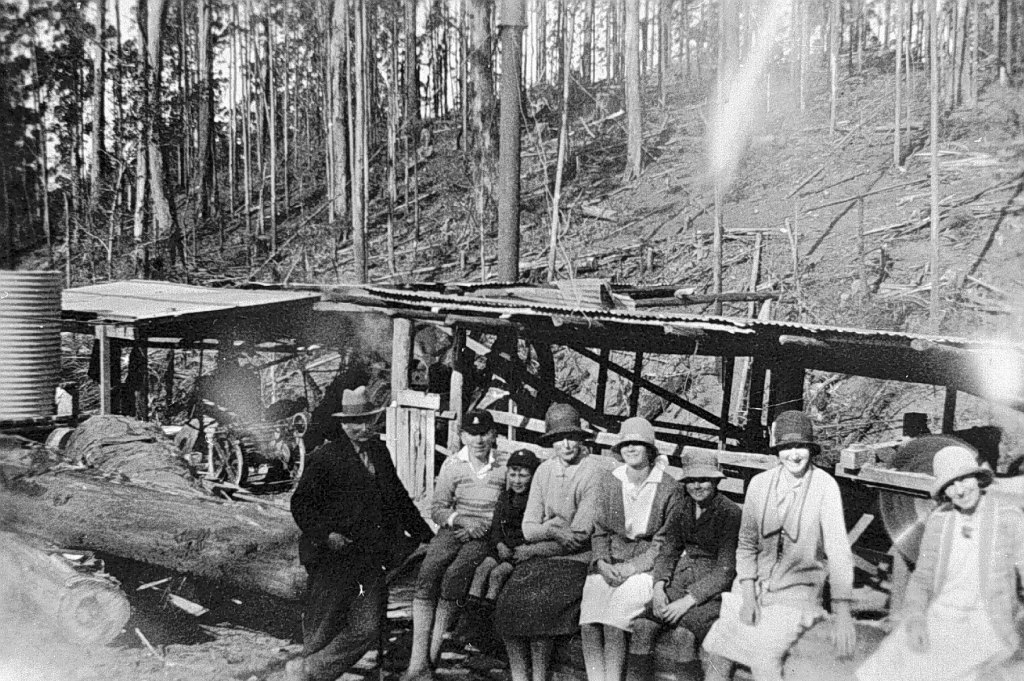
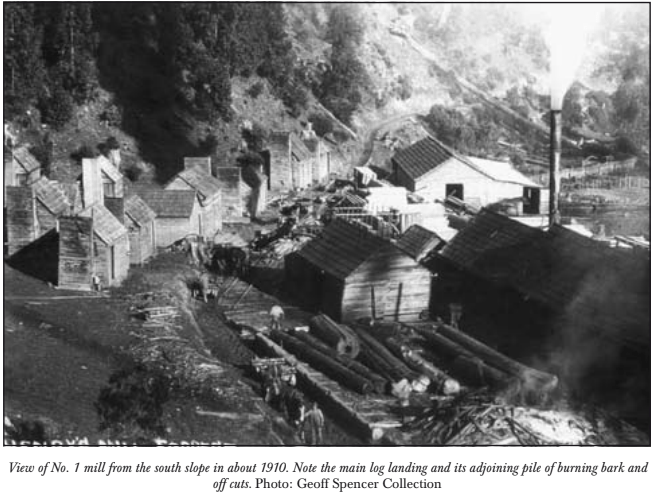
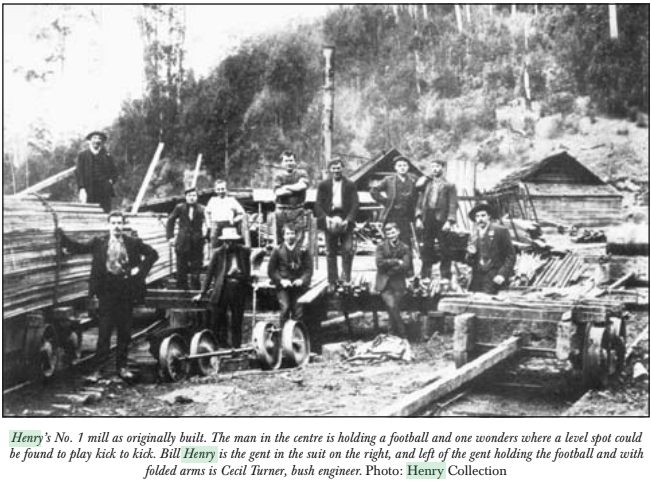
These photos are of Christian’s Mill near the Campaspe River. It was a portable outdoor setup that could be moved between summer and winter operations so it could cut timber all year. Logs were pulled by horses, mostly downhill, on jinkers, from up to two miles away. Using 20 men the mill could cut about 9 cubic meters per day with the vertical framed saw.

William died in 1899 and the business was taken over by his two sons and it continued to operate until 1918 when it was sold.

Houghton, Norm (2013). Wombat Woodsmen. A sawmilling history of the Wombat forest.

https://www.victoriasforestryheritage.org.au/forest-estate/native-forests/forest-descriptions/553-the-wombat-forest.html
Enough was enough.

Victorian bushfires in summer of 1943-44 burned over one million hectares, killed 51 people, injured 700, and destroyed over 650 buildings.

There had been deadly fires just days before Christmas in the northeast which had killed 10 firefighters from the Wangaratta fire brigade. More widespread fires across the State a month later killed 20 people and included blazes on the outskirts of Geelong and Melbourne at Beaumaris.

But the loss of a further 13 lives at Yallourn, 80 years ago today on 14 February 1944, together with the impact on the State’s electricity supplies when the critical brown coal fields caught alight, brought the summer season into sharp media and political focus.
The State Government hadn’t acted on Judge Leonard Stretton’s Royal Commission recommendations made five years earlier after the deadly 1939 Black Friday bushfires. The inertia was mainly due to the intervening war years and rival factions within rural and urban firefighting brigades in country Victoria.

The Premier Sir Albert Dunstan and Minister for Forests Sir Albert Lind, who had both delayed legislative changes in Parliament, decided there was no alternative but to ask Judge Stretton to chair a second Royal Commission.

Stretton’s report returned to his earlier themes, but this time he was even more strident about improving bushfire coordination outside the Melbourne area.

After nearly six months of debate and argy-bargy in State Parliament, legislation to establish the Country Fire Authority (CFA) was finally passed in two stages on 22 November and 6 December 1944. The Chairman and Board members were appointed on 19 December 1944. The CFA came into legal effect on 2 April 1945.

All the existing country brigades were invited to join the new organisation… most did… some reluctantly… but nobody seemed particularly happy with the new arrangements…

https://en.wikipedia.org/wiki/Country_Fire_Authority

Main map of the 1943/44 bushfires was probably produced for the Stretton Royal Commission. Source: State Library of Victoria. http://handle.slv.vic.gov.au/10381/119987

1944 Royal Commission map of the Yallourn fire

Hazelwood coalmine fire – 2014.

As they say… the days are long… and the years are short… but where did those 10 years go?

On Saturday 8 February 2014, I was acting as a mentor in a Level 3 Planning Team at the Traralgon Incident Control Centre (ICC). We were working on a small but complex bushfire in the Hearn’s Oak / McDonald’s Track area to the west of Morwell which had started the day earlier and was thought to have been deliberately lit.

There was serious concern about the Bureau of Meteorology’s weather forecast for Sunday of high temperatures and strong north winds, followed by a south west change around midday. The State Control Centre in Melbourne was requested to prepare a bushfire behaviour prediction map using the sophisticated Phoenix computer models.

The prediction map confirmed the planning team’s suspicions, that if the fire broke its containment lines it would spread to the east and impact Morwell as well as both the Hazelwood and Yallourn coalmines.

The possible fire scenarios, maps, warnings and advice were all given to the Police, SES, Latrobe Shire, coal mine representatives and others, at a briefing late on Saturday afternoon. This was the day before the fire broke out. Unfortunately, I don’t think Hazelwood coalmine owners (GDF Suez) fully understood the gravity of the map they were given and probably failed to adequately prepare for Sunday.

The rest of Saturday afternoon and evening were spent with Senior Sergeant Peter Fusinato from Victoria Police, Lance King from Latrobe Shire and the SES preparing a detailed evacuation plan for Morwell, just in case.

Public information meetings were held in the town and warning advice relayed to ABC radio.

The next day, on Sunday 9 February at around 1.15 pm, the fire Hearns Oak which had been contained overnight, but not fully blacked-out, broke out as feared under the influence of the strong south-westerly wind change and rapidly spread east towards Morwell.

About 30 minutes later, there were more smoke sightings south of Hazelwood on the Strzelecki Highway in the Driffield area. Arson was suspected and the Police were immediately notified.

Fire investigators discovered three kerosene-soaked toilet rolls which had been lit and chucked by the side of the road. It was almost as if someone had lined up the mine with the wind direction to maliciously cause the maximum damage. I understand that people were later arrested and charged.

The fires spread quickly and took hold in an unused part of the Hazelwood mine on upper levels of the coal batters. It also impacted the southern rehabilitation areas of Yallourn open cut.

It’s hard to be certain, but I believe it was the deliberately lit fires at Driffield which had the main impact on the Hazelwood mine rather than the fire originating from Hearns Oak. Not that it really matters now.

All effort was immediately thrown into a desperate and complex firefight. The priority was life and property in Morwell but, where possible, resources were sent to the mine to assist.

The Traralgon ICC was seriously understaffed.  Normally for a large complex bushfire there would be a planning team of 8 to 10 people including a mapping officer, resources officer, air observers, weather specialists, fire behaviour analysts, intelligence officers etc., but everyone was already deployed to the East Gippsland fires.

The ICC worked frantically with the Police, CFA and SES to trigger the evacuation plan for the western edge of Morwell township we had jointly prearranged but there was no time for people to respond and move. Shortly before 4 pm, a State Emergency Warning (SEWS) was issued for Morwell to warn people they were in immediate danger.

The plan included the closure of the Princes Highway and main railway line. But the driver of the V/Line passenger train bound for Melbourne from Morwell mustn’t have got the message from his control centre and luckily just made it through to Moe before the tracks were engulfed in smoke and flames. Lots of wooden sleepers were burnt and it took weeks to reinstate the line.

High voltage power lines to Melbourne, substations, and the Hazelwood power station itself was also under threat. There were safety concerns about using helicopters to drop water on high voltage electrical equipment.

In addition to protecting Morwell, other priorities were the Maryvale Private Hospital and the Gippsland Water Factory.  The fire destroyed conveyor belts and a large stack of pulpwood at the Maryvale paper mill.

By early evening, around 5.30 pm, the fire had grown to about 2800 Ha with extensive spotting at multiple locations.

Thankfully, nobody was killed or seriously injured that afternoon, but some houses, HVP plantations, farm fences and stock were lost while a large chicken farm was also threatened.

I’ve been involved in lots of major blazes over my forestry and firefighting career, but nothing like this.

The burning coal seams needed to be flooded with water and foam but the big water main which the SEC had installed years ago around the rim of the mine to run sprinklers over the coal batters and suppress the dust had been removed and sold for scrap by the new owners.

Also, the pumps in the bottom of the pit that could have been used to douse the blaze in the early stages didn’t operate because they were electric, and the power had been cut.

As the coal batters burned, they collapsed, and at one stage threatened some major mine buildings.

Specialist fire trucks with long booms that could spray huge quantities of compressed air foam were accessed from across Australia. But firefighters could only work down in the pit for about two hours because carbon monoxide would build up to dangerous levels in their blood. Crews had to be tested and rotated continually and a few ended up in the Traralgon hospital. Twenty firefighters were treated for smoke inhalation and there were complaints of severe health problems over the duration of the fire.

It was a dreadful place with the sulphurous smoke and dust, but the glow looked fantastic at night. I went down into the pit once for a look but didn’t stay long.

Remote control drones with cameras were used for aerial reconnaissance for the first time. The MFB had a new one and was able to fly through the acrid smoke and because it was fitted with an infra-red camera it could pick up any hot spots.

The fire lasted 45 days and was the largest and longest mine fire to occur in the Latrobe Valley. More than 7000 firefighters from Victoria, interstate agencies, the ADF and the mine owners were deployed.

But the main impact was the large amounts of acrid smoke and ash that settled on the adjacent townships of Morwell and Traralgon.

The Environment Protection Authority (EPA) and the Health Department were slow to act about the toxic fumes and smoke. It took nearly three weeks for the residents of Morwell to be officially advised to evacuate their homes and some limited government support was belatedly made available.

Local people were demanding answers about why this had been allowed to happen as well as who was responsible for regulating the mine and paying for the capping and rehabilitation of the worked-out coalfaces.

Additional ICC teams were flown in from other parts of the State over the following few days and weeks and the Incident Control Centre at Traralgon was overrun as we gave endless briefings on what was going on.

Big wigs, the Brass, and countless hangers-on seemed to immediately descend from everywhere into the cramped office space at Traralgon. They included lots of senior government honchos from Melbourne; Police Commissioners; the SES; Sharon Gibson – Latrobe Shire Mayor, councillors, John Mitchell – CEO and council recovery staff; CFMEU and UFU representatives; Red Cross; Ambulance Victoria; Environment Victoria; Rosemary Lester – Chief Health Officer; Dept of Human Services (DHS); Kylie White – Earth Resources; John Merritt – EPA Regional Manager; Craig Lapsley – Fire Services Commissioner and all the Fire Chiefs including, Alan Goodwin – DEPI, Peter Rau ? – MFB and Steve Warrington – CFA.

There were also visits from the State Premier – Denis Napthine; the Deputy Premier – Peter Ryan; the Opposition Leader – Daniel Andrews; and all the local state and federal politicians with their advisors and media entourages in-tow wanting a briefing. I can’t remember if the Prime Minister, Tony Abbott, came or not. It was manic and all a bit of a blur now.

Meanwhile there were still huge bushfires brewing in far East Gippsland. There were also major fires at Devon north near Yarram, in the Grampians, Wyperfeld, the Big Desert and Kilmore. It was hard to find people to fill key IMT roles and additional fire crews.

The fires in East Gippsland developed into a major campaign effort and burnt for over two months. They became so huge and could be seen from space.

To add to the stress levels, there was another departmental restructure underway with senior staff being targeted for redundancy. But that’s another story…

The Victorian Government held the Hazelwood Mine Fire Inquiry from late February to September 2014. There was a further WorkSafe court case. The mining company lawyers tried to claim that they hadn’t been warned that the Hearns Oak fire might enter their coal pit. But I knew they had received a personal briefing and Phoenix fire prediction map the day before and lucky for me there was an email trail, and my logbook was up to date. All my material was subpoenaed, and I gave a witness statement to departmental lawyers and waited to be called.

Ironically, after all the inquiries and court cases were over and the government had shelled out nearly $100M to extinguish the fire the French company that owned Hazelwood finally closed it in March 2017.

Top Photo: The main media and political interest in 2014 were a bushfire north of Melbourne at Mickleham and the Hazelwood coalmine which burnt for 45 days and cost a staggering $100 million. But just look a bit further east…. the snowy river complex lasted for over two more months and grew to 165 800 ha or roughly the same size as Melbourne.
NASA image – 10 February 2014 https://earthobservatory.nasa.gov/images/83117/city-sized-fire-in-australia

Delburn bushfires – 2009.

It’s been 15 years since the catastrophic Black Saturday bushfires on 7 February 2009, with the loss of 173 lives, and which devastated townships such as Marysville, Kinglake, Narbethong, Flowerdale and Strathewen.

But just over a week before, on Wednesday 28 and Thursday 29 January, there were six deliberately lit blazes south of Morwell near the townships of Yinnar, Mirboo North and Boolarra. Police later charged a man with arson.

While three of these fires were quickly extinguished by the CFA, the other three at Ashfords Road, Creamery Road and Lyrebird Walk developed, and ultimately merged to become the Delburn Complex.

The incident was primarily run by the CFA, with Kevin Pettit as the Level 2 Incident Controller.  Because of the plantations under threat, Kevin initially operated out of the Hancock Victorian Plantations (HVP) offices at Churchill, with the Department of Sustainability and Environment (DSE) in support, both on the ground and in the air with a large fleet of fixed wing firebombers and helicopters operating out of the Latrobe Valley.

A Level 3 Incident Control Centre (ICC) was later established at Traralgon on Thursday 29 January as the fire complexity and size escalated with Mike Owen appointed the CFA Incident Controller.

When I arrived at work on Friday morning, I was immediately deployed to conduct a series of public meetings about the fires. I had wrangled large angry mobs previously during the 2006-07 alpine bushfires so was very familiar with the unique challenges. I grabbed some maps and other stuff and together with a CFA presenter from Warragul, we went to meetings at Boolarra, Mirboo North, Yinnar and Churchill.

Over 1000 people attended the community meetings but the most difficult was at Boolarra where about 300 residents were under direct threat and were very frightened.

During the meetings people were advised that given the weather conditions on Friday and the likely fire progression, leaving early may be their best option.  At the time the CFA doctrine was to “stay and defend” rather than “leave early”.

Residents were also told that it was very unlikely that they would get either CFA or DSE trucks to protect their homes and there may not be time to issue a warning of the fire entering the township.

I remember speaking with the wife of a work colleague and friend after the Boolarra meeting. They lived on a hillside above the town on Piggery Road, and she asked me what she should do. I advised her to leave the house, particularly because she was on her own and her husband was on a CFA truck. Sadly, their home burned down later that night and I felt dreadful. I was troubled for a very long time and wondered if I had given her the right guidance. But given what happened a week later during Black Saturday at Churchill my solace was, they were both safe and alive.

A former Captain of the Boolarra CFA brigade attended the meeting and made some inflammatory and alarmist remarks. He also said he would ring the CFA siren as a community warning which was against CFA policy at the time.

The public meeting at Boolarra was filmed and a TV news story was aired weeks later when the Royal Commission hearings were being held. The journalist selectively used parts of the footage to create a misleading impression that residents had not been adequately advised or clearly warned of the approaching danger. DSE lawyers considered taking action because this was clearly false as the Royal Commission later acknowledged in its findings.

The main fire activity increased as predicted during Friday when the temperature reached 42 degrees with low humidity and moderate winds. The FFDI reached 52 (extreme). The fire area nearly tripled from 2,150 ha just before dawn, to approximately 5,750 ha close to midnight.

The final fire area was 6,350 ha with approximately 60% in HVP plantations, and 44 houses were lost. Importantly, no one died.

There were more public meetings over the weekend with swelling crowds. Local MP, Peter Ryan, accompanied me on Saturday.

It was also during the Delburn fires that the famous image of Sam the Koala, being given a drink of water by CFA firefighter Davide Tree, was taken by Mark Pardew from DSE. Sam became an international media star and was taken into care by Colleen Wood at Erica. There is a monument to Sam at Mirboo North.

The Delburn fires were contained by Tuesday 3 February but a large contingent of CFA, HVP and DSE crews remained on the ground and in the IMT, for blackout and patrol.

As it later turned out, crews and the IMT at Traralgon were well positioned to respond quickly when the Black Saturday bushfires started at Churchill on 7 February.

However, the story of the fires at Delburn were overshadowed and somewhat forgotten by these other more catastrophic events.

http://royalcommission.vic.gov.au/Finaldocuments/volume-1/HR/VBRC_Vol1_Chapter03_HR.pdf

Satellite image of Australian bushfires from January 30, 2009. NASA image created by Jeff Schmaltz, MODIS Rapid Response Team, Goddard Space Flight Center.

Dog’s Grave.

When travelling around State forests it’s not uncommon to find a lonely and forgotten grave tucked away in the bush. The last resting place of some unlucky traveller or pioneer killed in an accident, unable perhaps to receive medical aid in time. They were usually buried where they died.

The grave of former dance girl and colourful pub owner, Kitty Kane, which is just north of Walhalla on the Aberfeldy Road, is probably one of the better known in Gippsland.

About 30 years ago, I was inspecting logging coupes and new road works at Dargo with the Forests Commission overseer, Brian Madigan, and he took me to the remote and rather unusual Dog’s Grave, about 45 km southwest of Omeo on the Birregun Road.

Cobungra Station has a tradition dating back to March 1851 when George Gray, of Wangaratta, sent his two sons and four stockmen with a herd of some 600 beef cattle in search of pasture following the bushfires of Black Thursday, 13 February 1851.

The Gray family had grazing interests extending over the Great Dividing Range to the headwaters of the Wentworth River. They employed a drover, Peter Meehan, (sometimes spelled Meighan) to look after their cattle on the south side.

In his lonely vigil Peter got to know every creek and gully from Mt Birregun to Mt Baldhead while seldom meeting anyone. His only companions were Skinny, his horse and Boney, his dog.

As with all good bush folklore, there are a couple of versions of the story, but the commonly accepted one goes that in 1863, Boney, most likely an Australian Kelpie, died after it ate a poisoned dingo bait.

At the time, Peter was said to be driving cattle from Cobungra Station towards Dargo. On occasion the stockmen took stock as far south as the Stratford or Maffra sale yards.

Normally, Mount Birregun was covered in snow during winter which made it necessary for the drive to start in the autumn. It usually took between seven and eight days for the whole trek, depending on the weather and number of cattle. It was a perilous journey along the steep and narrow bridle paths with the Dargo River below.

Boney died at the first camp site into the drive towards Dargo and Peter built a small grave of flat stones and erected a rough bush picket fence.

Peter drowned in the Dargo River under mysterious circumstances in about 1883 and is buried in the local cemetery.

Years later in 1888, a camp cook with a government survey team examining a possible railway route from Briagolong via Dargo through to the goldfields of Omeo, noticed the dilapidated grave and rebuilt the fence, but bushfires inevitably destroyed it, and the site was lost again.

The stock route became redundant and was abandoned in about 1932 when the Alpine road connecting Cobungra Station to Omeo was completed.

However, the general location of Dog’s Grave remained marked on old Forests Commission inch-to-the-mile mapsheets.

In 1964, local Dargo identity and mountain cattleman, Jack Treasure, along with John Neilson, the Department of Mines Geologist, set out to find the exact location of the lost grave. They were acting on additional information from elderly Dargo resident David Phelan.

It took a while, but they eventually found a clearing near a creek and a pile of rocks that had once been the hearth and chimney of an old cattleman’s hut. A bit more searching and Dog’s Grave wasn’t far away. The pair then erected a third wooden fence.

A decade later in May 1975, two magnificent Harcourt granite headstones, made by Melbourne stonemason John Giannarelli, were unveiled beside Boney’s original grave.

The main headstone has an image of Boney and, below it, another inspired by Frederick McCubbin’s well-known painting “Down on his Luck”. A smaller granite stone on the left has a brass plaque with bush poem written by Jack Treasure in 1964.

The monument is a tribute to all pioneering families of the high country, and, for the first time, to the Australian Kelpie.

The unveiling was performed jointly by the Avon Shire President, Mr Gordon Hughes and Mr Louis Pendergast, President of the Omeo Shire. Dignitaries from the local historical societies, together with groups of cattlemen and their families attended the ceremony. Bob Fulton from the Forests Commission at Swifts Creek provided approval and support to erect the memorial on State forest.

The alternative story from Charles McNamara, a descendant of the family which owned Cobungra, is that the dog was called Angus and owned by drover Johnny Crisp.

The legend surrounding Dog’s Grave will never be fully settled, no matter how many times it gets debated over a beer at the bar of the Dargo Hotel or the Golden Age at Omeo. Either way, it’s worth a visit.

The second fence erected by Jack Treasure and John Neilson in 1964.
A Drovers dog passed away at this spot 1890s

Fireguards.

The Secretary of the Forests Commission Victoria, A V Galbraith issued instructions to Fireguards in about 1920. They included the following…

  • Fireguards are responsible for the safety from fire of the whole of the forest area entrusted to their charge and were under the immediate control of the District Forester.
  • They needed to provide their own strong, active, riding horse, and keep it in good condition and fit for daily work in the forest, a well as paying all the cost of feeding it properly at their own expense.
  • Each day during the fire season they must carry out mounted patrol work, visiting all dangerous places where there is inflammable debris or dangerously dry vegetation, or where, in the neighbourhood of settlement, timber cutters’ operations, or travellers’ camps, there is danger of fire breaking out.
  • They must prevent timber cutters, settlers, travellers, tourists, or other persons from lighting any fires whatsoever (except small necessary campfires in the bed of a creek or on the edge of a dam).
  • When any outbreak of fire occurred within or near the boundary of the forest they were to proceed at once to put it out, and if found that it is spreading dangerously, or getting beyond control, they must summon such assistance as is absolutely necessary to extinguish it.
  • They were supplied with axes, rakes, hide-beaters and water bags which remain the property of the Crown, and which must be properly accounted for by him at the end of the fire season.
  • In the event of continued wet or showery weather, when it is clearly safe to do such work, and where they can easily control the fire, they will carefully burn small belts of inflammable debris and undergrowth which are a danger to the forest, but when in doubt as to the safety of burning under such conditions they must not light any fire.
  • They will also during such weather, or when it is cool, and clearly safe to do so, employ themselves in cutting firebreaks, and narrow fire-lines on ridges and spurs as far as possible at right angles to the prevailing winds; also through and around belts of valuable young pole-timber with the object of protecting them from fire.

Probably, one of the most famous FCV fireguards was Bill Ah Chow who lived at Moscow Villa and was the fire lookout at Mt Nugong during the summer months.

What a great job…

https://drive.google.com/file/d/1qQro7mkEcQFk2W-xR-qEbONaZ3RAwnmm/view

Photos: At the end of the summer fire spotting season, and after the first good rain of autumn, Bill would set off on his horse along the many bridle paths that criss-crossed the alpine country as far as the NSW border throwing matches along the way to burn forest fuels and reduce the bushfire risk. Source: Ah Chow family.

A soggy Chief Fire Officer.

In the summer of 1946, a request was made by the Forests Commission to the RAAF base at Bairnsdale for bushfire reconnaissance flights over the Snowy River area in East Gippsland.

Because of the long-standing relationship with the Air Force, authorisation was often given for FCV staff to act as air observers in the RAAF aircraft.

On 11 January 1946, three Avro Anson’s based at Bairnsdale flew missions with Commission observers onboard to check on bushfires.  Orbost District Forester, Ted Gill, went along in Anson MG655 piloted by Flight Sergeant John Conlon.

Once over the forest the RAAF pilots took their instructions from the FCV observers.

Each Anson had a flight time of about four hours which enabled coverage of a large area of the remote bush by flying three abreast but widely separated. Radio communications was via the RAAF base at Bairnsdale as well as testing communications with new FCV ground radios. They planned to fly as far as the NSW border and return via Orbost, Nowa Nowa and Bruthen to the base at Bairnsdale with a minimum altitude of 1000 feet.

But on the return trip Anson MG655 collided with some overhead wires at Marlo and crashed into the Snowy River.

Pilot Conlon said under oath at the subsequent RAAF inquest that his Anson was at a height of 6000 feet near Mt Ellery and began a long glide towards the coast with the intention leveling off at 1000 feet before flying home to Bairnsdale.

But late during the descent the port engine failed to respond, and he continued losing height even with the starboard engine on full power. He still had plenty of fuel.

He advised the two other aircraft by radio and his intention of a forced landing on the beach at Marlo. On approach he said the aircraft flaps wouldn’t operate properly to slow his airspeed and he unavoidably hit two telephone wires strung across the inlet and ditched his aircraft into the river where it floated.

Meanwhile, the two other Ansons circled overhead and reported the crash by radio to the RAAF at Bairnsdale and that the occupants were safe before heading back.

There are no records of this crash in FCV Annual Reports or the Snowy River Mail newspaper archives.

But the story was all BS. It can now be revealed that the pilot John Conlon and other the airmen colluded to fabricate their evidence at the RAAF inquiry to cover up the fact that they had been flying too low.

The pilot of one of the Ansons, Sergeant Kevin Moloney, had a reputation for low flying contrary to standing RAAF orders. On the day of the accident Moloney decided to fly within a couple of feet of the water along a straight section of the Snowy River running roughly parallel to the ocean beach. The sheltered section of the inlet near Marlo was a safe anchorage for fishing trawlers and Moloney flew in a simulated strafing attack on the boats by ducking under the telephone wires, then skimming over the sandbanks and just missing the tops of the masts, as he had done many times before.

John Conlon had flown with Moloney before but had not followed his low flying shenanigans but, on this occasion, plucked up the bravado to emulate the mock attack on the trawlers.

But on their high-speed approach, which was a bit further above the water than Moloney had flown, Ted Gill was too late in warning the pilot of the cables strung across the water which then sheared off part of the cockpit and observation dome before tangling in the flaps and rudder as well as hitting the tail fin.

Crunch… the aircraft hit the water nose first and thankfully nobody was injured. Everyone including Ted climbed onto the wings and were taken ashore in boats.

Ted Gill later became Chief Fire Officer of the Forests Commission and needed very little encouragement to tell of his aviation adventure and how he ruined his new shoes wading ashore from the wreckage.

Ref: Tony Clark – 2018. Remember them – tragic RAAF accidents in Gippsland during WW2

Liar liar pants on fire. From National Archives of Australia NAA: A705, 32/12/840
The Commission developed a strong relationship with the RAAF from the 1930s through to the early 1960s. L-R – Lionel van Pragg -Pilot, FCV Chief Fire Officer – Ted Gill, and FCV Communications Officer – Geoff Weste. Standing at Laverton in front of an Avro Lincoln used for fire spotting – circa 1962. Source: Athol Hodgson

Bushfire in the burbs.

As the summer bushfire season of 1943-44 opened, Australia had already endured four years of war with many men and women away overseas or deployed to northern Australia.

In Melbourne’s bayside suburbs, as in all parts of Australia, austerity measures were in place with rationing of food, petrol, clothing, gas, electricity, firewood and other basic goods. There were also severe labour shortages which affected essential services like the railways, as well as community organisations such as the Red Cross and volunteer firefighters.

Melbourne was hot in January, and the driest since colonial records began. Less than three quarters of an inch of rain fell, less than a third of the long-term average, as drought conditions gripped much of southern Australia leaving many areas tinder dry and fire prone.

The early weeks of 1944 produced heat waves with temperatures exceeding 100 degrees on the old Fahrenheit scale.

Bushfires just before Christmas on 22 December 1943 had already killed 10 firefighters near Wangaratta.

Eighty years ago today, on Friday 14 January 1944 bushfires raged at Daylesford, Woodend, Gisborne and other central Victorian towns near Bendigo. To the west of Melbourne there were blazes out of control from Geelong to the South Australian border. Fires burned near towns such as Hamilton, Skipton, Dunkeld, Birregurra, Goroke and Geelong itself.

Friday was hot with a strong dry northerly wind, the maximum temperature rose to 103.2° F with a maximum wind gusting to 54 mph, the relative humidity fell to 6% and the moisture content in fuel plummeted to about 2%.

In the sleepy beachside suburbs of Beaumaris, Cheltenham, Black Rock and Mentone, about 12 miles south of Melbourne, the threat came swiftly as two overlapping bushfires broke out during late morning. The first began near the corner of Bay Road and Reserve Road and spread into the grounds of the Victorian Golf Club. It was followed by another nearby blaze soon after.

At the time, these neighbourhoods resembled small coastal villages with unmade roads, sandy tracks and modest weatherboard and fibro-cement houses scattered throughout the dense thickets of t-tree scrub with overhanging manna gums and an understory of acacias and tall bracken. There was also a string of more substantial brick homes with manicured gardens along Beach Road overlooking Port Phillip Bay.

The inferno headed south and burned properties along Beach Road towards the Beaumaris Hotel and eventually reached the foreshore near Table Rock.

Fire brigade officers reported that the water pressure was so poor that their hoses were useless, the flow being little more than a trickle even when pumps were used.

The fire also cut telephone and electricity as the timber poles burned and fell blocking many streets.

The fire occurred before the formation of the Country Fire Authority (CFA) and there was limited coordination and communications amongst volunteer firefighters. Control was quickly handed over to the Melbourne Metropolitan Brigade’s (MFB) Chief Fire Officer, James Kemp, when the extent of the disaster became obvious.

Large numbers of volunteers, air raid wardens, army personnel from barracks at Caulfield, State Electricity Commission (SEC) staff, police, residents and regular firemen fought the blaze.

Some residents evacuated to the relative safety of the beach. It’s reported that some put what possessions they had managed to grab into small boats to keep them safe. But one boat loaded with suitcases broke loose and drifted out to sea, driven by the strong northerly wind and was eventually recovered the next day near Williamstown.

The fire eventually burned itself out late on Friday afternoon when it reached scrubland on the coast near Rickett’s Point.

The overall fire area was comparatively small at about 1500 acres, and the part burnt by flames only totalled 700 acres. But the ferocity of the blaze placed some 118 houses in grave danger and 58 homes were destroyed, with 8 others suffering serious damaged. An additional 57 properties sustained damage to outside sheds, dunnys and fences.

Most of the losses were behind the iconic Beaumaris Hotel in the Tramway Parade area. Another eight homes were lost along Dalgetty Road. Cromer Road, Coreen Avenue, Hardinge, Rennison and Stayner Streets. The caravan park on Beach Road was also burned with the loss of seven vans and five motor cars.

Thankfully no lives were lost, but 20 were killed in other parts of Victoria.

The Prime Minister, John Curtin, announced an immediate £200,000 Commonwealth grant for fire victims in NSW and Victoria, while the Victorian Premier, Albert Dunstan, added a State grant of £50,000. Public appeals were also opened which were co-ordinated by bayside councils.

As is always the way, the aftermath of the Beaumaris fires produced a flurry of finger-pointing and attempts to shift blame.

Issues arose over road construction, power and water supplies as well as restrictions on clearing of native vegetation. The risks of charcoal gas producers on cars and uncontrolled burning off by residents also received notable mentions.

Because of wartime austerity measures and shortages of building materials, it took years for communities to rebuild. Many families simply moved away, and it wasn’t until the 1950s and Melbourne’s post-war housing boom that the suburbs rebounded.

There was also justifiable public outcry at the lack of government action after similar events five years earlier in 1939 and the landmark Royal Commission by Judge Stretton. One of his key recommendations had been to create a single fire service for country Victoria.

These fires, along with those at Wangaratta and Yallourn a month later on 14 February 1944 finally forced the State Government to act.  The Premier Sir Albert Dunstan and Minister for Forests Sir Albert Lind, who had both delayed legislative changes in Parliament, decided there was no alternative but to ask Judge Stretton to chair a second Royal Commission.

Stretton’s report returned to his earlier themes and once again highlighted the lack of a cohesive firefighting ability outside the Melbourne area.

After nearly six months of debate and argy-bargy in State Parliament, legislation to establish the Country Fire Authority (CFA) was finally passed in two stages on 22 November and 6 December 1944. The Chairman and Board members were appointed on 19 December 1944. The CFA came into legal effect on 2 April 1945.

https://localhistory.kingston.vic.gov.au/articles/319

In January 1944 a bushfire raged through the Melbourne seaside suburbs of Cheltenham and Beaumaris. https://trove.nla.gov.au/newspaper/article/272068974
Beach Reserve, Beaumaris c 1935. Source: SLV

The Parliament House Dummy-Spit.

State forests and public land not only produce timber but are also important for sand, crushed rock and dimensioned stone for buildings.

Victoria has large quantities of hard basalt, or bluestone, across the western district plains but in the early days of the Colony it had to suffer the indignity of importing sandstone from NSW.

In about 1861 Francis Watkins, a stone mason from Stawell, was hunting at Mount Difficult in the Grampians when he spotted some high-quality and durable rock.  

The white sandstone had excellent grain, texture and colour. More importantly, it was weather resistant and easy to work, but hardened when exposed to the elements.

Francis took a lease on 3 acres of Crown land at what later became known as Heatherlie Quarry and by the 1870s was supplying stone to Stawell for the courthouse, Anglican and Catholic churches, the Town Hall and memorial tombstones.

Between 1872 and 1876, Watkins submitted samples of the stone for consideration for the Governor’s proposed new residence, Melbourne’s Law Courts as well as for Parliament House, but was rejected each time because it was deemed either poor quality or too expensive.

Stone for Parliament House was instead chosen from Bacchus Marsh, but it decayed rapidly, and large parts had to be replaced with stone from Tasmania. Such was the outrage over the design and construction of the project that in 1876 a Royal Commission was held into the matter.

Francis enlisted the support of his local member of Parliament, Mr John Woods MP, who advocated that stone quarried from his electorate would be most suitable for the Parliament Building.  

If you look carefully, just near the corner of the Royal Exhibition Buildings in Carlton, there is a lonely column of sandstone which has defiantly stood there since 1881. The odd-looking obelisk with the slightly wonky lean looks a little out of place against the magnificent World Heritage Building. It has always intrigued me, and at first glance it resonates as a century-old dummy spit. The plaque which was put there in 1979 says in part…

this pillar of stone quarried from Stawell was placed here on the insistence of the Hon. John Woods, M.P. to express his indignation of the choice of New South Wales stone for Parliament House and to show the enduring qualities of local stone.

But by 1882 the fortunes of the Heatherlie Quarry had reversed and a government-funded narrow-gauge tramway connected the quarry to Stawell and the main railway to Melbourne. Contracts were signed to use the stone for the next stage of Parliament House and by February the first rail trucks reached Stawell on their way to Melbourne.

But things came to an abrupt halt when there were concerns about the quality of some of the initial samples. The matter was subsequently investigated by an Expert Committee, a Board of Enquiry, and a Parliamentary Select Committee, who all visited the quarry site.

Finally in 1885, a tender to build the classical colonnaded front of Parliament House, which looks down Bourke Street, using Mt Difficult stone was accepted.

Between 1886-1887 the Heatherlie Quarry was working at peak production employing over 100 men. Optimism was high and a new township was gazetted which even included a school.

The quarry also supplied stone for the Melbourne Town Hall, State Library, General Post Office (GPO), Regent Theatre and Port Authority Building among others.

But Melbourne’s economic boom following the 1850s gold rush turned to bust in 1890, and the demand for building stone plummeted. However, the quarry reopened in 1899 with more orders for significant Melbourne buildings.

The quarry declined and was eventually closed in 1938 seeing much of the machinery sold. The Tramway (which is now a rail trail) was closed to traffic in 1949.

Limited quantities of stone were used until about 1981 for the repair of existing buildings, as well as facing the wall in Melbourne’s troubled City Square and extensions to an ANZ Bank.

The Grampians National Park was proclaimed in 1984.

In the 1990s, the State Premier Jeff Kennett suggested completing Parliament House’s unfinished “grand design” which included a large central dome as well as north and south wings. But these new works would have required reopening the Heatherlie Quarry, and it was deemed politically too difficult in a National Park so the idea was shelved.

The sandstone pillar was erected in 1881 at the insistence of John Wood MP. The plaque was placed on the column in 1979. Photo: Museum Victoria.

The “grand design” with a huge dome and wings of Parliament House were never completed. Source: SLV

Victorian timber industry – 1982.

What a difference 42 years makes.

This 1982 map shows Victorian hardwood and softwood sawlog production, as well as the number of mills by region.

The Forests Commission reported in 1981-82 that there were fewer new houses completed than for the previous 30 years. Home loan interest rates were at a record high of 16.5%.

Consequently, the sales of sawlogs from State forests were down from the previous year to 1.08 million m3 of hardwoods and 0.33 million m3 of softwoods.

Pulpwood to APM at Maryvale and softwood pulp to Australian Forest Industries at Myrtleford and Australian Newsprint Mills at Albury are not included in the map.

Importantly, the map was produced before the 1985 report of Timber Industry Inquiry, chaired by Professor Ian Ferguson from the University of Melbourne.

Ferguson’s report was followed by the Timber Industry Strategy (TIS) in 1986 which set new and optimist directions.

The TIS included 15-year sawlog licences to give greater resource security; encouragement of investment in value adding such as kiln drying; a new log grading system; clearer log allocation and pricing mechanisms; regional sustainable yields rather than statewide figures; Forest Management Area Plans with new public consultation ideas; the Code of Forest Practice; Harvesting Prescriptions; Forest Operator Licencing and a roading levy which built the South Face Road among others.

The TIS was also the catalyst for the Silvicultural System Program (SSP) trials in the Central Highlands and East Gippsland to assess alternative harvesting techniques.

Funding was also increased for major reforestation programs and Statewide Forest Resource Inventory (SFRI) to map and measure timber resources.

From: Atlas of Victoria. Ed by J S Duncan – 1982.

The Bendoc Log.

The 1 January 2024 not only marks the beginning of a New Year, but also marks the end of timber harvesting in Victorian State forests.

Some people will be rejoicing, but many will be angry and looking for explanations, or someone to blame.

However, the demise of native forest timber harvesting has been a very long time coming and is a complex saga that has taken decades to unfold. Forestry has always been a bothersome political issue and one day I’m gunna write a book.

But for today, I’m marking the occasion with the story of a log… just one log… but not just any old log… a bloody big log… the Bendoc Log…

More significantly, the Bendoc Log in far-far East Gippsland, sits at the very epicentre of environmental activism and years of argy-bargy over the future of Victoria’s forests. Bendoc has also been the scene of many bitter and protracted blockades with the ”cops and loggers” in the middle.

Bendoc and the remote Errinundra Plateau are about as far as you can get from Parliament House in Spring Street or Canberra, but they somehow came to characterise the complicated blur between federal and state jurisdictions. Probably, the most obvious example of this murkiness was the fraught Regional Forest Agreement (RFA) process in the 1990s, which was meant to resolve the matter… once-and-for-all.

The State forests around Bendoc, like so many other places, have suffered from the compounding effects, and slow incremental creep, of countless political and administrative “quick fixes”, often strongly influenced by the voting preferences of marginal and inner-city electorates, rather than informed by sound, long-term, forestry advice.

The Bendoc Log also perhaps signifies the endless and tortured debate over sustainable and renewable timber supplies; security of regional economies and jobs; a widening disconnect between urban and regional communities; forestry facts and fallacies; armchair experts and academics of all flavours; shifting public opinion and growing disquiet about forest preservation verses balanced multiple-use; National Parks verses State forests; old-growth verses regrowth; deforestation verses regeneration; sawlogs verses woodchips; plantations verses native forests; public land verses private land; the short and long-term impacts of major bushfires; widespread concerns about climate change and questionable claims of carbon offsets in forests; all influenced and over-simplified by a sometimes-biased or hostile media.

The latest and very effective tactic of “Eco-Lawfare” by tangling up VicForests inside an expensive legal system of court rooms and injunctions, needlessly arguing over some poorly worded government legislation or policy loopholes, in the end, had some far-reaching and unintended consequences. Leaving the interpretation of complex forest policy to judges and lawyers wearing funny wigs, was never going to end well.

And finally, this gigantic lump of wood represents the myopic forfeiture of a sustainable supply of strong and beautiful Ozi hardwood timbers, helped by a convenient consumer blindness to the globalisation of the timber trade with cheap imports sold in hardware stores which come from some far-away land, often with unsustainable logging practices and dodgy environmental, governance and social standards.

But… back to the Bendoc Log… the story goes that in 1981 Ken Hepburn, drove his 1976 Mack truck on a perilous journey from Wombat Track to Cuthbertson & Richard’s sawmill at Bendoc.

His load was a giant 60-tonne log which was said be the largest ever harvested in the Bendoc area. It measured 9.2 metres in length and 251 cm in diameter with a volume of about 45 cubic meters.

This giant Shining Gum (E. nitens) was felled by Steve Goodyear of Bombala which took him over four hours.

The D7F bulldozer on the coupe was incapable of pulling the massive log so the operator, Des Yelds, an experienced bushman, built an earth loading ramp next to the log and pushed it onto the truck.

With such a heavy load, the bulldozer then towed the Mack truck from the landing along the narrow coupe access track as far as the main Back Creek Road.

The short butt section of the colossal log was displayed outside the Bendoc sawmill for many years until it was donated to the town in 2004 by the mill owner, Alan Richards, and later moved to its current location in the Historic Park, which is opposite the iconic Bendoc pub.

It was a major logistical exercise to shift the log again and many townsfolk came out to witness the event.

The huge log is still in pretty good condition for its age after having been exposed to the weather for over 40 years. It is frequently photographed by visitors to the town.

The Bendoc Log now stands stoically as a fitting memorial to a once thriving and prosperous Victorian timber industry.