The famous Vienna Mozart Boys Choir found themselves stranded in Australia on the final leg of their global tour.
Australia declared war on Germany on 3 September 1939, the day after their final concert in Perth Town Hall, so the choristers suddenly found themselves no longer celebrities but, in effect, Australia’s youngest aliens.
On the invitation of the Archbishop for Melbourne Daniel Mannix, the boys, ranging in age from 8 to 14, came with their musical director Dr Georg Gruber and their teacher Dr Otto Sternberg.
Gruber and Sternberg were later accused of being Nazi sympathisers and interned for the duration of the war, while the boys formed the nucleus of the St Patrick’s Cathedral Choir.
Mannix arranged for each of the choir boys to be billeted to foster homes in the inner city and schooled at East Melbourne.
When the war ended most of the boys elected to stay rather than return to their war-torn homeland.
Vienna Mozart Boys Choir with Archbishop Mannix in 1939. Source: Canberra Times.
One of the pressing requirements placed on the Forests Commission during World War Two was to organise emergency supplies of firewood for heating and cooking because of shortages of coal, briquettes, electricity and gas.
Employing Prisoners of War was one part of the solution
The Forests Commission had first occupied a 14-acre site at Graytown, east of Heathcote in 1919, firstly as a worker’s camp, and then later as a sustenance camp during the 1930s Depression.
The site was acquired by Department of External Affairs and the Army in 1943 and converted into No. 6 Labour Detachment, also known as Camp #6, to house Prisoners of War to cut firewood for Melbourne.
The Graytown camp was surrounded by a double row of barbed wire fences about 6 feet high, with guard towers on each corner. The men were housed in tents with wooden floors. It had barracks, cookhouse, dining room and ablution block for communal use. There was a large sports field and a priest from Murchison visited every two weeks to hold Mass. Some men were allowed to visit a nearby church.
Camp #6 was first occupied on 30 March 1943 by 253 Italian prisoners captured in North Africa, plus a handful of Finnish merchant seamen who arrived on 21 July 1943.
Sailors were captured from the German raider Kormoran, which sunk off the Western Australian coast in November 1941 after a fierce battle with HMAS Sydney where both vessels sank.
The Germans were first housed at Harvey Camp WA, then Murchison Camp. On 4 September 1943, the crew of the Kormoran moved into Graytown to replace the Italians and Finns.
The Italian POWs had set a record for best day’s cutting of 110 tons of 12-inch blocks, but the German POWs raised the bar to 120 tons – using equal numbers of men and four saw benches.
It’s reported that the Germans at the Graytown camp initially enjoyed the outdoor work but became progressively dispirited as the war dragged-on, and their weekly productivity dropped dramatically.
To help improve morale an orchestra was formed by the POWs who also waited on tables rather than cutting timber.
Meanwhile, the German navy officers were housed separately at the nearby Dhurringile mansion. Tensions boiled over leading to a breakout in January 1945 when 20 prisoners tunnelled under the barbed wire. They were all later found.
All the German prisoners left Graytown on the 14 November 1946 and were repatriated back home to Europe when they eventually sailed from Melbourne on-board the Orontes in January 1947.
Like many other FCV camps, Graytown was used after war to house immigrants from the Baltic states.
Many buildings were still there until the late 1980s, but now only concrete footings and segments of barbed wire fence can be found.
He was born in Germany and as a teenager chose to pursue a career as a pastry cook.
Karl migrated to Australia in 1930 and worked in Melbourne at Ikinger’s cake shop in Brunswick. He then established his own business, the Embassy, which operated in Malvern until the late 1930s. He married Hilde Mayer in 1939.
But on 4 September 1939, Karl was detained as an enemy alien along with hundreds of other German residents.
Muffler and his father-in-law Adolf Mayer were among the very first Germans to be detained, being arrested the morning after war was declared largely because of their membership of the Deutsche Arbeitfront (German Labour Front) of which Mayer was president.
The group built a club house at Belgrave, occupied from 1934 to 1939, and while few in number, its members were considered to be Nazi sympathisers and had already come to the attention of the authorities.
Belgrave residents have been taking increasing notice recently of German gatherings. Occasionally young German men and women are heard singing Nazi anthems on the roads, and tall, blond Germanic types are seen in the streets or driving through in motorcars. The club building is well-equipped for guests, and has a wireless aerial, a concrete cellar, wide verandahs and other amenities. The swastika flag sometimes floats over the building.” – Sun-News Pictorial, 24.4.1938
When the activities of this Nazi club were raised in Federal Parliament, Prime Minister Joe Lyons dismissed it saying
“if we are concerned at the existence of a Nazi club in Australia we should also be concerned at the existence of the many Communist clubs”. – Argus 29.4.1938
The clubhouse and its fittings were stripped over the following fortnight.
Karl was interned at the Tatura Camp in northern Victoria for the next five years. He kept himself occupied decorating cakes and learning woodcarving and drawing.
Hilda was not interned but was issued with a travel permit with severe restrictions that kept her within 15 miles of the GPO.
On the 20 June 1944, Karl was released from internment but directed to work for the Civil Alien Corp (CAC). He moved to Camp No2 in the Mt Disappointment State forest as an enemy alien. He was released in 1945.
Muffler was naturalised in 1947 and remained in Australia until his death in 1996.
Karl did this sketch of Camp No 2, dated 9 August 1944. The site became known as Bambara when Camberwell Grammar took it over in 1963. Source: Museum Vic. https://collections.museumsvictoria.com.au/items/1346926FCV Camp – V12 Broadford No 2. Photograph taken by Jack Gillespie probably in the mid to late 1940s. Source: FCRPA Collection – Stephen Gillespie
Internees at Tatura, 1943. Karl and his father-in-law Adolf Mayer, back row, second and first from left. Source: AWM
There were at least 17 bush camps operated by the Forests Commission which held smaller groups of CAC workers. Over the period of the war its estimated that about 700 men cut firewood and produced charcoal to help ease Victoria’s energy shortage.
Probably the best-known camps used by the Forests Commission during “Emergency Firewood Project” were in the Mt Disappointment State forests, which was then part of the Broadford District. Charles Pavey was the newly appointed District Forester.
The Commission engaged enemy aliens registered with the Civil Aliens Corps (CAC) at its firewood camps, not Internees, which is a subtle but important difference. Although, from 19 June 1944, POWs were accommodated at Mt Disappointment and Kinglake West.
Confusingly, different names are often used to describe the same camp. The records of the forestry camps are also patchy, and shrouded by wartime secrecy, so unravelling the sequence of events is difficult, but the six firewood camps included –
Camp No. 1. – was at the intersection of Allison Road, Flowerdale Road and Two Tees Road.
The land was flat, and it had a good supply of water.
It was built by the Forests Commission before the war to house unemployment men (sussos) during the Great Depression. At the beginning of the war the camp was being used by FCV crews, but they were required to move to “Regular Camp”, which is situated on the corner of Flowerdale and Main Mountain Roads.
Camp No 1 was converted to accommodate 60 Civil Aliens Corp (CAC) workers and was occupied in May 1943. It was sometimes referred to as the “Strath Alien Camp”.
There were no security fences or guards. The men were not permitted to leave the precinct without permission but were known to visit other camps or make their way into Wallan.
A bushfire dugout and charcoal kilns were constructed, and in 1944, a powder magazine was added to store gelignite used to construct roads.
POWs moved into the camp on 19 June 1944 (see V12 Broadford Hostels below). It was then often simply referred to as “Broadford Camp”.
After the war the camp was repurposed as the FCV’s overseer school until about 1968. All the buildings are now gone, and the site is a popular picnic ground.
Camp No. 2. – was on Bakers Flat at the corner of Two Tees Road and Tree 15 Road.
It was purpose-built in about 1943 and designed to house 50-60 men. It was occupied by CAC workers on 19 March 1943. It was sometimes called “Reedy Camp”.
The camp had in-ground charcoal kilns and would have included a bushfire dugout.
Like Camp No. 1, Italian POWs moved into the camp during October 1944 after it was upgraded. (see V12 Broadford Hostels below). Camp No. 1 was also simply referred to as “Broadford Camp”.
Camp No. 3. – was built on Mill Range Road next to a small dam, about a mile south of the junction with South Mountain Road. It was occupied in September 1942 and designed for about 35 men.
Camp No. 4. – was on South Mountain Road, near the Kilmore water supply reservoir. It was built for 60 men and was occupied on 25 October 1943.
Camp No. 5. – was established at Broadford in about October 1943 and housed about 15-20 men in sawmilling operations near the railway yards.
V12 Broadford Hostels. – Two major POW camps were built in 1944 over the existing sites of Camp No. 1 and Camp No. 2. The first opened on 19 June 1944 and the second followed on 29 October 1944. The two camps were designed for 75 men each.
V18 Kinglake Hostel. – The new POW camp was built at Kinglake West. There were 10 large buildings including accommodation and ablutions blocks, a kitchen and dining room. It was occupied on 29 November 1944 by up to 150 men and was discontinued on 27 August 1945.
With all this activity, firewood production from the Broadford District peaked in 1943-44. But not long after the completion of the five camps, the District Forester, Charles Pavey, complained in his annual report that the best of the CAC men had been drafted to northern Australia and production dropped, and never recovered. This was the main reason to rebuild the existing camps to house POWs, who arrived in 1944.
Firewood Production.
The workers in the CAC camps cut an average of five tons a week, whilst an experienced axeman could cut 20 tons. Allegations were often made that the aliens were on a “go-slow”.
As Melbourne was still suffering from a severe firewood shortage and experiencing fuel rationing, the Forests Commission and the Power, Fuel and Water Supplies Committee felt that it was necessary to examine the issue of pay for the alien wood cutters.
Under the existing arrangement with the CAC, single men were to receive no less than one pound per week, while married men were to receive no less than £4-11-0- per week. However, the aliens were not permitted to be paid more than £5-10-0 per week, regardless of how much firewood they cut.
In one account, the wife of Antonio Silvio wrote to authorities advising she had three children, and her husband only received £4-11-0 per week, less 15 shillings for the camp mess. She complained it wasn’t enough to live on.
On 9 October 1942, higher rates of pay were issued to replace the military rates set in April. But under the new terms the aliens were to be paid in accordance with their output, at the rate of 6/3 per ton of firewood cut.
The new order was introduced on 21 October 1942, and immediately the Forests Commission saw the firewood output improve, so that by the end of February 1943 the men were cutting an average of 9.2 tons per man each week
But it was still felt that the men were capable of cutting more wood, but that the ceiling on their potential earnings £5-10-0- per week was a big disincentive to improve output.
A Forests Commission report on the “Employment of Aliens on Firewood Cutting” identified that many of the men cut their maximum amount of firewood in three days and then made very little effort to cut any more.
The Commission estimated it would need 500 experienced axemen, 800 quality CAC workers, plus another 1500 POWs to meet the demand for firewood. These numbers were simply not available.
Kinglake and Broadford POW camps.
The loss of manpower to northern Australia in late 1943 was the impetus for the Forests Commission to ask the Federal Authorities and the Army to change the emphasis from CAC Camps to Prisoner of War camps. The decision was made in April 1944 to convert the existing No. 1 and No. 2 camps to house low security Italian POWs.
Three POW hostels were built, with two at the existing camp sites No 1 & No 2 at Mt Disappointment which were rebadged V12 – Broadford Hostels and another new camp, V18 at Kinglake West.
Ex-army buildings were transported to Kinglake West from Ballarat with labour from a CAC camp at Eden Park near Whittlesea. FCV Forester Murray Thomson oversaw the new camp.
The POW camps had to meet the higher standards of the Geneva convention and needed more work. The extra construction work required to make the change to POW facilities meant that firewood production again dropped off, which was made worse by a cold and wet winter.
By 19 of June 1944 the conversion of the existing No. 1 camp was complete and was occupied by 75 prisoners of war. No. 2 camp followed soon after.
The camps were officially termed “Prisoner of War Control Hostels (PWCH)” and were approved for specific projects such as cutting firewood or producing charcoal. There were no barbed wire fences, but remoteness in the bush was the main security measure for the POWs.
The first group of Italian POW arrived at V12 Broadford on the 19 June 1944. The second group followed on the 14 August 1944 and on the 5 October 1944, Chaplain Viriglio Zubiani arrived to provide for the spiritual welfare of the Italians. The next group arrived on the 29 October 1944 while the last group arrived at Broadford on 3 December 1944.
An advance party of Italian POWs arrived V18 Kinglake West on the 29 November 1944. A second group arrived on the 3 December 1944, with some being transferred from V12 Broadford. The main group arrived at Kinglake West on the 10 December 1944.
It was noted that although the prisoners had no previous experience in firewood cutting and were unable to speak English they readily adjusted to the task at hand and seemed to “take a great interest in it”.
By the end of 1944, there were over 300 Italian POWs in the camps. In addition to cutting firewood, they improved roads, built water supply dams and water races, maintained fire breaks and dug outs. They required very little supervision.
But by the second half of 1945, and the end of the war in sight, the camps were being progressively closed.
As the “employer”, the FCV was required to pay the Army one pound per week for each man, as well as the cost of food. The Army was to supply all food at contract rates, plus 15%, and together this was to form the minimum payment. The Commission was not responsible for security, insurance, medical attention or accidents, and the Army was required to equip the men with blankets, clothing and mess utensils.
The Italian Consul to Melbourne, Mario Luciolli, reported that conditions were excellent as far as hygiene and other facilities were concerned in a camp which he visited. His preliminary report regarding the employment of prisoners of war cutting firewood said that preparations for the camps were proceeding well. But he reminded the Forests Commission of the importance of conforming very closely with the rules laid down in the Geneva Convention.
There were also some Australian Army staff at the prisoner of war camps in addition to Forests Commission staff, who acted as supervisors and trainers.
At the Kinglake West camp there were at least two interpreters, one of whom was an alien who had been sent to construct the camp. He stayed on to help supervise the wood-cutting gangs.
Forests Commission officers learnt enough rudimentary Italian to communicate basic instructions to the prisoners, as well as some of the distinctive regional words for different tools.
Two Italian Sergeant Majors, Raffaele Sbarra and Pasquale Greco, were valuable inclusions. They maintained good order and conduct of the men, and it was reported the relationship between FCV staff, and the POWs was mostly cordial, although there is an incident of a POW threatening a forestry supervisor with an axe.
It appears that discipline was not a problem, as the forest camps offered a relief from the monotony of confinement; and the prospect of escaping and “going bush” was filled with too many uncertainties.
But local wildlife sometimes supplemented the monotonous rations.
Although, after starting well, the Commission found that the prisoners of war were not performing according to expectations.
By June 1945, the Forests Commission proposed curtailing the POW operations. With the end of the war in sight, the prisoners showed little promise of improving their productivity, reflecting the problems that the Commission faced throughout this period trying to motivate non-voluntary and unpaid labour.
In 1945, with a mild winter, and good production in other parts of the state, the overall State firewood situation improved.
POW Escapes.
There were two groups of Italian POWs who made a break for freedom from V12 Broadford. The first group of four men escaped on the 17 February 1945 after leaving camp a rabbiting trip and were captured four days later on the 21 February, on the Hume Highway, 14 miles from Seymour. They were returned to Murchison Camp and given 28 days detention.
The second group of five escapees from V12 Broadford were “at large” from the 24 September to the 26 September 1945. Their records show they were “recaptured and marched in V12”. There is no disciplinary charge on their records, and they continued to serve at V12 Broadford until the hostel closed on the 15 December 1945.
Meanwhile, German officers were housed separately at the nearby Dhurringile mansion. Tensions boiled over leading to a breakout in January 1945 when 20 prisoners tunnelled under the barbed wire. They were all later found.
Post war camps.
The war in the Pacific ended on 2 September 1945, but 66 Italian prisoners at Camp No. 1 (also known as V12 Broadford) were given approval on 16 October by the Director General of Manpower to stay with the Forests Commission to continue cutting firewood.
However, Camp No. 1 finally closed to the POWs on 15 December 1945 when the last of them left.
But cutting of firewood continued from Camp No. 1 with the arrival of postwar immigrants and refugees from Lithuania, Latvia, Estonia, Poland, Czechoslovakia and Yugoslavia, or “Balts” as they became known.
It was reported in the Argus newspaper in July 1949 that Camp No. 1 had all the modern conveniences. Workers lived in army-type huts with electric light, comfortable beds, plenty of blankets, and a mess that turned out three-course dinners under the direction of Chef Frank Chute who had previously served with the 2/8th Bn in the AIF.
Camp No. 1 was later transformed into the Forests Commission training facility for overseers from about 1946 and remained in use until the early 1970s. The site is now a popular camping ground.
Camp No. 2 (also known as V12 Broadford) was vacated by the POWs on 7 August 1945. It was used briefly used by the FCV before being leased to Camberwell Grammar in 1963 as the Bambara school camp. The site was destroyed in the 2009 Black Saturday bushfires. The Salvation Army took over the site in 2003.
The fate of Camps 3, 4 and 5 after the war is not known.
The last of the V18 Kinglake West group departed on the 26 and 27 August 1945. The site was used after the war by the Forests Commission as its assessment school. It later became a commercial school camp but the last of the original buildings were lost in the 2009 bushfires.
Summary
At the end of the war in 1945, the use of alien labour through the CAC scheme and prisoners of war based at Broadford and Kinglake West was finished.
The men had given a valuable service to the people of Melbourne through their efforts to maintain firewood and charcoal supplies.
For the Government, the Forests Commission proved itself an effective organisation for engaging enemy aliens and the prisoners of war.
The Commission which was by then well experienced in the management of labour camps, both before and during the war, offered the ideal opportunity to absorb some of the of post war refugees.
Thanks to Joanne Tapiolas, Trevor Viénet and Karen Christensen for their assistance with this complex story.
Eleanor Bridger (1994). Labour and internment camps in the Victorian forests, 1930-1945. Thesis Master of Arts in Public History. VGLS.
Camp No 1. c 1945. FCRPA CollectionCamp No. 1. 1962. Photo: Noel Fraser. Source: FCRPA CollectionCamp No 1. Source: Wandong History Group.Photo of reunion after the war. Source: Wandong History Group.
Kinglake West as the FCV assessment camp. c 1950. Source: FCRPA Collection.
Camp No 1. Unknown date and source.
Layout of Camp No 1. Late 1960s. Source Trevor Viénet.
On 1 September 1939 war broke out across Europe, which was followed by the Italian leader, Benito Mussolini’s declaration of war on the 10 June 1940. Then on 7 December 1941, the Japanese Imperial Navy bombed Pearl Harbour, starting war in the Pacific.
With the renewed conflict, combined with the terrible memories of the previous war still raw, there was an outbreak of fear within the wider Australian community.
Australians felt geographically isolated and alone. They also feared invasion which led to the introduction of the National Security (Aliens Control) Act in September 1939. Importantly they overrode all other State and Federal laws.
The Australian policy was drafted in accordance with one developed in Britain, reflecting Australia’s continuing reliance on Britain during the War.
Each State applied the national regulations slightly differently, but all aliens were required to register, and their travel was restricted.
It’s important to distinguish the subtle differences between groups. Firstly, there were aliens who were permitted to remain at home, but with travel restrictions. Then there were enemy aliens who were required to register with the Civil Alien Corps (CAC). Some enemy aliens were arrested and interned in special camps, and lastly there were Prisoners of War (POW).
Unfortunately, these terms are often get used interchangeably. To add to the confusion the different categories of people sometimes lived together in the same camps.
Prisoners of war, enemy aliens and internees had different rights and authorities treated them differently. For example, prisoners of war could be forced to work, while enemy aliens working for the CAC and internees were paid for any work they did. POWs were also subject to the standards of the Geneva Convention.
Prisoners of war and internees were held in camps behind barbed wire fences and the Department of Army kept meticulous records for each person. In time, some placements to work camps for prisoners of war did not necessarily require barbed wire.
There is a common misuse of the term “internee” when discussing forestry workers. Forestry workers as a member of the Civil Aliens Corps were not internees. They were civilian aliens. Some might have previously been interned, but at the time of their enrolment in the Civil Aliens Corps they were no longer classified as an “internee”.
Men who worked in the Civil Aliens Corps were employed by the Allied Works Council which had a different reporting and administrative system, and not all records are freely available or were appropriately archived.
Many records (including those in old FCV files) as well as references, particularly those found on the internet, don’t clearly distinguish between the various categories and tend to muddle the terminology. But language matters.
Enemy Aliens and Internees.
With the outbreak of the War in Europe in 1939, and later Japan in 1941, thousands of Australian residents suddenly found themselves identified as potential threats to Australia’s national security.
The war led to panic that tens of thousands of Australian residents might become sympathisers, saboteurs or spies.
Sweeping national security laws were aimed at identifying and isolating anyone deemed by military intelligence as a security risk. There were limited rights of appeal.
It was not only Italians, Japanese and Germans who were identified, but also Greeks, Russians, French, Maltese, English and many other nationalities.
By November 1939, over 12,000 potential threats to national security had been screened by Victorian Authorities. They included:
Men who were naturalised British subjects but of Italian or German descent, and living in Australia, could be drafted into the armed forces. They were often used as Interpreters.
Men who were resident in Australia, but were not naturalised British subjects, had to register as aliens at the beginning of hostilities.
Aliens only became an enemy alien when their country made declarations of war. Some were later arrested and interned, while others were required to register for the Civil Aliens Corp (CAC).
Women and children who were identified as aliens were not generally interned unless they were seen as a particular threat.
Enemy aliens also included some civilians and refugees who were transported to Australia by its overseas allies.
Military Intelligence grouped all aliens according to their suspected security risk. The categories broadly covered people who were suspected of espionage; or who were suspected of belonging to the Italian Armed forces; had any association with Communist organisations; or a foreign political organisation such as the Fascists; or criminal gangs such as the Mafia.
In addition, those who were involved with shipping, transport and communications, factories for war materials and any other operations with an opportunity for sabotage were included in the screening.
All leaders of influence within the Italian community, such as the Church, and all Italian males of military age were included.
Some “aliens” were interned because they were “educated” and authorities felt they were capable of leading an uprising while others who were illiterate were interned because they were likely “followers”.
Seventh Day Adventists were also swept up in the process.
Aliens were required to register with authorities and obtain permission to travel or change abode within their local police district.
Restrictions meant that aliens were not permitted to be in possession of firearms or other weapons; cameras or surveying apparatus, any apparatus capable of signalling, any carrier or homing pigeon, motor cars, motorcycles or aircraft, or any cipher, code, or other means of conducting secret correspondence.
In addition, it was an offence for aliens to speak in a language other than English on the telephone.
The regulations were divisive and encouraged the public to report suspicious activity. Many members of Melbourne’s Italian community recalled being reported for just speaking Italian by their neighbours.
Midway through the war, more than 12,000 people – mostly men, but some women and children, were held in internment camps. They included about 7000 Australian residents, including 1500 British nationals.
A further 8000 people were sent to Australia to be interned after being detained overseas by Australia’s allies. Italians and Germans arrested in the United Kingdom, Palestine, Singapore and the Malaya Straits and New Guinea were also brought to Australia for internment.
A famous group of Jewish refugees that were interned included 2000+ Dunera Boys, and about 600 chose to stay in Australia after the war. Other examples include the Vienna Boys Choir who had been touring in Australia at the outbreak of the war but were placed under the care and guardianship of Archbishop Daniel Manix in Melbourne.
The Government released many internees before the end of the war. Others could leave the camps when fighting stopped. Those from Britain or Europe could stay in Australia. But most Japanese, including some who were born in Australia, were sent back to Japan in 1946.
Civil Aliens Corps (CAC).
The Civil Aliens Corps (CAC) and the Civil Constructional Corps (CCC) were established in 1943 as a civilian labour force under the Allied Works Council (AWC).
The War Cabinet approved this step as a means of relieving Australia’s worsening manpower shortage as the war progressed. It was felt that aliens and ‘British subjects’ who were not eligible to enlist in the Australian armed forces, were a valuable labour force and as such be directed to work in projects of national importance.
The Allied Works Council took overall control of wartime projects such as construction, forestry, maintenance of camps, roads, aerodromes, railways and docks.
The Civil Aliens Corps (CAC) was established under the National Security (Aliens Service) Regulations. It was primarily composed of male refugees and enemy aliens, between the ages of 18 and 60, who were not interned, but were directed to register for work on infrastructure and defence projects.
The men needed to pass a medical and fitness test, and many were exempted on these grounds. Personal hardship was also a reason for exemption.
Many were exempted because they worked in reserved occupations such as manufacturing or farm labourers.
Overall, across Australia, less than 10% of all enemy aliens were employed by the CAC.
While being engaged in the CAC was sometimes regarded as “national service”, the enemy aliens were paid a wage. The average male wage in Victoria in 1942 was about £5 per week.
The CAC was disbanded in May 1945 and many men transferred into the Civil Construction Corps (CCC).
Prisoners of War (POW).
Prisoners of War (POW), unlike internees or enemy aliens, were enemy soldiers who had been captured or surrendered.
Most of the POWs initially sent to Australia were Italians and Germans captured during the North Africa campaign, in Eritrea, Abyssinia, Greece, Albania and the Mediterranean Sea.
The Italian prisoners sent to Victoria were initially held at Murchison Camp #13, which had four compounds each accommodating 1000 men.
An Italian officers’ camp was also built at Myrtleford Camp #5, comprising of two compounds for 500 men each. Myrtleford had a strong and respected Italian-community – mostly tobacco farmers and many POWs were later allowed to work unguarded in local farms.
Sailors from the German raider Kormoran, which sunk off the WA Coast in November 1941, were housed in the first instance at Harvey Camp WA, then Murchison Camp followed by a POW forest camp near Graytown, which was known as No. 6 Labour Detachment Graytown. The German officers were kept at the Dhurringile mansion
Japanese POWs captured in New Guinea were transferred through Gaythorne Camp in Queensland first, then Cowra Camp NSW, Hay Camp NSW and some were sent to Murchison Camp.
For the most part, prisoners of war were dressed in Australian uniforms left over from the First World War which had been dyed maroon. The Italian POWs complained about the colour, to be told that this was the only colour to successfully dye over khaki.
Camps.
Camps were established across Victoria. The level of security and standards of construction varied depending on the category of the inmates and the security risks.
Many were repurposed camps which had previously been used by FCV workers during the Great Depression of the 1930s.
Victoria had POW camps at Dhurringile Mansion, Camp #13 near Murchison, Camp #6 near Graytown, Camp #5 near Myrtleford, as well as camps at Tatura, Rushworth and Rowville in eastern Melbourne.
The camp at Graytown, which housed German POWs, was used to cut firewood.
Most of the higher security internment camps were in the Goulburn Valley, with two at Tatura and two at nearby Rushworth, because food was plentiful and there was a good supply of water. They were also far enough away from the coast to deter escapes.
Both POW and Internee camps were enclosed with barbed wire and had guards.
Dozens of smaller facilities without guards were also located across Victoria.
Civil Aliens Corps (CAC) workers often enjoyed more relaxed camps with Stanley Huts or tents in remote forests without fences or guards. The camps were often relatively temporary in nature.
CAC workers accrued holidays and subject to permission were allowed to take holidays. They were allowed to go into town on a weekend, though limited finances often limited this to a fortnightly or monthly visit.
Initially POWs, CAC men and Internees were housed separately, but there are many records of the groups being mixed which adds to the puzzle.
Additionally, but separately, there were also dozens of low security internment and CAC camps for enemy aliens. Together they held between 4000 to 8000 people.
There were at least 17 bush camps operated by the Forests Commission which held smaller groups of CAC workers. Over the period of the war its estimated that about 700 men cut firewood and produced charcoal to help ease Victoria’s energy shortage.
Thanks to Joanne Tapiolas for her help with this complex story.
In January 1942 the Forests Commission identified seven Internment and POW camps for 2000 men to cut firewood but about 17 smaller camps were eventually established. Their location is not fully known. https://trove.nla.gov.au/newspaper/article/8230153
Virgilio Zubiani (PWI47824) was an Italian Chaplain. National Archives. Source: Joanne Tapiolas
Italo Rossi (Army) PWI 62562 – Born: 6 July 1916 at Cortona Arezzo. Captured on 4 January 1941 at Bardia Libya. Interned on 18 February 1941 in India. Arrived on the MT VERNON on 26 April 1944 at Melbourne. POW at Broadford Camp. Departed Australia on the OTRANTO on 10 January 1947 for Naples, Italy. Source National Archives
Armando Rosignoli (#25557) was at Camp No 1. At the conclusion of the war on 3 May 1946, he was sent to V22 camp at Rowville. National Archives. Source: NAA. Joanne Tapiolas
By March 1945 it was reported that the nationalities of POWs in Australia were –
18,000 Italians
1,500 Germans
4,000 Japanese
There were three levels of camps –
Prisoner of War & Internment Camp (PW & I Camp) – Administrative and Parent Camp (e.g. Tatura No 2.)
Prisoner of War Control Hostel (PWCH) – Operated like a small camp and established for specific projects. (e.g. Broadford and Kinglake firewood camps).
Prisoner of War Control Centre: Without Guard (PWCC) – Placement of prisoners of war on farms.
Prisoners and Internees were often moved between States so it’s tricky to give a definitive number of POWs in Victoria at any one time.
The name A.D. Hardy often appears in connection with big trees in Victoria.
During the period 1918 – 1940 he published several articles in “The Gum Tree” and the “Victorian Naturalist”.
He appears to have been very thorough preparing his articles. He traversed access tracks and thick bush by chain and compass to locate the trees, then spent hours cutting scrub to obtain a clear line of sight and used proper surveying equipment to measure tree dimensions. This work suggests he made serious efforts to obtain first-hand and reliable measurements, rather than depending on second hand reports.
Consequently, his articles about big trees are now amongst the most reliable records available.
But not a great deal seems to be known about him. In the latter part of his career he worked for the Forests Commission and records show that Alfred Douglas Hardy was born in Mansfield on 1 August 1870, a son of John Hardy, then an Assistant Government Surveyor for Victoria.
He was appointed to the Public Service of Victoria on 1 July 1883, when less than 13 years old. (In those days your general education was complete when you acquired the Qualifying Certificate at the end of year six).
Alfred was appointed as Chief Draughtsman on 1 July 1910. He prepared the blueprint map of the Cumberland Valley in April 1922 based on the FCV surveyor Cornell’s measurements.
He was also an amateur naturalist, with wide interests, and also specialised in freshwater algae. In 1909, the MMBW appointed him “honorary algologist”, a position that he held for the rest of his life.
In an article written by Alfred in 1918 the letters F.L.S. follow his name. Their meaning is not clear but could mean Fellow of the Linnean Society; a view which is supported by a 1921 article by him referring to him as Botanical Officer for the Forests Commission. However, in later articles no letters or titles appear.
Alfred retired from the Forests Commission in 1935 at the compulsory age of 65.
Alfred later gave evidence the Stretton Royal Commission into the 1939 bushfires in his capacity as Vice-President of the Victorian Branch of the Australian Forests League. He said the League was:
strongly opposed to the use of fire as a means of clearing the forest of the native shrub vegetation or the natural litter, especially in mountain forests of mountain ash or messmate, and particularly those of mountain ash where a light fire will damage the trees.
Alfred Douglas Hardy continued to publish for many years.
He died in 1958, aged 87.
Source: Ken J Simpfendorfer (April 1982). Big Trees in Victoria.
The Sample Acre. From A. D. Hardy (1935), Australia’s Giant Trees. Victorian. Naturalist, March 1935. pp 231-241. FCRPA Collection.
This massive tree was named after King Edward V11 (1841 – 1910). It was in the Cumberland Valley on the south side of the Marysville-Cumberland Track near the Cora Lyn Falls.
Its girth at ground level was 112 feet.
At a height of 6 feet above ground it was 88 feet.
It then tapered to 80 feet at 10 feet above the ground.
The height of the tree was 200 feet to its broken top.
It’s believed to have been destroyed by fire in about 1920.
Foresters, naturalists and the public have always remained fascinated by Victoria’s tall trees and magnificent wet forests.
But by the late 1800s, most of the giant trees reported by Government Botanist Baron von Mueller, and many others, were being rapidly lost to bushfires, timber splitters and land clearing.
The magnificent stands of mountain ash at the head of the Cumberland Valley near Marysville had already gained an international reputation as the tallest grove of hardwoods in the world and a pristine beauty spot.
In 1896, Mr H D Ingle, then a local forester (later one of the Forests Commissioners of Victoria), often referred to the tall forests in the Cumberland Valley. Trees he claimed were well over 300 feet in height.
Nicholas Caire, famous photographer and naturalist also knew of these big trees and had named the biggest King Edward VII. It had a girth of 88 feet at 6 feet above the ground and a height of 200 feet 1 inch to its broken top. Caire photographed it in about 1907, but it was destroyed by bushfire in about 1920.
The Cumberland Valley had been cut over by timber splitters in the late 1800s and the massive trees were becoming senescent and approaching the limits of their age. They were beginning to deteriorate and fall over.
Access to the valley had always been difficult. It was situated on the old Yarra Track which went to the gold mining fields further east at Woods Point and Mattlock, but the road wasn’t suitable to transport heavy logs or sawn timber.
Various sawmillers and the Forests Commission had explored access to the upper reaches of the Armstrong Creek catchment with an extension of railways and timber tramways up from the Yarra Valley near Healesville, but the terrain and the costs were too prohibitive.
Understanding the unfolding sequence of events surrounding the Cumberland valley dispute is complex. The period coincided with considerable political turmoil. Between November 1920 and March 1935 there were several switches of Government and different Ministers for Forests, each bringing their own perspective.
Nov 1920 to April 1924 – Alexander Peacock (Nationalist)
April 1924 to July 1924 – Richard Toucher (Nationalist)
July 1924 to Nov 1924 – Daniel McNamara (Labor)
Nov 1924 to May 1927 – Horace Richardson (Nationals)
May 1927 to Nov 1928 – William Beckett (Labor)
Nov 1928 to Dec 1929 – John Pennington (Nationalist)
Dec 1929 to June 1931 – William Beckett (Labor)
June 1931 to May 1932 – Robert Williams (Labor)
May 1932 to March 1935 – Albert Dunston (United Country)
Several surveys and proposals for timber reservation of the Cumberland Valley had been considered. One of the first was by FCV surveyor, Mr Cornell, in January 1922 when he was asked by Commissioner Hugh MacKay to identify a route from the Acheron Mill site, across the Great Dividing Range, to the headwaters of the Armstrong Creek catchment.
A “blueprint” was then produced by FCV draftsman Alfred Douglas Hardy in April 1922 which identified 1,800 acres. It also highlighted the best stands of timber which were to the north of the “Big Culvert” on the Yarra Track.
With the encouragement of the Marysville Tourist Association, a small 380-acre Tourist Reserve was identified by the Forests Commission in October 1923.
At the time, the Cumberland Valley was swept up in the MMBW’s ambit claims for more closed water catchments, including the Armstrong Creek. The government was looking for a compromise to placate the sawmillers for the loss of timber.
William Beckett was both Minister of Public Health and Minister of Forests in the Labor Government of Premier Edmond John Hogan. He considered the mountain ash in the Valley as one of Victoria’s best assets.
In 1927 and 1928, Beckett moved to break the deadlock over the MMBW demand, made four years earlier, for the excision of 90,000 acres of Crown lands for water supply in the Upper Yarra. Beckett finally forced a compromise solution: there would be 45,000 acres of water reserve from which logging would be excluded, at least temporarily.
Beckett was soon besieged by deputations from all sides, particularly the Hardwood Millers Association. He soon bowed to pressure and promised to throw open all but 100-acres of the magnificent 40,000-acre old growth in the Cumberland Valley. The Minister was later embarrassed to learn that the Forests Commission had already set aside a 380-acre reserve in October 1923.
In preparation for the visit of the British Empire Forestry Conference in 1928, the Forests Commission cleared the dense undergrowth from a stand of 27 tall mountain ash trees in the Cumberland Valley, which it then named the “Sample Acre”.
The delegation visited in September 1928 and the Minister for Forests, William Beckett, accompanied them.
The former Inspector-General of Indian Forests, Sir Peter Clutterbuck, marvelled at “the finest stand of timber he had ever seen”.
There was a sudden and unexpected change in the State government in November 1928 with conservative William MacPherson as the new State Premier, and John Pennington as Minister for Forests.
Efforts continued to mount by local communities such as the Marysville Tourist Board and conservation groups led by Russell Grimwade from the Australian Forestry League (AFL), the Field Naturalists Club of Victoria and the Australian Natives Association (ANA) to set aside these forests near Marysville and protect them against logging.
Intervention by the influential Town and Country Planning Association (TCPA) led by eminent conservationist Charles Barrett soon followed, and a series of well-attended public meetings in Melbourne and deputations called for the area to be declared a National Park.
Prominent individuals such as painter Arthur Streeton noted in November 1928 of the “endless beauty of the green and living forest” while Professor Ernst Johannes Hartung of Melbourne University proclaimed the Valley ought to be preserved as a rare botanical and zoological sanctuary.
The incoming Forests Minister inspected the area on January 17, 1929, and declared the Cumberland as a “national asset of inestimable value”. But in a tactical move on the following day, Pennington proclaimed a larger one square mile reservation (640 acres), to be known as the Cumberland Memorial Scenic Reserve, dedicated to returned soldiers.
Pennington then re-opened tenders for the Cumberland timber but with the added condition that all mill logs were to be felled by Forests Commission employees and sold to the successful tenderer “in the round” rather than more wasteful method of the past, “off the bench”.
A political furore erupted.
Following Minister Pennington’s promise for a larger reserve in January 1929, a survey was conducted in December 1929 by FCV Surveyor Lionel Camm, together with the local District Forester, Finton Gerraty, to identify the boundaries on-the-ground of a larger 640-acre reserve. The reserve included both the Cora Lynn and Cumberland Falls.
The 27 trees in the Sample Acre were on the northern fringe of the proposed reserve. Lionel Camm said in his report.
“The reserve included a stand of mature mountain ash sufficient ‘to give any one a correct idea of the height, dimensions and characteristics of the mature tree in its native habitat”.
With strong promotion from the Marysville Tourism Association the Cumberland Valley developed into an iconic destination for day trips and was claimed to be Victoria’s most popular tourist spot.
Signs were erected in 1935 directing visitors to the “Sample Acre” listing the dimensions of the tallest trees.
A permanent reserve of 640-acres was set aside by the Forests Commission in 1937. The Marysville Tourism and Progress Association was active on its Committee of Management.
However, the Great Depression during the 1930s, led to a fading interest in the timber in the Cumberland Valley
The road between Marysville and the Cumberland Valley was upgraded in January 1938 with a government grant of £1800. The road was not only good for tourism, but also potentially benefited the timber industry because it provided road access where previous tramway proposals had failed.
Further enlargement of the Cumberland Scenic Reserve was not supported by the Forests Commission because it claimed that “the big trees were at the end of their lifespan, would grow no bigger and when they died there would be no young forest to replace them”.
But the reserve did not placate the critics, and the dispute dragged on for more than 20 years, and was never satisfactorily resolved.
The Australian Forestry League (AFL) renewed its campaign in 1935, as part of a broader push to preserve forests and watersheds. The campaigns continued over the next four years.
The Cumberland Valley only narrowly escaped the catastrophic Black Friday bushfires in January 1939. Although fire entered the sample acre at one point.
Timber salvage from the extensive fire-killed stands across the Central Highlands took the focus away from the Cumberland. A sawmill was established on the eastern edge of the scenic reserve at Cambarville, which operated until 1970.
The 640-acre area created in 1937 was formally set aside as a Scenic Reserve in 1959, under section 50 of the Forest Act. In 1974, it was extended eastwards by 70 acres to incorporate the historic sawmill site at Cambarville.
In 1968, the Armstrong Creek Catchment, which covers Cumberland Valley, was included in the Yarra tributaries lease agreement with the MMBW. Water was diverted via two small weirs near Reefton into Melbourne’s water supply.
The MMBW had concerns about pollution stemming from the Cumberland Valley and made it clear that it preferred to close the recreation area. But in 1972, the roads, walking tracks and car parks were all realigned and upgraded by the FCV. A toilet facility was also built.
John Pennington’s 1929 ambition of creating a one-square-mile reserve dedicated to returned soldiers was finally realised in 1994 with the unveiling of a plaque at Cambarville by Returned Services League President, Bruce Ruxton.
The Cumberland Valley Reserve and the site of the historic Cambarville sawmill settlement was incorporated into the Yarra Ranges National Park in 1995.
Stephen Legg (2016). Political agitation for forest conservation: Victoria, 1860–1960.
Peter Evans (2022). Wooden Rails & Green Gold: a country of timber and transport along the Yarra Track. Light Railway Research Society.
Geoffrey Munro (1991). Cumberland Scenic Reserve, in Tom Griffiths,(ed), Secrets of the Forest, Allen & Unwin.
FCV Surveyor Cornell instructions from Commissioner Hugh MacKay in January 1922. Source: PROV
This blueprint was drawn in April 1922 by FCV draftsman Alfred Douglas Hardy based on Cornell’s survey and identifies 1,800 acres including good stands of mountain ash. Source: PROV
The Gum Tree, December 1928.
Empire Forestry delegates at Marysville in September 1928. The Gum Tree, December 1928
Poster: The Tallest Trees in the British Empire. Marysville, Victoria. By Percy Trompf (1936). Australian National Travel Association. National Library of Australia.*
The 380-acre tourist reserve was identified in October 1923 by the Forests Commission. The outline of Cornells original 1,800-acre survey can be seen. Source: The Gum Tree, December 1928.The Minister for Forests, John Pennington, proposed an enlarged memorial reserve to honour soldiers on 19 January 1929. https://trove.nla.gov.au/newspaper/article/3979312 https://trove.nla.gov.au/newspaper/article/3991945The larger 640-acre Scenic Reserve identified by FCV surveyor Lionel Camm in December 1929 was later proclaimed in 1958 under Section 50 of the Forests Act. The 70-acre extension eastward in 1974 to cover the historic Cambarville sawmill is also shown as hatched. Source FCV files, PROVMap used to prepare a FCV tourism brochure in the late 1970s showing the 640-acre scenic reserve and the site of the Big Tree remaining from the 1928 Sample Acre. Source PROVThis memorial plaque was unveiled by Bruce Ruxton from the Returned Service League (RSL) on 16 February 1994. Photo: Peter McHugh 2025.Leadbeater’s Possum, Victoria’s faunal emblem, was “rediscovered” at Cambarville in 1961.The Big Culvert on the old Yarra Track was built in 1870. Photo: Peter McHugh 2025.Relic from the sawmilling days at Cambarville. Photo: Peter McHugh 2025.Upper Cumberland Falls – Marysville. C 1908. State Library Victoria. http://handle.slv.vic.gov.au/10381/383924The tallest tree on the Sample Acre in the Cumberland Valley was 301 feet 6 inches tall. Source: State Library Victoria. http://handle.slv.vic.gov.au/10381/370984Currently the largest tree, which was once 301 feet, 6 inches, has been reduced in stature to 288 feet, 2 inches (87.84m). Photo Peter McHugh, 2025Cambarville Township. c 1945. Source: State Library. http://handle.slv.vic.gov.au/10381/413342Cambarville Township. c 1945. Source: State Library. http://handle.slv.vic.gov.au/10381/413306
In preparation for the visit of the British Empire Forestry Conference in 1928, the Forests Commission cleared an acre of dense undergrowth from a stand of tall mountain ash forest in the Cumberland Valley east of Marysville, which it then suitably labelled the “Sample Acre”.
FCV tree expert Alfred Douglas Hardy wrote in March 1935 –
“So long ago as 1896, Mr H D Ingle, then a local forester (later one of the Forests Commissioners of Victoria), repeatedly referred to the tall forest in the Cumberland Valley, easterly from Mt Arnold. Trees in that forest, he claimed, were well over 300 feet.
So, to him may be credited the finding of one just exceeding that, since one in his tall forest is the Cumberland Tree, 301½ feet, accurately measured.
The Chairman of the Forests Commission, Victoria, for years held the opinion that the tallest tree would be found in the Cumberland River of Tyers River Valley.
For those to whom the earlier record is not available it may be re-stated that in preparation for the visit of the British Empire Forestry Conference in 1928, the Forests Commission of Victoria cleared the dense undergrowth of Pomaderris, Tree-ferns, Senecio, Hedycarya, Olearia, etc. from an acre, which the Commission has labelled “Sample Acre”.
The measurements made by Mr Ferguson, of the Commission’s service in 1928, gave the following results:-
Total number of trees 27. Height measured with Abney level (or clinometer), average – 266 feet, tallest of the group – 293 feet. Girth at 10 feet; average – 13.S feet; largest girth – 17 feet 4 inches.
A mean of more measurements might have increased Mr Ferguson’s average. My own mean, using two Abney levels, was 303 feet. Subsequent theodolite measurement by Mr Mervyn S Bill, Forests Surveyor, being 301½ feet.
The girth of this tallest Australian tree is 20½ feet at about 5 feet 6 inches and about 17 feet at 10 feet from the ground.”
In 1947, the heights of the 27 trees on the plot ranged from a minimum of 232 feet to a maximum of 301 feet 6 inches.
Measurements made again by the Forests Commission in 1955 of the tallest trees on the Sample Acre were –
Tree
Height.
Girth – 10 feet above the ground.
1.
285 feet
14 feet
2.
283 feet
16 feet, 6 inches
3.
301 feet 6 inches
16 feet, 5 inches
4.
285 feet
13 feet, 6 inches
5.
285 feet
13 feet, 6 inches
6.
279 feet
16 feet
7.
271 feet
13 feet, 9 inches
8.
283 feet
22 feet, 7 inches
From: Ken J Simpfendorfer (April 1982). Big Trees in Victoria.
The Sample Acre only narrowly escaped the 1939 Black Friday bushfires when local MMBW crews extinguished the blaze.
Unfortunately half of its big trees were destroyed during a storm in 1959 and the tallest tree on the plot was damaged. Another major storm on 21 December 1973 toppled more trees and damaged the crowns the remainder.
The fallen timber was assessed by Peter Ford and Jim Sherlock from Marysville and a salvage operation was conducted with follow up regeneration treatment
The area was also impacted by the 2009 Black Saturday bushfires.
The exact boundaries in the bush of the original 1928 Sample Acre. and the locations of its tall trees are now unrecognisable today because of fires and storms.
Currently the largest tree, which was once 301 feet, 6 inches, has been reduced in stature to 288 feet, 2 inches (87.84m).
Alfred Douglas Hardy (1935). Australia’s Giant Trees. Victorian. Naturalist, March 1935. pp 231-241.
The east branch of the Plenty River, Silver Creek and Wallaby Creek catchments were permanently reserved for water supply purposes in 1872.
Together with the 5,700-acre Yan Yean, which was completed in 1857, the catchments were part of the first system of reservoirs and aqueducts suppling water to Melbourne. The Toorourrong Reservoir was added in 1885.
Water from the combined 11,500 acres of the Wallaby and Silver Creeks, which are on the northern side of Great Dividing Range, was diverted via deep granite lined channels over a low saddle into the 10,500-acre Lower Plenty River catchment at Jack Creek, at a glorious spot known as the “Cascades”.
Public Works Department engineer, William Thwaites, designed most of the works.
In 1891, the catchments, together with surrounding buffer areas, were transferred to the Melbourne and Metropolitan Board of Works.
Wallaby Creek once had some of Victoria’s tallest mountain ash (Eucalyptus regnans), some growing at 300.5 feet. But the forests were extensively burnt in the 2009 Black Saturday Bushfires and the trees were nearly all killed. The subsequent thick regeneration has severely affected its water yield in accordance with projections of Kuzera’s Curve.
A sumptuous lodge was also built near the aqueduct. It was available for the MMBW Commissioners and their guests as a private weekend retreat. But the buildings were destroyed in the 2009 bushfires.
Long term research by the legendary botanist from Melbourne University, Professor David Ashton, showed that the oldest trees in Wallaby Creek originated from a bushfire in about 1700, whilst other old trees regenerated after the great fire of 1851.
Interestingly, before the fires some stands of mature mountain ash were very open with very little understory
The catchment is now part of the Kinglake National Park.
Water-borne diseases were killers in all major cities throughout the nineteenth century. There was shocking news about the outbreak of cholera in Britain in the late 1840s.
Such diseases were caused by a lack of clean drinking water, together with unhygienic wastewater and sewage disposal.
Melbourne grew rapidly after the 1851 gold rush and the city initially sourced its water from wells, tanks and from a pump on the Yarra River, but this soon became hazardous to public health.
All the night soil, trade waste, as well as waste from kitchens and homes was just thrown into open channels in the street and it simply flowed wherever gravity took it… mostly back into the Yarra. The problem got so bad that some British journalists unkindly described the City as “Smellbourne”.
Responsibility passed from the City of Melbourne to the Sewers and Water Supply Commission (SWSC) in 1853, and the Yan Yean reservoir was built on the Plenty River soon after in 1857. It was Australia’s first water supply reservoir and was based on the innovative gravity-fed design of ex-convict James Blackburn.
Continued delivery of poor-quality water from Yan Yean forced access restrictions to be imposed in 1879. This undoubtedly established the precedent for the closed catchment policy of the MMBW.
The Toorourrong Reservoir, near Whittlesea, was constructed in 1883-1885 as an extension of the Yan Yean system to tap into Wallaby Creek and the upper reaches of the Plenty River.
The completion of the Yan Yean and Toorourrong Reservoirs on the Plenty River prompted a preliminary survey of the 35,500-acre Watts River catchment in the wet mountain forests east of Healesville.
The initial surveyor’s report of the Watts River was completed in 1880 and suggested two engineering alternatives. The first incorporated a large storage dam 105 feet high, while the second and cheaper option called for a low diversion weir near Healesville. Both schemes included 41 miles of aqueduct to take the water to Preston. The Watts River scheme was intended to supplement the winter supply for Melbourne while the Yan Yean Reservoir refilled.
William Ferguson was appointed as Victoria’s first “Caretaker and Overseer of Forests” in 1868 and was dispatched by Clement Hodgkinson in 1872 to assess the timber in the Watts River catchment.
He reported dense stands of tall and straight trees on the spurs averaging from 100 to 150 trees to the acre. On the rich river flats, the trees grew less densely but attained an extremely large girth, especially in the Watts Valley. He recommended that every acre in the prized Watts Valley be reserved as State forest for timber production.
Ferguson also reported to Hodgkinson, and in the Melbourne Age in February 1872, about a massive tree which had fallen across a tributary of the Watts River with an astonishing length of 435 feet from the roots to the top of its broken trunk. But many remain sceptical of this unverified claim.
The decision on the Watts River scheme was made in 1886 for the construction of a low diversion weir about 5-miles east of Healesville, along with the aqueduct to Preston. The system was officially opened on 18 February 1891.
Water was augmented from small diversion weirs and aqueducts on the Coranderrk and Donnelly’s creeks as well as Grace Burn near Healesville.
Between 1885 and 1891, all the alienated freehold land in the Watts River catchment was compulsorily purchased and the small settlement of Fernshaw on the Black Spur was removed.
The Blacks Spur Road which runs through the middle of the Watts catchment, between Healesville and Narbethong, was realigned in parts and remains one of Victoria’s premier tourist drives.
The current Maroondah Dam was completed in 1927, submerging the earlier diversion weir on the Watts River.
A Royal Commission into Sanitation was established in 1888 to address concerns about the spread of disease, particularly typhoid. The Melbourne & Metropolitan Board of Works (MMBW) was established with its first Board meeting on 17 March 1891, as a tangible outcome of the inquiry.
The 1890 legislation established a Board of 39 unpaid Commissioners, all drawn from Melbourne and Metropolitan Councils, with a full-time elected Chairman, Edmund Gerald FitzGibbon.
Planning the future water needs of Melbourne’s growing population became a fundamental responsibility for the new MMBW.
In a bold and visionary political move, the control of the water catchments was transferred from the Lands Department to the newly established MMBW.
The Board then announced a closed catchment policy where timber harvesting, recreation, mining, farming, grazing, settlements and all public access was not permitted, mainly as a step against the threat of disease.
Melbourne’s catchments are very unique because safe drinking water is supplied directly from closed forested catchments to customers with very little retention in storages or chemical treatment.
The deep soils and rich organic layer under the mountain ash trees also act like a giant sponge which slowly releases water over the dry summer months and reduces the reliance on storage reservoirs.
The manoeuvring over the water catchments occurred at a time when the Lands Department was still trying to alienate and sell more Crown land, the beleaguered Forests Conservator, George Perrin, was trying to save as much productive forest as possible to ensure the state’s timber needs, while the general public, and most of their elected representatives, remained largely indifferent.
Diverting additional water from 12,800 acres in the upper reaches of the Acheron River into the Watts catchment was a detailed matter for the 1897-1901 Royal Commission into Forests and Timber Reserves. The Acheron River flows north of the Great Dividing Range into the Goulburn River. The catchment had valuable timber resources, and the river was important for irrigation, and its redirection into Melbourne was too politically unpalatable for rural parliamentarians to swallow.
Interestingly, the water catchments had not been formally vested[1] in the MMBW when it was formed in 1891, a matter the Board regarded as an administrative oversight. The catchments were however included as Permanent forest reserves, and under the control of the State Forests Department in the proposed Forest Bill in 1907. The MMBW moved quickly and successfully lobbied the Premier and Ministers against the inclusion.
Furthermore, when the Forest Act was being drafted, the Board of Works insisted on the insertion of Section 16 (6) to allow for State forests to be excised for water supply purposes in the future.
A series of sequential and expansionary steps soon followed as the MMBW sought to increase Melbourne’s water supply from further afield.
The first claim was made by the MMBW in February 1908, just weeks after the appointment of the new State Forest Department, for the 32,650-acre O’Shannassy catchment.
Foresters and sawmillers were well-aware that the headwaters of the O’Shannassy catchment had some of the state’s best timber resources and together with the local municipality vigorously opposed the reservation based on economic grounds. But their calls fell on deaf ears, and the O’Shannassy was vested with the Board in 1910 and the diversion weir and aqueduct running along the contour below the Mount Donna Buang Range was completed in 1914.
The Board then lodged a renewed claim for the entire Upper Yarra catchment in April 1915, a total of 50,000 acres.
Plans were well advanced for an extension of railway lines and new sawmills to access these heavily timbered forests. The Shire of Upper Yarra, the Lilydale-Warburton Railway Trust and the State Forests Department were again livid and raised emphatic and angry protests arguing the timber harvesting and water supply were compatible.
The magnificent Cumberland River in the mountains east of Marysville was renowned for having some of Victoria’s tallest remaining trees. It was subject to a long running campaign in the 1920s to have land set aside as a scenic reserve.
The Cumberland was also on State forest within the Armstrong Creek catchment, although there was also an ambit claim by the MMBW.
The matter of closed catchments was always contentious, and the Forests Commission formally announced its contrasting policy in 1922.
The stage was set for decades of disagreement and argy-bargy between the FCV and MMBW over the closed catchment policy. But on a positive note, the debate was also the driver for some world-class catchment hydrology research.
The Commission lobbied vigorously, consistently (and mostly unsuccessfully), that timber harvesting under tightly controlled conditions was entirely compatible with the protection of water quality. It pointed out that the practice of “multiple use” was widely practiced in other rural water catchments across the State, and in other places around the world.
The MMBW was always very politically astute and well-connected, and many said it was an open secret that the Board of Works wanted to take control of all the forested catchments on the whole of the southern fall of the Great Dividing Range.
A map produced by the MMBW in 1922 unashamedly shows the Board had their eyes on the entire Upper Yarra catchment together with the Baw Baw, Thomson and Aberfeldy Rivers, which flow into the Gippsland Lakes.
The construction of the Silvan Dam in the eastern foothills of the Dandenong Ranges began in 1927 to supplement the O’Shannassy scheme and was completed by 1930. The FCV once again relinquished more State forest to the MMBW.
On completion of the O’Shannassy aqueduct earlier in 1914, and despite protest, the Board pushed ahead with its preliminary survey for the Upper Yarra reservoir which it had first identified as early as 1888.
Unlike other MMBW water catchments, the State forests in the Upper Yarra were never vested in the Board, despite the Board’s request, but were permanently transferred under lease. The MMBW gained effective control and imposed restrictions on public access. Logging was not permitted except in the buffer areas.
In 1928, the Forests Commission and the Board of Works signed a compromise agreement whereby 45,000 acres of State forest in the Upper Yarra catchment, above Walsh Creek, would be reserved for water supply with a smaller area of 5000 acres remaining available for timber harvesting on the buffers to the catchment.
In 1930, the Board changed its mind and arguably reneged on the deal. Matters became strained when the FCV engaged the Crown Solicitor who found the earlier agreement a “model of ambiguity”.
The Commission began to lobby for the right to begin logging the 5000 acres. Permission was finally granted in 1938, but the 1939 bushfires soon after, and the massive salvage operation that followed, disrupted all the Forests Commission’s previous timber harvesting plans.
Timber salvage in the Walsh Creek basin was accelerated following the 1939 bushfires but, in 1940, the Commission surrendered its remaining rights after the Board of Works offered a compensation payment for the loss of timber royalties.
However, timber was salvaged from areas to be submerged, and this was initially under the supervision of the Forests Commission, and later the Board of Works.
But then WW2 intervened in late 1939, and work didn’t resume on the Upper Yarra Dam project until 1948.
Melbourne’s population grew rapidly, particularly in the post-war period, and water demand continued to rise. The average daily water consumption rose from 53.50 gallons per head in 1891 to 76.89 gallons in 1940.
The Upper Yarra Dam wall, constructed of earth and rock fill, was the highest dam of its type in the southern hemisphere when it was completed in 1957. It tripled the amount of water impounded for Melbourne’s use.
The Dam and its associated works, such as the 6,200 foot-long Little Joe tunnel, took 10 years to complete and was the most expensive water supply project the Board had undertaken.
The completion of the Dam coincided with the centenary of Melbourne’s water supply system beginning with the Yan Yean Reservoir.
The Forests Commission continued its long campaign of opposition to the closed catchment policy of the MMBW, arguing that timber harvesting, controlled public access and the protection of water supplies were all compatible.
Between 1957 and 1960, the State Development Committee held an inquiry into the utilisation of timber resources in the watersheds of the State.
Submissions to the Committee were made by both the Forests Commission and MMBW, with the Commission once again strongly advocating for logging access to closed water catchments. It advanced as evidence its successful conduct of harvesting in many proclaimed catchments across rural Victoria. The Commission also pointed out the State was spending £10 million per year on importing timber.
The Committee recognised the importance of timber to the State and its summary report said …
“it is practicable for logging to be carried out without deleterious effects provided strict supervision is maintained over operations”.
But the Parliament had no appetite to overturn the closed catchment policy which had stood since 1891, and the status quo remained.
The Forests Commission was disappointed, but probably unsurprised, by the decision. They were more concerned that future access to the timber resources in the Thomson and Aberfeldy catchments could be restricted with the construction of any new storage reservoir.
It’s also fair to say there was a lack of scientific data to make an informed decision, so politicians were very unlikely to risk the safe water supplies for over 1.8 million people in Melbourne without compelling evidence.
The MMBW had commenced research into forest cover on water supplies as early as 1930. It included species trials with planting of Coast Redwoods and other conifers at Cement Creek.
Following the Parliamentary Inquiry in 1957-60, the Board set up an innovative series of paired catchment experiments in the wet mountain forests at Coranderrk near Healesville. They were designed to measure the long-term impacts of timber harvesting and bushfire on water quality and quantity.
It took another 10 years for the preliminary results to emerge, and there were a few key conclusions:
timber harvesting could be carried out without detriment to water quality given good planning and rigorous implementation of prescriptions,
the most dramatic threat to stream flows was not timber harvesting but remained catastrophic bushfires like those on Black Friday in 1939. (see Kuczera curve)
The 1960s again saw more prolonged droughts and deadly bushfires on the fringes of Melbourne.
The drought stoked growing concerns about long term water supply security, and in 1965 a Parliamentary Public Works Committee began another inquiry into future water supplies for the growing city. They reported in 1967.
In response to the Inquiry, the Bolte Government immediately approved works for a 20km diversion tunnel from the Thomson River into the Upper Yarra reservoir. Detailed planning began for the construction of the massive Thomson Dam in Gippsland to add to Melbourne’s water storage capacity.
The Inquiry also led to the construction of Cardinia, Greenvale and Sugarloaf Reservoirs, which are all off-river storages. Sugarloaf has a full treatment plant while Cardinia and Greenvale are chlorine dose only.
A diversion from the Big River, which flows into Eildon Weir, was also considered, but scuppered by the Premier on political grounds when he boldly stated that no water shall flow over the Great Dividing Range into Melbourne, (conveniently overlooking the Wallaby Creek).
In addition to the Thomson, some smaller diversion catchments known as the “Yarra Tributaries” were set aside. A 10-year lease agreement was struck between the Commission and the MMBW in 1968 to augment water supplies. Five small concrete weirs on the Armstrong Creek (east and west), Starvation, McMahons and Cement Creeks were built to divert water directly into the Silvan Conduit that connected the Upper Yarra Reservoir to Melbourne.
All the newly designated Yarra Tributaries, as well as the Thomson Catchment, were on State forest, unlike the vested MMBW water catchments. They were partly closed to public access and some gates were erected, but timber harvesting continued with some additional protections.
Construction of the new Thomson Dam commenced in the early 1970s and was completed in 1984.
The debate about closed water catchments subsided during the 1970s and 1980s, and when most of the land was incorporated into the Yarra Ranges National Park in 1995, the long running argument about timber harvesting evaporated.
[1]“Vesting” is the formal legal process of committing, or dedicating, Crown land to statutory authorities like the MMBW for public purposes and involves a notice in the Government Gazette.
Williams, David (2024). The Forests Commission’s Role in Catchment Management.
Peter Evans (2005). The Great Wall of China: Catchment policy and forests beyond the Yarra watershed 1850-1950. Proceedings 6th National Conference of the Australian Forest History Society Inc.
Report number 13 of the Royal Commission on State Forest and Timber Reserves (1900). Proposed Diversion of Water from Upper Acheron for Supply of Metropolis, and question of vesting catchment area in Metropolitan Board of Works.
[1]“Vesting” is the formal legal process of committing, or dedicating, Crown land to statutory authorities like the MMBW for public purposes and involves a notice in the Government Gazette.
Top Image: The original diversion weir on the Watts River near Healesville was completed in 1891 but is now submerged under Maroondah Reservoir. Source: SLV http://handle.slv.vic.gov.au/10381/289212
This 1922 MMBW plan shows the existing Yan Yean, Wallaby Creek, Watts (Maroondah) and O’Shannassy catchments. It also shows the proposed Upper Yarra reservation along with an ambit claim for the Armstrong, Thomson, Aberfeldy and Baw Baw catchments. The small Cement Creek near the O’Shannassy along with the Acheron River is not included. Source: SLV http://handle.slv.vic.gov.au/10381/120587
By the time of the formation of an independent Forests Commission in 1918, the area of Victoria’s Reserved forest estate had stabilised at about 4 million acres.
All forest experts and enquiries said this figure was far too low for Victoria’s future timber needs and it was claimed that a minimum of 5.6 million acres of productive and accessible forest were required.
Most of the state’s remaining public land was designated as unalienated Crown land (e.g. Protected forest) and was still subject to sale by the powerful Lands Department.
But there was still strong resistance for more forest reservations by those in government and by those interested in gaining more land for grazing and agriculture, and unfortunately there was general public apathy.
Perhaps foreseeing a threat to the fragile integrity of reserved forest estate in a post war reconstruction period, Hugh MacKay wrote in the 1917-18 annual report –
It is my duty to call attention to the danger which will threaten the existence of many of the most valuable forest reserves on the northern plains during the coming period of repatriation [of soldiers]. Scattered over a wide expanse of country between Horsham and Chiltern, they afford there the only safe supplies available of fencing timber and fuel for future years. They bear in quantity, in addition to other species, grey box and ironbark, two of the most useful and durable of Australian hardwoods and as a source of supply of railway timber alone their permanent retention as forest is essential…
It would be an incredible folly after the period of forest destruction which culminated in the ruin of the Otways, of the Moormbool box forest in the Heathcote district and of the Gippsland red gum forest
Following the end of the War almost 78,000 diggers returned home to Victoria.
Soldier Settlement Schemes were designed to provide some of these returned soldiers with a livelihood. It was also a reward for their service. The patriotic notion of “Yeoman Ideal” and of a “land fit for heroes” resurfaced with a promise of prosperous farms, secure families and thriving rural communities.
The Land Act (1898) gave power to the State government to compulsorily purchase portions of large land holdings and sell or lease that land in smaller parcels for farm development.
Under the Discharged Soldier Settlement Act (1917), Crown land could be made available for settlement but, as it turned out, much of it was purchased, subdivided and resold.
The scheme was first administered by the Victorian Lands Purchase and Administration Board and, from 1918, by the Closer Settlement Board.
Settlements were established in the dryland farming areas of the Mallee, South Gippsland and the Western District, and in the irrigation areas of the north-west along the Murray, central Gippsland near Maffra and Sale, and the Goulburn Valley.
In addition, the British Government passed the Empire Settlement Act in September 1922, which promised 10,000 migrant settlers for Victoria over the next five years.
By 1930, the Victorian Government had acquired 2.5 million acres and about 12,000 returned servicemen had taken up the scheme.
Low interest finance and no repayments for the first 3 years on 36-year purchase leases were introduced for the settlement of discharged soldiers. From 1922 assisted British immigrants were also settled on the land as part of the Closer Settlement schemes.
Few had seen their block of land before they bought it, and only 20% had any farming experience. It was lottery and some soldier settlers were lucky enough to secure a good block. Some farms remained free from the ravages of pests and disease, but none could escape the plunge in farm commodity prices in the 1920s.
By 1926, nearly a quarter of the soldier settlers had walked off their properties. A Royal Commission in 1925 had identified many shortcomings of the schemes especially the marginal land such as the Mallee and recommended against settlement in future.
Perhaps one of most notable returned servicemen who later worked for the Forests Commission was Bill Ah Chow. He attempted to settle with his wife Myrtle at Mossiface near Bruthen and worked the land for three years, but the shoulder injuries he sustained in the war made farming too difficult.
With his extensive knowledge of the local bush, Bill was offered a job by the District Forester, Jim Westcott, as a Fire Guard and famously built Moscow Villa on Bentley Plain in 1942.
Soldier settlement schemes were revisited again after WW2, most notable at Heytesbury in western Victoria.
Bill Ah Chow’s application in 1923 for two small allotments of land under the Soldier Settlement Scheme in the Parish of Bumberrah at Mossiface. PROV: VPRS 5714/P0000, 664/86
Handbook issued by the New Settlers League of Australia, 1925. Source: PROV.
“One of the grandest public estates in the Colony”. Conservator George Perrin – 1894.
The European settlement of the Red Gum forests along the Murray River, like many other places, followed the initial routes of early explorers such as Hume and Hovell, Charles Sturt and Major Mitchell.
Despite attempts by the NSW Governor to restrict land settlement to 19 counties around Sydney, the squatters soon established pastoral runs.
In December 1840, Edward Curr, a Tasmanian merchant and landowner, acquired a sheep run near Heathcote. With the help of his sons, Edward and Thomas, they took up several additional runs.
To overcome the problem of summer grass they selected a tract of country on the south side of the Murray River known as Moira. The forests were flooded for several months during the winter and spring but then flourished over summer with excellent sheep fodder.
Red Gum seedlings are sensitive to fire and the openness of the forests may have been explained by indigenous burning.
The Curr’s were soon joined by other pastoralists, and by the mid-1840s the Red Gum forests at Barmah were surrounded by other squatters.
Efforts by Governor Gipps in 1844 to tax the squatters were strongly opposed and eventually thwarted in both Sydney and the Colonial office in London. The pastoralists were then left in control of one of the richest grazing and forest assets of the Colony at ridiculously low prices.
A one-square-mile, or 640-acre, “Presumptive Right” was granted to Roderick McDonell in February 1854 to surround his small farm, slab hut, stockyards and stable at Yielima, and remains a legacy of the pastoral era.
The discovery of gold at Bendigo and Ballarat in 1851 increased the fortunes of the grazier’s by supplying the miners.
A railway line was extended beyond Bendigo to Echuca in 1863 and sleeper cutters fanned out across the nearby Red Gum forests. Collier and Barry were the main contractors, but they closed the mill when the railway was completed in 1864.
With the new railway line to Melbourne, Echuca developed into a thriving inland-port, and by mid-1865 a fleet of 26 paddle steamers were working the Murray River plying the profitable wool trade.
In the 1860s, durable species like Red Gum was in big demand for the construction of wharf piers and for export to India for railway sleepers and construction timber. As Bendigo’s quartz mines began to go deeper and deeper, red gum was found to be an excellent timber for the slabbing of shafts.
The later expansion of Victoria’s railways under the notorious “Octopus Acts” of 1880 and 1884, once again fuelled the demand for sleepers, and at least six millers were at work in the Red Gum forests.
Interestingly, the sleepers were cut in spot mills rather than hewn with axes, which was a very wasteful practice, and one which the Forest Conservator, George Perrin, had continually fought the railways over.
Some of the first mills were established near the Goulburn River junction and Collier and Barry in 1863 and James Macintosh, a migrant from Elgin in Scotland in partnership with Amos and Taylor. After a flood in 1867, Macintosh bought out his partners and shifted his Goulburn Junction mill to Echuca East in 1868. Five or six other smaller mills also located there.
The competition between sawmillers was unscrupulous and cutthroat. It was alleged that in the mad scramble to access the best timber, millers attempted to exclude newcomers by sending gangs of men to new sawmill sites, where they would fall and brand all the available trees, regardless of their condition or size, and make no attempt to remove them.
As the timber trade in the Barmah forest expanded, the mills of James Mackintosh and his competitors in Echuca evolved into vast and complex industries. In 1873, Mackintosh’s Echuca East works consisted of sawmills, offices, stables, a blacksmith shop, Mr Macintosh’s substantial home, and houses for his employees. A tramway had also been laid down from the river to the mill.
James Macintosh was not only a pioneer entrepreneur of the red gum trade, he was also, a prominent local citizen, a Borough Councillor and Mayor, as well as an elder of the Presbyterian Church. The unusual memorial archway in Echuca made of Red Gum was erected by Macintosh to honour the visit of the Colonial Governor, Sir Henry Brougham Loch, in 1884.
As early in 1869, Crown land bailiff, Henry Stephenson, warned his superiors of the impact of over cutting of the forests. He pointed to magnificent stands of tall and straight trees which still remained. He strongly advocated for the creation of the Barmah Timber Reserve and in July 1869 some 19,600 acres was proclaimed.
Just one year after Stephenson’s report, the newly appointed “Overseer of Forests and Crown Land Bailiff, William Ferguson, wrote of the riches of the River Red Gum reserves and pointed out the threats to his senior officers in Melbourne. These included the Assistant Commissioner of Crown Lands and Survey Clement Hodgkinson, and Baron Von Mueller.
In many places he counted 80 to 100 trees per acre, upwards of 60 feet tall and 18 to 20 inches in diameter. Great preparations, he warned his superiors, were being made for hewing down the best timber and sending it to India. Already huts had been erected, and preparations were being made to bring portable steam engines into the forest.
Ferguson concluded that:
“with proper care and protection these forests on the Murray may be made available for generations as they are magnificent nurseries for young trees which are now being so ruthlessly destroyed.”
Ferguson’s advice was acted upon with the proclamation of the Yielima State Forest in July 1870, which brought the total area reserved to roughly 45,000 acres. The Lands Department to ceded to the request because the Barmah forest was flood prone and not suitable for alienation into farmland.
Timber harvesting was permitted in the State forests but mechanisms to regulate it was full of loopholes and there were few foresters on-the-ground to enforce them.
Clement Hodgkinson then attempted to regulate the sawmillers in 1874 by restricting cutting areas to 5000 acres, to give the forest a chance to recover. But the opposition from millers, some rural politicians and the local press was too strong, so the plan was shelved.
A local Forest Board was proposed for the Red Gum by Premier James McCulloch, river boat owner and later sawmiller. Legislation to create the Boards had been enacted in 1871 and was intended to give Boards the power to grant licences, to manage and control Timber Reserves, to appoint bailiffs, to conduct prosecutions, give penalties and collect moneys.
But many observers felt that the power and local influence of sawmillers, particularly James Mackintosh, made it unwise to establish a local board for the Red Gum forests. A change of government in 1877 scuttled the idea altogether.
In its almost unregulated state, the Red Gum trade continued to expand. In 1875, it was estimated that seven sawmillers in the Echuca district alone employed almost 400 men and cut almost 400,000 superficial feet of timber from 1000 logs per week.
The annual winter flooding of the forests impacted the pattern of timber harvesting and transport. When the forest dried out in spring, logs were cut and taken to the banks of the Murray River by bullock or horse teams and waited to be loaded onto barges and towed or floated downstream to sawmills. Some of the logs were stockpiled on the banks of the river near Echuca.
In 1873, Mackintosh owned two steamers, the Enterprise and the Julia. It’s said that he was the first sawmiller to use river transport to bring the logs to a mill with log barges which could carry 40 tons or about 30,000 super feet.
Barges were either insiders or outsiders. Logs were either placed inside the barge or chained below the out-riggers hanging across the gunwales.
The famous Paddle Steamer, Hero, later to be owned and operated by the Forests Commission during WW2 to solve Victoria’s fuelwood crisis, was launched from Mackintosh’s sawmill in September 1874.
Steam engines were also used to operate small portable spot mills in the bush to cut logs from the late 1800s until the 1940s.
In November 1877, in an effort to regulate cutting and conserve young forest regrowth, the Red Gum trade took another hit when the Minister for Trade and Customs Peter Lalor (of Eureka Stockade fame) announced a duty of 10 shillings per 100 super feet would be levied on timber exported to other states and overseas. Sawmillers and contractors protested loudly as their markets collapsed overnight.
Alexander Robert Wallis, Secretary of Agriculture and member of the Central Forest Board, was sent to investigate the complaints. His scathing report from 20 July 1878 justified the Government’s stance as he witnessed for himself the forest devastation. He estimated that only 4 to 6 years of timber remained, but that careful controls could ensure that the forests were not exhausted.
Unsurprisingly, the locals strongly disagreed with Wallis’ assessment. In August 1878, the local MP, Duncan Gillis, claimed that nearly 1,000 people were unemployed as a direct result of the duty.
Sawmillers and mill workers reacted swiftly by organising protest meetings against the Government and deputations were made directly to the Premier, Graham Berry.
The Government capitulated and suspended the duty for a year from August 1878. But they required millers to enter into bonds to pay the duty if the legislation was reimposed. A long period of uncertainty followed. The duty was suspended twice more, before being finally repealed in August 1881.
The economic depression of the early 1890s, together with the crippling state tariffs, forced James Mackintosh into liquidation. Other sawmillers either amalgamated or closed.
The industry had been brought to a standstill. Where 14 mills had been hard pressed in 1877 to cope with demand for sleepers, only 3 mills remained by 1881.
The Red Gum trade had seen its greatest days.
However, Richard James Evans, who came to Australia from Wales, then founded a sawmilling firm in Echuca in 1899. The mill was moved to the present site near the wharf and current historic precinct in 1923. The Evans Bros. also owned and operated the paddle steamers Edwards and Murrumbidgee, which were used to transport of logs until 1956. Three “outrigger” barges were named Alison, Impulse and Clyde while two “insider” barges were named Ada and Whaler.
In 1892, it was then pointed out to the Colonial Government that while Victoria granted the right to cut Red Gum at nominal fees, across the River in New South Wales a royalty of 12/6 per 1,000 superficial feet was charged.
Under this arrangement a sawmill in Echuca obtained 1,600 logs at Yielima for the payment of 31 pounds while the same number of logs obtained from across the river in NSW would have generated a royalty of 700 pounds.
To prevent excessive cutting of the Victorian Red Gum, the State Government was forced to follow suit, and in 1892 a royalty of 5 shillings per 1,000 super feet was introduced.
One of the only other active measures for maintaining the Forest was the thinning of 15,000 acres by unemployed workers in 1892, under the direction of the Conservator of Forests, George Perrin.
The Royal Commission on State Forests and Timber Reserve reported critically in 1899 on the state and management of the Barmah and Gunbower forests.
The Royal Commissioners also noted that the River Red Gum forests were under the supervision of only one forester, who was stationed near Barmah. His duties were to patrol the reserve from end to end (a distance of about 70 miles); measure logs for the sawmills and assess royalty; and supervise the sleeper hewers, who were at work along the course of the Goulbum River. Grazing in the forest also received their critical concern, which echoed Perrin’s earlier complaints.
Following the formation of the State Forest Department in 1907, and later the Forests Commission Victoria in 1919, foresters attempted to put controls on the previously haphazard and wasteful cutting of timber.
The Commission was able to put greater focus on producing a sustainable level of harvest of sawlogs and sleepers, better silviculture to regenerate and thin the forest, regulating flooding, better licensing of grazing and apiary, building roads and controlling bushfires.
Rather than the previous unregulated arrangement of “sawmiller selection”, the bush was assessed by an authorised forest officer and individual trees blazed on the trunk and given a “toe brand” at the base with a hammer featuring a crown and an identifying number before being felled. Cut logs and sleepers were also branded by the local forester and measurements recorded for the payment of royalties.
Priority was given to producing mill logs from the main trunk. The head and spreading branches, as well as inferior shaped trees, were then cut for sleepers, strainers and fence posts.
Sleepers were first cut into nine-foot lengths then split into billets which were squared with a broad axe and adze. Tall and straight trees produced by thinning were used for posts, piles and poles. Firewood and wood for charcoal was cut from the residue.
From 1945 onwards, the availability of ex-army blitz trucks and tracked diesel tractors to load logs progressively replaced the paddle steamers on the river.
From about 1950, petrol chainsaws and swing saws increased the speed and output of cutting.
Following deliberations of the Land Conservation Council, the Barmah State Park was proclaimed in 1987 which continued to permit timber harvesting and cattle grazing. It was later legislated as the Barmah National Park in 2010.
Source: Charles Fahey (1988). Barmah Forest. A history. CFL Historic Places Branch
From Fahey (1988). The 1800s reservations that foresters argued for are similar in shape and size to the Barmah National Park we see today.
Timbergetters with hand axes and forestry inspector with sawn felled River Red Gum along the Murray River, early 1900’s. Scan of B&W print from album. marked SC3372
Steam spot sawmill. Photo: Barmah Forest Heritage and Education Centre at Nathalia.
George” – Ruston & Hornsby engine owned by the Evans Bros Sawmill at Echuca, bringing a log into the mill. Source: Moulds 1990.Murray Pine Logs at Evans Bros Sawmill on Murray Esplanade opposite the Bridge Hotel [ Sourced from Barmah Chronicles by G M Hibbins, Photo from Evans Family CollectionMany other Red Gum sawmills were spread along both sides of the Murray River. This one is at Koondrook c 1900.
A large chunk of the Otways State forest between Apollo Bay and Hordern Vale was the focus of a bitter dispute in the early 1920s.
It was only saved from clearing and sale for agriculture by the determined efforts of foresters, sawmillers, the media and the community.
The land is now part of the Great Otway National Park.
Early last century State forests were still commonly regarded by the general public, and by most of their parliamentary representatives, as inexhaustible “Wastelands of the Crown” and ready for disposal via alienation into freehold property for the purposes of agricultural settlement.
The Lands Department was a dominant government organisation with alleged political affiliations to vested landholder and pastoral interests inside the Parliament.
The sale of Crown land was also a major source of revenue for the State Government.
The Forest Service on the other hand was the poor cousin and beleaguered foresters like George Perrin constantly struggled to combat the political manoeuvring to release more of Victoria’s State forests for agriculture.
Importantly, large sections of the Otway Ranges had been unsuccessfully cleared for agriculture in the 1890s and the loss of productive forests and waste of timber had been a subject of the 1897-1901 Royal Commission.
The Forests Commission Victoria was created in 1919 and saw its mission to increase Otway forest reserves by “reclothing with the timber of which it had been denuded” and jealously guarded the thousands of hectares it had acquired from bankrupt, abandoned and voluntary sale blocks.
Local municipalities were not big supporters of State forests or reforestation because the land didn’t generate rate revenue.
In the 1920s the Lands Department sought to acquire access to the Hordern Vale forest with a view to converting it to farmlands.
Ironically, the area proposed for clearing was surrounded by 90,000 acres of abandoned farmland from previous settlement attempts in the 1890s.
Despite being required under the legislation, the Lands Minister, David Oman, stated in 1921 that he would no longer even consult with the Forests Commission over land settlement.
The first test case came in June 1923 when Oman announced a proposal to excise 26,850 acres (subsequently reduced to 12,000 acres) of State forests for farming in the densely forested Otway Ranges west of Apollo Bay.
The Forests Commission and the Minister for Forests refused to hand the area over to the Lands Department.
Political agitation to support the Forests Commission’s opposition to the scheme was swift.
In November 1923, deputations from the Australian Natives Association (ANA), the Australian Forests League (AFL), the Hardwood Miller’s Association and the Australian Women’s National League implored the Minister for Forests, Sir Alexander Peacock, to prevent the proposed excisions. They all pointed to earlier futile attempts at farming in the 1890s and suggested some forests were best left unsettled.
Sawmillers pointed to the substantial reductions in employment, income and royalties that the clearing of a sustainable forest industry would cause.
Local Apollo Bay interests pushed the settlement scheme, while the Geelong Timber Merchants emerged as a powerful pro-conservation lobby.
The Melbourne Press, led by the Argus, Australasian, and the Age thundered that the scheme was deeply flawed and lacked due process.
The revival of the idea that forests influenced climate and rainfall was particularly notable during this dispute. The need for water supply schemes for Colac, Camperdown, Terang, Warrnambool and, eventually, Geelong led to the expulsion of farmers from the heads of Arkins Creek, the Gellibrand River and the West Barwon River in the period 1910 to 1960.
In June 1925, after nearly two years of heated exchange, and in the face of so much opposition, the Premier John Allan and State Cabinet finally rejected the proposal and shelved the scheme.
But one major casualty was the resignation in December 1925 of the first Chairman of the Forests Commission, Owen Jones, who moved to New Zealand and bitterly attacked the Victorian State Parliament’s neglect of forestry from afar.
The furore over Jones’ resignation together with the proposed amendments by Albert Lind to the Forest Act to, in effect, turn the clock back and allow the Governor-in-Council to excise land permanently from any Reserved Forest became a major issue in the metropolitan press with numerous articles, editorials and letters.
The Argus documented the long history of political interference in Victorian forestry and noted that the Parliament’s traditional “passive resistance” to forest reservation had shifted to one of “positive hostility”.
The Forests Commission’s 1924-25 annual report once again highlighted the constant pressure, backed by the influence of selfishly interested parties who do not hesitate to nibble still more of the forests away. But it also commented on its small but significant victory.
This adverse influence culminated during the year in a determined effort to alienate from the Otways an area which would virtually have meant the extinction of this famous forest. After a stern fight the interest of the forest won the day, and for the time being, at least, the Otway forest is saved.
But the political agitation to clear and sell the forests in the Otway Ranges wasn’t over yet and bubbled up from time-to-time over the ensuing decades.
The last great clearing of the western Otways was from 1956 to 1970 under the Heytesbury settlement scheme centred on Simpson. About 43,000 ha of forest vanished in this operation. Gellibrand sawmillers asked for the opportunity to cut through the forest ahead of the bulldozers dragging the clearing chains and balls but were told it was none of their affair and the trees were pulled over, piled into windrows and burnt.
Legg (2016). “Political Agitation for Forest Conservation: Victoria, 1860–1960”. International Review of Environmental History.
Map showing 90,000 acres of abandoned settlement land from the 1890s (solid black), Reserved forest (hatched) and the proposed 12000 acres that David Oman wished to alienate and sell (between the dotted lines). Prepared by Hugh Mackay – FCV Commissioner. Source: The Gum Tree. Vol 8, No 31, 1924.
The large area of forest (now part of Great Otway National Park) between Hordern Vale and Apollo Bay was earmarked for clearing by the Lands Department in 1923. Fierce opposition by the Forests Commission and others blocked the move. The Chairman of the Forests Commission Owen Jones resigned. Source: Google maps.
Clearing for agriculture was actively promoted by the State Government through the Lands Department. The fledgling Forests Commission tried to preserve as much productive State forest as possible. This photo is from a small album of the Otways forests produced by the FCV in the early 1920s, no doubt to block the proposal. Source: Public Record Office.
Charles Edward Lane-Poole was born in England in 1885 into an intellectual and widely travelled family. He began studying engineering in Dublin but lost his left hand in a shooting accident when he was 19, and felt he could not continue as an engineer so turned to study forestry at the prestigious National Forestry School in France at Nancy, graduating in 1906.
At the time, the British Empire was parading its prestige, power and influence across the world and its distant dominions. The Colonial Office functioned as a central recruitment and employment agency that sent foresters to India and the colonies where they were appointed to positions by the authorities of the various territories.
Lane-Poole was first placed to Transvaal in Africa in 1906 and later to Sierra Leone in November 1910. Palm oil was the main export and there were some trial plantings of rubber, but it was a small, backwater posting, with little trade and an unhealthy climate on the “Fever Coast”.
Lane-Poole left Sierra Leone in 1916 to take up a new appointment as Conservator of Forests in Western Australia.
He applied for the Chairmanship of the Forests Commission Victoria in 1919 when it was first formed. However, the English forester, Owen Jones, was subsequently appointed and Lane-Poole was offered a role as one of the Commissioners, but he turned it down to remain in WA.
Lane-Poole then had a major falling-out with the State Government in WA over forest policy and offered his resignation in July 1921. The Premier, James Mitchell, was not reluctant to accept it.
Lane-Poole spent the next three years surveying the Papua and New Guinea forests, from the lowlands to the highlands, on behalf of the Federal Government.
In 1924, the Commonwealth Government took a positive step towards involvement in forestry with the appointment of Lane-Poole as its Forestry Adviser, ironically on the recommendation of Western Australian Senator George Pearce.
Royal Commission on the Constitution – 1927.
In August 1927, a Royal Commission was established to examine the powers of the Commonwealth under the Constitution which had operated since Federation in 1901.
Forests and bushfires were a state responsibility but there had been positive moves for greater cooperation with the development of a national forest policy following the first interstate forestry conference in Sydney in 1911.
Lane-Poole held strong views on many things and was one of the first to give a statement at the Royal Commission. He pointed to the unsatisfactory area reserved for forestry purposes which was less than half of what was needed to meet national timber requirements. The 1920 Premiers Conference in Hobart had adopted a goal of 24,500,000 acres of reserved forest across the nation based on the estimates provided by Lane-Poole. He also highlighted a critical shortage of softwoods, which were being made up by expensive imports.
Lane-Poole also wanted to centralise power with the Federal Government to reserve and control an expanded national forest estate, and to eliminate political interference by State Parliaments and Ministers.
He possibly had a good point, but Lane-Poole clearly had trouble building relationships and was openly critical of the management of native forests by the states, which didn’t win him any friends.
His assertion that there were only ten trained foresters in Australia caused great offence to those running the States’ forest services, particularly in Victoria which had been operating the Forestry School at Creswick since 1910.
The Royal Commission closed in 1929 without making any firm recommendations about the control of forests.
Forestry & Timber Bureau.
However, as part of his earlier recommendations to the Federal Government on forest policy in 1924, Lane-Poole drew up a plan for a Forestry Bureau with five branches to:
Advise on forestry matters in Commonwealth territories such as Canberra, Northern Territory, Papua New Guinea and Norfolk Island.
Provide a financial and professional link between the Commonwealth and States.
Improve professional training for foresters at a new Australian Forestry School.
Build a research centre to investigate silvicultural and management problems. In 1933, the legendary Max Jacobs was appointed a research officer and carried out an investigation into timber supplies and the eucalypts of the Northern Territory.
Create a forest products laboratory. The CSIR was established in 1928. This later became the Division of Forest Products within the CSIRO.
Collecting and distributing forestry information including the publication of reports and bulletins.
It took until 1930 for the legislation to pass and Lane-Poole headed the Bureau from its inception until 1944.
Lane-Poole later led the Commonwealth Government’s involvement in forestry the Empire Forestry Conference held in Australia and New Zealand in 1928, then throughout the Great Depression of the 1930s and WWII, but he never had adequate funds or staff.
He was called as an expert witness to the Stretton Royal Commission into the 1939 bushfires and clashed with A.V. Galbraith.
The end of the war, and Lane-Poole’s retirement, prompted a review of the Federal Bureau’s powers and functions. The value of information-gathering and planning functions of Commonwealth Timber Control during the war had convinced the government that they should be continued in peace time. A rebadged Forestry and Timber Bureau operated, in cooperation with the states, from 1946 onwards with a range of new functions.
Australian Forestry School (AFS).
A national forestry school had been supported at successive interstate forestry conferences since 1911. It was announced by the Prime Minister, Stanley Bruce, in May 1925 and was initially located at Adelaide University, with Norman William Jolly as Professor.
The Australian Forestry School (AFS) provided two years of additional study for students who had already completed two years in their state universities and was based upon the model of the French Forestry school at Nancy where Lane-Poole had studied. It was not associated with any established university and therefore could not confer degrees. Students qualified with a Diploma in Forestry from the AFS and a BSc from their home universities.
The Australian Forestry School moved from its temporary home in Adelaide to Canberra in 1927 and Lane-Poole was appointed acting Principal at the Yarralumla campus which he had long been a zealous crusader for.
The state forest services were expected to nominate a steady flow of students, provide them with fully funded cadetships, and employ them once they graduated. But the number of students sent by the states never met expectations, in part due to the Depression, and the Canberra school was often threatened with closure.
Victoria initially sent Alf Lawrence and Charlie Venville in 1926 to attend their first year of study at Adelaide. Ben Benallack and Reginald Torbet attended Canberra from 1928 to 1931, and John Barling and Frank Incoll followed between 1930 and 1931.
Alf Lawrence later travelled to Oxford in 1934-35 to study for a Diploma of Forestry at the Imperial Forestry Institute on the prestigious Russell Grimwade Prize. Returning from England he was one of the most highly qualified foresters in the country.
Lane-Poole remained adamant that the newly established forestry school in Canberra should take over all responsibility for training of Australia’s professional staff and pressed Victoria to close the School of Forestry (VSF) at Creswick.
While other states cautiously relinquished their fledgling forestry schools, the Chairman of the Victorian Forests Commission, A.V. Galbraith, refused to close Creswick. This rejection was in part due to the acrimonious dispute with Lane-Poole, over his allegations of lower professional standards of Victorian foresters.
The prickly relationship soured irretrievably when Lane-Poole wrote to the Argus newspaper on 14 December 1929, slurring Victorian forestry training by suggesting that Creswick was a “woodsman” school rather than a legitimate tertiary institution.
With the support of Melbourne University Professor, Alfred James Ewart, Victoria abandoned the fraught arrangements with Canberra and reverted all its training back to the School of Forestry at Creswick.
Victoria then chose to go its own way and forged strong and lasting academic relationships between Creswick and the University of Melbourne.
And that is why there are three forestry institutions in Australia, rather than one.
The bitter split also created a rift within the Institute of Foresters of Australia (IFA), which was only formed in 1935, because of its refusal to grant full membership to foresters holding only the Victorian Diploma. This petty dispute took many years to heal and undoubtedly proved a major setback to the advancement of professional forestry in Australia.
Lane-Poole held both roles as Head of the Federal Forestry Bureau and Principal of the Forestry School at Canberra until the end of 1944.
After Lane-Poole’s retirement, enrolments at Canberra’s beleaguered Forestry School rapidly increased and flourished under the new direction of Maxwell Ralph Jacobs.
However, the Yarralumla campus eventually closed at the end of 1964 with the opening of the Department of Forestry at the Australian National University (ANU) which developed a four-year Bachelor of Science in Forestry degree and postgraduate research degrees.
Summary.
A picture emerges of Lane-Poole as an energetic, committed and sometimes controversial forester. His overzealous principles, abrasive manner and intolerance of his state counterparts regularly brought him into conflict with employers and colleagues.
His temper and contempt for foresters without his level of professional training, together with his lack of political acumen marred his career.
However, Lane-Poole’s persistence in the face of great difficulties was remarkable, his unquestionable commitment to the advancement of scientific forestry, training and conservation ensures his rightful place in the history of Australian forestry.
Source: Leslie Thornley Carron (1985), A History of Forestry in Australia. ANU press.
Following Federation in 1901, the States retained control of forests within their borders.
But within a decade, the heads of the various State forestry authorities were expressing interest in developing national policies and were given political approval and encouragement to meet and discuss them.
The first of what were to become regular interstate forestry conferences was held in Sydney in 1911. It was attended by New South Wales, Victoria, South Australia and Queensland along with the Government Botanist of Tasmania.
The Conservator, Hugh Robert Mackay, represented the Victorian State Forest Department. Resolutions covered a range of recurring themes, and he said in the 1911-12 annual report.
In November of last year an Interstate Conference on Australian forestry was held in Sydney, all the States being represented except Western Australia.
In addition to useful discussions on matters of forest work and management in detail, resolutions were passed calling the attention of the State Governments to the following important subjects :—
The necessity of laws in all States of the Commonwealth for the conservation, maintenance, and planting of forests, together with the creation of permanent and inalienable reserves, controlled by a permanent authority with adequate powers.
The foundation of a well-equipped forest school in the Commonwealth for the thorough training of students in forestry.
The necessity of establishing plantations of trees of commercial value on large areas of waste land in the several States.
The creation of an Australian association for the advancement of forestry, with the object of inducing the general public to take a deeper interest in forests and tree-planting.
The necessity of concerted action in the establishment of coniferous plantations and in the maintenance of natural coniferous forests, in view of the approaching shortage in the world’s supplies of pine and fir.
The inadequacy in all the States of legislation for the protection of forests from the ravages of fire.
The preservation under forest law and strict control of forests on mountain watersheds, in view of their important influence on streamflow and water supply.
The second Forestry Conference was held in Melbourne and Creswick in 1912 with Mackay as the host. Representatives from the Dominion of New Zealand also attended. Mackay painted a depressing picture depleting areas of forests and of the ongoing neglect by Government. He recommended that each state reserve upwards of 10% of its area for forestry purposes.
The 1912 conference also recommended a program of action to establish uniformity in nomenclature of indigenous tree species. The establishment of the Australian Forestry League was also supported (item number 4 from 1911).
At the fourth conference in Perth in 1917, the visionary Commissioner for New South Wales, Norman Jolly, estimated that Australia would need 25 million acres of forest producing 10,000 million super feet per year for an eventual population of 25 million people.
The next (fifth) interstate Forestry Conference in Hobart in 1920 coincided with Australia’s first Premiers Conference that had “forest” matters on the agenda. The meeting concluded that 24.5 million acres nationally should be permanently reserved as forest to secure timber supplies. The Victorian component was to be 5.6 million acres.
The interstate forestry conferences continued until 1924 but were eventually replaced with broader Empire Forestry Conferences.
The first in a series of Empire Forestry Conferences commenced in 1920 and the third was held in Australia and New Zealand in 1928.
The 1928 conference, among other things, helped focus attention on the need for the establishment of more secure forest reserves. The Forests Commission was able to report.
Total area of Victoria = 56,246,000 acres (approx.).
Total area of agricultural and other non-forested lands = 42,259,000 acres (approx.).
Total area under forest (exclusive of 1,920,000 acres of Mallee scrub) = 13,987,000 acres (approx.).
Total area of reserved forest desirable as a margin of safety to meet the requirements of a growing population was 5,650,000 acres.
Despite a small nett gain of only 181,417 acres since the formation of the Forests Commission 1919, by 1926, the total area of Victoria’s forest reserves was 4,330,452 acres, (not including the vested MMBW water catchments) leaving the State approximately 1.3 million acres short of the agreed 1920 Commonwealth target.
But more importantly, a considerable proportion of the area of Reserved Forest was of little or no value for timber production, being native bush that was too steep, too dry, inaccessible or with poor soil quality. It was mainly reserved because it wasn’t suitable for agriculture and sale by the Lands Department.
Ever since its appointment in 1919, the Commission had drawn attention to this deficiency and urged the Minister and State Government to remedy it, but on every occasion, it was faced with strenuous protest and opposition from selfishly interested parties.
Efforts were also continually made to reduce and alienate the existing forest reserves for settlement.
The following figures show the slight gain of area of State forest and Timber Reserves from when the Commission took control in 1919 compared with the position in 1926.
Ref: Empire Forestry Conference (1928). Handbook of Forestry in Victoria.
This photo is significant. It’s the delegates to 1920 Forestry Conference in Hobart with the new FCV Chairman Owen Jones sitting on far left and Hugh MacKay sitting second from the right. Hugh Robert MacKay was the first Conservator of Forests. Previously a Senior Inspector, he had been Secretary to the Royal Commission of 1897-1901. Charles Lane-Poole is standing third from the right. Source: A History of Innovation – eighty-five years of research and development at Forestry Tasmania. (2008) https://libraries.tas.gov.au/Digital/au-7-0095-01439_1
The following figures show the slight gain of area of State forest and Timber Reserves from when the Commission took control in 1919 compared with the position six years later in 1926.
It was primarily a small band of foresters that fought hard behind the scenes to save Victoria’s remaining native forests from settlement and clearing and they were often publicly criticised as opponents of development.
The foresters maintained a low public profile, partly because they often worked within the Public Service which forced them to remain anonymous and impartial. They chose instead to express their views internally within the corridors and meeting rooms of their departments and not engage in fractious public debates.
Even after the formation of the independent Forests Commission Victoria (FCV) in 1919, the powerful Lands Department continued to sell valuable forested Crown land and the foresters remained frustrated at the lack of progress of forest reservation, adoption of sound forestry principles and forest conservation.
The Australian Forestry League (AFL) was proposed at the first Interstate Forestry Conference held at Sydney in 1911 and officially formed at the following meeting in Melbourne in 1912. Membership included several prominent foresters such as the Victorian Conservator, Hugh Robert Mackay, along with some influential Melbourne businessmen and scientists.
The inaugural President was notable botanist, Professor Alfred James Ewart from Melbourne University, who also oversaw the curriculum at the Victorian School of Forestry.
The League included other big names like forestry benefactor, industrialist and philanthropist Sir Russell Grimwade.
Undoubtedly, the patronage of the powerful Australian Natives Association (ANA), which was formed in Melbourne in 1871, gave the Forest League much of its political influence.
The League was able to publicly advocate for the forest conservation and the promotion of “a forest conscience” which became a fashionable, and enduring, appeal associated with the organisation.
The League’s 1917 constitution called for “the advancement of educational and legislative measures and the encouragement of individual effort tending to ensure the maintenance, extension and renewal of the forests of Australia”.
For almost four decades from 1917 to 1955 the League produced the very conservative, but very informative, Gum Tree magazine.
The League received valued support from Governor-General Sir Ronald Munro-Ferguson during the war years over political meddling in forest management, securing adequate funding, reducing waste, expanding softwood plantations and addressing growing international concern at impending timber shortages.
In 1921, the Empire Forestry Association (EFA) was formed under royal charter, with the direct patronage of the king and the Prince of Wales.
Morris Carver from the Forests Commission was made the honorary secretary of the Association.
The objectives of the Australian Forest League and Empire Association were clearly in parallel and President of the AFL Russell Grimwade, was appointed vice president of the EFA 1932.
Forests Commission stalwart, and big tree specialist, Alfred Douglas Hardy, remained an active member of the Australian Forestry League and contributor to the Gum Tree for many decades.
The Gum Tree later became the official magazine of the Federation of Victorian Walking Clubs and the League of Tree Lovers.
The Gum Tree – Cover of the first edition, March 1917. Source: SLVThe Gum Tree – First edition, March 1917. Forward from the Governor-General, Sir Ronald Munro Ferguson. Source: SLV The Gum Tree – First edition, March 1917. Source: SLV
Owen Jones was an Empire forester, wartime aviator, foundation Chairman of the Forests Commission Victoria, conservationist and political casualty.
A worldwide search began in January 1919 for a candidate for the important new role of FCV Chairman with a salary of £1,000 per year and over 100 applications were received.
Owen Jones was born in 1888 at Farringdon in England, although its often reported he came from Wales.
Jones was in many ways the archetypal colonial forester. Educated at Kingswood School near Bath, he was head of the 1st XI, and the 1st XV rugby teams, and his sporting achievement were taken as an indicator of teamwork and a capacity to adapt to arduous forestry work.
After winning a scholarship from the Government of Ceylon, Jones completed a natural sciences degree at Oxford in 1910. This was followed by a Diploma of Forestry in 1911 under the famous forester Sir William Schlich.
Jones included a period of training in Germany preparing a working plan, the epitome of scientific forestry accomplishments at the time.
Upon graduation in 1911, through to 1916, Jones took up the role of Assistant Conservator of Forests in Ceylon and was part of the first cohort of professionally qualified foresters in the country.
While in Ceylon, Jones faced three major problems including reducing unsustainable levels of demand for railway sleepers and timber for public works, of ongoing forest offences and of the difficulties of gazetting areas as forest reserves.
In February 1917, after several attempts, Jones resigned to enlist in the Royal Flying Corps as one of Britain’s original “Warbirds”.
After obtaining a Commission in August 1917 he served overseas as a pilot with the Independent Air Force on strategic bombing raids into Germany. He was wounded and later stationed at RAF Cranwell in England as a flying instructor.
With an eye to career advancement, Jones chose not to return to Ceylon after the War and, at the age of 32, applied on 3 February 1919 for the Chairmanship of the newly formed three-person Forests Commission Victoria.
Jones was appointed after a State Cabinet Meeting on 24 June 1919, with the offer being cabled to London the next day.
On 4 July 1919, eight days after receiving notification, he married Elsie Veronica Farmer in London.
Getting a passage to Australia presented significant logistical problems in the immediate post war period but Lieutenant General Sir John Monash was confidentially approached to hold back some Australian officers to make space for the couple.
After some delays, on 20 October, Jones and his wife sailed on the Morea which arrived in Melbourne on 28 November.
The first Commissioner was Hugh Robert Mackay who brought huge experience and had previously been a Senior Inspector, the Conservator of Forests, Secretary to the Royal Commission of 1897-1901, and had drafted the Bill on which the 1907 Act to create the State Forest Department was based.
The second position was offered to well-known Australian Forester, Charles Lane-Poole, but he turned it down to remain in Western Australia as their Conservator of Forests.
The position then went to experienced Victorian forester William James Code who had worked in the Forests Branch of the Lands Department before 1900. Code was later made Chairman in 1925 when Jones left for NZ.
Alfred Vernon Galbraith was appointed as Secretary to the Commission. He was later elevated to Chairman in 1927 on Codes retirement and remained in the position until his death in 1949.
Owen Jones’ first priorities as foundation Chairman of the new Forests Commission were to put the organisation on a secure commercial footing, introduce sound and sustainable forestry principals as well as securing professionally trained staff. The Victorian School of Forestry at Creswick had opened earlier in 1910.
He said:
Forests must be developed by roads, tramways or railways, they must be cultivated and improved so that their volume production reaches a higher standard, and above all, they must be so regulated as to produce constant and equal yield, so that local industries may be brought into being by the assurance of unfailing supplies. It is in this that lays the chief function of the forester.
But Victoria at that time was a “Settler State” with an unshakable vision based on expanded pastoral farming, and where suitable land, invariably forest-covered, was in short supply and often seen as “Wastelands of the Crown”.
By the time Jones arrived in 1919 the small fraternity of foresters often clashed with the powerful Lands Department which sought to release more public land for clearing and settlement.
Most politicians were vocal in their opposition to calls to reserve more forests seeing it as blocking the needs of land settlement in a post gold rush era.
The Lands Department was a dominant government organisation with alleged political affiliations to vested landholder interests inside the Parliament.
The Forest Service on the other hand was the poor cousin which struggled to combat the constant political manoeuvring to release more of Victoria’s forests for agriculture.
The Minister for Lands, David Oman, adopted a hostile anti-forestry stance by directing that in the future Lands Department officials would not consult with the Forests Commission, and they alone would judge if forest-covered land was to be selected for settlement.
Matters came to a head when in November 1923 the Minister for Lands announced a proposal to throw open for farming nearly 27,000 acres of State forests between Apollo Bay and Hordern Vale in the densely forested Otway Ranges.
It was only saved from clearing for agriculture by the determined efforts of foresters, sawmillers, the media and the community.
The Melbourne Press, led by the Argus, Australasian, and the Age thundered that the scheme was deeply flawed and lacked due process.
In June 1925, after nearly two years of heated exchange, and in the face of so much opposition, the State Cabinet finally rejected the proposal and shelved the scheme.
The immediate aftermath of the “victory” for the Otway forests was personally distressing for Jones who was harshly criticised by some state politicians, who also urged that his salary should not be increased from £1,000 to £1,250 as proposed in the Forests Bill of 1924.
In December 1925 Jones resigned from the Commission and moved to New Zealand as a forester with a large afforestation company, New Zealand Perpetual Forests, where he bitterly attacked the Victorian State Parliament’s neglect of forestry from afar.
Jones had been an early advocate for the value of aerial photography in forestry and of aeroplanes for firefighting. He presented a paper at the State Premiers’ conference in Melbourne in 1920 titled “The possibilities of Aerial Photographic surveys for forest purposes”.
Later in New Zealand in 1937, Jones used aircraft to search for fires in plantations and direct fire-fighting efforts.
At the outbreak of World War 2 Owen Jones joined the NZ Forestry Companies and was appointed Commanding Officer of the 14th Company. They joined up in England with two forestry companies raised in Australia.
However, once in England Jones sought a role that would make fuller use of his experience and skills. He became a photographic interpreter for the Royal Air Force, and at peaceful Maidenhead on the Thames he could be found making the most revealing discoveries about the ingeniously camouflaged countryside, some of which he had known at the time of his youthful continental studies.
On his return Jones remained dedicated to his profession and became a respected figure amongst New Zealand foresters. He was one of the foundation members of the NZ Institute of Foresters in 1928 and later established a Rotorua Branch and, in 1946–48, served as national president of the institute.
Owen Jones, the first Chairman of the Commission, was one of Britain’s original “Warbirds” in the Royal Flying Corps during World War One. He had long championed the idea of forest surveying, mapping and assessment from aerial photographs. FCRPA Collection
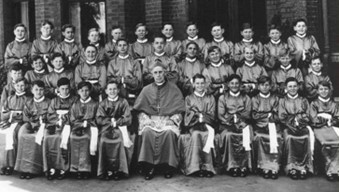


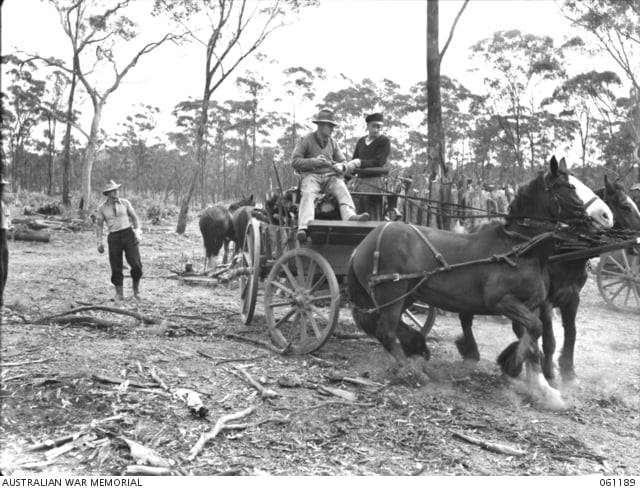

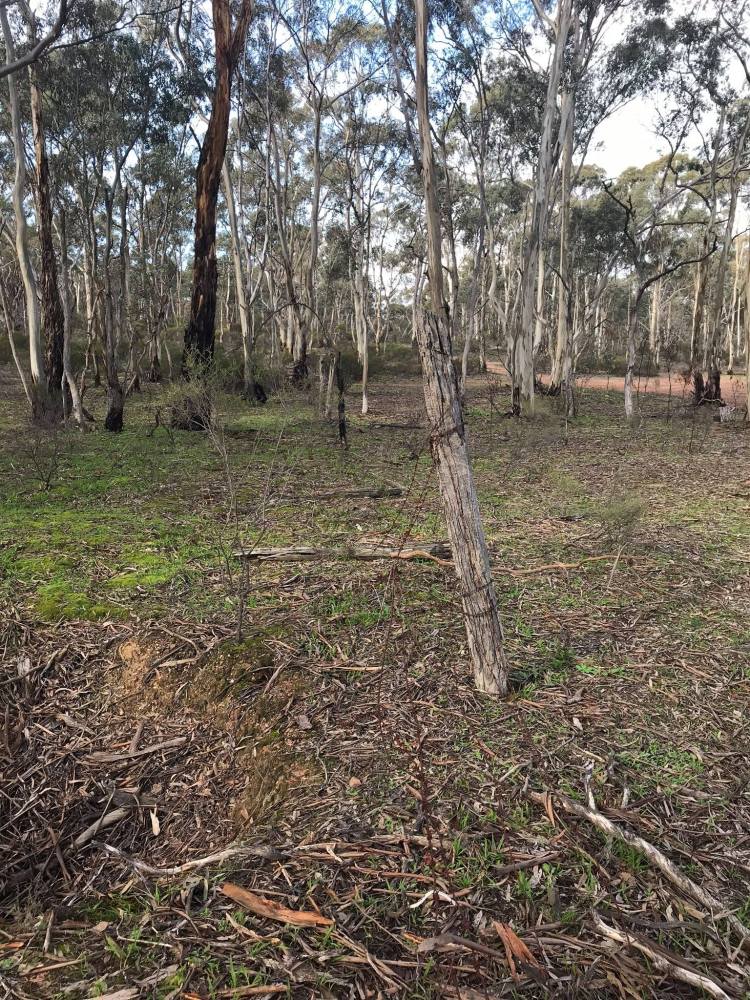
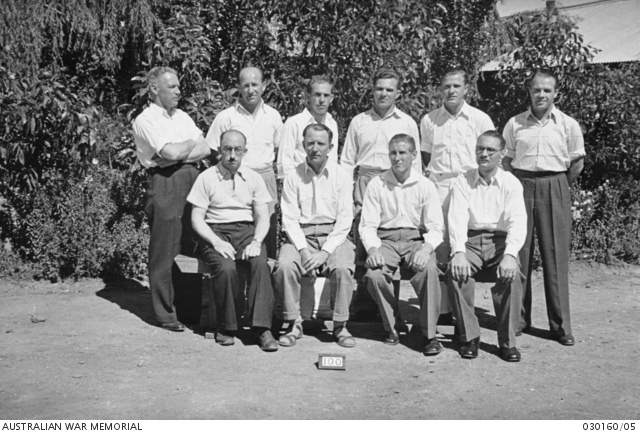


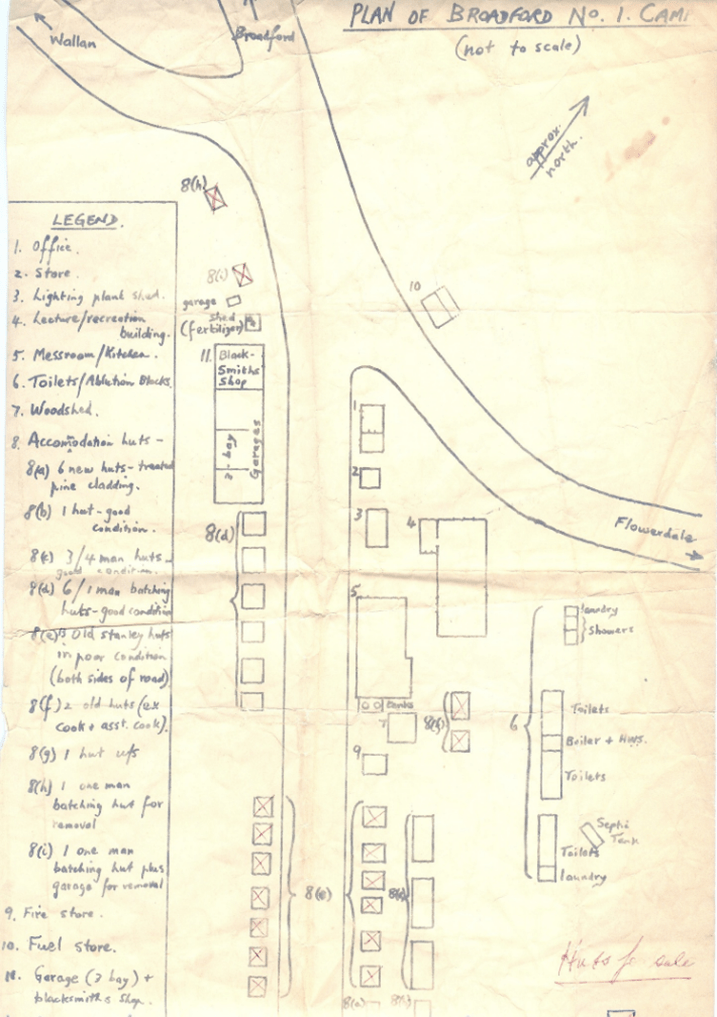
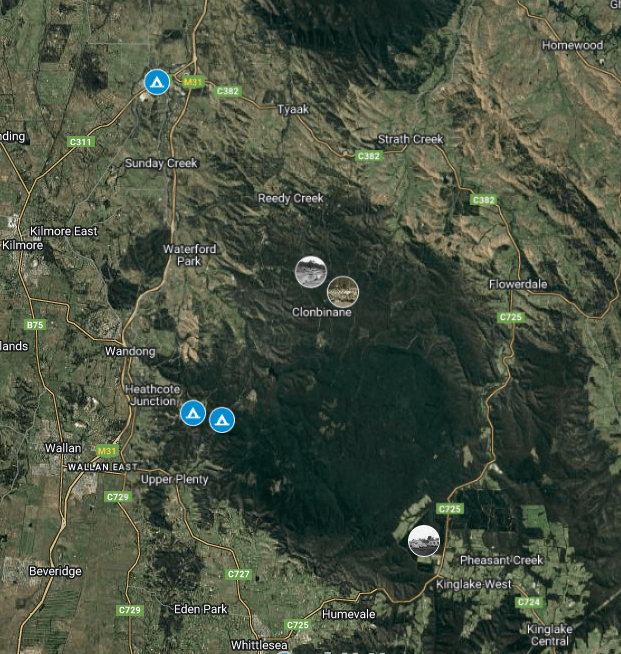

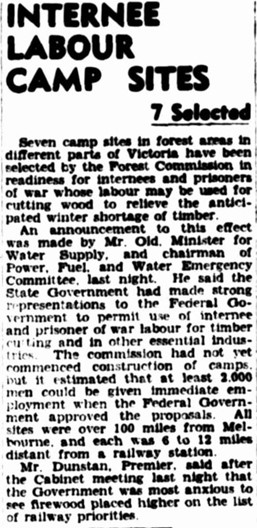


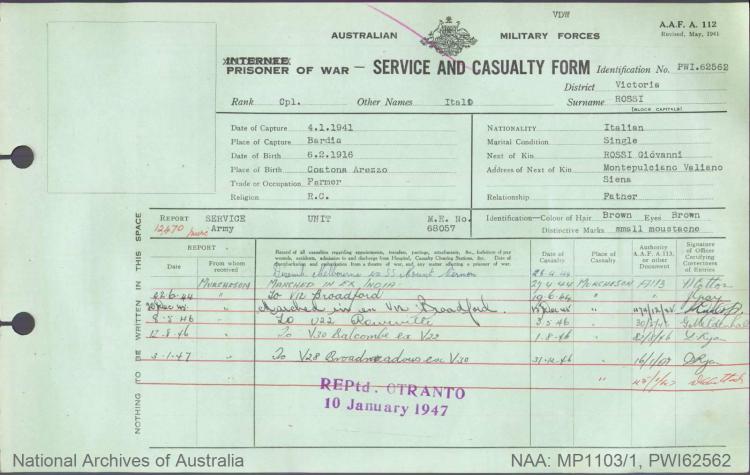

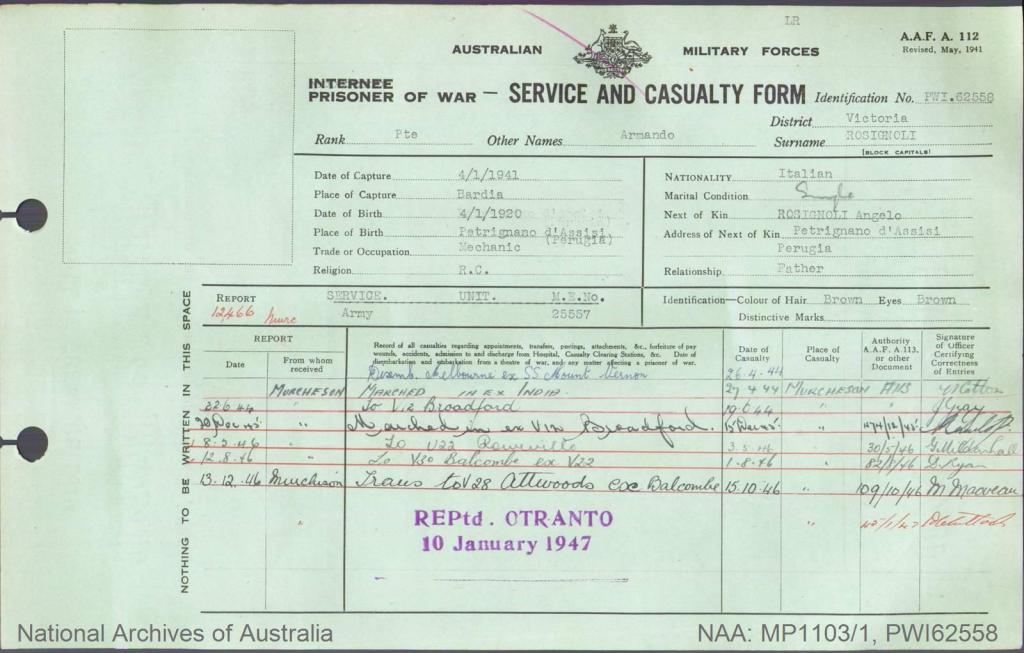
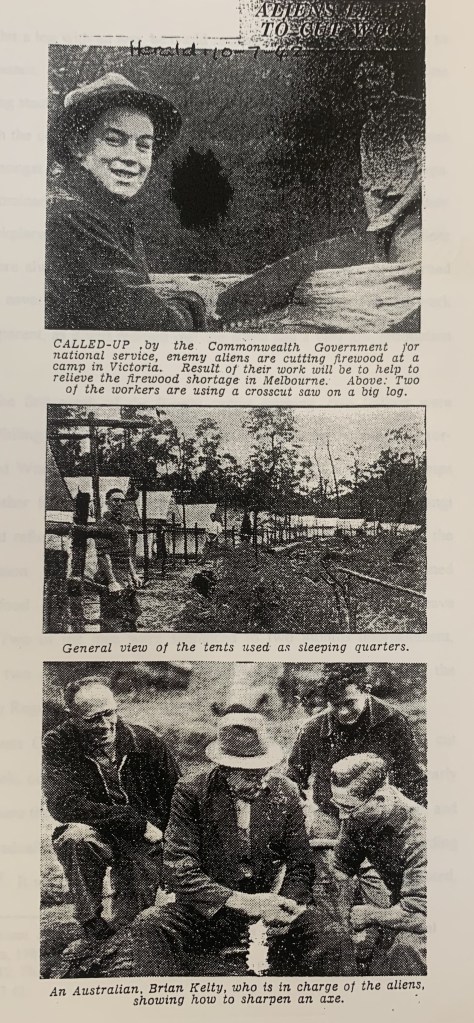


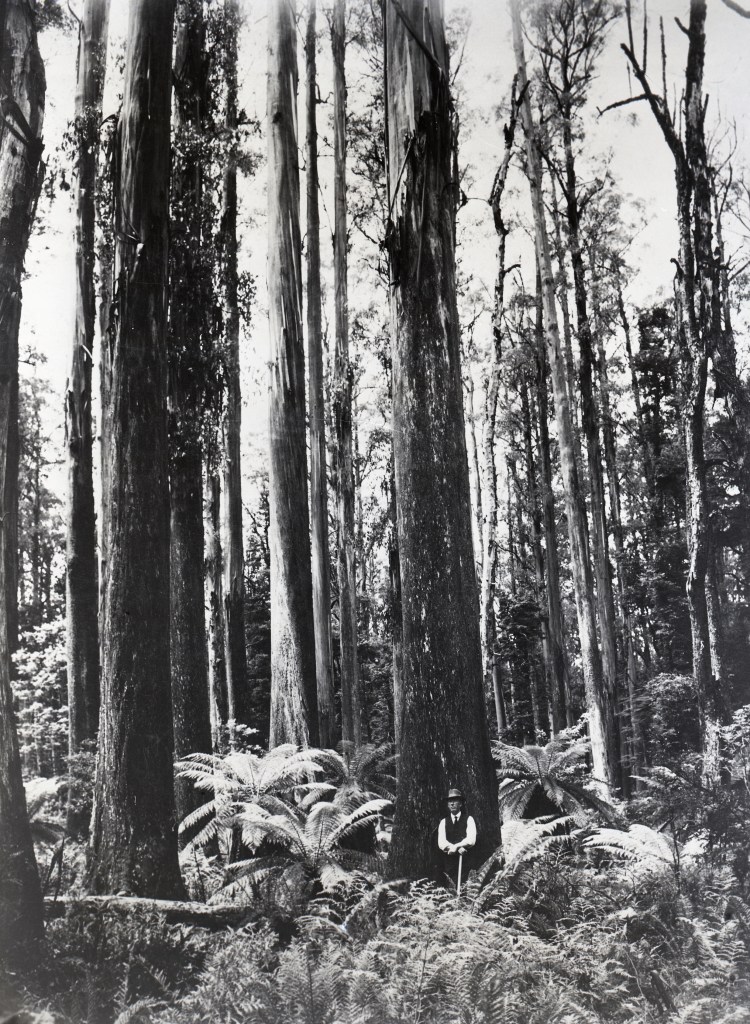


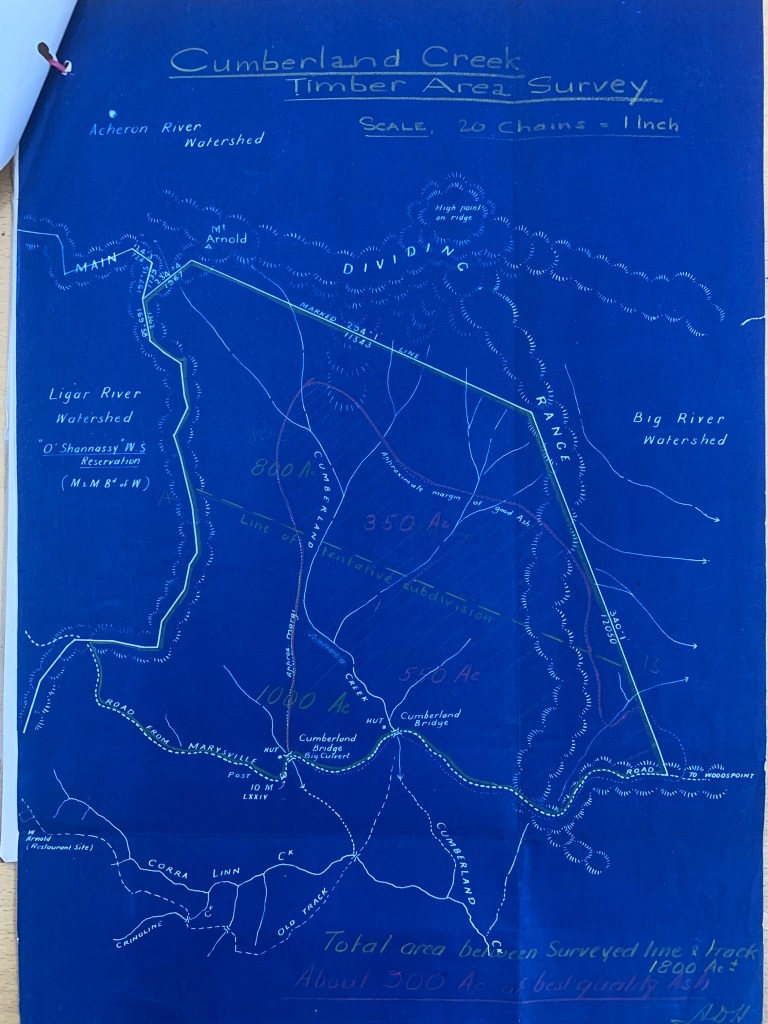

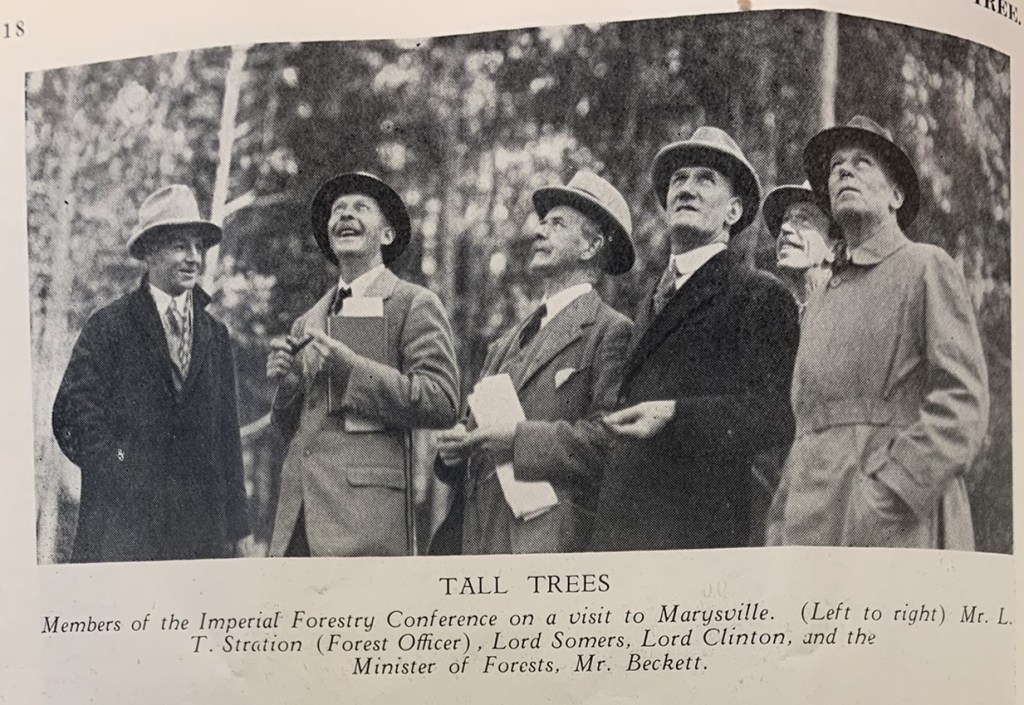
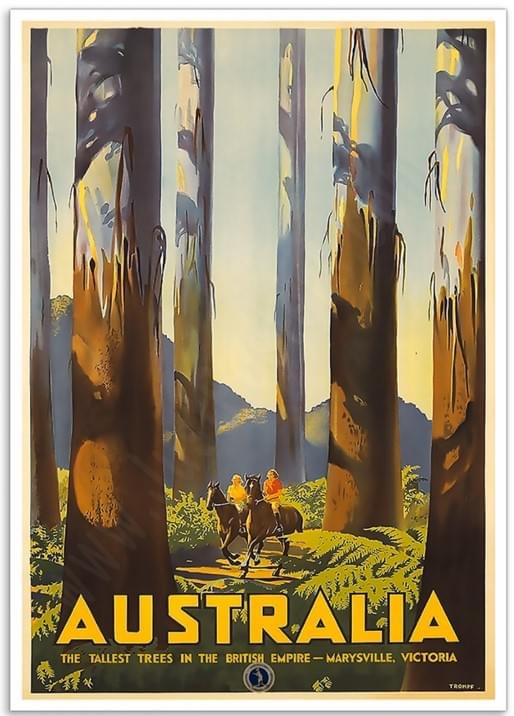


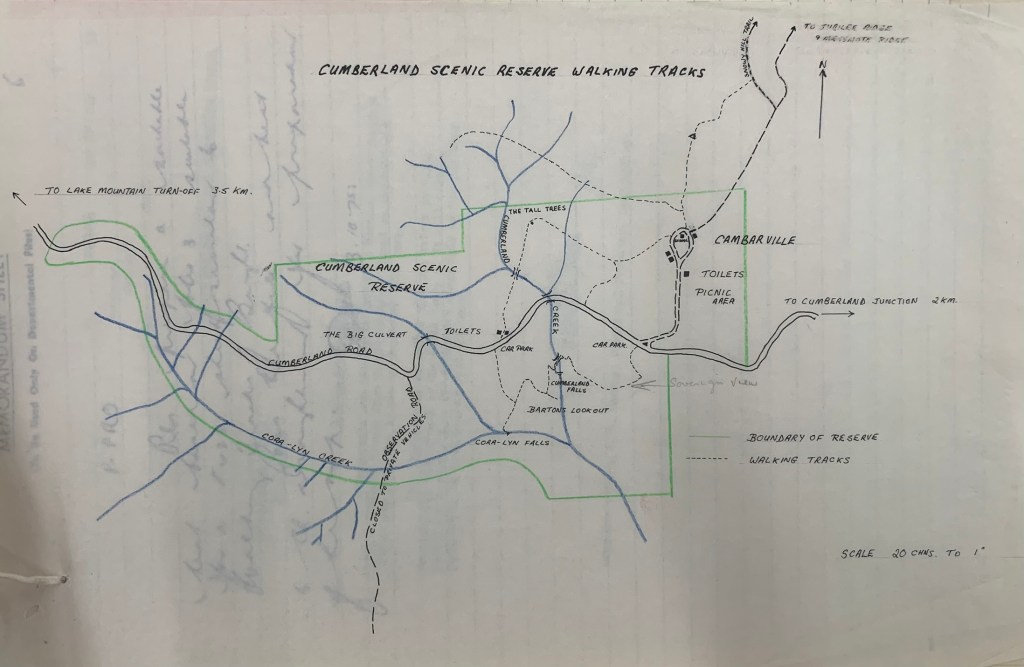


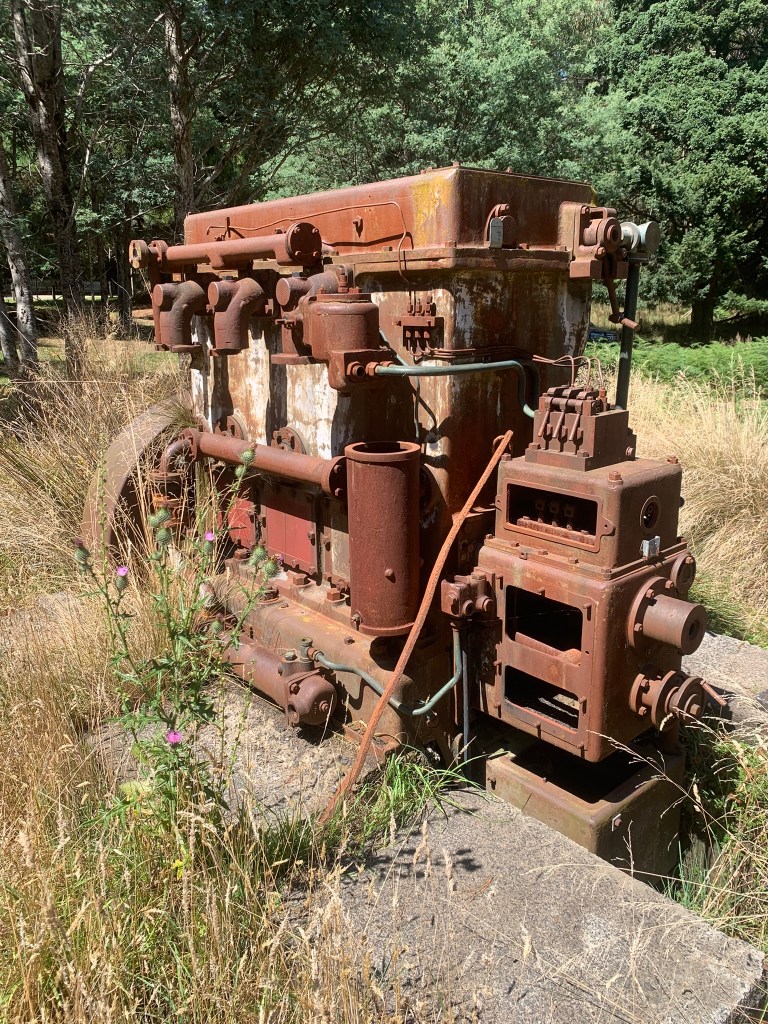
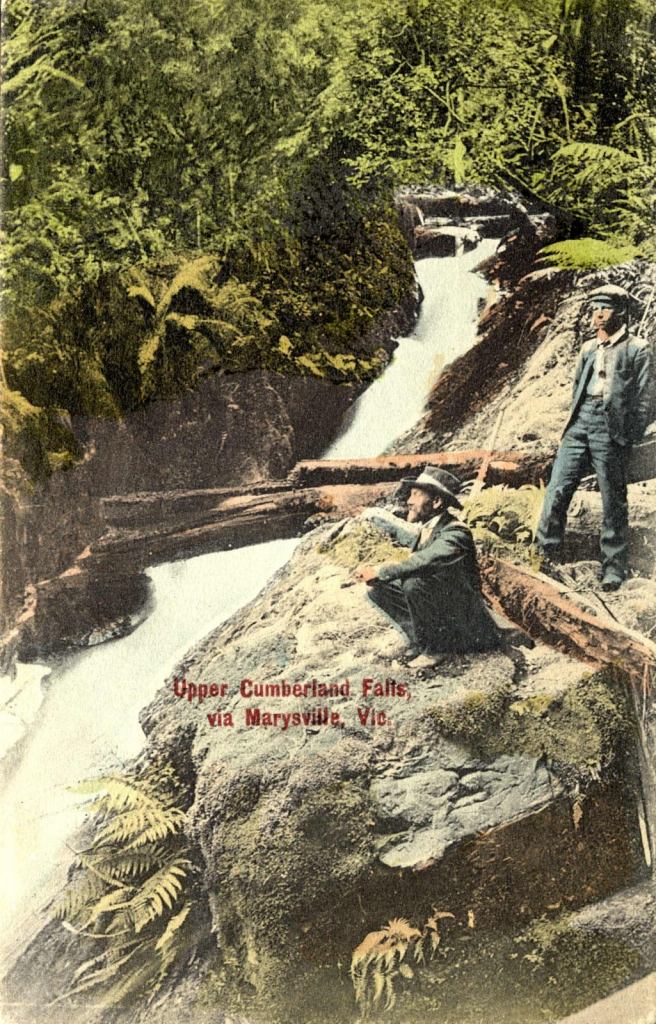


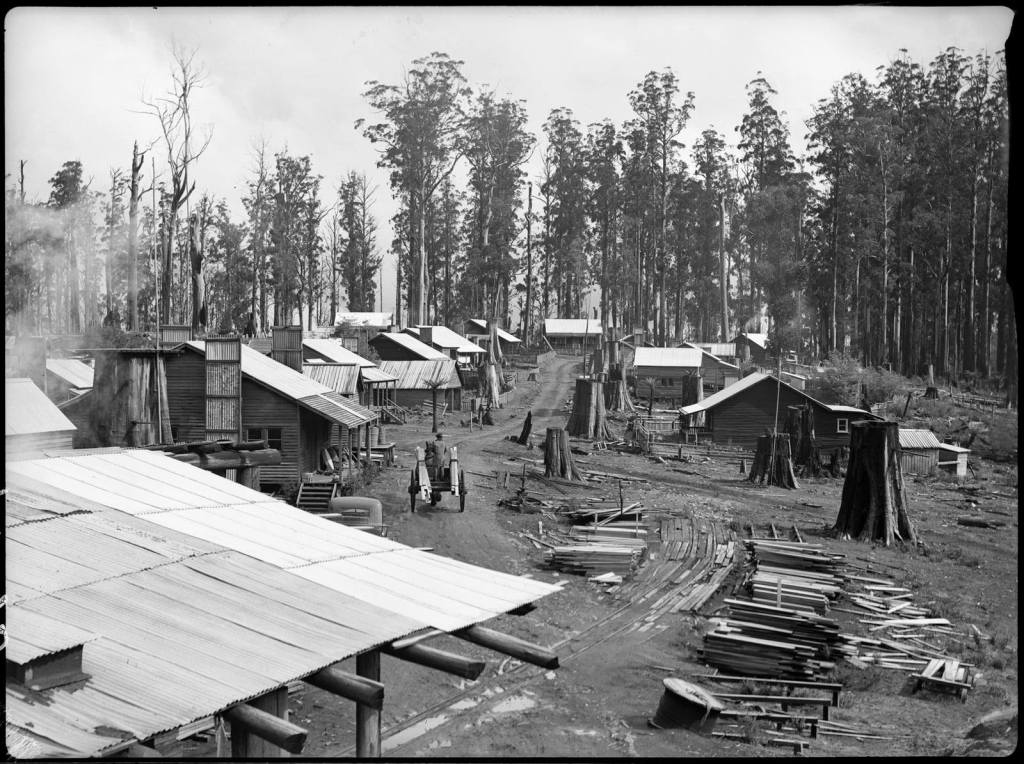
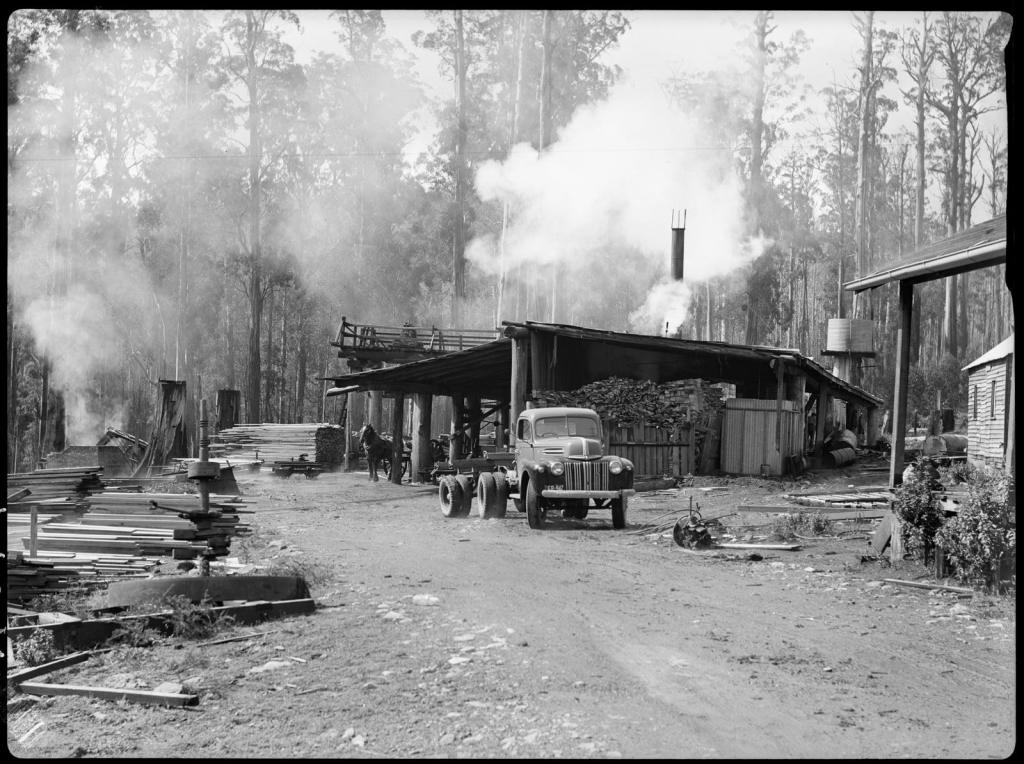
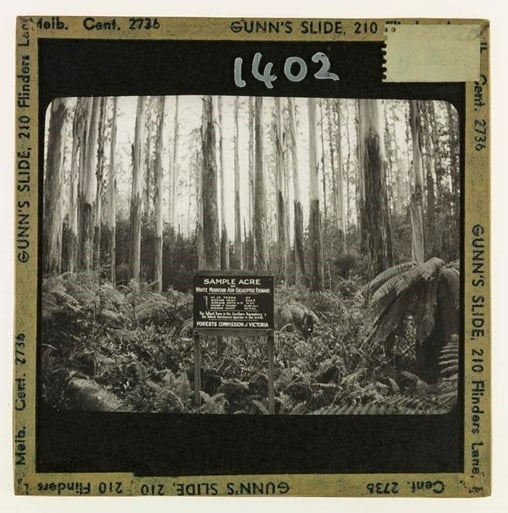


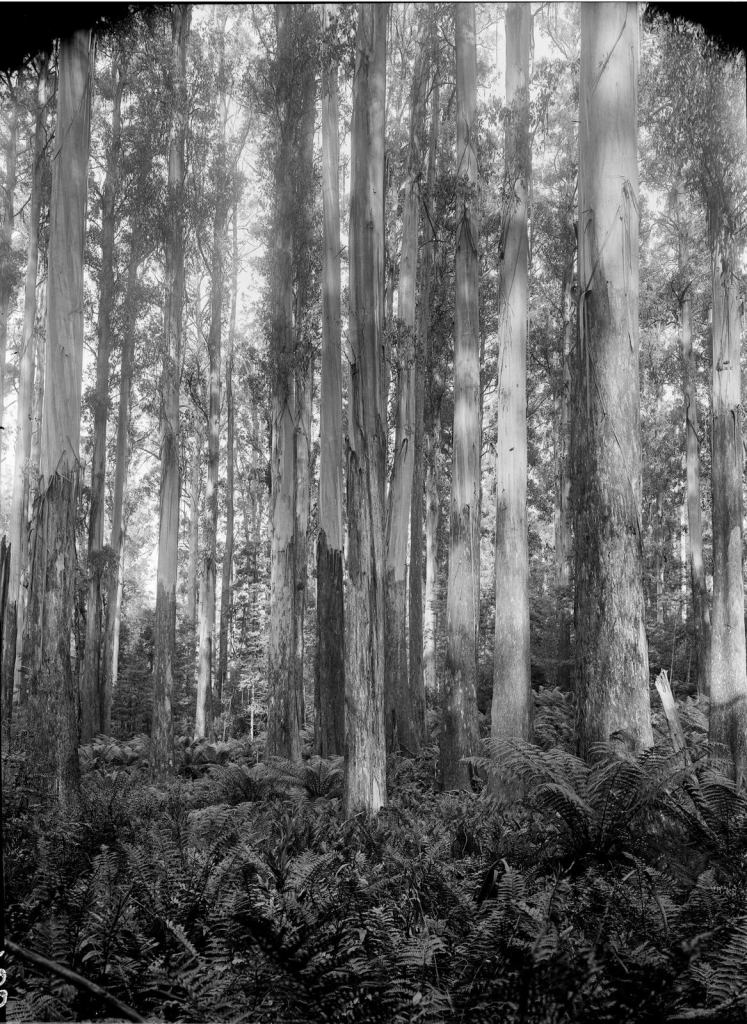
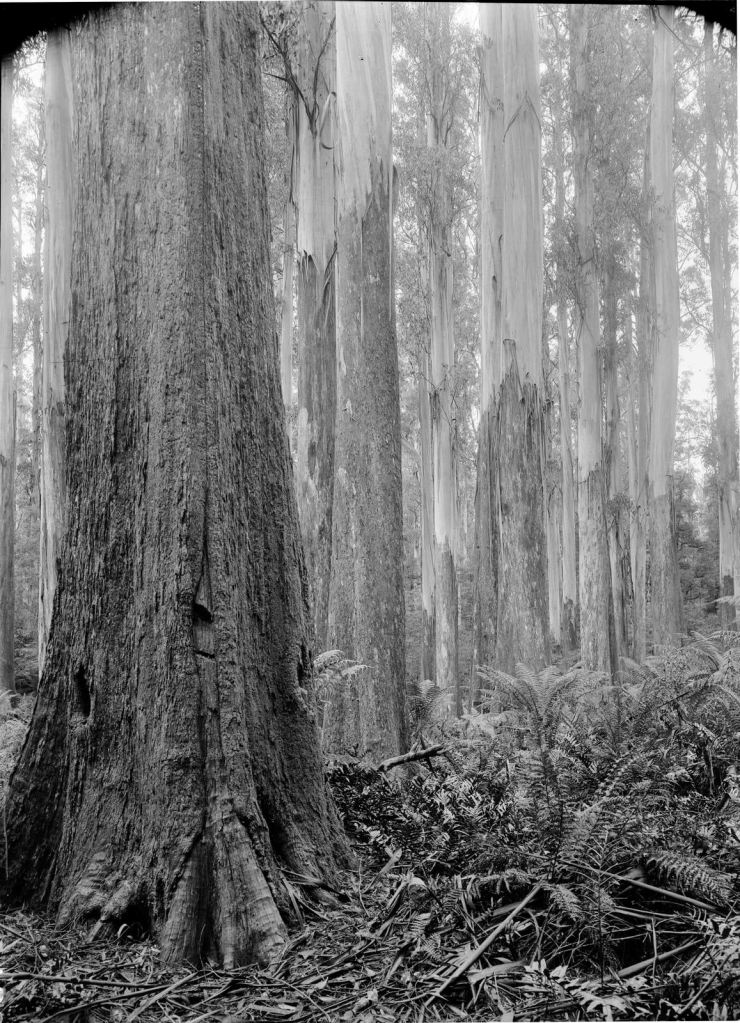

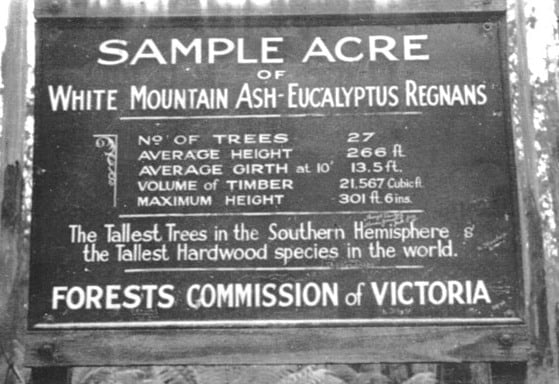
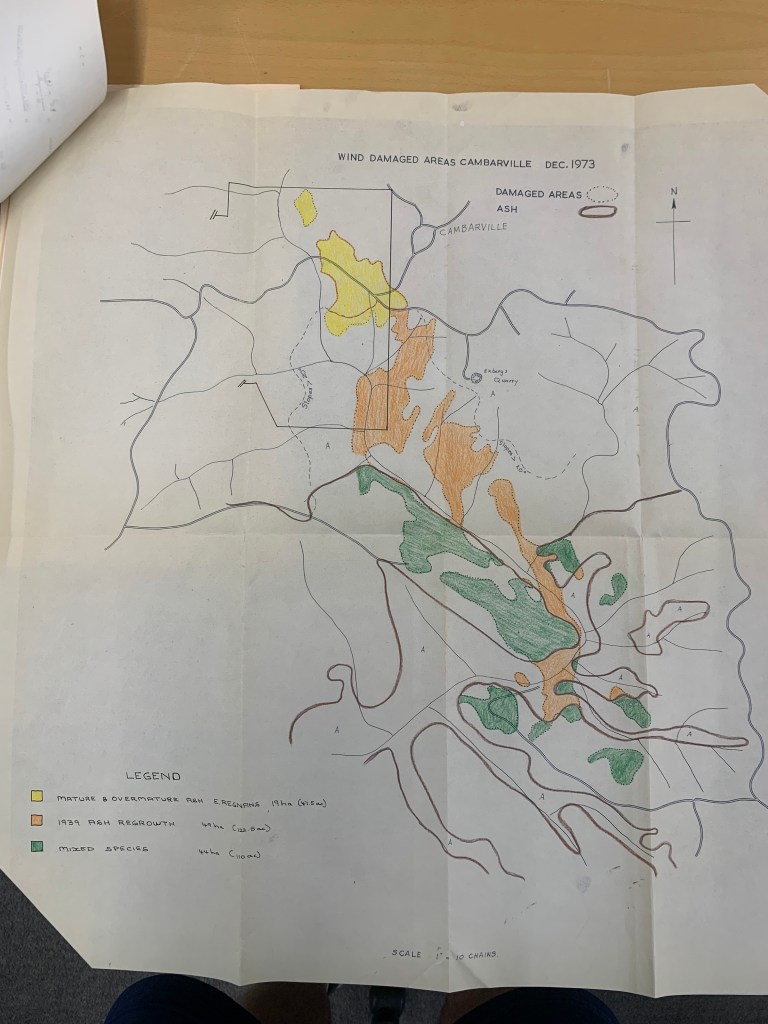

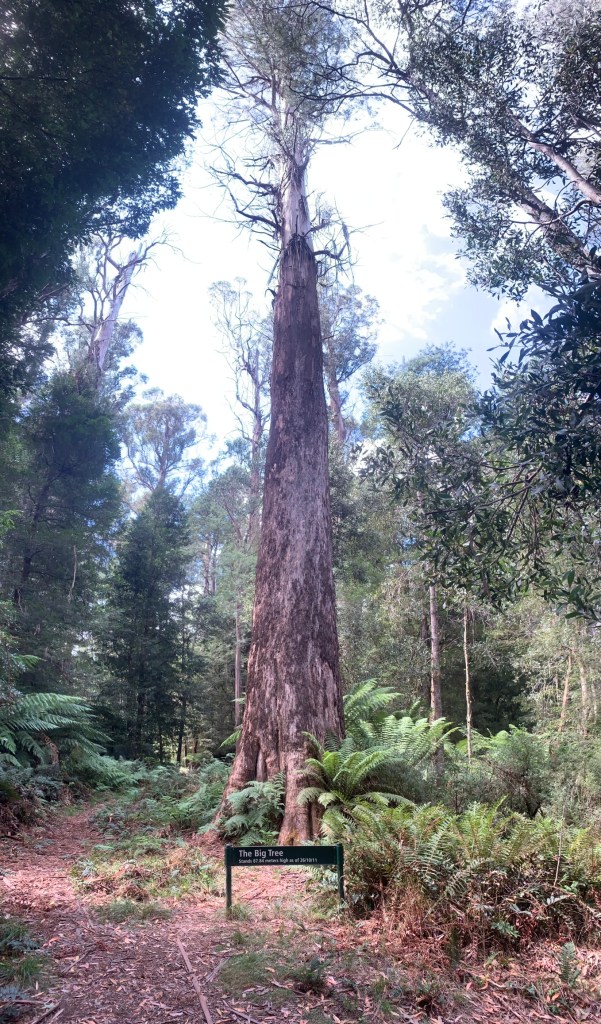
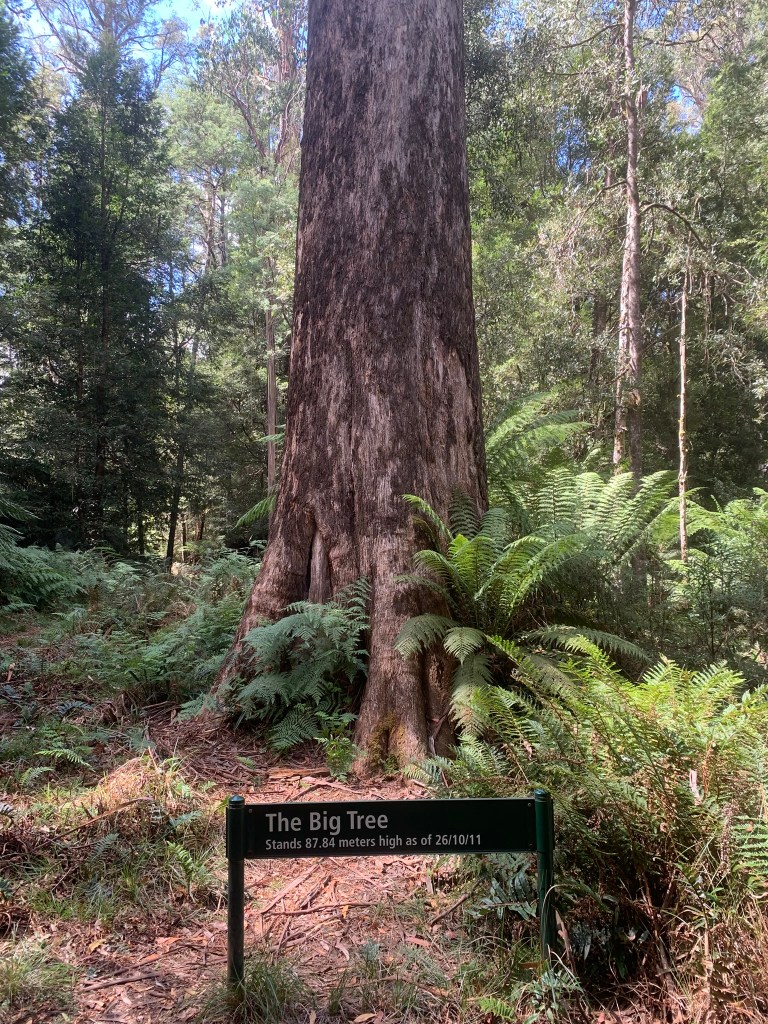
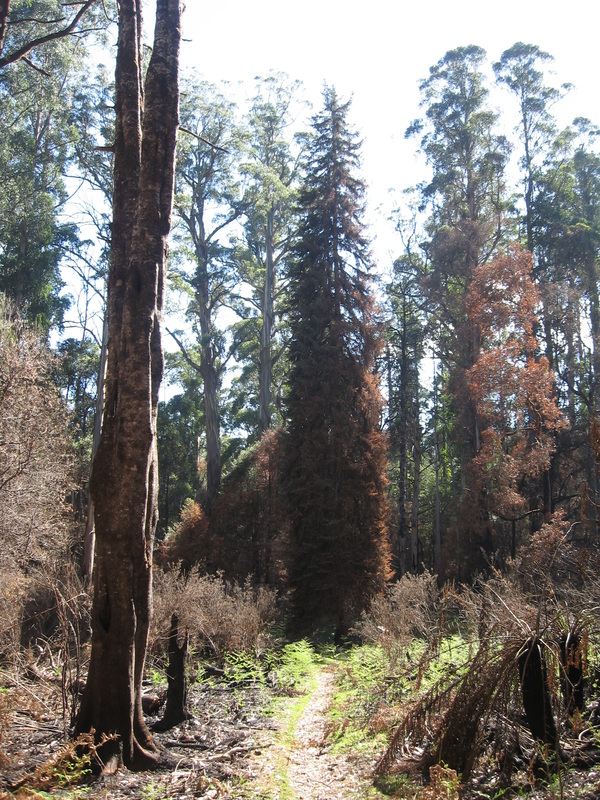
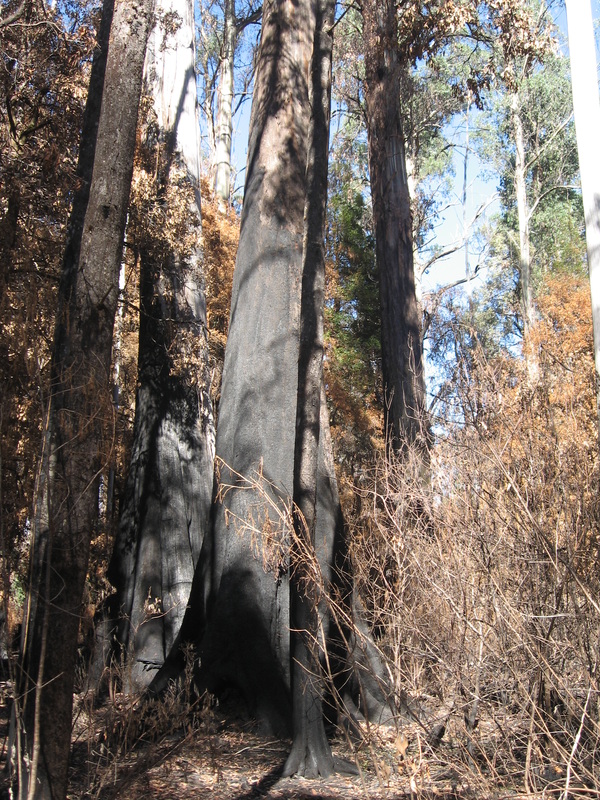


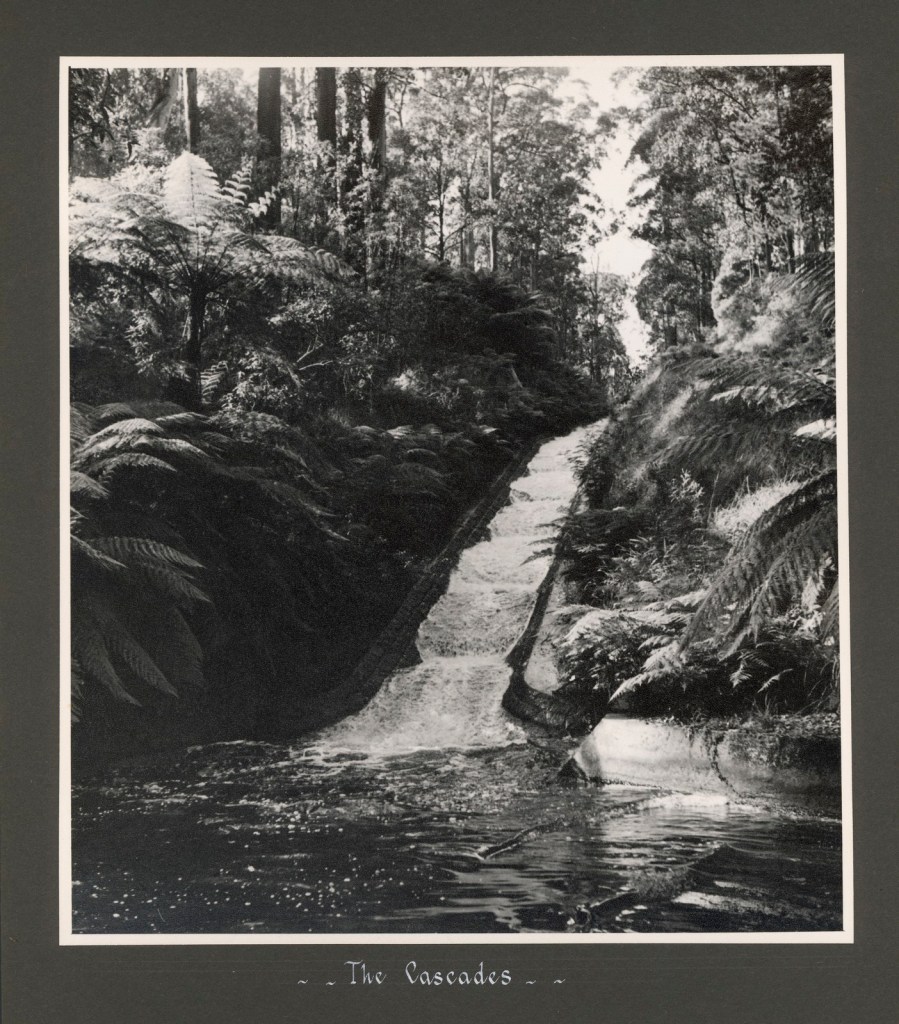


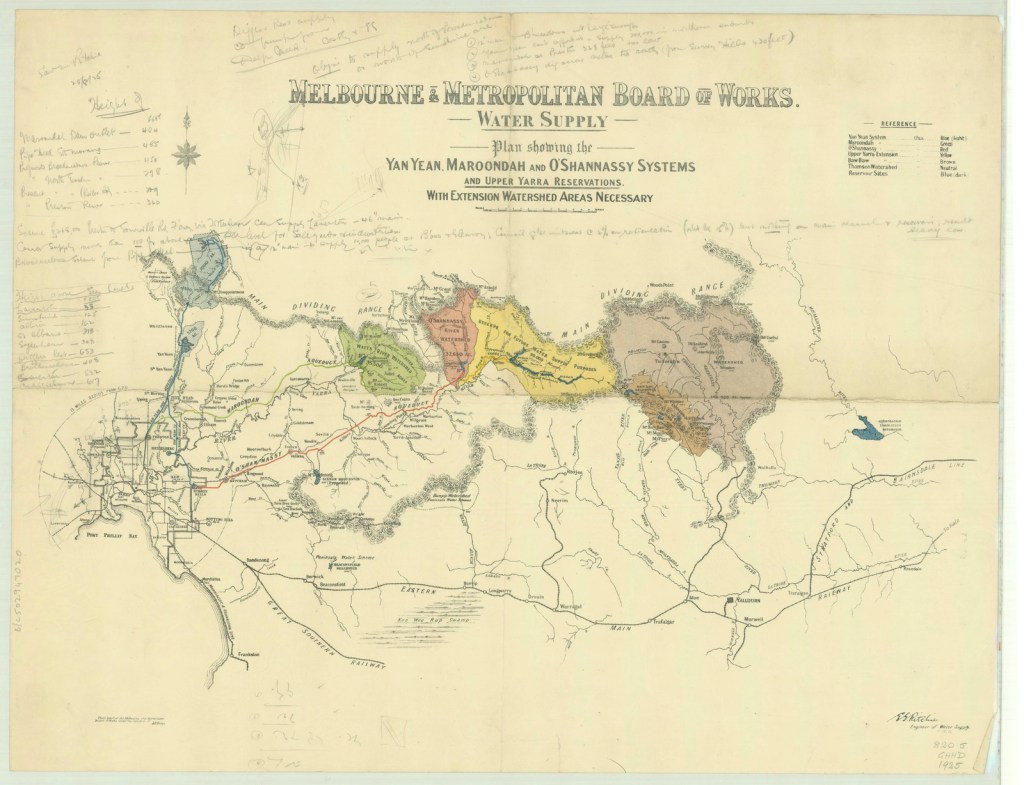
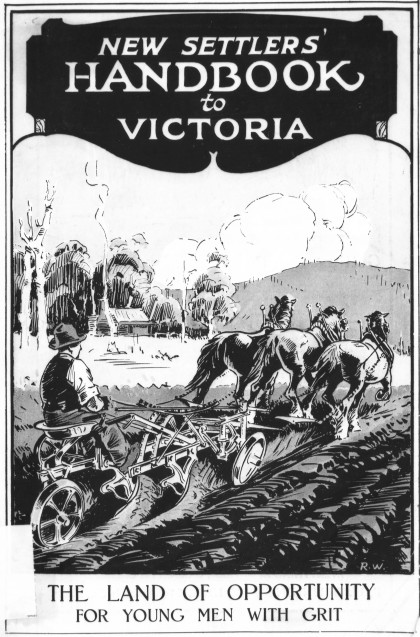
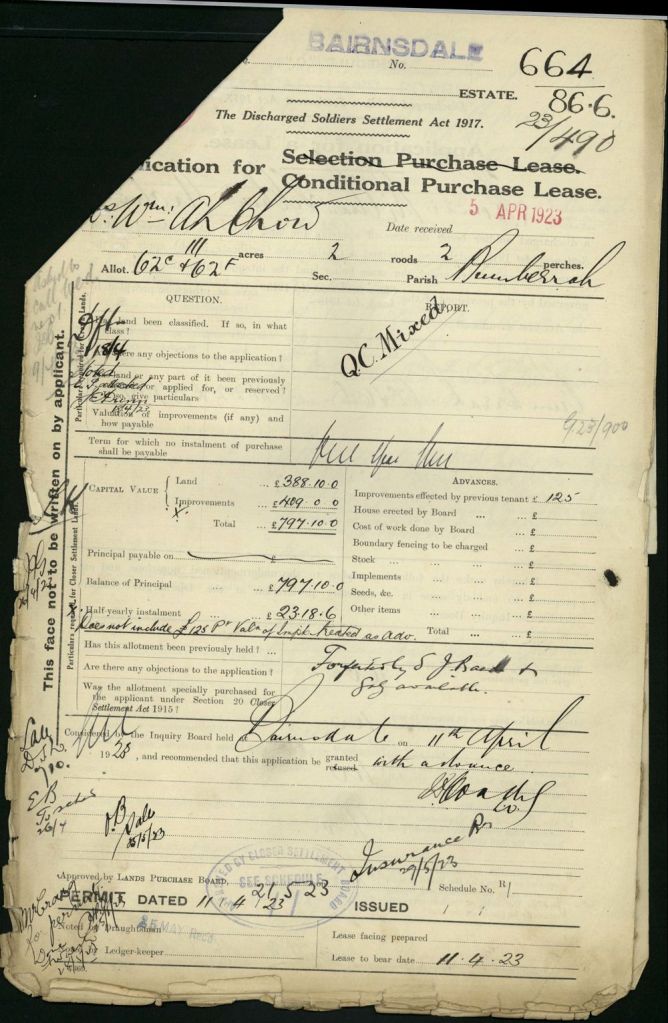
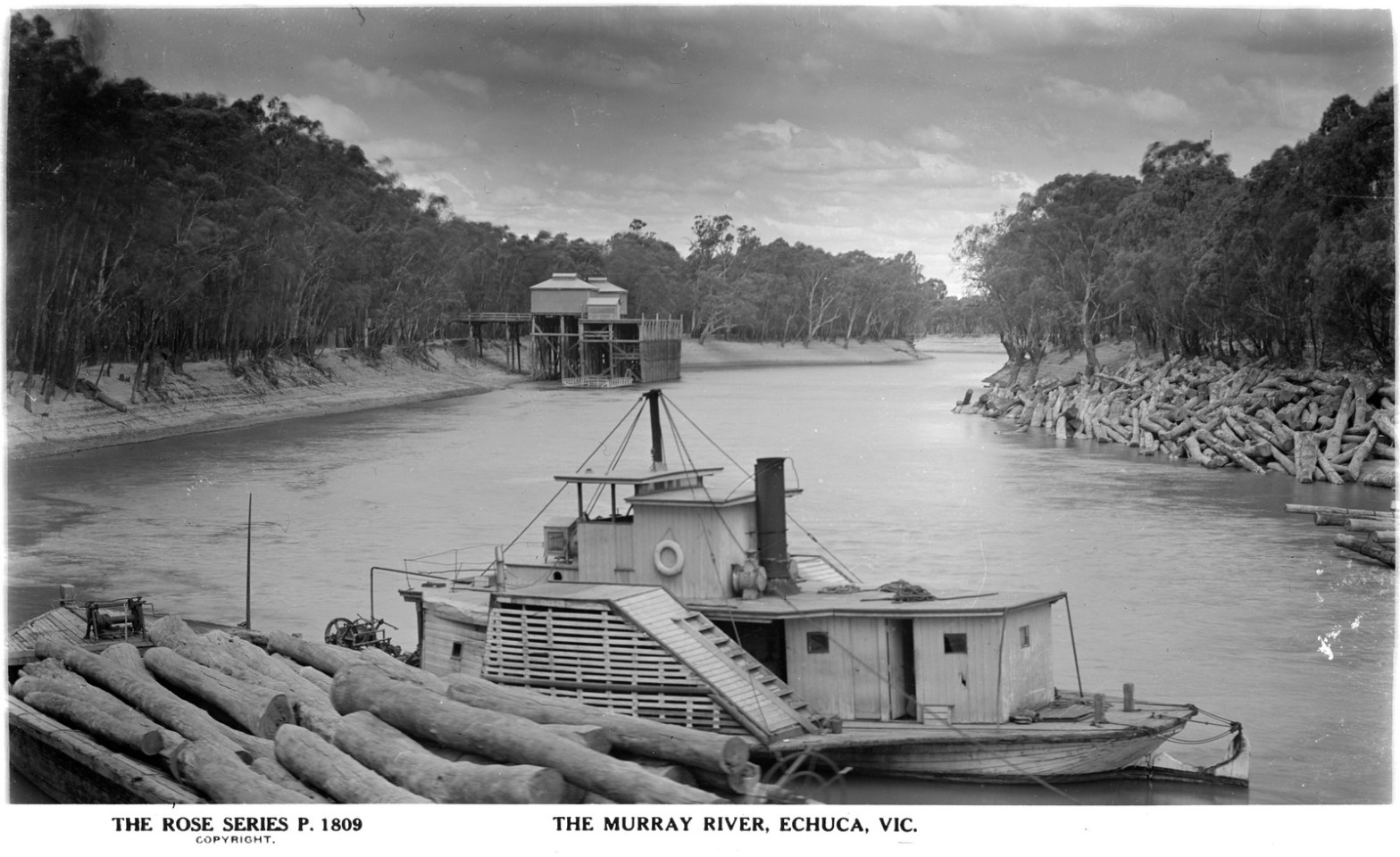
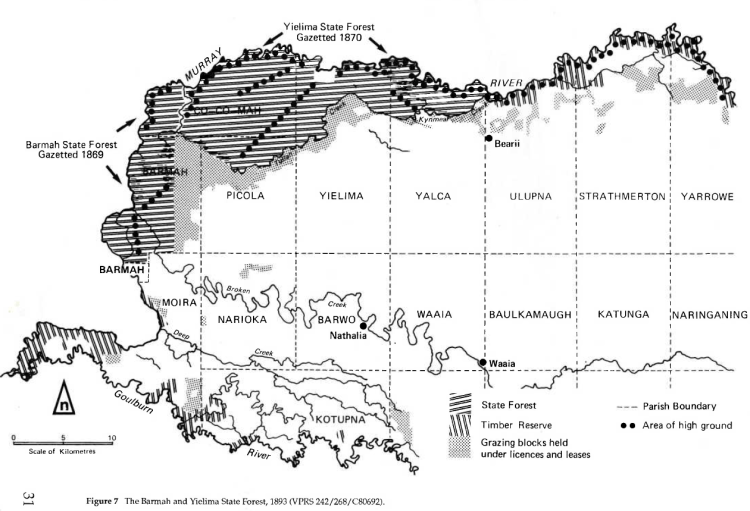


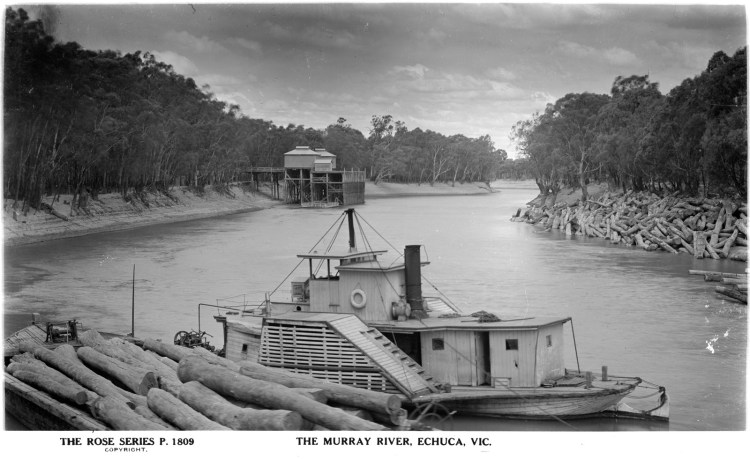
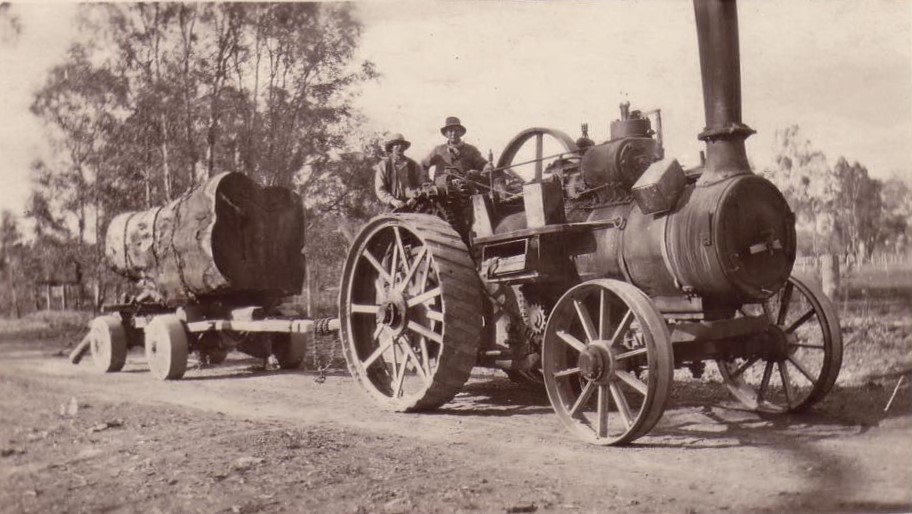


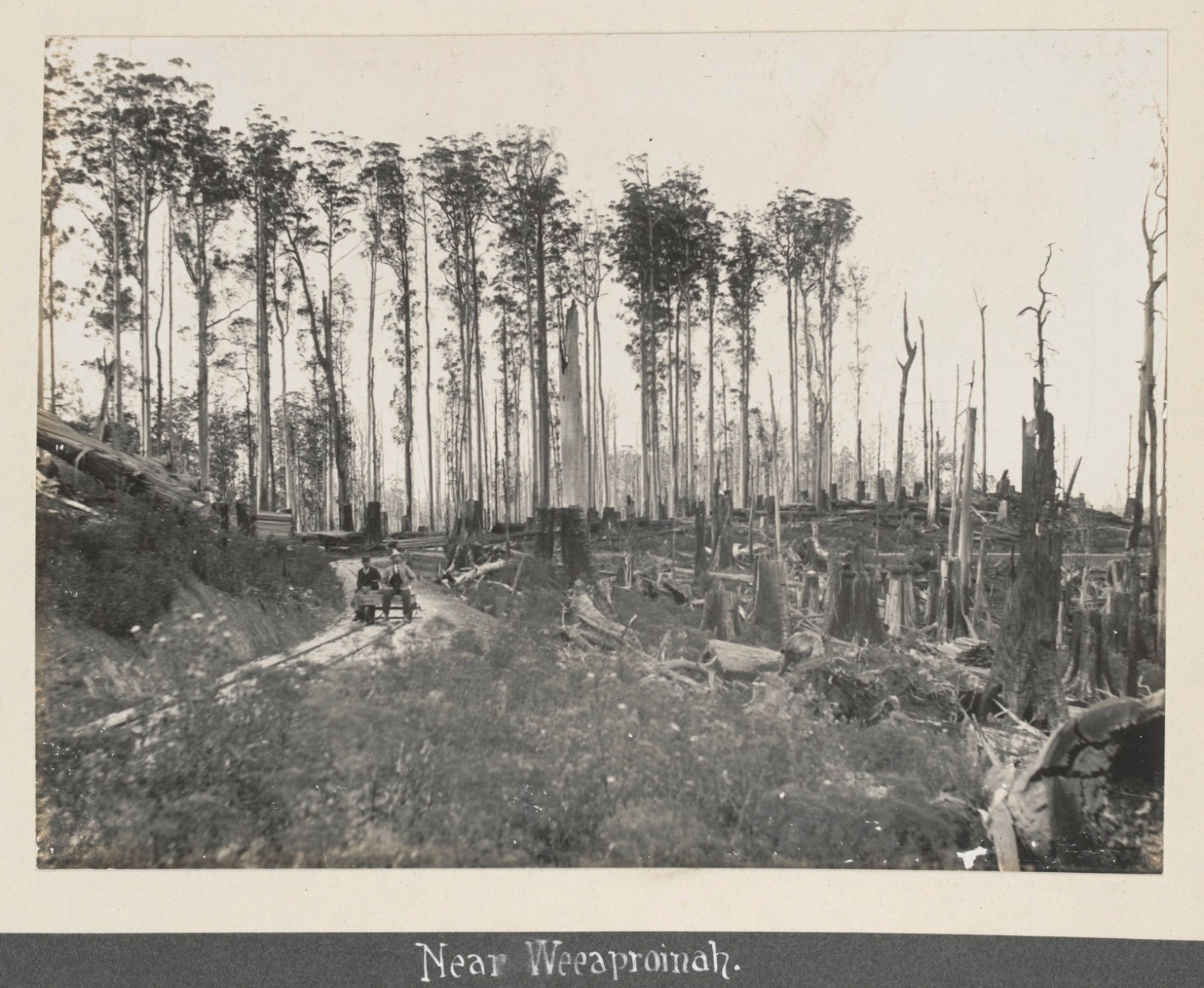

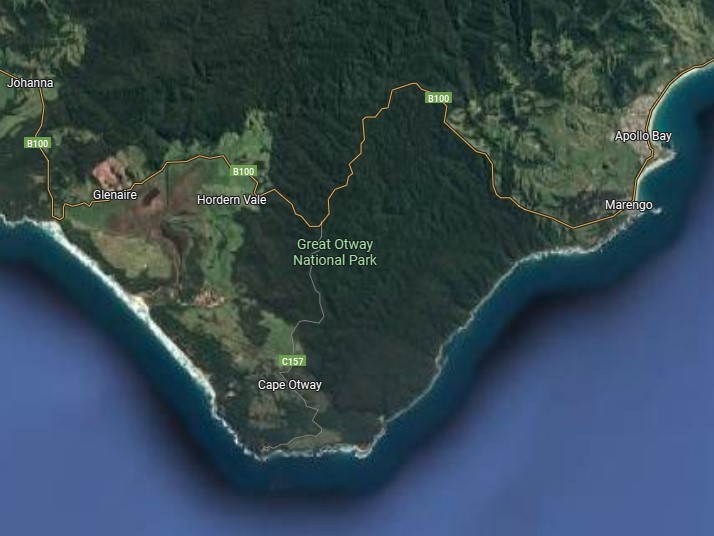

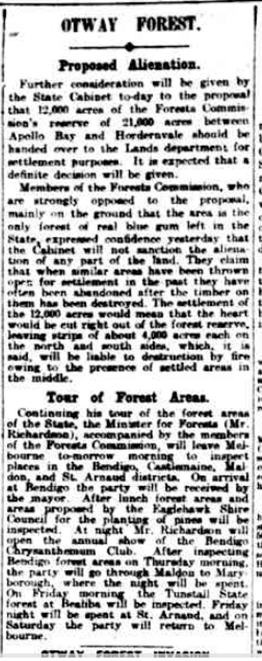
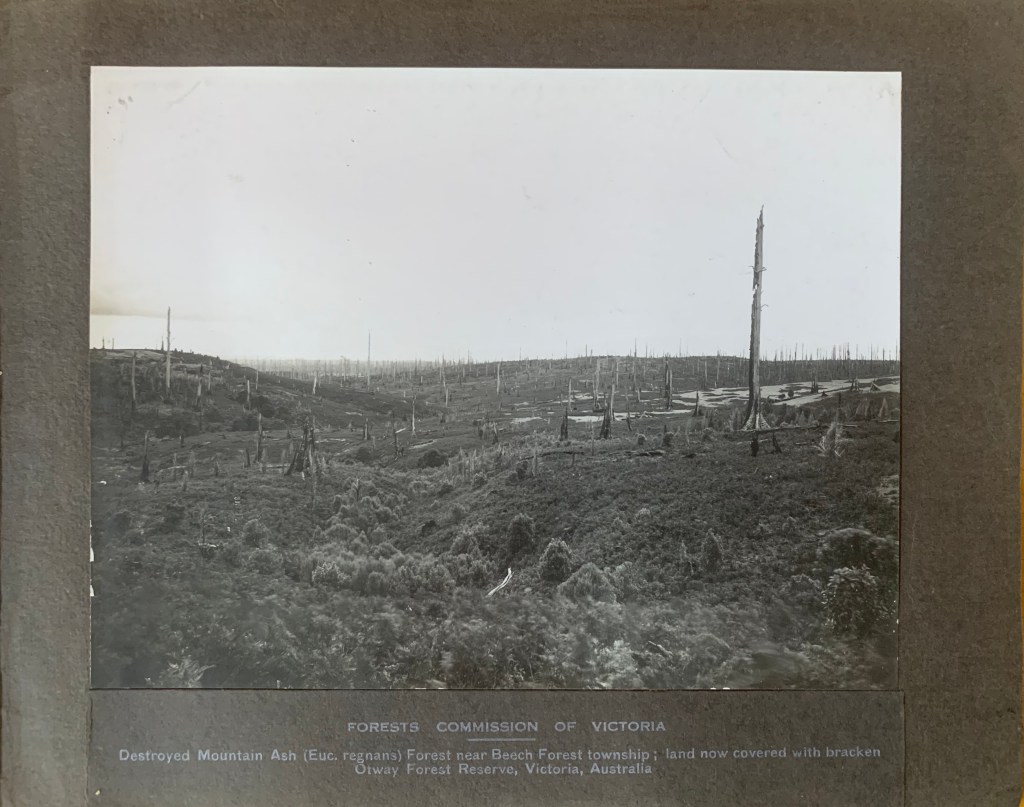
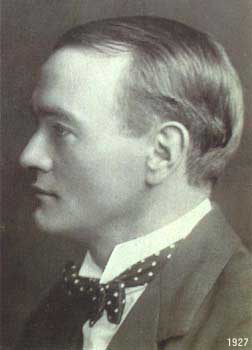
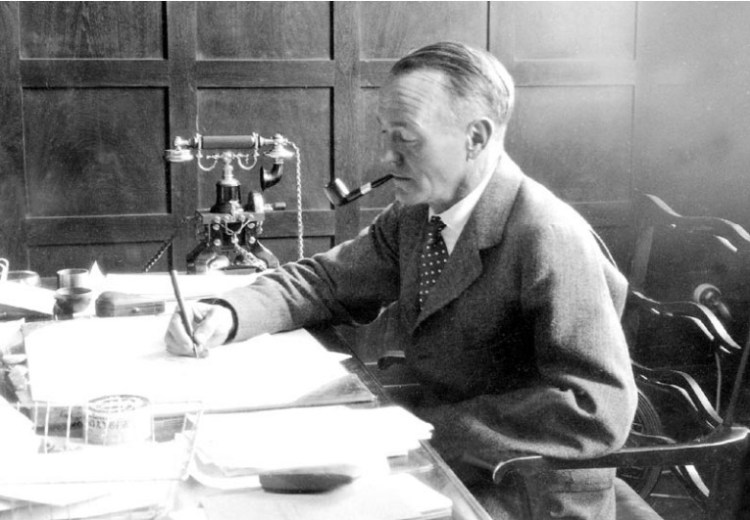
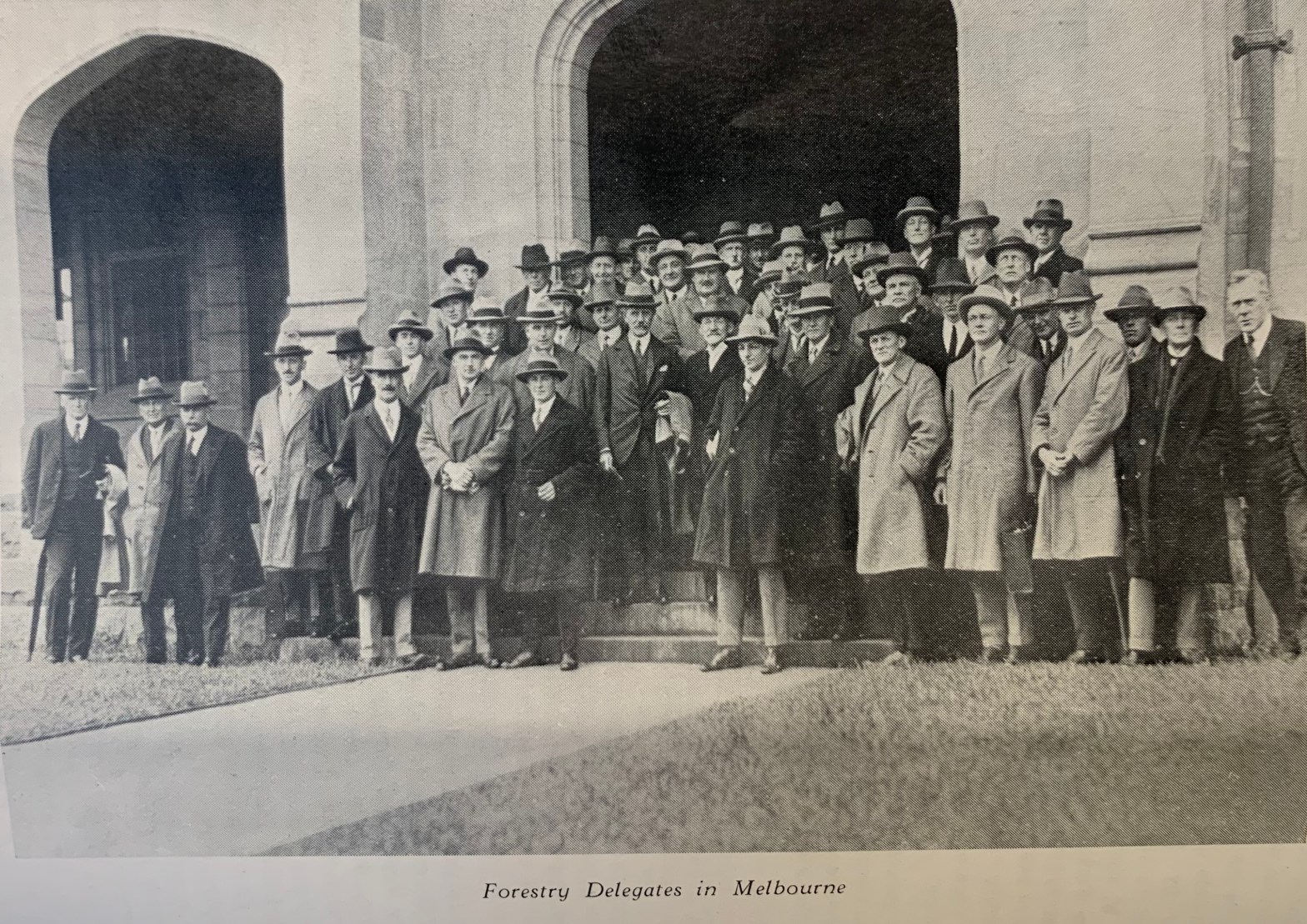

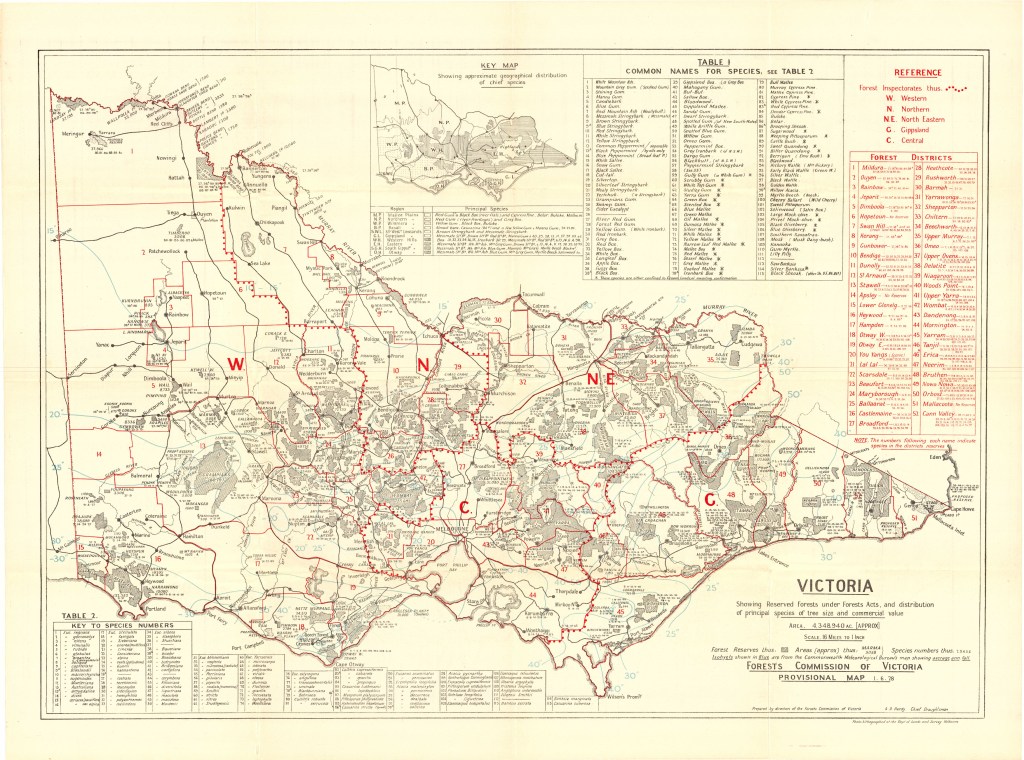
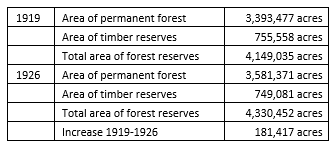
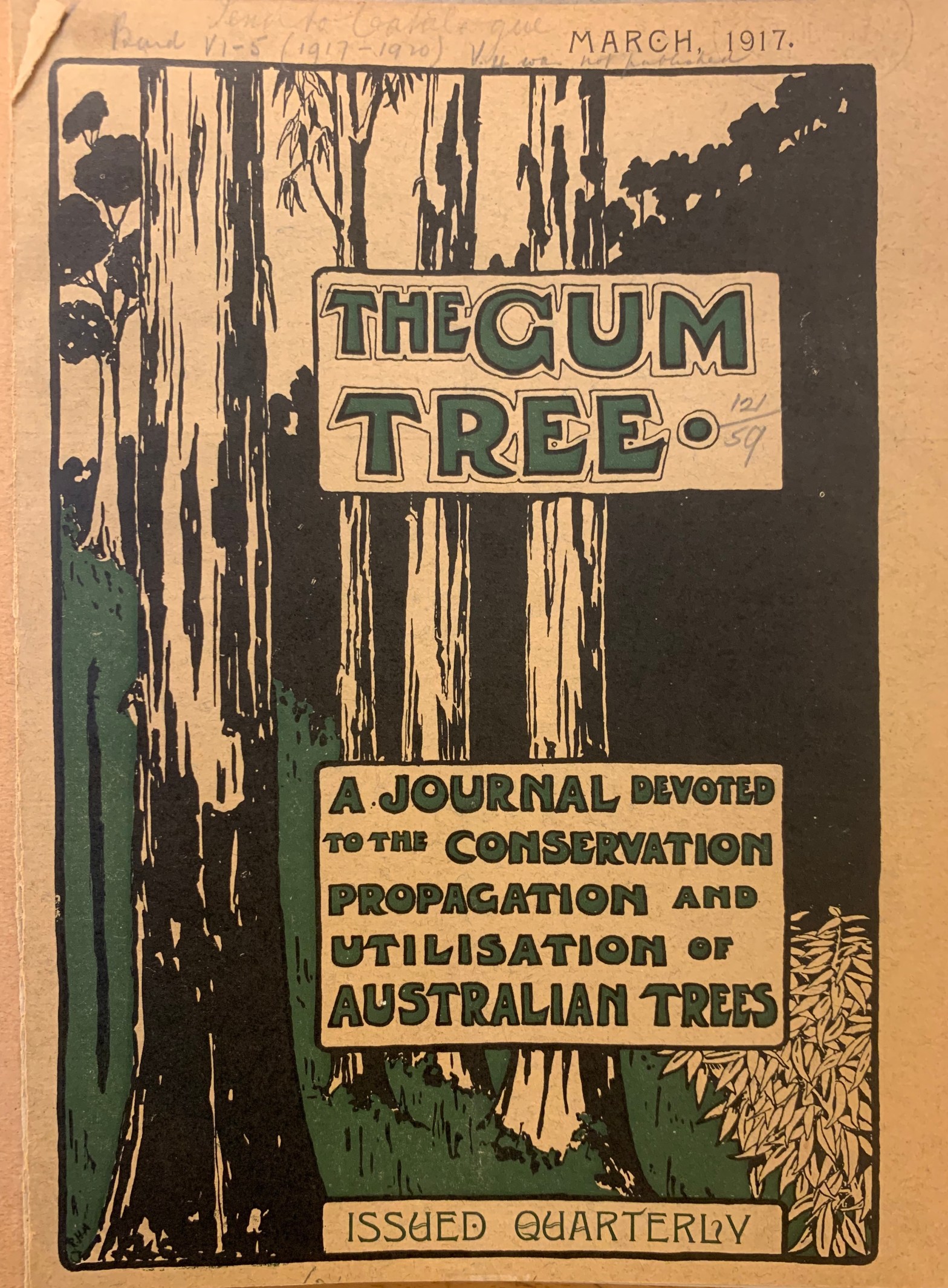
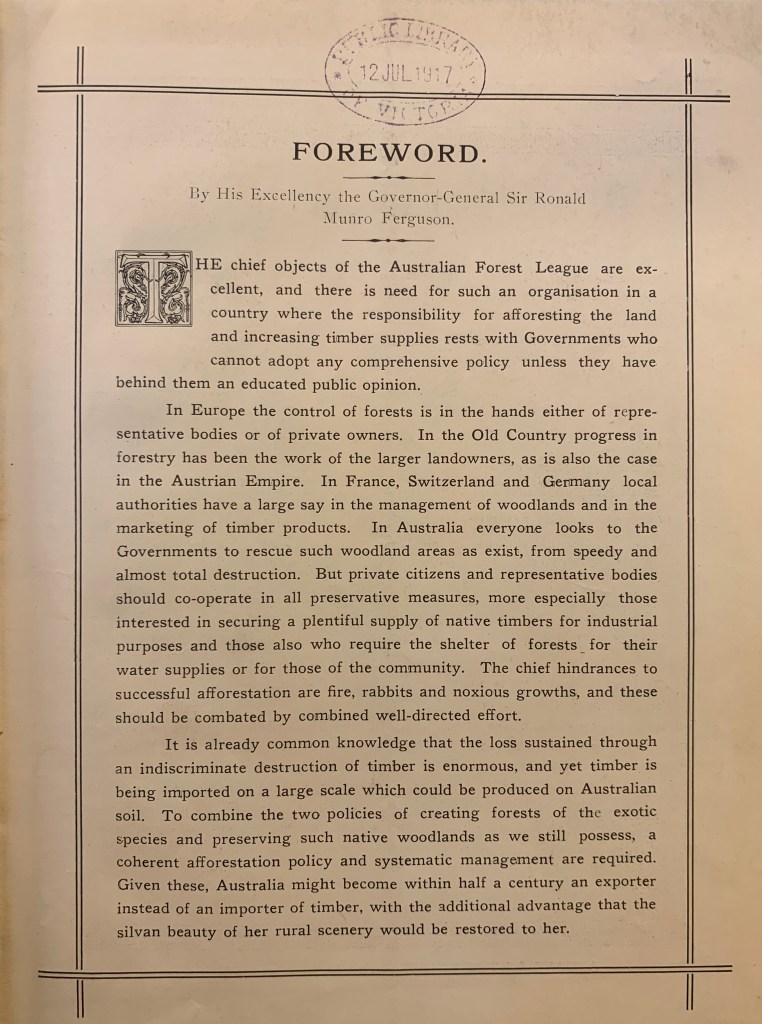


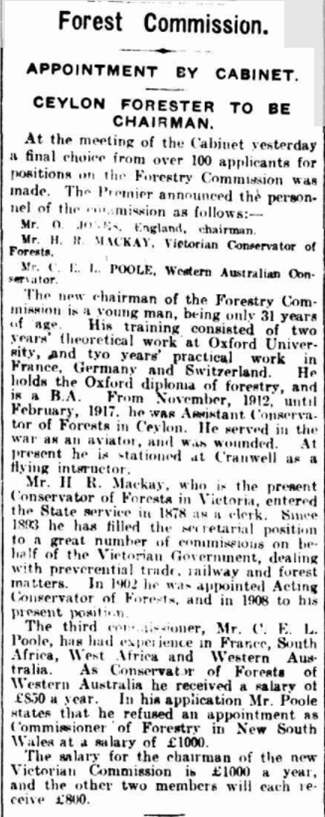
 Victoria’s Forests & Bushfire Heritage