The Silvicultural Systems Project (SSP) was a key research initiative that followed the release of the Timber Industry Strategy (TIS) in 1986.
Long running controversy about clearfelling of forests for sawlogs and pulpwood (woodchips), which was the dominant harvesting and regeneration system, led to the SSP to develop and evaluate alternatives.
SSP trials were established in mountain ash forests at Tanjil Bren in the Central Highlands, and mixed species coastal lowland forests at Cabbage Tree in East Gippsland.
Each trial area was about 10 ha and included several alternative silvicultural treatments including group selection with variable sized gaps and strips, shelterwood, seed tree and clearfelling. Burning and mechanical site preparation after harvesting were compared for each treatment .
A primary objective was to determine if alternative silvicultural systems could successfully regenerate eucalypt forests after harvesting.
The studies were probably the most comprehensive silvicultural and ecological studies undertaken in Australian native forests. The studies covered operational safety, economics, soils, tree growth, silviculture, water quality and biodiversity.
An interim progress report was prepared in 1990. Many other technical reports were prepared.
The SSP trials demonstrated that clear felling, followed by high-intensity slash burning and seeding, was the most operationally and economically effective, but alternative harvesting and regeneration systems were possible.
The studies also highlighted the importance of what I call the Silvicultural Trinity of S’s – being Seed supply, Seedbed and the subsequent Seasonal conditions for successful seedling germination, survival and growth.
The SSP trails were run in conjunction with a Value Adding Utilisation System Trial (VAUS) in East Gippsland to examine the silvicultural and environmental effects of harvesting pulpwood for woodchips to manufacture pulp and paper products.
The studies were intended to last for more than 50 years but were maintained for only 12. There have been some intermittent measurements, but SSP was wound down because of Departmental restructuring and funding cuts.
The idea of independent certification and labelling of timber began to take hold in Europe and north America during the early 1990s. Retailers and suppliers wanted to promote their products to consumers as complying with sustainable and responsible forestry practices.
Certification also fitted neatly with an idea, that was pervasive at the time, of timber companies having a “social licence” (without defining exactly what that meant, or how it was measured).
A number of certification schemes began with the Forest Stewardship Council (FSC) in 1992, and the Programme for the Endorsement of Forest Certification (PEFC) later in 1999. These eventually emerged as the dominant global certification organisations.
The FSC and PEFC schemes both operate in Australia and compete in the marketplace. They are slightly different in how they are derived and assessed, with both having supporters and detractors. In some cases, there has been open hostility between the two certification camps.
The Forest Stewardship Council (FSC), which is based in Germany, offers forest certification and licences for the use of its logo. The FSC model requires environmental, industry and community groups to reach consensus.
PEFC is a global organisation based in Switzerland and is the world’s largest. It is marketed in Australia under the Responsible Wood (RW) logo as the dominant certification standard. In 2023, there were nearly 12 million hectares of RW-certified forests and plantations in Australia.
The Australian Forestry Standard (AFS), which recognises existing forestry practices like clear felling and woodchips, as well as standards like Codes of Practice and RFAs, was developed in 2002 under the umbrella of the PEFC.
Timber certification schemes all involve a set of written forestry standards, independent and third-party auditing and reporting, as well as a traceable chain of custody from the producer to the consumer.
Environment groups tend to support FSC because they have greater influence over outcomes, while the timber industry prefers PEFC/RW, but retailers and consumers probably don’t care.
Major Australian hardware retailer, Bunnings, instituted its “Responsible Timber Sourcing Policy” in 2003 with a revision in 2018. Bunnings gave a commitment that forest products would originate from certified forests in all its 513 stores across Australia and New Zealand by December 2020.
Bunnings required timber products be independently certified to either the Forest Stewardship Council (FSC), Programme for the Endorsement of Forest Certification (PEFC), or another equivalent.
Currently, Victorian businesses certified under either PEFC or FSC, include – VicForests, Midway, Pentarch Forestry, PF Olsen (Aus) and Hancock Victorian Plantations (HVP), among others.
VicForests had been a FSC member from 2011 until 2020 but ongoing disputes with some environmental groups, which remained intractably opposed to native forest harvesting, resulted in failure.
But despite VicForests having achieved certification under both the Australian Forestry Standard and the PEFC in 2007, Bunnings dumped Victorian native timber products from its shelves after the Federal Court ruled in 2020 that timber was felled illegally.
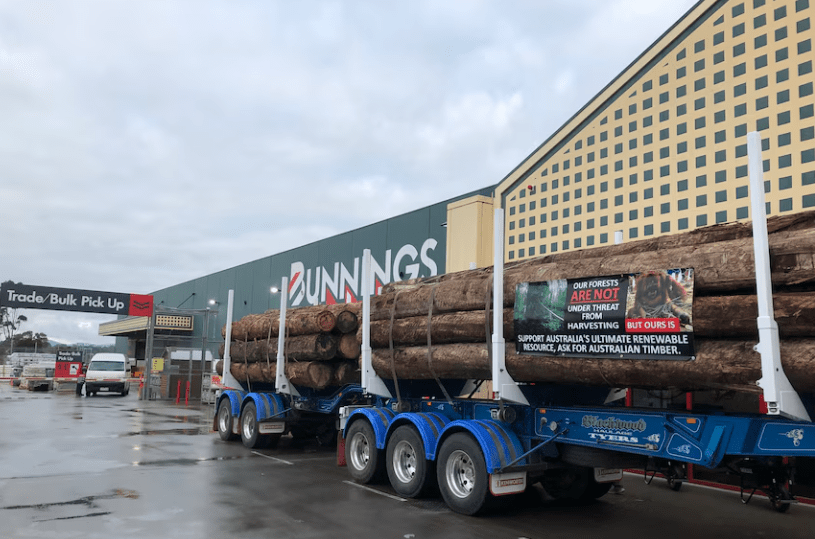
Gippsland timber workers and the Construction Forestry Maritime Mining and Energy Union (CFMMEU) blockaded the Bunning’s store at Traralgon in July 2020 over the company’s decision.
The Court decision was partially overturned in a successful appeal by VicForests in 2021 to the full Federal Court.
And while Bunnings was not a major retailer of VicForests products, it was a symbolic blow due to the company’s high profile.
Bunnings tomato stakes in 2018. The familiar one-inch square hardwood stakes produced by a local sawmill were not to be found. The only ones available were shrink-wrapped bundles of six and dressed all around. Nicely presented, BUT from Indonesia, and imported by a local company. Photo: Gregor Wallace
Log trucks parked at the entrance of Bunnings store in Traralgon to protest the retailer’s decision to stop selling VicForests harvested timber. July 2020. Source: ABC.
I often joked throughout my 40-year forestry and bushfire career that there were three sorts of firefighters in rural Victoria.
Firstly, there were the large numbers of CFA volunteers in their bright yellow overalls and shiny red trucks with the flashing lights, fighting house and scrub fires in small country towns, on private and cleared farmland, or around houses scattered along the forest interface.
These CFA men and women who turn-out so rapidly and so selflessly in tanker crews and strike teams do a sensational job. Their local communities and the media are quite rightly very proud of them. I certainly am.
Secondly, there were the “blue shirts”. You know… the paid staff in the CFA, the Regional Officers and so on. A good bunch of folks they are too.
And then not forgetting the Forest Fire Management Victoria (FFMVic) staff along with the permanent and summer firefighting crews in their jolly green overalls. whose primary focus was bushfire.
And then there were people like me – the conscripts – those professional foresters and other staff employed by the State Government in DEECA (or whatever its name was that week) that had another full-time job, but where forest firefighting was a major but important add-on.
And it just seemed to get bigger and bigger each year, particularly as ranks of experienced staff began to thin.
Unable to employ much simpler “surround and drown” tactics that usually last less than 12 hours or so, forest firefighters often confront large campaign bushfires in remote and rough terrain that can stretch for weeks or even months.
Comparatively small in numbers, the FFMVic staff and conscripts mostly take-on the critical but less glamorous senior management roles such as incident controllers, planners, situation, communications, mapping, aircraft operations and logistics officers etc…
While out in the bush on the fire front, conscripts with their local knowledge and experience marshal resources, direct operations and are appointed as sector or divisional commanders.
Conscripts also tend to cop the laborious and mucky recovery jobs responsible for picking up the pieces when the colour and movement of the firefight has long faded.
In my experience, Victorian forest firefighters have always been a pretty innovative “can-do” lot with a strong sense of duty who tend to focus on working together and just quietly “getting stuff done”.
Nearly one-third of Victoria is State Forest and National Park, with an even bigger proportion when you just look at Gippsland. It’s a vast estate from the mountains to the sea.
Foresters, Rangers and many others who have full-time roles managing this land find themselves caught up in fighting fires, often in remote and prolonged campaigns, well away from the public or media gaze.
Dry firefighting with bulldozers, rakehoes, chainsaws and axes by its very nature is hard physical work but an essential skill in these far-flung places with limited access to water. It’s something that had been developed and honed over many decades by the Forests Commission.
Logging contractors, machine operators, sawmill workers and truck drivers, along with shop keepers in small rural towns who supplied the fire fight were also critical. I recall the Briagolong publican selflessly opened his kitchen at 3am in the morning to supply breakfast for the hungry and dirty nightshift hordes at very short notice.
Firebombing aircraft and helicopters play an important role but there is no substitute for “boots-on-the-ground”.
When I began as a junior forester just out of Creswick in the 1970s, crews were deployed to chase remote lightning strikes across the mountains and told not to come back until the fires were either out or you were relieved.
In my first summer, there were 606 outbreaks, of which 77 occurred over a period of just three days. Lightning caused most of these in the alpine areas of the State. Many were controlled quickly but eight developed into major fires and Stage 2 of the State Disaster Plan was enacted. The staff were so severely stretched that large RAAF Iroquoi helicopters then came to help but most Forests Commission crews were away from home for about three to four weeks straight without a rest.
We towed a wooden trailer with a canvas cover and set up a rudimentary camp in a small clearing in the bush somewhere on the Dargo High Plains near a river but still close to the fire edge on the rugged Blue Rag Range south of Mt Hotham.
It wasn’t possible to get a vehicle with a water pump or bulldozer close to the actual fire edge so each day our crew walked several kilometres down a steep and slippery scree slope into the Wongungarra River and then bashed our way through the thick scrub before we even got to the fire.
On a couple of the smaller spot fires that summer I know that some crews abandoned their heavy tools and chainsaws at the bottom of the valley and left them sitting on a sandy riverbank rather than lug them back up the steep slopes. Some gear was later recovered by RAAF helicopters, but most was lost forever.
Our camp was a fairly primitive affair, and I quickly learned from the old hands it was wise to come away and expect to remain pretty self-sufficient for the first three days or so until better arrangements for food and supplies could be made.
The improvements to base camp facilities over recent years with hot showers, decent cooked food and medical support has been phenomenal and very welcome.
We took basic rations with us but mostly got our meals back in a basecamp once it was properly established. And I never want to see tinned baked beans or spam again.
Sometimes meals were delivered to the fireline in “hot packs” that looked a bit like packaged airline food and tasted about the same. They were usually cold because they had been prepared many hours before.
Some clever people even took fishing rods with them to try and catch some trout for breakfast in the remote and pristine rivers.
When our crew worked night shift out on the fireline it was common to start a little campfire in the cold chilly hours just before dawn. Then cook some food out of a tin and scratch a patch clear with a rakehoe to lay down in the dirt and ash next to the coals to try to keep warm and snatch some sleep. I hated night shift.
While the permanent staff like me were paid by cheque each fortnight the AWU crews were paid in cash. The pays were made up into small manila envelopes by two admin officers in the Mirboo North office where I was posted and sometimes delivered to the crew out in the field, often by the junior forester (i.e. me or some other lowly shit-kicker).
After the big alpine fires in January 1978, one of the fortnightly payrolls amounted to nearly $32,000 (or four times my annual salary). This humongous pay was delivered by two more senior staff, and they took a .22 pistol with them to protect the money in case of a hold-up. The pistol and ammunition were normally kept in the office safe. Remembering that the AWU crews worked alongside the Morwell River Prison inmates in the nursery and planting trees in the remote hill country of the Strzelecki Ranges, so this was a real risk.
There were so many fires that summer of 1977-78 that the Department didn’t have enough money to pay all the overtime owed to staff. So, while the crew got paid the staff had to wait until the new financial year in July to get our back-pay. It came in one big lump and then the taxman took most of it because marginal tax rates were around 70 cents in the dollar. Ouch !!!
Staff were also paid an additional $3.07 per week as a “disability allowance”, which was just about enough to buy a quarter of a tank of petrol when the pump price was hovering around 22 cents/litre. This miserable amount was to compensate for the strict requirement to be within a two-hour recall from my home district for the whole of the fire season (or about five months). Even when not rostered on stand-by.
In an era before mobile phones, it also meant being contactable by a landline at all times or letting the district duty officer know where you were. This was pretty difficult when I was still single and living on a farm out of town.
Moreover, we couldn’t take any recreation leave over the summer months. It wasn’t until 1985 and many years of union and staff agitation that a limited summer leave roster was introduced. The new system allowed for up to two days leave but was restricted to only 10% of the staff at any one time. Senior staff with school-aged children tended to get first pick, so Christmas Day, Boxing Day and New Year’s Day were often spent on fire standby or availability.
And let’s not even mention compulsory staff transfers …
Then there are the bushfire widows.
Generally well away from the media spotlight, very few people other than our families were often even aware that forest firefighters might spend weeks away deep in the mountains with the heat, dust, snakes and flies.
So really, when you think about it, there is a fourth and largely hidden and mostly unacknowledged group of firefighters.
We should all pause for a moment to thank the many long-suffering and unsung “bushfire widows”, who quietly tolerated their firefighting partners heading off to remote locations in the bush with strange sounding names like Mount Buggery or the Terrible Hollow, usually at incredibly short notice and without knowing exactly when we would get back home.
Mostly women, but some men too, were just left simply to left to “hold the fort” and cope with the sudden domestic disruption, they were the glue that kept the show-on-the-road back at home.
The nightly TV news rarely covered the events unfolding in the forests far from home and, until recently, the lack of mobile phones and internet made communications difficult or impossible until we returned.
The Department was like a large and extended family and the friendly staff in the Forest District office were the lifeline.
But while we were away, these pesky bushfires often crept close to the edge of the small country towns where we lived to create real fears for our loved ones.
In recent decades the large bushfires across the mountains created huge plumes of smoke over the horizon which then often drifted into the valleys far below to create an ever-present reminder for our families and our communities. Everyone was affected, attendances at community meetings swelled while the armchair experts ran commentary.
And despite decades of patient and exasperating explanation, the media still can’t seem to fathom the difference between the CFA in yellow overalls and forest firefighters in the green ones… Grrrrr…
Let’s just say that someone very close to me once rang the regional ABC radio station out of frustration to “set the record straight”.
The common and overused media cliché often ascribed to firefighters as “heroes“ never sat comfortably with me and likening them to ANZACs, as some did, was going way too far.
I’m also pretty sure not too many folks outside Victoria’s small and close-knit forest firefighting community fully appreciated that without the support of our families the Department could not respond so rapidly and deploy such a large firefighting force into the field for the extended campaigns that we all endured.
Constantly watching the weather radar and the lightning storms to see if our weekend plans were about to be changed was the norm.
And like many others, I missed out seeing my kids opening their presents on Christmas morning on more than one occasion. Birthdays, school concerts and other important family occasions over the summer were also problematic
Thankfully times, technology and techniques have changed but the culture, commitment, and comradery of the forest firefighters have not.
For me, being shit-scared on the back of the Forests Commission tanker at Cockatoo during the Ash Wednesday bushfires in 1983, and then later in the days after Black Saturday in 2009 looking for bodies on Red Hill Road and then wrangling community meetings in front of large angry mobs at Traralgon are my notable bookends.
And everyone of this small group of conscripts and their families has a story to tell.
I’m proud to say I was a forest firefighter. But we should also not forget our ever-supportive bushfire widows….
*This story is intended as a tribute to my own “bushfire widow” who supported me and our family over many decades. I definitely do not wish any offence or hurt to any real widows who have lost loved-ones during, or as a result, of bushfires.
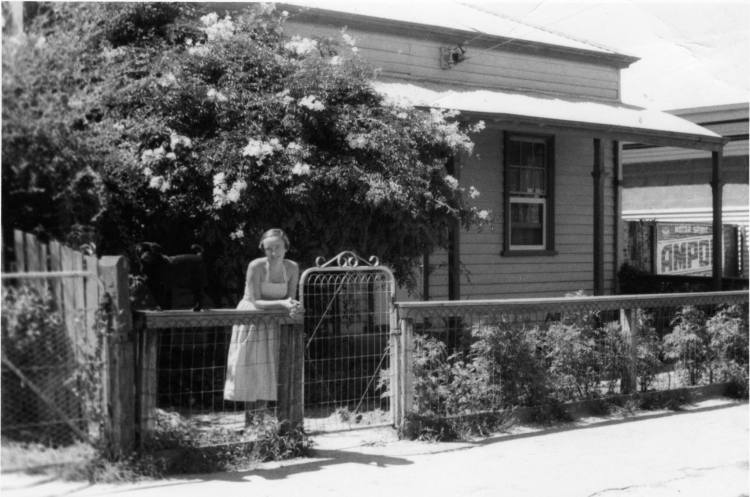
Photo: Newly married Joy Hodgson, wife of Athol, outside their home in Bruthen in 1953. Athol went on to forge a stellar career as a forester, firefighter, fire researcher, senior manager, FCV Commissioner, Chief Fire Officer and was awarded an Order of Australia. FCRPA: Collection
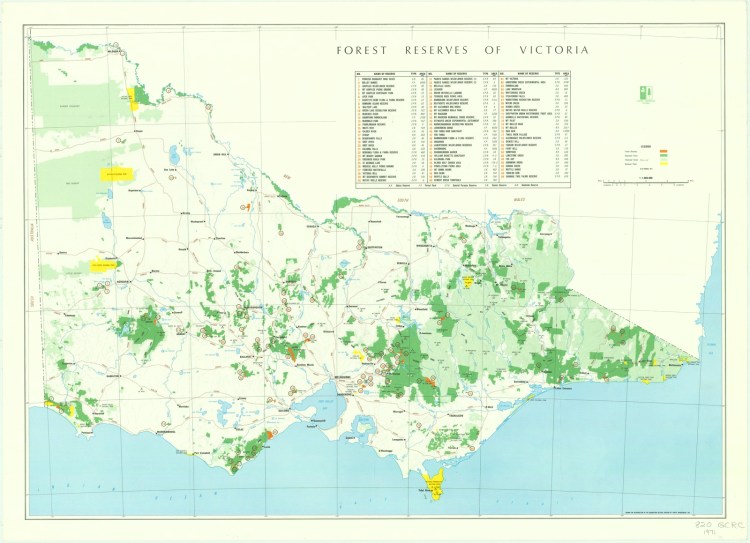
About one-third of Victoria, or about 7.1 million hectares, is publicly owned native forest.
The first area of State forest set aside for recreation was in 1912 at Centennial Park, which was then part of the Mt Arapiles Timber Reserve.
Recreational use of State forests expanded in the 1930s with greater access to private vehicles and forest roads.
The Mt Buller ski fields were developed by the Forests Commission from the early 1940s.
Under Section 50 of the Forest Act (1958), the Commission began setting aside more reserves, usually for recreation, or the conservation of natural features.
In 1958, the area covered by this provision was quite small being only 700 ha, with the exception of Mt Buller at 1710 ha.
But by the 1950s it became evident that community attitudes to forests and conservation were beginning to shift.
In 1958, the Commission added Lake Mountain and Mt Baw Baw reserves.
Over the next 10 years, the number of Section 50 reserves increased to 81 with an aggregate area of 17,300 ha. These included Sherbrooke, the You Yangs, Macedon Ranges, Grampians (Wonderland Range), Barmah and the Lerderderg Gorge.
In the early 1970s, the Commission, under the new Chairmanship of Dr. Frank Moulds, formed the Forest Environment and Recreation (FEAR) Branch to give greater focus to the multiple use of State forests.
FEAR Branch was an innovative idea and other state forest services around Australia soon followed.
Forest Rangers were also employed in the busier parks from this time.
Work by the Forests Commission started in October 1970, and by 1976 the Victorian segments of the Alpine Walking Track were completed.
By about 1973, the area set aside in forest reserves had grown to 56,000 ha.
In 1979, it was estimated that about 6 million day-visits were made to State forests and people spent about $36 million, mostly in rural economies. The most popular activity was pleasure driving with nearly 80% of the total, followed by picnicking and walking.
Visitation was increasing at about 10-15% per year putting a strain on roads, facilities and meagre district budgets.
Providing timber for housing and domestic use from the State’s native forests, together with expanding softwood plantations, to support Victoria’s rapidly expanding population had always been an important goal for the Forests Commission.
It had also been a very a clear directive from the State Government to meet Victoria’s timber needs and to expand the State’s rural prosperity.
While there was a local sawmilling industry from the 1850s, Victoria relied heavily on imported timber until about 1900.
There was also an imperative to restore some of the damage done to the State’s forests caused by the indiscriminate cutting during the gold rush, and the mad scramble for land settlement that followed in the late 1800s.
There were loud calls, particularly after shortages experienced during WW1, to increase timber production from the State’s native forests to reduce the dependence on imports.
The timber supply shock was no doubt a factor in the State Government creating the Forests Commission as an independent entity immediately after the war in 1918.
Experimental seasoning workshops and kilns had been established by the Department in 1911 to investigate the properties of local hardwood timbers and to develop a sawmilling industry.
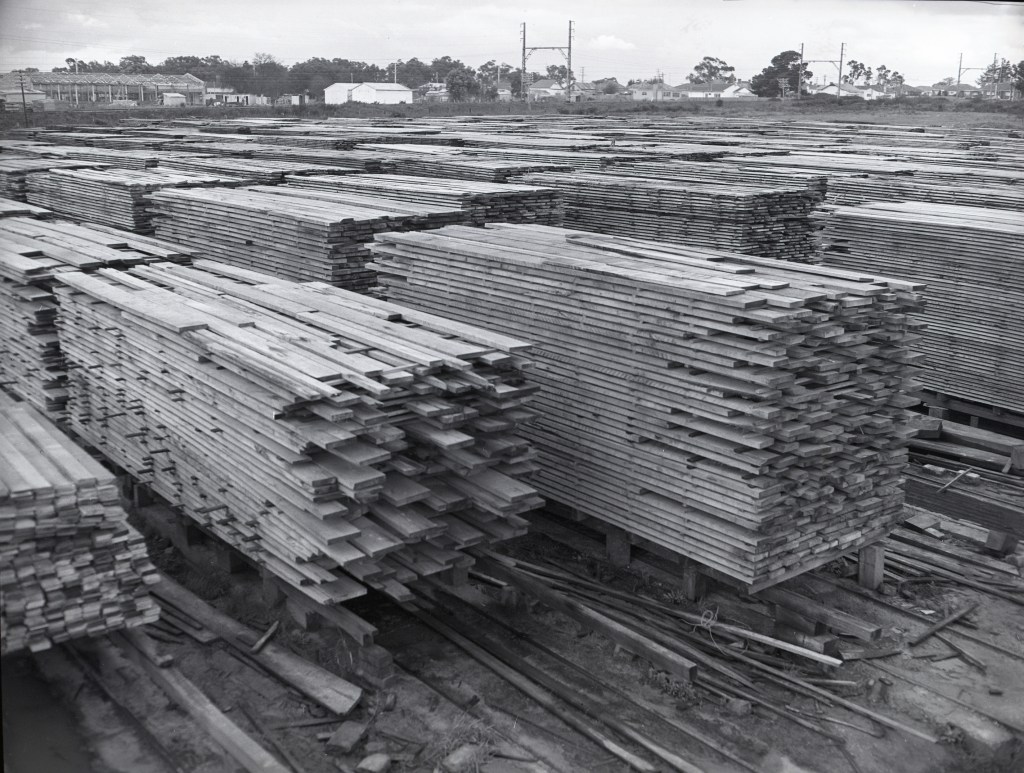
The State Seasoning Works at Newport demonstrated the potential uses of Victorian hardwoods and this pioneering work done in partnership with the CSIRO bore fruit. By 1931 it was estimated that 80% of the flooring laid down in Melbourne was kiln-dried mountain ash cut from the State’s forests.
The research work at Newport and by Dr Herbert Eric Dadswell and his colleagues at the CSIRO from 1929 until 1964 the expanded the understanding and uses of native timbers.
Experimental softwood plantations had been established at Frankston and Harcourt in 1909. The largest plot was some 2,500 acres at the McLeod Prison farm on French Island in 1917, but the major softwood expansion wasn’t until the early 1960s.
Victoria’s native forests continued to provide sawn timber, heavy construction timbers, railway sleepers, power and telephone poles, fencing materials, firewood and pulpwood for papermaking.
Timber for Homes.
The rate of house construction between 1920 and 1939 was relatively steady, except for the period of the Great Depression in the 1930s.
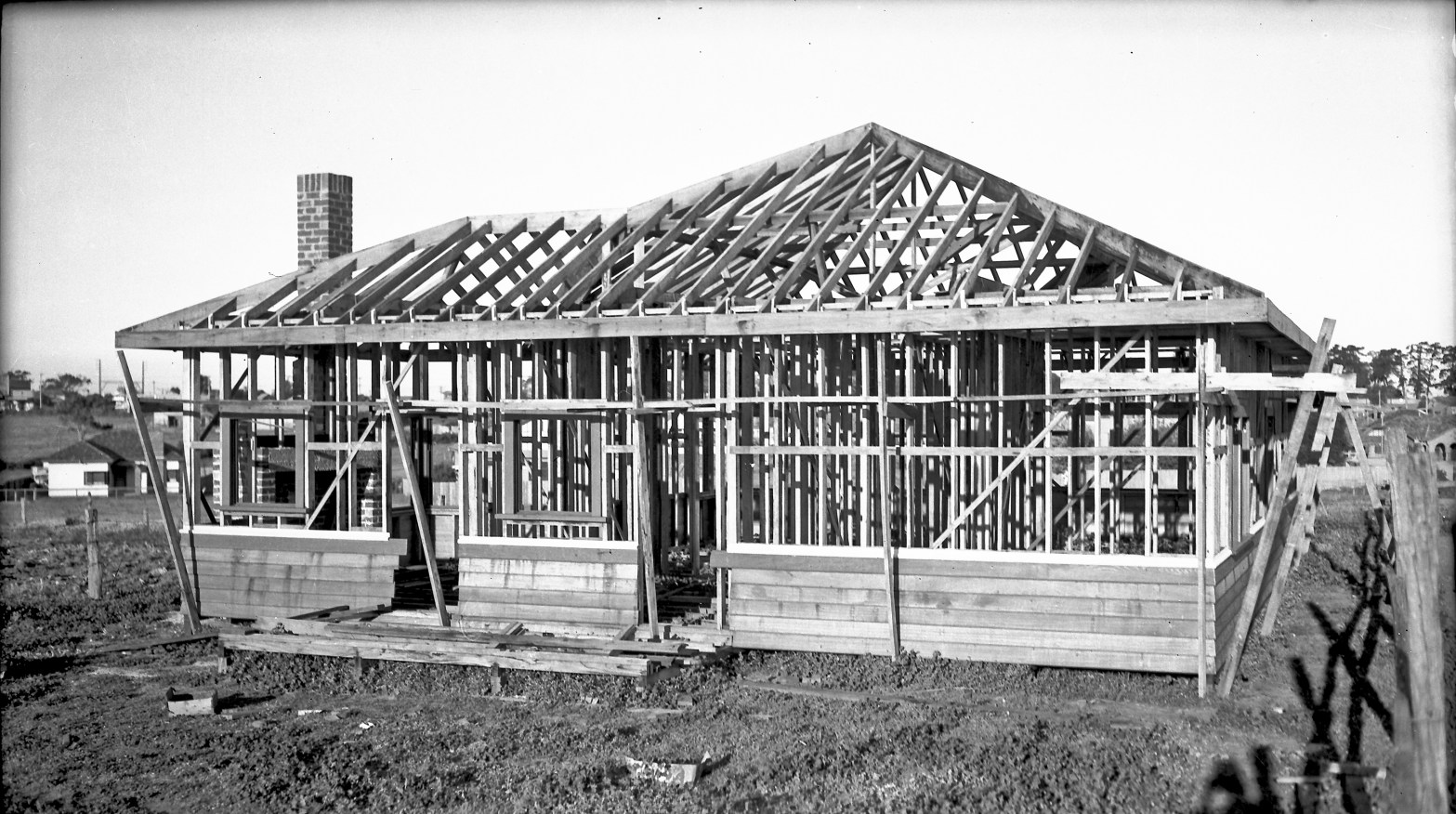
Green scantling timber was used for wall and roof framing and sub-flooring. Dried and dressed hardwoods, particularly messmate and mountain ash, were used for internal flooring, door and window frames and architraves.
Softwood weatherboards were imported from Baltic States for external cladding, while old-growth Oregon was imported from North America for large structural timbers. Asbestos cement sheet was also used widely.
With the outbreak of WW2, the Commission’s efforts were directed towards salvaging the mountain forests burnt across the Central Highlands in 1939 and supporting the war effort.
Sawn timber production for domestic housing increased rapidly in the five years after the war, and then more than doubled by 1955, in the post-war housing boom.
From the mid-1950s the volume of sawn timber remained relatively stable, even though the number of new houses constructed each year increased steadily by an average of about 900 per year, from 20,700 in 1956, to 38,100 in 1976.
The increasing demand for housing during this period was coupled with a trend towards larger homes.
But while local green hardwood timber remained the main material for wall and roof framing, concrete sub-flooring and brick-veneer exterior cladding became increasingly popular which reduced the demand on native forests.
By the mid-1960s, sawmilling was recognised as one of Victoria’s largest rural industries which provided wide opportunities for decentralised employment.
Techniques for cutting and seasoning eucalypt timbers were well established while builders, architects and homeowners had come to appreciate the strength, versatility and beauty of Australian wood.
The Victorian Timber Promotion Council (TPC) was created by an amendment to the Forests Act in 1969. The TPC was supported by the Commission and sawmilling industry with a levy on all sawlogs. It strongly promoted the uses of local hardwood and softwood timbers and produced the popular Timber Framing and Stress Grading Manuals to support builders and architects.
There was a trend in the 1970s for particleboard flooring with carpet or cork covering instead of kiln-dried local hardwoods.
Victoria’s softwood plantation estate (both private and Government) also expanded during this time, but local softwood timber supplies remained very limited until the late 1970s when harvesting from the significant areas of maturing plantations increased.
In the decade from 1974 to 1983, it is estimated an average of 39,500 houses per year were constructed using timber from Victoria’s State forests.
And while average house size was continued to increase the use of timber per unit of floor space decreased steadily over that period. For example, the average house size in Victoria in 1974 was 150 m2, but then increased to 170 m2 by 1983. Over the same period the volume of timber per square metre of floor space decreased from an average of 0.14 m3 in 1974, to 0.11 m3 in 1983.
Over the period that reliable figures were reported (1900 – 2022), the volume of sawlogs harvested from Victoria’s native forests was about 90 million cubic meters. Production spiked during the 1939 salvage and then peaked in the early 1950s but then steadily declined.
And from 1932 to 1992, which coincided with the separation of the Victorian Plantation Corporation (VPC), the production of softwoods from the state-owned plantations was a further 9.5 million cubic meters and was continuing to grow.
There is no doubt that the Forests Commission contributed significantly to Victoria’s economic prosperity for more than six decades by ensuring there was a renewable and sustainable supply of timber from the States native forests and softwood plantations to build millions of family homes across Melbourne and regional Victoria.
Sir Wilhelm Schlich noted in his 1922 summary of Forest Policy of the British Empire that while progress was being made Australia lacked many of the skills to undertake inventory needed to prepare proper working plans.
Responding to the shortage, the Chairman of the Forests Commission, A.V. Galbraith, made concerted efforts in 1926 and 1927 to recruit trained foresters from Norway (Bjarne Dahl, Bernhard Johannessen and Kristian Drangsholt) as well as from the United Kingdom (William Litster and Karl Ferguson from Scotland with Mathew Rowe from the Forest of Dean).
Kristian Drangsholt finished school in 1916 and then was employed in practical forestry in the southern part of Norway till the Spring of 1918. From 1921 he studied for three years at University towards a Master of Science as a Forest Engineer, this was followed by a Diploma Forest Engineering in Spring 1924.
He served six months in the Norwegian Kings Guard, followed by a year on a whaling expedition to the Antarctic. Norway is a country bordered by sea with a proud heritage of Vikings, ships and ship builders, and it seems that many young Norwegians went to sea at an early age.
On 5 February 1927, Kristian arrived with Bernhard Johannessen onboard the same ship into Australia. Bjarne Dahl arrived a year later in March 1928.
Together, the three Norwegians formed the nucleus of the FCV’s new Forest Assessment Branch to begin systematically mapping and measuring Victoria’s vast forest estate.
Despite Kristian’s formal forestry qualifications and mastery of English, his initial posting was at Bright and Creswick as chainman earning a measly 14s 6d per day.
But Kristian and Bernhard were soon appointed as Forest Assessors in November 1928 at a higher salary of five pounds ten shillings per week, plus 3d per day camping allowance and a horse allowance of 40 pounds per year.
Their first major assessment projects were in 1928 with Drangsholt taking the Rubicon Valley and Johannessen the adjoining Royston Valley.
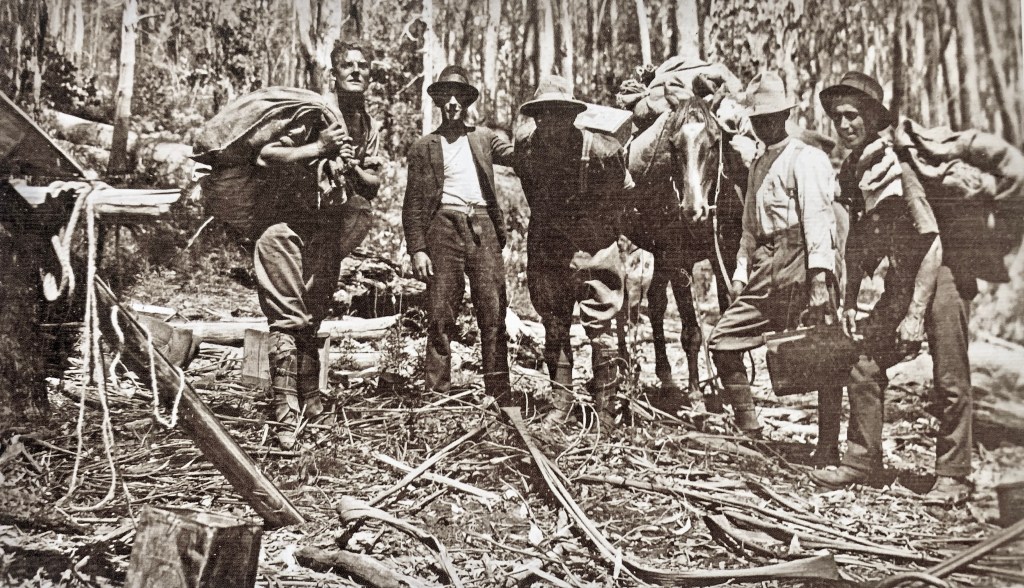
Both men employed a chainman and an axeman as assistants, and their camps consisted of bush or cattlemen’s huts (if there were any) or drafty tents.
Accidents were common in the harsh conditions and help was far away.
The assessment crews also lived off the land, hunting and fishing to supplement their meagre and repetitive rations.
The assessment teams conducted “base line surveys”, which were long transects of one-chain wide strips separated at five chain intervals. This equates to a 20% sample of the forest. Within each transect, plots were set out where trees were counted, measured and aged, and their condition and species noted.
The diameter and height of the standing trees was measured and an estimate made of the output of sawn timber.
Assessment crews often worked in trackless bush and produced some of Victoria’s first topographical maps of the State forest.
Maps were produced using survey tapes, Gunter’s Chain and prismatic compass. Steep slopes were surveyed using an Abney level and elevations at fifty feet intervals were taken with an Aneroid barometer.
Twenty thousand acres were surveyed and mapped in the Rubicon valley using this laborious manual technique. It had to wait until 1944 before the first aerial photographs taken by the RAAF became available.
After Rubicon, Kristian assessed forests at Powelltown, Mount Horsfall, Castlemaine, Maldon, Lal Lal, Brisbane Ranges, Brittania Creek, West Tanjil, Upper Thomson, Mount Donna Buang, Daylesford, Blakeville, Cobaw, Moondarra, Orbost, Nowa Nowa, Waygara, Tyldesley, and Tostaree.
Bjarne Dahl moved into Head Office in about 1930 and by the 1940s was appointed Chief Forest Assessor for the FCV. In early 1945, he established an Assessment School at Kalatha Creek near Toolangi. The school later moved to Kinglake West in 1947 to the site of the POW camp established during the war. Dahl eventually left the FCV in 1948 to establish plantations in Gippsland for APM forests Pty Ltd.
Bernhard Johannessen took a job with the Dutch Forest Service in Java in 1930 and was never seen again after the war.
With increasing the availability of rugged 4WD vehicles during the 1950s, which could operate on a rapidly expanding forest road network, assessment work progressively became more mobile. Portable radios like the RC-16B also became available after the war.
During the colder winter months, the assessors returned to Head Office to prepare maps and write up reports.
Like his fellow Norwegians, Kristian Drangsholt would have seen more of Victoria’s forests than most ever did. He was a man of exceptional strength and sense of purpose and preferred the bush to the office.
Kristian was undoubtedly one of the Forests Commission’s “larger-than-life” characters who spent most of his career in the bush as a forest assessor, but in 1957 he built a family home in the Dandenong Ranges and worked as a forester based at Kallista. He retired in 1964 and died in 1968.
Kristian’s fascinating story, “Man of the Forest”, was written by his son, David, in 2014.
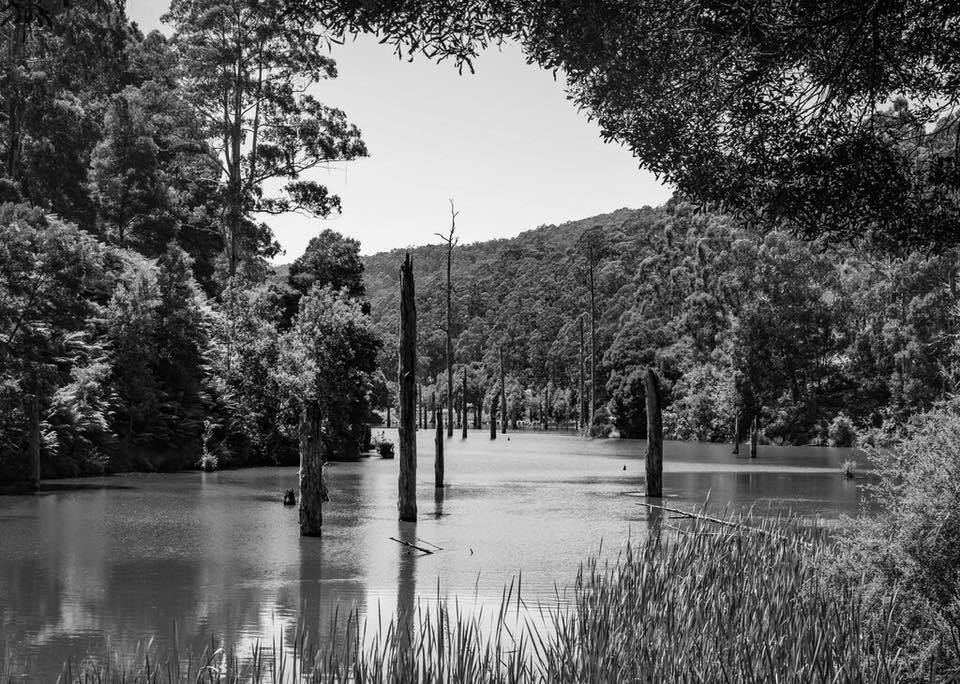
Lake Elizabeth stretches languidly for about a kilometre along the heavily forested valley of the East Barwon River, about seven kilometres east of the township of Forrest in the Otway Ranges.
It’s a popular attraction for campers, walkers, and canoeists, not least because you can spot platypus in the early morning and at twilight…. if you’re quiet and lucky.
Forrest was a thriving timber town from the early days of settlement, but especially after 1945 when timber was desperately needed to feed Melbourne’s post-war construction boom.
For some years the Forester-in-Charge of the District was Bill Meadows.
During a prolonged deluge on a long weekend in June 1952 Bill and his assistant Mark Stump were “playing endless games of monopoly”. Records show that on 17 and 18 June, the total rainfall at Tanybryn near the top of the Otway Ranges was 40 inches, which is over one metre of rain, more than enough to float Noah’s Ark.
Forest Overseer Jack Hoult was told by an East Barwon farmer that while the West Barwon was a raging flood, the East Barwon was just a trickle.
Something was up… so they drove the Land Rover cautiously up the Kaanglang Road, which had recently been completely rebuilt, to discover that the mountainside along with their new road had disappeared in a gigantic landslip, leaving the steeply pitching bedrock glistening in the light rain.
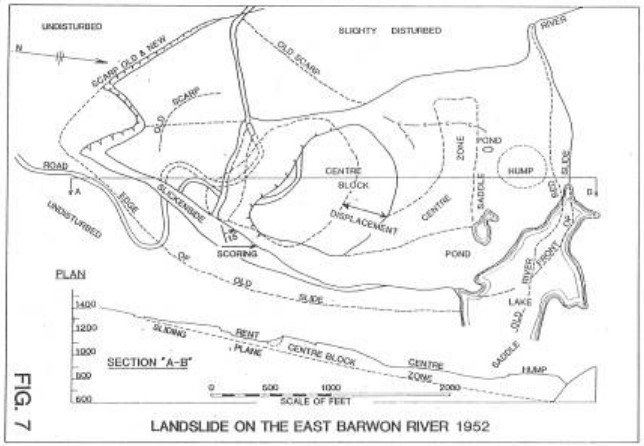
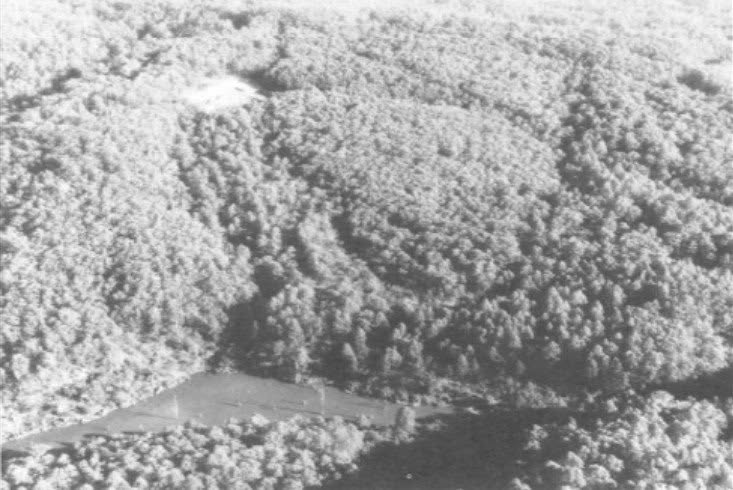
A huge 48-hectare slab of sandstone with approximately 6 million cubic metres of soggy earth had slid into the East Barwon River below damming its flow. The water in due course over-topped the loose earth wall causing more flooding downstream.
Being the man in charge, Bill took numerous calls from Melbourne newspapers who asked what the new lake was called. The headline news in 1952 was the ascension to the throne of new Queen Elizabeth, so Bill patriotically replied: “Lake Elizabeth” and the name stuck, although some of the locals grumbled because they wanted it called Lake Thompson after a local farmer.
Twelve months later on 5 August 1953 and following more heavy rains the top 26 metres of the dam breached, and another surge of water carried tonnes of gravel and boulders several kilometres downstream.
The residual lake now contains about one fifth of its original volume.
Lake Elizabeth is a site of National geomorphological significance. Another well-known example of a perched lake is Tali Karng in the Alpine National Park north of Heyfield which was formed some 1500 years ago.
The profile of the massive slip. Source: Rosengren 1984.
A giant 48 ha slab of sandstone, soggy mud and wet forest slid into the East Barwon River in mid-June 1952 after 1000 mm of rain fell in just two days. Source: Corangamite CMA.
The Forestry Heritage Museum at Beechworth, which was opened with much flourish and fanfare by John Haber Phillips AC, Chief Justice of Victoria, during the Beechworth 150th celebrations on 27 July 2003, closes forever today.
A merry band of volunteers from the Forests Commission Retired Personnel Association (FCRPA) will brave the chilly conditions this week to move everything out, and hand the keys back to the Shire.
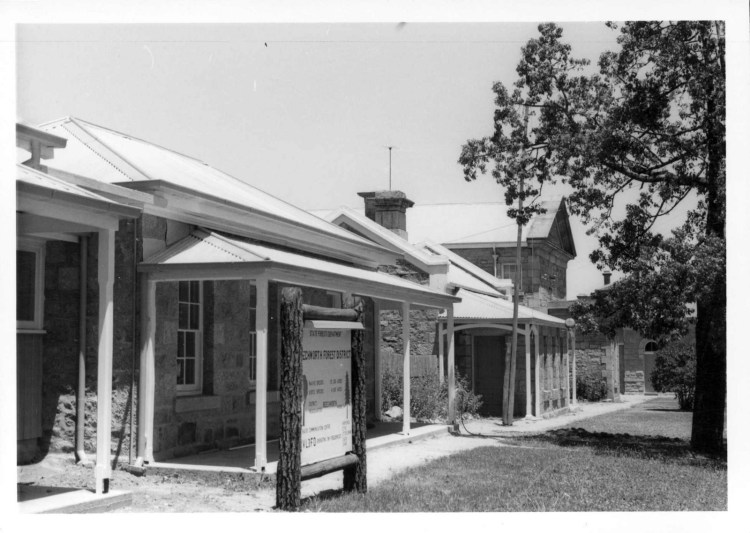
The museum is currently in the old Gold Warden’s Office, which is one of Beechworth’s original buildings. This building, plus the Chinese Protector’s office next door, were occupied by the Forests Commission in 1920 and continually functioned as a District Office until about 1985.
We don’t have any visitor statistics but, anecdotally, there was a steady stream of foot traffic into the museum making a beeline from where the tourist buses stop and grey nomads park their ginormous Winnebagos towards the iconic Beechworth Bakery for a sticky bun and frothy mugachino.
The museum has always been free entry, but the donation box accumulated enough shekels each month to help keep the lights on and pay the bills like insurance.
Indigo Shire are the custodians of the buildings and in 2021 engaged Melbourne consultants to review the historic precinct around the town. Despite being long-term tenants in the museum building, the FCRPA were not advised or engaged in the process, and a report was lodged before the Council which proposed.
“The Chinese Protector’s Office and the Gold Warden’s Office will be changing exhibition spaces, for artistic activation, interpreting and exploring themes relevant to the Gold Story.”
The retired foresters maintained that the consultants had failed to recognise that forestry has been part of the fabric of Beechworth since the gold-mining era. Many plantations were planted to stabilise the diggings.
Timber was also essential for the development of the mining villages as well as the surrounding farmhouses, for underground mining, for industrial and domestic heating.
Forester H.D. Ingle was stationed in Beechworth in about 1891 and he was followed by M. Griffin in 1905. It was pointed out that the museum building had a longer association with local forestry, land management and bushfires than it ever did with gold.
But the Council made it clear to the retired foresters that their new grand design didn’t include a forestry museum.
To be fair, the Shire has been supportive over the decades opening and closing the building every day and keeping an eye on things.
But more importantly, the membership of the Association is aging and thinning with no new recruitment because our constitution requires members to have been employed by the FCV, which folded in 1984.
And small country museums everywhere are struggling to stay open.
The writing was on the wall…. there was no immediate pressure, but we chose to move out, rather than be booted out.
We also decided a while back to get-with-the-times and digitally photograph our material and make it all freely available online with Victorian Collections. Interestingly, the most popular item at Beechworth has been the Gunter’s Chain.
Some additional items will be photographed this week by Wodonga camera wizard, Mark Jesser.
The best of the artefacts from Beechworth will be merged with DEECA’s Altona collection, which is available to visit by appointment. Surplus and duplicate items are being donated to museums at Heyfield and Mansfield.
Hopefully very little ends up in the skip (but how many hard hats do you really need to keep).
Facing the reality, the retired foresters are also in the process of winding up our affairs to remain as a social club, but still with a significant online presence, until the lights get switched off.
A sad day for sure, but thanks to all those who have shown interest and support for the Beechworth forestry museum.
Judge Stretton clearly identified the inseparable trinity of forests, soil and water.
The “Save the Forests” campaign was founded in January 1944 and rose from the ashes of the 1939 Black Friday bushfires.
It was broad-based and included representatives from over 50 government and philanthropic organisations, and boasted over 100,000 members.
The Forests Commission played a key role in the campaign which had noble goals of improving forests, protecting them from bushfire and growing trees to restore farmland.
Its activities included operating native plant nurseries, community tree planting, programs for schools, seed collection, farm inspections and advice as well as organising a number of high-profile events including “Forest Week” at the Melbourne Town Hall.
By 1951, the campaign became the Natural Resources Conservation League (NRCL).
The Forests Commission Retired Personnel Association (FCRPA) have been entrusted with a couple of very generous donations over the last few months.
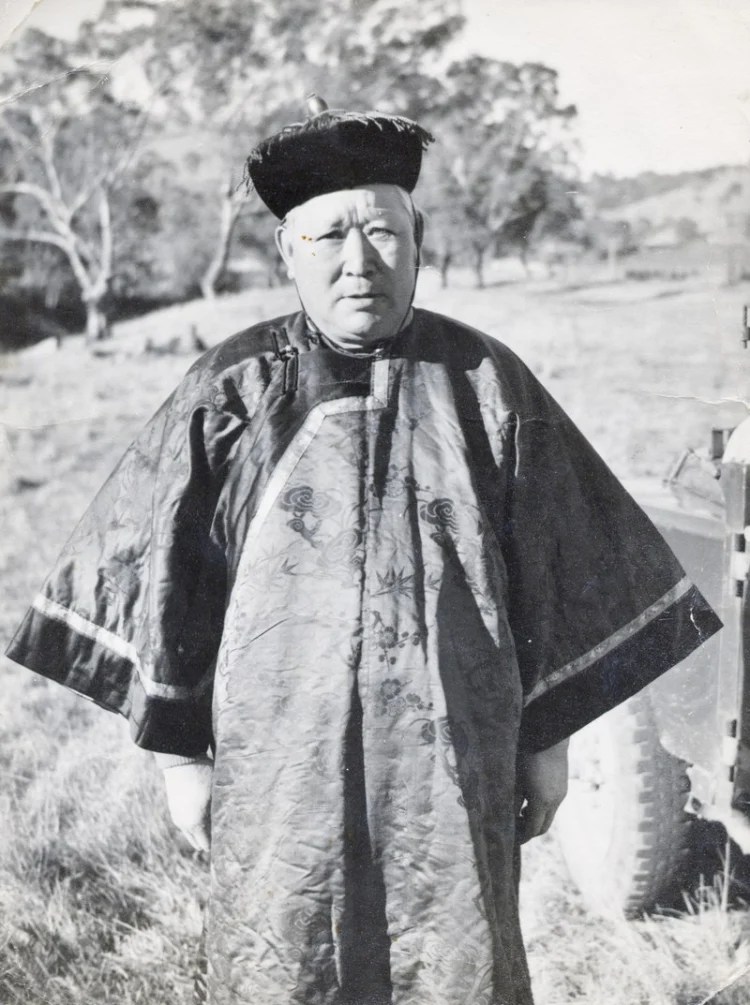
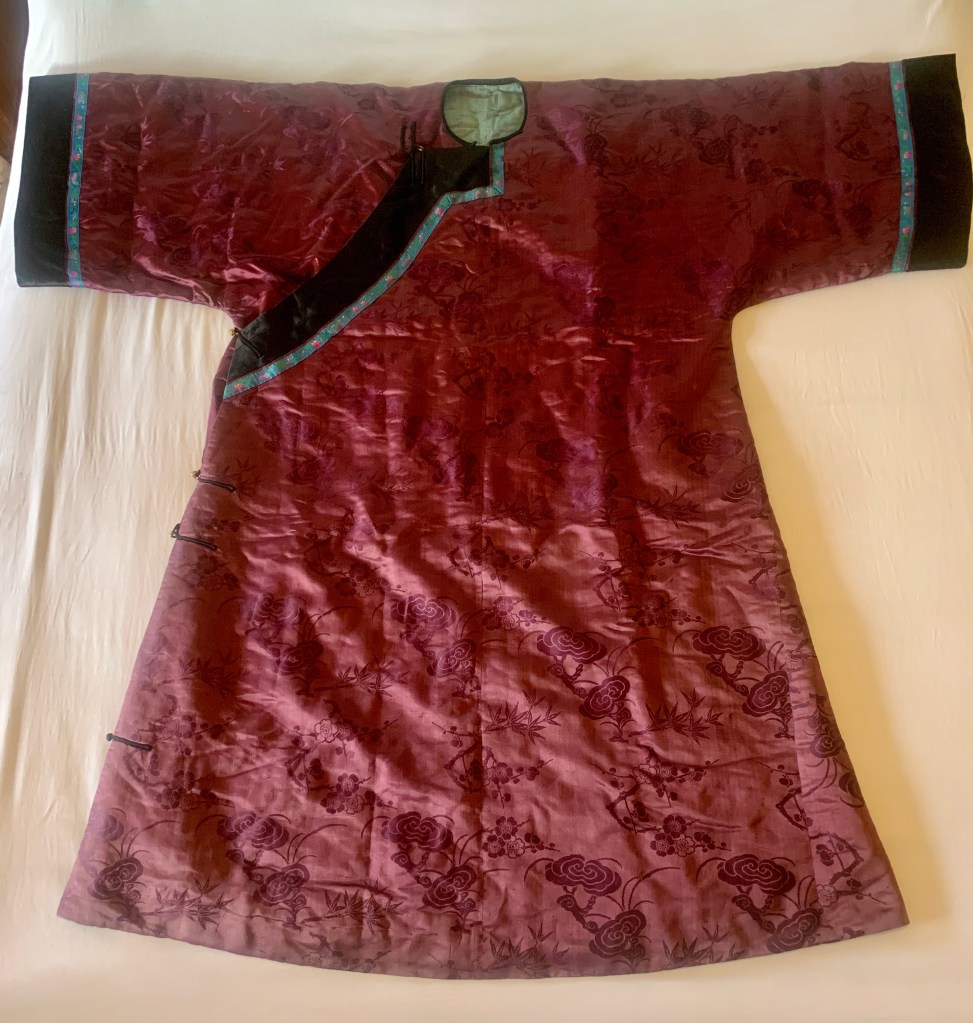
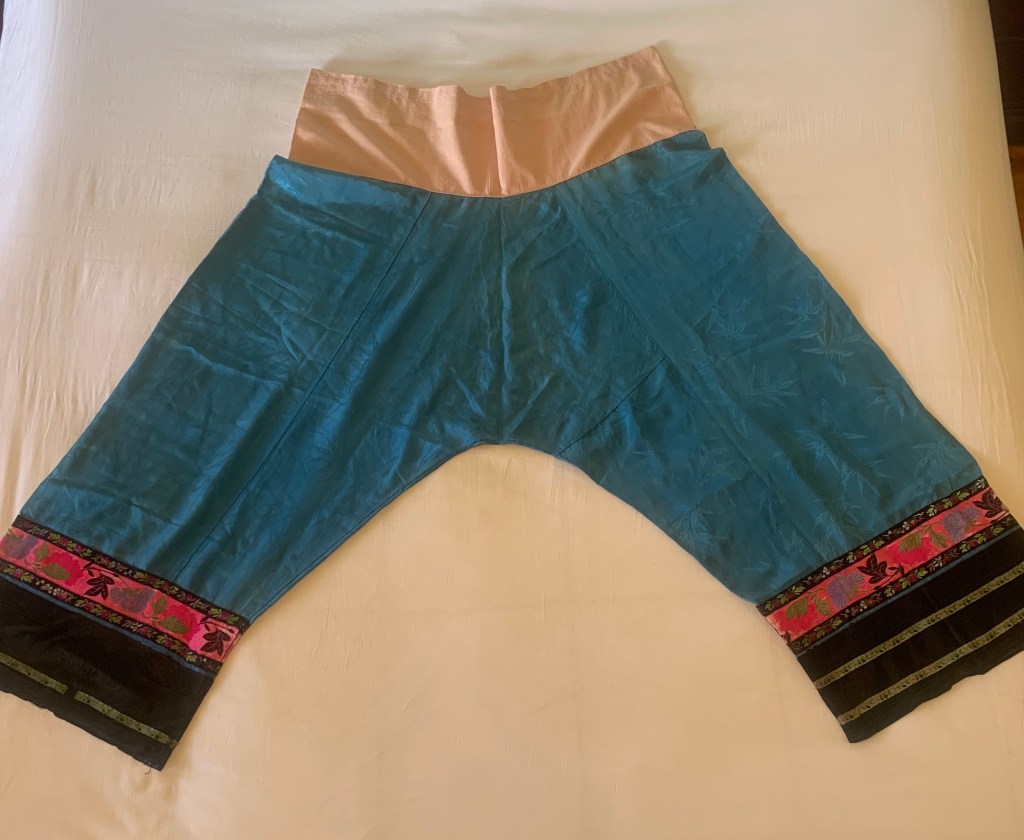
These are the Chinese robes that belonged to Forests Commission fireguard and builder of Moscow Villa – Bill ah Chow.
Every organisation has a handful of colourful characters, and the Commission had its share, but Bill remains one of its enduring legends.
After Bill’s death in 1967, the robes were safely kept by Bill’s daughter, Rose, until she died in 1993. The robes then passed to Bill’s granddaughter, Janice, and were also highly prized. Janice wrote a book about Bill and Moscow Villa in 2019.
I have written several times about Bill on Facebook, Wikipedia and my forest history blog. I’m also often asked to give evening talks about Bill (there are a couple coming up).
I became friendly with the ah Chow family when I started to write forest history stories. Much of my information came from Janice and from retired foresters that were personal friends with Bill, including Athol Hodgson.
After much deliberation, the family felt the retired foresters were better positioned to keep Bill’s story alive and we are deeply honoured by the gesture.
Bill loved to tell embellished campfire stories and often claimed to be a descendant of Chinese Royalty, but his family believes the robes were more likely picked up from a second-hand shop in Little Bourke Street in the 1940s.
In 2018 I wrote to the Chinese Museum in Melbourne and they gave this advice.
Mr. Ah Chow is dressed in a way that imitates a Mandarin or official of the Qing Dynasty. His hat looks like a mandarin style hat, a Qing dynasty official’s headwear, although it’s quite unlikely that he was actually a Mandarin. The button atop the hat usually indicated the wearer’s rank. His robe fastens up to the neck with buttons, which is typical of Manchurian style men’s clothing of the Qing dynasty also. He is not wearing a rank badge, which denoted official status. This kind of garment was also normally worn with a separate collar, which Mr. Ah Chow is not wearing in any of these pictures.
The foresters association aim to get the items professionally photographed and added into the Victorian Collections database.
We will also seek some professional advice about how to properly store and protect these amazing and priceless items of clothing. DEECA’s Altona museum is not an ideal spot to keep them because its not air-conditioned.
Thomas William Ah Chow – Chinese costume (photo circa 1950).Bill who often claimed to be a descendant of Chinese Royalty, but his family believes it was more likely he picked his robes up from a second-hand shop in Little Bourke Street. Photo: Ah Chow family.
The Forests Commission Retired Personnel Association (FCRPA) have received a couple of very generous donations over the last few months.
One is the brass identification plate from the Washington Winch.
The winch sits deep in the forest east of Swifts Creek and is the last one of its particular type left in Australia.
It was made by the Washington Iron Works company in Seattle.
This unique winch was one of two machines imported in 1920 to operate in the Karri forests of WA.
Both machines were later purchased by the Forests Commission after the 1939 bushfires for salvage logging at Toorongo to drive elaborate “high lead” cable systems.
This particular machine was later sold to Jack Ezard from Swifts Creek in 1959 where it operated on its current site until about 1961. The fate of the second machine is unknown. It was possibly cannibalised for parts.
The Ezards were innovative sawmillers who introduced high lead logging into Victoria. They had owned and operated sawmills in the Warburton area from 1907, before shifting to Erica in Gippsland in 1932.
Bulldozers and powerful logging trucks eventually made steam and the Washington Winch redundant.
The plate was recovered from underneath the Washington Winch in about 1980. Permission was sought at the time from Ezards sawmills.
The heavy 21 cm diameter plaque with the markings 11 x 14 refers to the double drums and the serial number is assumed to be 3832.
It will be displayed at DEECA’s Altona Museum.
The winch is listed on the State Heritage Register.
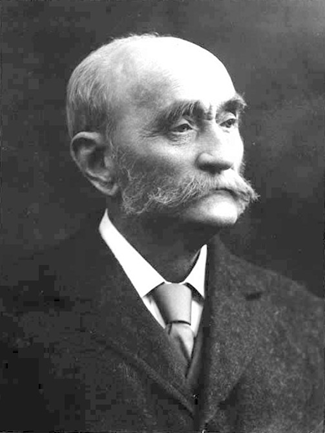
Wilhelm Schlich was from the Prussian school of forest management in the 1890s. He worked extensively in India for the British and later became a professor at Cooper’s Hill forestry school near Surrey in England, where he influenced generations of foresters across the British colonies.
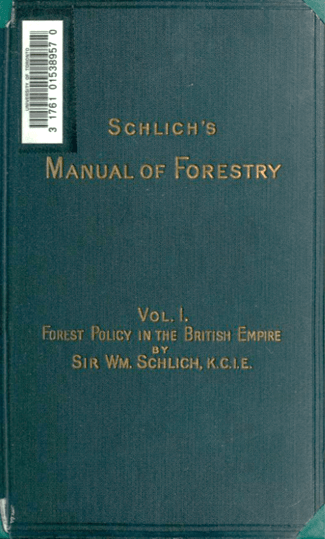
He advocated the use of working plans in his five-volume “Manual of Forestry” which were written between 1889 and 1896. The first two volumes covered silviculture while the others dealt with forest management, forest protection, and forest utilisation. They became standard and enduring texts for all forestry students.
The idea of working plans spread throughout the British Empire and were recommend by Ribbentrop in his report to the Victorian State Government in 1895. This was echoed in the Royal Commission and the then stipulated Forests Act (1918), which created the Forests Commission.
The founding Chairman of the Forests Commission, Owen Jones, had trained under Schlich in Germany and had also prepared a working plan. This no doubt this influenced the decision by State Cabinet to recruit him from England.
There was no set formula, but working plans covered a range of things including timber harvesting, silvicultural thinning and pruning of younger native forests, establishment of exotic softwood plantations, construction of tramways, roads and bridges to enable licensed sawmillers to access timber stands, the maintenance of fire breaks and the operation of patrols to control illegal timber cutting and prevent fires.
The Commission pursued the idea of mapping, assessment and working plans with some vigour but lacked the skills and resources to fully implement them.
Schlich pointed out in his summary of British Empire Forest Policy in 1922, that Australia lacked many of the skills to undertake inventory needed to prepare proper working plans.
This shortage was one of the main reasons why the new FCV Chairman, A.V. Galbraith, recruited trained foresters from Norway (Bjarne Dahl, Bernhard Johannessen and Kristian Drangsholt) as well as from the United Kingdom (William Litster and Karl Ferguson from Scotland with Mathew Rowe from the Forest of Dean) in the 1920s.
To cope with the growing workload the Commission also restructured in 1926, dividing the State into five Divisions each with a Chief Inspector and four inspectors, and a total of 51 Districts.
A Forest Engineering Branch was also added in 1926 in the Head Office to deal with an expanding works program.
The Commission always saw itself as the champion of forest reservation and conservation and constantly advocated for an increase in permanent reserves.
It also had a very clear intent to move forests management from the chaotic “cut and run” approach of the 1800s to a more orderly and sustainable one.
BTW – The Forest Management Planning process which began under the Timber Industry Strategy (TIS) in the late 1980s fell under Section 20(a) of the Forest Act (1958) which required the Department to produce working plans.
Handwritten working plan for the Woohlpooer State Forest prepared by R S Code, Inspector of Forests, in the late 1930s.
There are some important parallels between the efforts of early foresters in North America to protect and conserve their forests from exploitation and clearing, and the experiences here in Victoria. There are also some striking differences.
The US Forest Service began in 1905 around the same time as the Victorian State Forest Department and the relationships have always been strong. Policies were also forged by catastrophic bushfires… theirs in 1910 and ours in 1939.
The organisations also held similar views about the protection and wise use of forests.
America’s first professional forester, Gifford Pinchot, came from a wealthy and politically well-connected timber family.
He was largely responsible for the national awakening of land management and conservation. Importantly, he enjoyed the strong support of the US President Theodore Roosevelt who set aside vast tracts of national forest.
Pinchot said –
“conservation is the foresighted utilisation, preservation and/or renewal of forest, waters, lands and minerals”.
And…
“where conflicting interests must be reconciled, the question shall always be answered from the standpoint of the greatest good of the greatest number for the longest time”.
Pinchot thought of the greatest good in terms of the balance of multiple uses, including land, wilderness, forage, wildlife, timber, water and outdoor recreation.
Pinchot’s views were similar, but differed, from another great American forest conservationist, John Muir. His activism helped to preserve the Yosemite Valley and Sequoia National Park. Muir also co-founded The Sierra Club.
Pinchot saw conservation as a means of managing the nation’s natural resources for long-term sustainable commercial use without destroying the viability of the forests.
Muir acknowledged the need for timber and the forests to provide it, but valued nature and wilderness for its intrinsic and spiritual qualities.
From the mid-1960s, with increasing public criticism, environmental activism and legal challenges to traditional uses such as timber production, the US Forest Service found it more difficult to determine the greatest good.
Meanwhile is Australia, the same principles of balance and multiple use, which had been originally described in Wilhelm Schlich’s “Manual of Forestry” in 1898, were strongly advocated as the core policies of the Forests Commission.
This 2006 documentary was made to celebrate the centenary of US Forest Service. A similar film was suggested a while ago to tell the story of Victoria’s forest heritage but stumbled at the barrier.
This painting of Gifford Pinchot first appeared in The Saturday Evening Post in 1955 and now hangs in the U.S. Forest Service national headquarters in Washington, D.C.
Andraes Stihl was a Swiss-born engineer and is often said to be the “father of chainsaws”.
After serving during WW1, he studied mechanical engineering in Eisenach and later founded the Andreas Stihl Company.
Then in 1926, Stihl patented the “Cutoff Chainsaw for Electric Power” which was the world’s first electric chainsaw. But it weighed a hefty 64 kilograms with its one-inch gauge chain and handles at either end. Due to its bulk, it required two people to operate.
In 1928, Stihl’s former business partner, Emil Lerp, built and patented the first petrol chainsaw, known as the Dolmar.
A year later, in 1929, Andreas introduced his own petrol version, a two-man saw called the “Baumfällmaschine Type A”. Producing 6 horsepower and weighing 46 kilograms, the saw was marketed as a “portable tree-felling machine”.
The Sthil company continued to revolutionise and grow and, in 1931, became the first European company to export chainsaws to both the United States and the Soviet Union.
Following the Second World War, lighter materials, metal alloys and improved engine designs revolutionised chainsaws together with the logging and timber industry. The first one-man chainsaw was produced in 1950 but was still heavy.
The Stihl Contra was launched in 1959 and set the design standard for modern chainsaws. The gearless one-man chainsaw produced 6Hp and weighed only 12 kg. It also featured a diaphragm carburettor capable of working in any position which offered flexibility without having to manually change settings.
Many other companies now manufacture chainsaws, but Stihl remains one of the world’s biggest.
The man, the myth, the legend, Andraes Stihl with the STIHL Contra. The gearless one-man chainsaw was a milestone. The 6Hp Contra weighed 12 kg and set the design standard for nearly all modern chainsaws. It was launched in 1959 and revolutionised forestry.
The cabbage-tree palm (Livistona australis) grows along the remote Cabbage Tree Creek, 30 kilometres east of Orbost. The palm is regularly found in NSW and Queensland, but only at this isolated spot in Victoria.
Famous explorer, A. W. Howitt wrote that heart of the Cabbage-tree was eaten by the Gunai/Kurnai people. Leaves were used for shelter and fibres for string, rope and fishing lines.
Early settlers also ate the Cabbage-tree palm and used the fronds as roofing and for brooms.
A cottage industry developed weaving the fronds into cabbage-tree hats.
Bundles of the palm leaves were gathered and carried home to be boiled, dried and finally bleached. Women and children spent their spare time plaiting hats for the family.
Orders were soon received from all over the country. A well-made cabbage-tree hat could fetch as much as twenty pounds. They proved very popular with Australian bushmen, gentleman squatters and young sportsmen.
Source: A Thornton, Walkabout Magazine. (1 July 1945). Vol. 11 No. 9. Page 16.
Cabbage tree palm (Livistona australis) in Curtis’s Botanical Magazine, Vol 103, no 6274 (1877).
Cabbage Palm Hat. c 1860. This particular hat was worn by Marcus Clarke, journalist and novelist, after his arrival in Melbourne in 1863. Source: SLV http://handle.slv.vic.gov.au/10381/209287
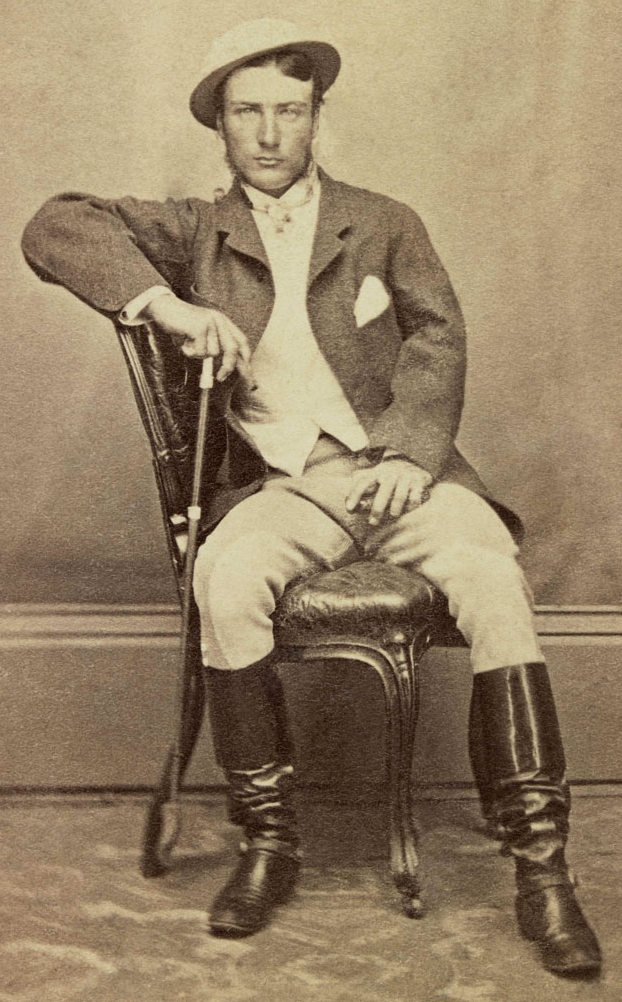
Australian writer Marcus Clarke wearing a cabbage tree hat, 1866. Source: Wikipedia.
The magnificent River Red Gum (Eucalyptus camaldulensis) has the widest natural distribution of any of the Australian eucalypts.
Specimens have also been planted across the globe, including Sicily where I have just returned from.
It seems that River Red Gum was widely planted by Italian authorities after the war for timber and to stabilise soils, and some locals now consider them an invasive weed.
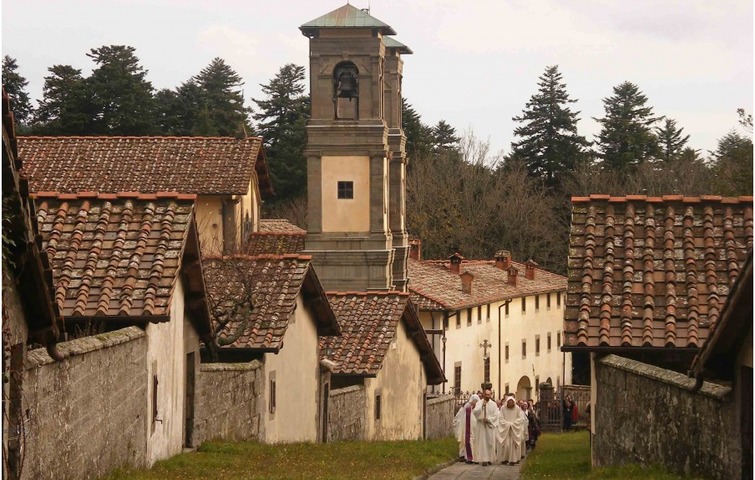
But more interestingly, its botanical name can be traced back to an ancient religious hermitage in the mountains near Naples which was constructed in 1585 by the Camaldolese congregation of Monte Corona.
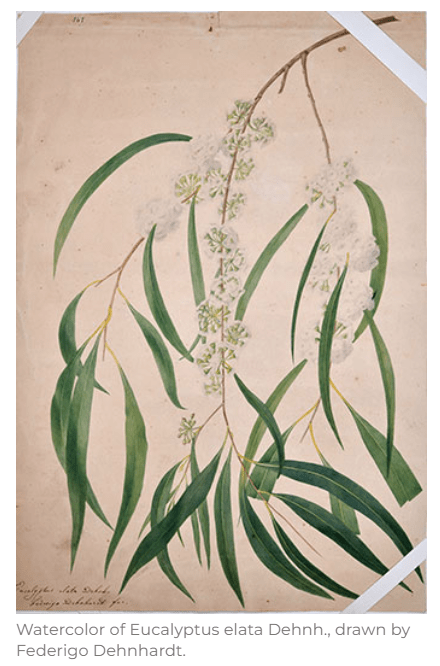
In 1816, the distinguished Italian gardener, and Director of the botanical garden of Naples, Federigo Dehnhardt, was engaged to develop a private garden for a local nobleman, Count Francesco Ricciardi Camaldoli. The Count had been gifted some of the original lands of the Camaldoli Hermitage by the new Bourbon Government.
The garden was known as L’Hortus Camaldulensis di Napoli.
Dehnhardt propagated some River Red Gums in 1818 with seed that had been collected and sent over by Allan Cunningham, the famous NSW government botanist.
The trees grew so well that Dehnhardt described and named the species, Eucalyptus camaldulensis after the hermitage where the trees had been planted. His description appeared in the 1832 edition of a catalogue which recorded the names of all the species growing in the gardens, but his book was largely unknown to the botanical community. His specimens are housed in the Natural History Museum in Vienna.
Dehnhardt’s work was overlooked, and the River Red Gum was initially named Eucalyptus rostrata by the NSW botanist, Diederich von Schlecterindahl in 1847.
But Schlercterindahl’s name was declared invalid because it had already been given to the Swamp Mahogany in 1797 by a Spanish botanist.
In 1853, the Victorian government botanist, Ferdinand Von Mueller renamed the River Red Gum Eucalyptus longirostratis ( after the ancient Greek word for the long point, or beak on the cap that covers the developing flower)
But finally in 1934, notable Australian botanist William Blakely recognised Denhardt’s original work and the name Eucalyptus camaldulensis for River Red Gum was accepted.
In 1922, the River Red Gums planted by Frederick Dehnhardt were sadly cut down and the Camaldoli gardens were abandoned. The garden is now completely incorporated into urban expansion near Naples.
With the generous support of the Dahl Trust I have been busy over the last few months writing a new eBook titled “The Working Forests”.
The project about Victoria’s rich forest and bushfire heritage is due to be finished by the end of the year.
I had to break it up into two volumes because of problems with MS Word and instability of big files.
Attached is a link to a draft of Volume 1.
It contains about 200 short stories spread over nearly 600 pages with lots of pictures, maps and white space. It takes up about 140 MB in size.
Volume 1 roughly covers the chaotic period from colonisation in 1803, the 1850s gold rush, the trashing of the forests leading to the Royal Commission in 1897, the formation of a State Forests Department in 1907, through to the 1939 bushfires and the war years in the 1940s.
It also includes a big section on tall and remarkable trees which hopefully dispels some of the myths.
Volume 2 is in advanced draft and is about the same size.
It will start with the post war reconstruction and A. V. Galbraith’s “Grand Design”.
Building an effective fire fighting agency and major bushfires will be in there
Post war forestry and staff training to build a professional organisation.
Plantations, reforestation and silviculture.
It will tackle the rise of environmental activism in the 1970s.
Formation of CFL and the Timber Industry Strategy was a major turning point.
Changing community and political attitudes leading to the demise of the timber industry in 2024 will be tricky to write (but I have a few insiders to help).
The wide range of uses and values of State forest will also be covered.
And the great outdoors.
I have a long list of notable people too
I’m interested in your thoughts –
Is anything missing ?
Are there any major errors or bloopers ?
Does it look and feel right ?
It doesn’t have a comprehensive index because in electronic format it’s easy to skim, search and scroll. Is this a problem?
I have cited my main references and used lots of links but have stuck to my normal conversational (e.g. non-public service speak) style of writing. There will be a list of “further reading” at the end
It also hasn’t been proofread so please don’t focus on typos and wordsmithing at this stage.
I have linked to the main stories on the FCRPA website and tried to minimise duplication. The long term stability of these links is a concern.
It will be far too expensive to print. It was always planned to be a free eBook that could be safely stored in the national library to be downloaded and shared online.
I’m going off-line for a month and won’t be back till early June. I’m happy to take comments by email, but I might not be too quick in responding.
theworkingforests@gmail.com
Thanks once again for your support and encouragement.
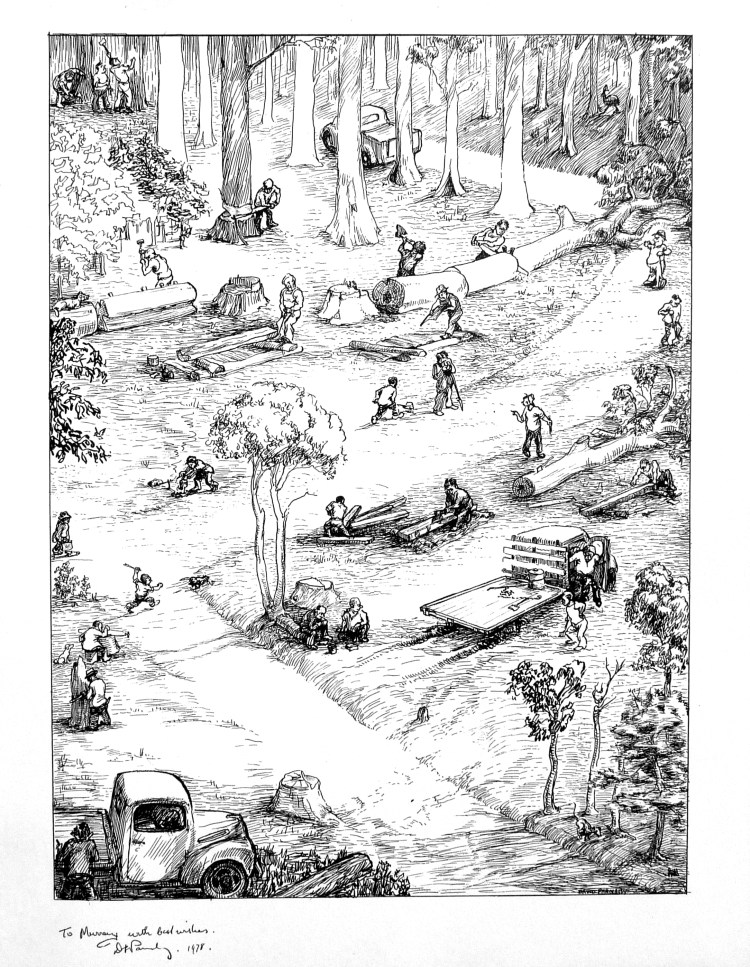
Cover: The Sleeper Cutters – Cann River. David Parnaby graduated from the Victorian School of Forestry in 1940 and initially worked in Assessment Branch. He later had District postings at Heathcote, Powelltown, Dandenong Ranges, Bruthen and Beechworth. Promoted to District Forester in 1951, David was moved to Cann River, then Heathcote (1955), Castlemaine (1958) and Daylesford (1971). Following a period with Forest Protection in Melbourne he retired in 1980. David was an accomplished cartoonist who provided insightful and humorous commentary through the Victorian State Forester’s Association Newsletter. His keen eye for the antics of sleeper cutters at Cann River in the 1950s remains a classic. The more you look at this, the more you will see. This copy was a gift to the FCV’s Chief Forest Assessor, Murray Paine, in 1978 and is now with Gregor Wallace.
Driven by a deep philanthropic desire to provide employment for some of the more seriously maimed returned soldiers, several prominent Melbourne citizens, together with the support of Department of Repatriation, established the Tobacco Pipe Manufacturing company in Leicester Street Carlton in 1918.
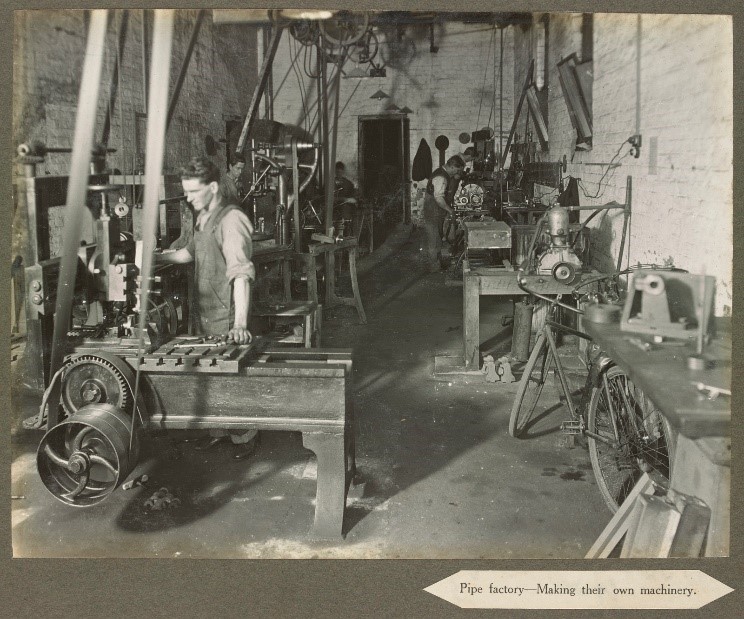
The factory needed to not only invent, but also build its own machinery, and even had its own wood testing laboratory, while the Commonwealth Institute of Science and Industry was engaged to investigate the suitability of various Australian timbers because little was known at the time.
Timber was selected for its low flammability qualities.
The ideal wood for making pipes needed to be even grained, dense and heavy and with long and firm structural fibres that could take a highly polished finish.
Some species contained essential oils and tannins that tainted the pipe smoke which ruled them out.
The famous wood technologist Richard Thomas Baker in his important work published in 1919, “The Hardwoods of Australia and their Economics”, refers to the combustibility and suitability of certain pipe woods.
Southern Mahogany (Eucalyptus botryoides) from Gippsland proved most popular, while other species included Swamp Mahogany (E. robusta) and Jarrah (E. marginata). Somewhat surprisingly, River Red Gum, then known as E. rostrata was rejected.
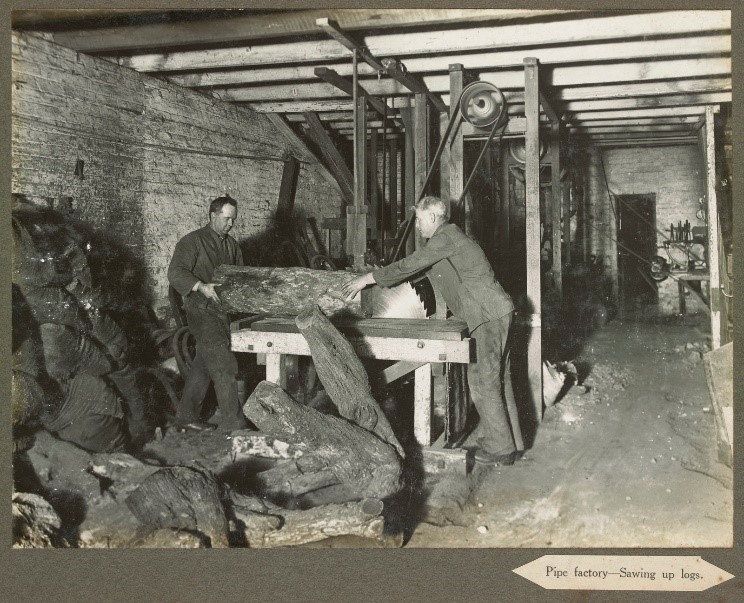
Logs were first broken down at the circular saw bench, and after passing through numerous cutting, docking, and shaping machines, pipes were finished off by hand.