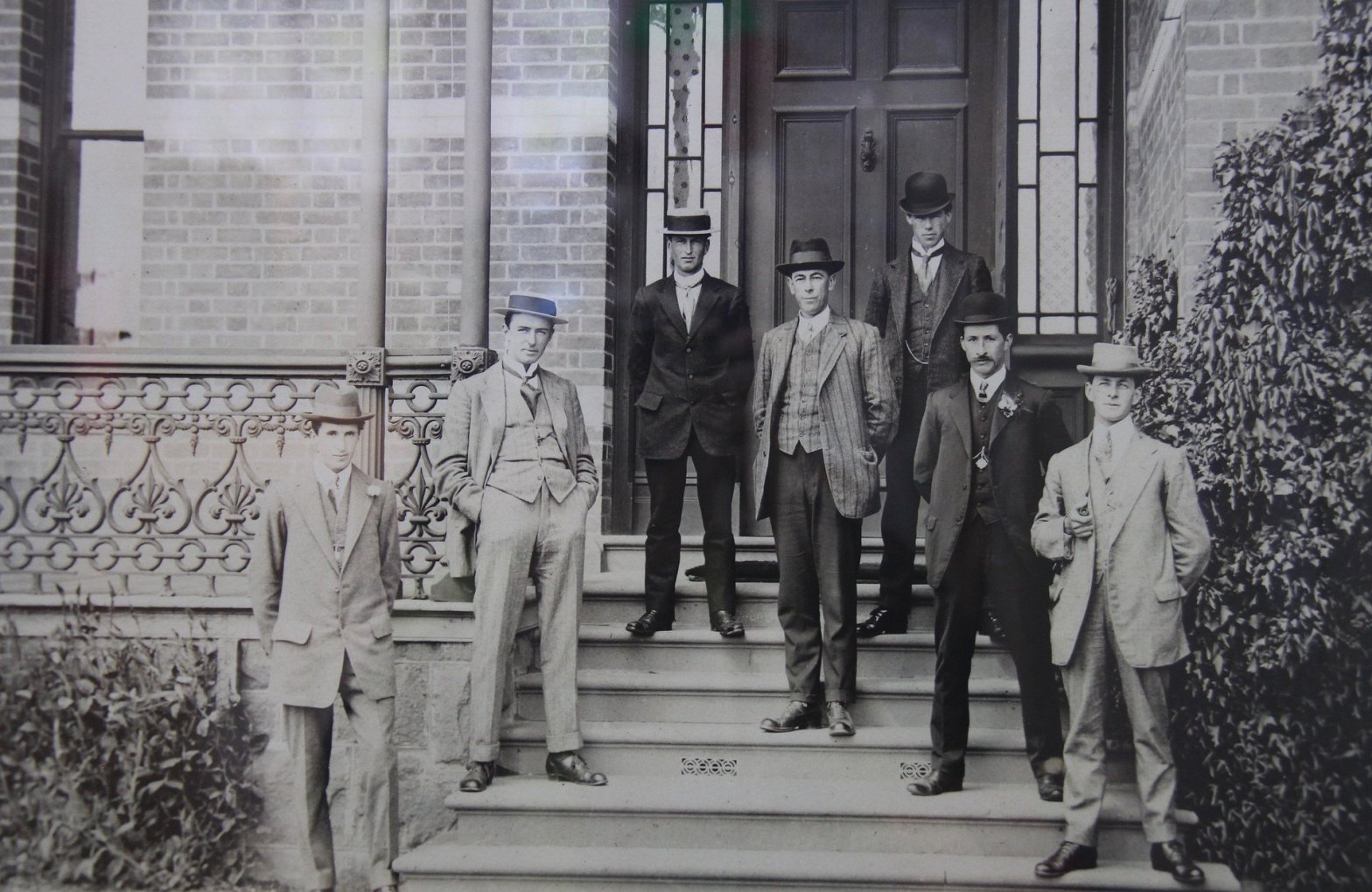
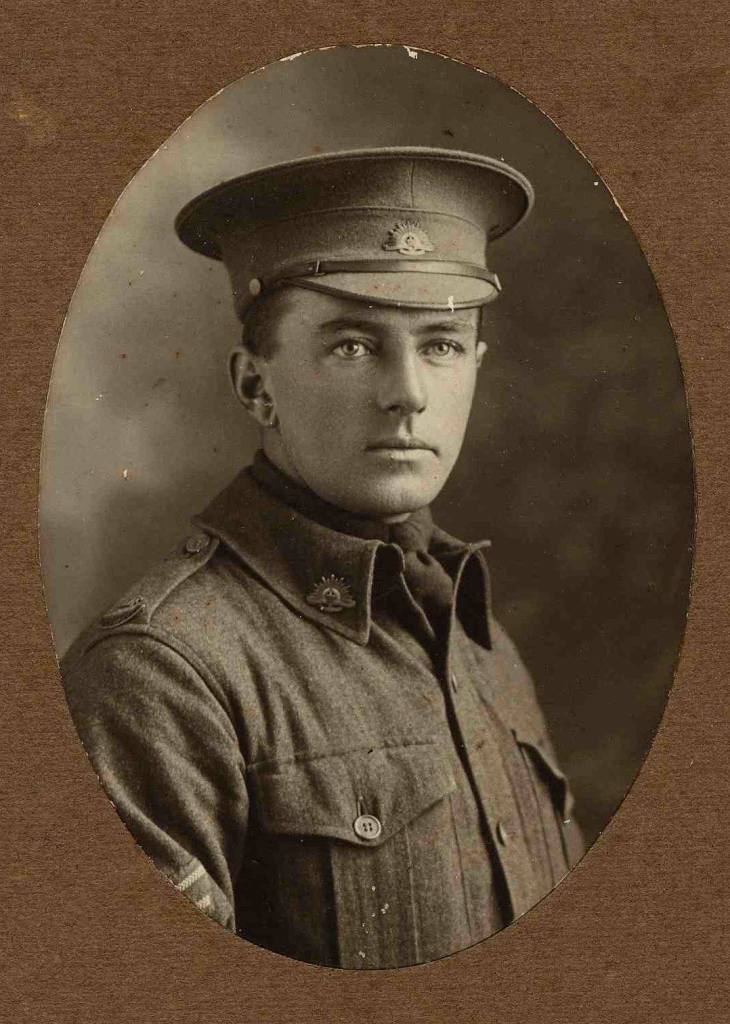
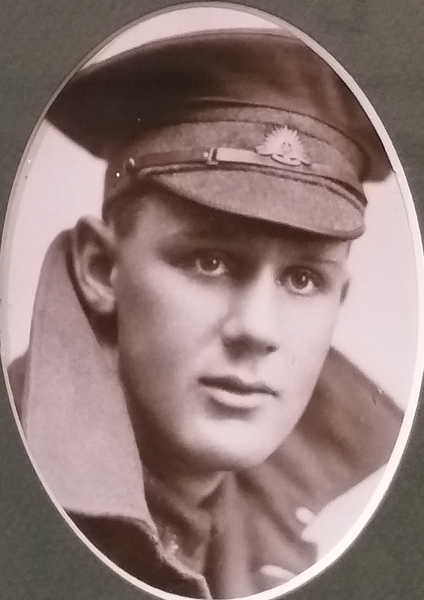
Reg Lindsay was one of the first foresters to graduate from the Victorian School of Forestry at Creswick in 1912.
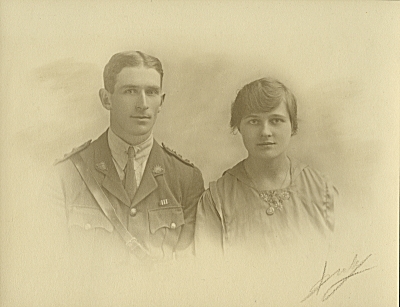
He was also a member of the famous Creswick artist family and brother of Norman Lindsay, the author of The Magic Pudding.
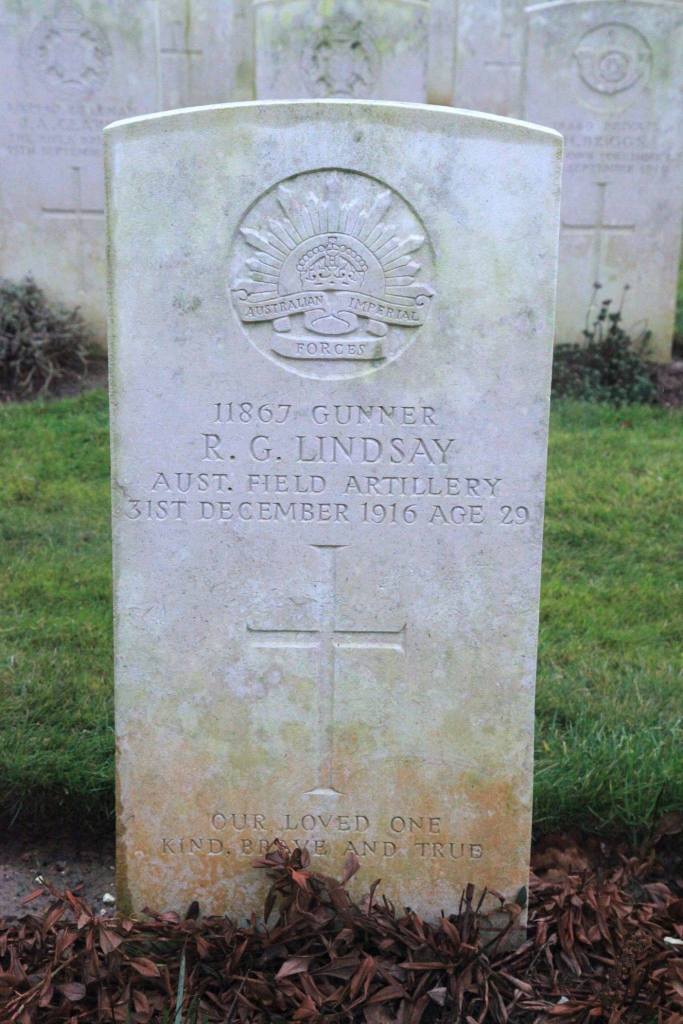
Sadly, Reg was killed instantly in France with four other soldiers while queuing for rations on 31 December 1916 when they were hit by a shell landing directly on them, although it’s often more colourfully reported that he was shot “when dashing out of his dugout to rescue a bottle of rum” on New Year’s Eve.
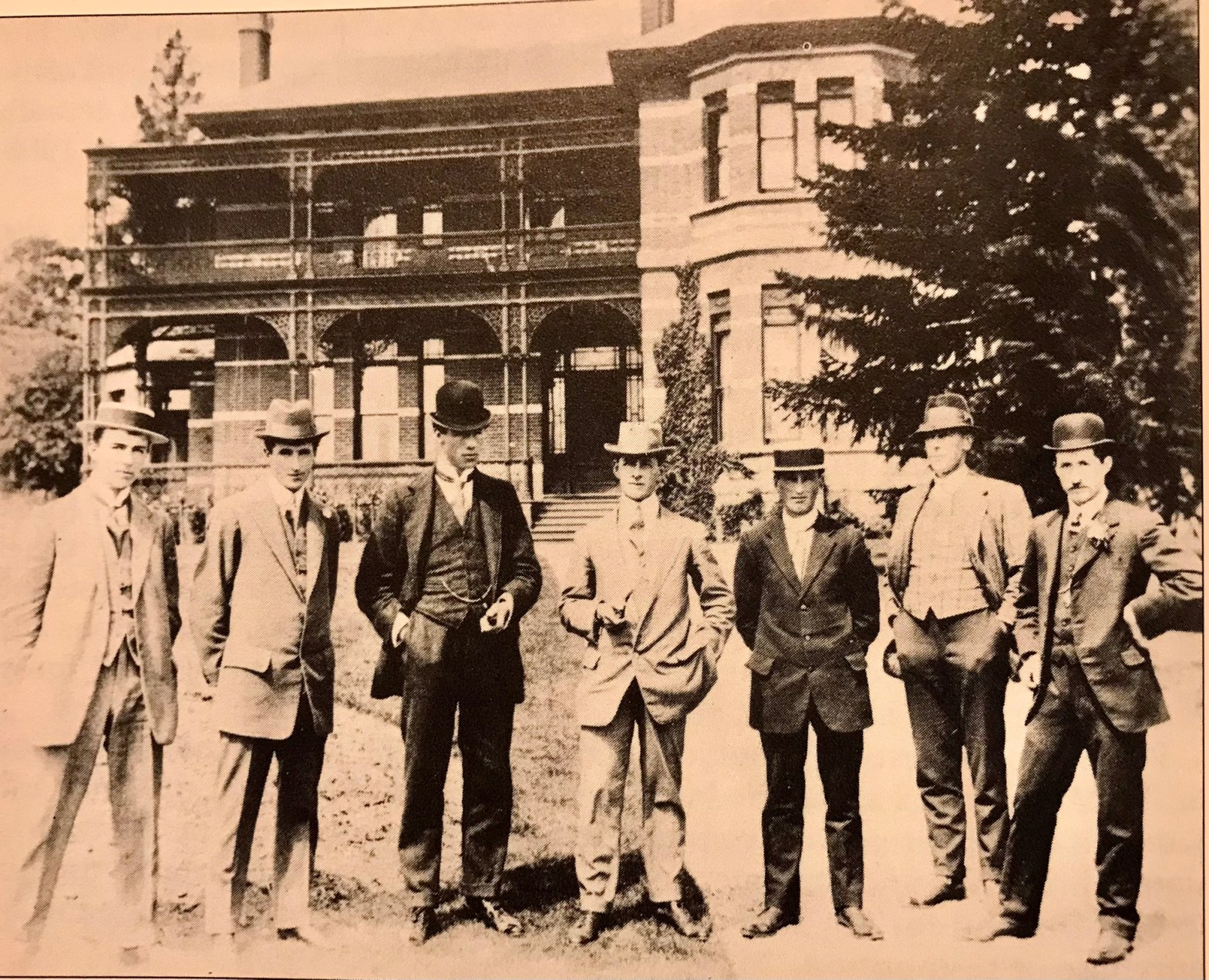
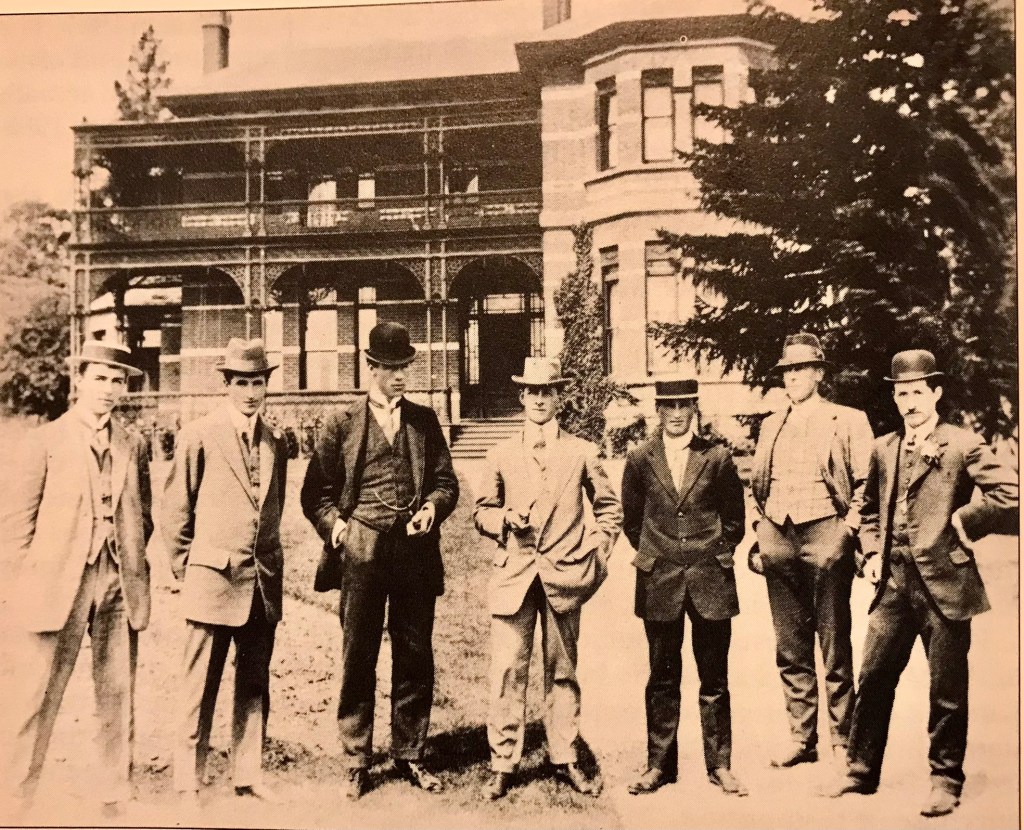
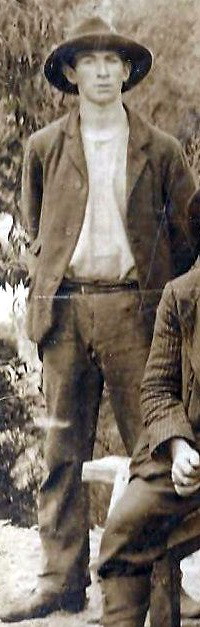
That’s Reg… on the steps of Tremearne House, second from the left, with the snappy boater hat and hands shoved in his pockets. Apparently, he was a bit of a lady’s man.
He was 29…
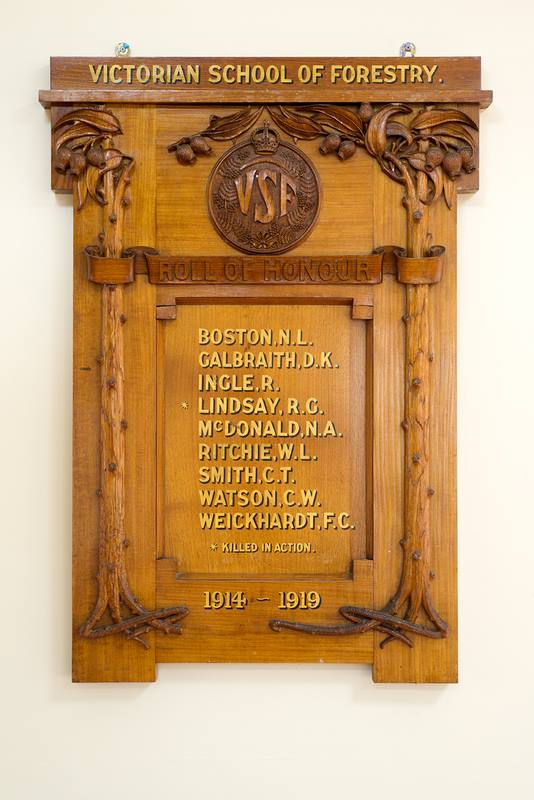
Reginald Graham Lindsay – KIA 31 December 1916. Photograph from the collection of Robert C. Littlewood.Source: AncestryThe Victorian School of Forestry (VSF) honour board. Source: University of Melbourne.FCV Honour Board at the Beechworth museum. Photo: Peter McHughGuards Cemetery Lesbeufs, France. (Plot VI, Row Q, Grave No. 9). Photo: Robert C. Littlewood 2016In 1910, six students began classes at the Victorian School of Forestry. Pictured on the steps of Tremearne House in 1912 are the graduates. From left to right: Walter Henry Horn, Reginald Graham Lindsay, Henry O. Felstead (Nursery superintendent), Norman L. Boston (Nursery staff), J. Sampson, A. Ken (Nursery staff), Arthur H. Warren. Source: University of Melbourne.
Norman Boston was one of the first to attend the Victorian School of Forestry at Creswick in 1912 as nursery staff.
He was born in Daylesford and enlisted in the 59 Battalion AIF (#2578) in 1916, at a relatively senior age of 38 and 7 months.
He embarked on the Shropshire in September 1916 and served in France.
Norman returned to Australia in July 1919.
In 1928 he was listed in Victorian public service records as “staff foreman to assistant forester plantations” based at Macedon.
I believe Norman died in 1936.
Norman Boston (second from the left) with first intake of students in 1912
In 1910, six students began classes at the Victorian School of Forestry. Pictured on the steps of Tremearne House in 1912 are the graduates. From left to right: Walter Henry Horn, Reginald Graham Lindsay, Henry O. Felstead (Nursery superintendent), Norman L. Boston (Nursery staff), J. Sampson, A. Ken (Nursery staff), Arthur H. Warren. Source: University of Melbourne
Frederick Anderson was born on 15th July 1893 in Buangor, which is between Ballarat and Stawell.
He enlisted for military service with the 14th battalion on 14th September 1914 and remained until 10th May 1919. He was one of the first to join up and his service number was 545.
His occupation before enlistment was as a foreman in State Forests Department.
He landed at Gallipoli where he was wounded. He was gassed and wounded again by shrapnel in France. He was awarded the Military Medal in 1916 for entering German trenches and going back repeatedly under machine gun fire to rescue the wounded. He rose the rank of Captain in 1918.
He married Margaret Hayton in England in 1918.
After the war, Fred and Margaret ran the Glenthompson Post Office in western Victoria for 32 years.
Fred then reenlisted in the second world war in 1940 as a Captain (V1298) in the 15th Battalion of the Volunteer Defence Corps.
He returned to Glenthompson and Fred died on 7 May 1965.
Frederick Anderson – Source: AncestryFrederick Anderson – Source: AncestryFrederick Anderson – Source: AncestryFrederick Anderson – Source: Ancestry FCV Honour Board at the Beechworth museum. Photo: Peter McHughHe married Margaret Hayton in England in 1918
Reg was born at Beechworth in 1899 and entered the forestry school at Creswick in 1915. It’s reported that he, along with many others, struggled with his subjects and was required to sit supplementary exams.
At the time, nearly half of the intake failed. The Board blamed students and the staff for the poor results.
By 1916 things were improving but the Board still considered Reginald Ingle “did not show sufficient evidence of capacity to justify his further continuance as a trainee at the forest school”.
Despite his VSF results, the records show Reginald was a graduate in 1917.
Around the same time there were changes to the teaching staff and the appointment of Charles Carter as the Principal.
Reginald joined the 46 Battalion (#3404) of the AIF in February 1917 and sailed to England in May. Oddly, he listed his occupation as orchardist, maybe because forestry was a protected profession.
Reg was wounded in France in September 1917 by a gunshot wound to his right hand and ended his war in hospital in England. He returned to Australia in March 1919.
Reginald resumed with the Forests Commission in 1919 and went onto a long and successful career with placements at Macedon, Port Campbell, Ovens, Yarram, Tarnagulla and then at Neerim South in 1927.
In 1929 he was appointed as the assistant forester at Chiltern, and by July, he was promoted as the District Forester at Yarrawonga.
In 1938 Reginald moved to Maryborough as the District Forester with his final career posting at Bendigo in 1952. Reginald Ingle retired from the Commission during the 1959/60 financial year, and I believe he may have died in Maryborough in 1971
Reginald Ingle in 1928 at forestry refresher course at VSF
Frederick Conrad Weickhardt was born in Clunes in February 1899.
Con as he was known to his family, was one of nine candidates to pass the entrance exam into Victorian School of Forestry (VSF) at Creswick in April 1913.
Like another of his fellow students who went off to the war, David Kennedy Galbraith, Frederick is not listed as having graduated from the school, but his name is on the VSF honour board.
Frederick was aged just 18 years and 4 months when he enlisted in Melbourne (#2278) on 15 June 1917.
He joined as an electrical air mechanic in the Australian Flying Corps (AFC). His parents owned the Clunes bakery and wrote a letter giving their blessing for him to join provided he could use his skills and follow his training.
He embarked overseas on 30 October and arrived in Devonport in England on 27 December 1917.
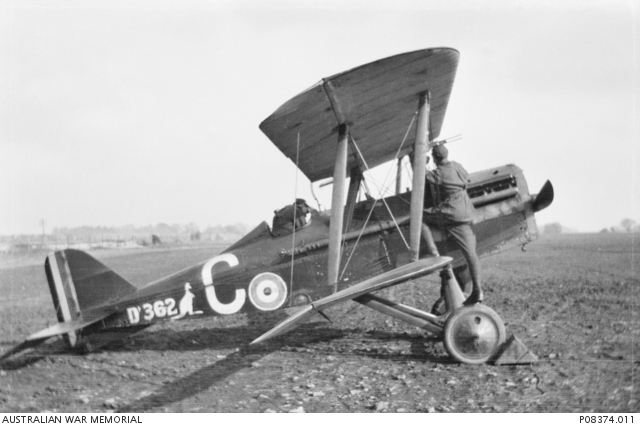
Frederick was admitted to hospital at Aylesbury with pleurisy on 27 February 1918. After a month in hospital and some further time in the AFC Depot, he was posted to the 6th Training Squadron at Leighterton in the Cotswolds on 16 May 1918, the home of the “Flying Kangaroos” where he served until the end of the war.
He returned to the AFC Depot at Wendover on 9 December 1918, where he remained for three months, before he was granted special leave to work as an electrical fitter for the firm of Edmundson’s Electrical Co. in Westminster in London from 20 March to 3 September 1919.
Frederick embarked for Australia on 22 September 1919 and arrived back in Melbourne on 12 November, where he was formally discharged from the AIF on 8 February 1920.
And just like David Kennedy Galbraith, Frederick’s name doesn’t appear on the State Forest Department honour board held at Beechworth.
Aircraft Mechanics on a Rolls Royce engine at AFC depot 1918AFC No. 6 (Training) Squadron aircraft including S.E.5a scouts. Note the Flying Kanagaroo on the side
Charles was born in Majorca near Maryborough in 1895 and entered the Victorian School of Forestry (VSF) in 1913 as one of the first student intakes.
He was also a member of the Creswick 71st company militia.
Charles graduated in 1915, and in February 1916, he enlisted in the 59th Battalion (#1769) aged 20. Charles listed his occupation as a student, rather than a forester, when he signed up.
Promoted to the rank of Sergeant and then wounded in France, Charles, returned home in February 1919 and resumed his career with the Forests Commission.
Charles then had postings at Heathcote and Barmah (1927), Assistant Forester at Belgrave (1929), Forester at Macedon (1930), District Forester at Nowa Nowa (1934–1938), Yarrawonga (1938) and Cohuna at Gunbower (1939).
In 1942 Charles re-enlisted (V362896) in the “Home Guard” as a signaller with his old battalion based at Bendigo and rose to the rank of Captain.
After the war, Charles resumed full time employment with the Forest Commission. He was posted as Divisional Forester at Wangaratta in 1949, before retiring in 1960.
He died in 1976.
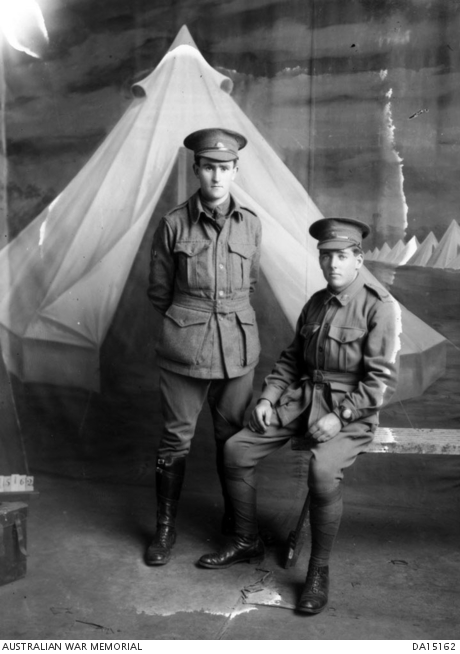
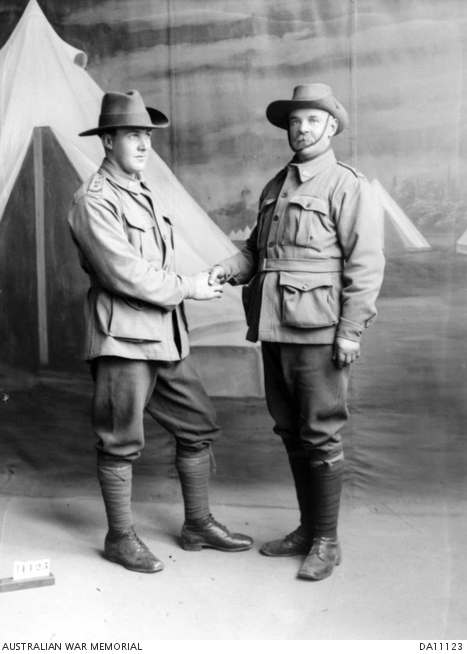
769 Private Pte Charles William Watson.Studio portrait of 1769 Private Pte Charles William Watson (standing) and 1765 Pte Robert Hancock, 59th BattalionVSF honour BoardFCV Honour Board at BeechworthPhotograph taken in the Chemistry Lab at the VSF in 1915 : Students from the graduating classes of 1915 and 1917 – (l to r) FG Gerraty, D Walker (Ballarat School of Mines – Lecturer), C Smith, A Small, T Hart (Principal), Charles Watson, R Ingle, P Sims, W Trainor, W Zimmer, M Campbell, G McEwan
James joined the 29th Battalion on 12 July 1915 at a relatively senior age of 44 and embarked from Melbourne aboard HMAT Ascanius on 10 November 1915.
A native of Stawell, he lived at Brimpaen and worked as a forest officer in the Wartook and Murra Murra state forests on the western side of the Grampians at the time of enlistment. I think the Murra Murra bush may now be known as the Black Range or Burranj Range.
Prior to 1910 he had been a farm roustabout and boundary rider in Victoria, NSW and WA.
James returned from England to Australia on 8 April 1917.
He resumed duty as a forest officer with the Forests Commission at Brimpaen before retiring in 1934 and moving to Hay in NSW to live with his sister.
He never married but was well known around the district for his welcoming hospitality.
James travelled extensively in his retirement including a visit to China. He was planning another trip to Queensland but died in Horsham hospital of pneumonia on 7 May 1944. He is buried at Brimpaen and flags on the Horsham town hall were lowered to half mast in his honour.
He is sometimes listed as “James Leas Shaw” due to an incorrect interpretation on his enlistment papers.
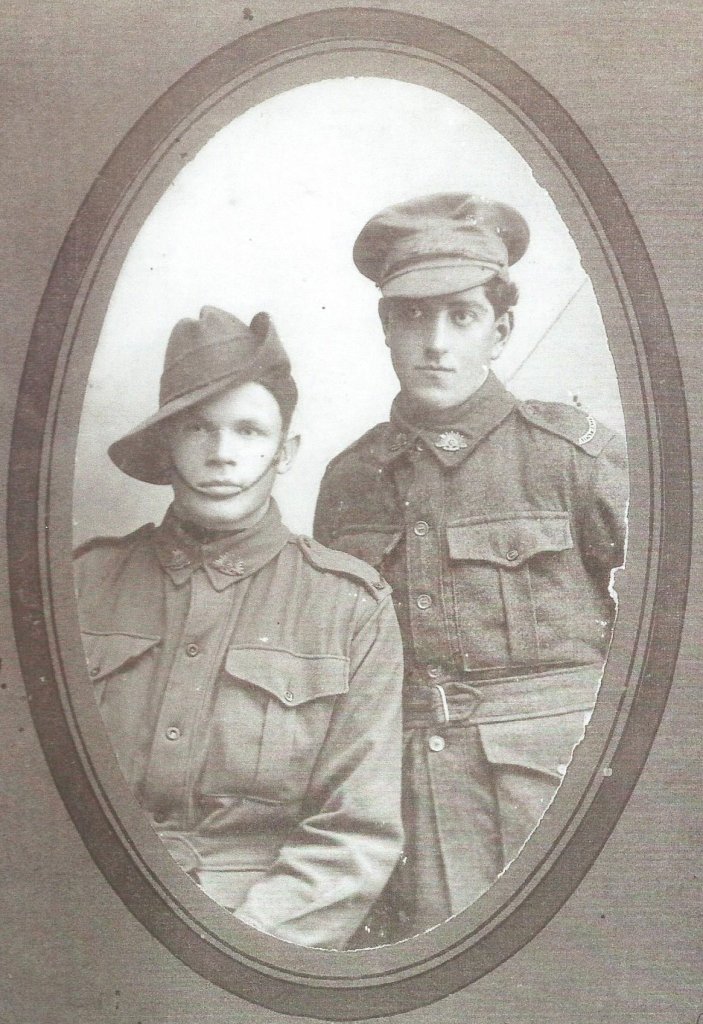
Left to right: 2296 Private (Pte) Donald William McTavish, 4th Reinforcements, 22nd Battalion, of Horsham, Vic; and 1246 Private (Pte) James Leas Shaw, D Company, 29th Battalion, of Horsham, Vic, aged 44. Pte McTavish enlisted on 24 July 1915 and embarked from Melbourne aboard HMAT Hororata on 27 September 1915. He was killed in action on 27 July 1916 at Pozieres, France.
Studio portrait of nine soldiers. Identified, centre, back row, is 1246 Private (Pte) James Leas Shaw, D Company, 29th Battalion, of Horsham, Vic, aged 44.
FCV Honour Board at the Beechworth museum. Photo: Peter McHugh
David Kennedy Tener Galbraith was born in Bendigo in October 1896.
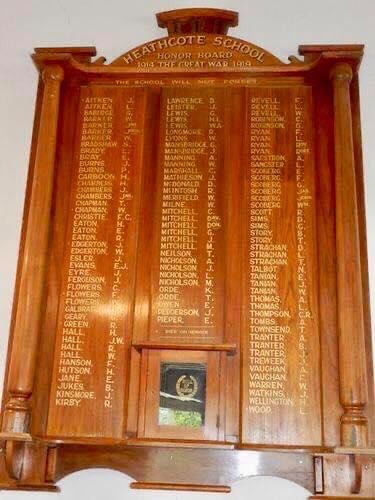
He was living in Heathcote when he was one of nine candidates to pass the entrance exam into Victorian School of Forestry (VSF) at Creswick in April 1913.
David is not listed as having graduated from the school, but his name is on the VSF honour board.
Forestry mustn’t have been his calling because David is then listed in the McIvor Times newspaper as transferring from the Bendigo Branch of the Bank of Australasia to Charlton in December 1914.
David joined the AIF on 4 December 1915 when he was 19 and left Australia a few months later on the 20 May 1916.
He puts his occupation as a bank clerk on his enlistment papers rather than a forester.
He served as a gunner (#22932) with the 1st Australian Field Artillery Brigade in both France and Belgium and was gassed.
He returned in June 1919 and lived in Melbourne.
And just like Frederick Weichardt, David’s name doesn’t appear on the State Forest Department honour board held at Beechworth.
However, there are a number newspaper reports in 1934 of a David Kennedy Galbraith, aged 37, a bank clerk from Numurkah, married with two children, and a war veteran, pleading guilty to fraud of £36/2. This was a lot of money during the depression when average weekly wages were about £5 per week. David was sentenced to 18 months imprisonment with hard labour.
David Kennedy Galbraith died in Heidelberg in 1974.
William Ritchie was a from a forestry family. His father, James Stewart Ritchie, trained as a crown land bailiff in the 1890s at Creswick under the now famous John la Gerche.
William was born at Glen Park near Ballarat in 1895 and was one of the first students to enter the Victorian School of Forestry (VSF) at Creswick when it opened in 1910 but lasted for only one year.
In 1912 he was a trainee forester at the nearby forest nursery established by la Gerche but still attended night lectures in Tremearne House at the Forestry School in order to graduate in 1914.
In 1913 he went tree planting at French Island and later in 1915 to the State nursery at Macedon.
But on 25 September 1916, aged 20, William enlisted Royal Australian Naval Bridging Team and sailed off to the war. He switched to the AIF as a Sapper with the 1st Army Troops Company of the Royal Australian Engineers in March 1917, while in Egypt.
His military records indicate he mostly served in England.
On returning to Australia in May 1919 William resumed with the Forests Commission and took the job at the newly established Moonlight Flat Plantation near Harcourt.
By 1926 he was promoted to OiC at Bright to oversee the massive Ovens plantation project where he supervised the planting of millions of pine trees on the steep hills and river flats denuded during the earlier gold mining.
During WW2, because of severe staff shortages, William was the District Forester for both Bright and Ovens Plantations.
In 1950 William was appointed as the District Forester for Creswick, which included the nursery where he started, and by 1955 rose to Assistant Superintendent of Plantations for the FCV based in Head Office.
William Ritchie retired in 1960, aged 65, and died in 1989.
Oddly, William is listed on the VSF honour role as W. L. Ritchie while on FCV honour roll he is listed as W. S. Ritchie, but on his enlistment papers he has no second initial at all… I can offer no rational explanation…
And to add more branches to the family tree, William’s son is well-known FCV forester Russ Ritchie who graduated from VSF in 1944 and retired as Divisional Forester at Wangaratta in 1984.
Furthermore, there is Trevor Ritchie (son of Russ) who graduated from the Forestry School at Creswick in 1967, and then Ted Stabb (nephew of Russ), who graduated in 1971 and remarkably is still working as a forester for DELWP.
Robert Kerr was born in 1885 as the eldest son of Robert Kerr (senior), the assistant head teacher at the Prince of Wales State School in Northcote.
Kerr later gained both First and Second Certificates from the Teacher Training College and was appointed junior teacher at Victoria Park in Collingwood, later becoming assistant at Armadale.
In 1908, he resigned as a teacher and joined as a public servant with the State Forests Department, the predecessor of the Forests Commission Victoria (FCV). It’s not sure what his job was, but he was living in North Melbourne at the time.
Robert Kerr then enlisted in the 57th Battalion on the 23 August 1916.
Kerr was also a qualified pianist and gymnasium teacher, and had spent five years with the 1st Battalion, Victorian Scottish Regiment before enlisting.
Robert embarked from Melbourne aboard HMAT Nestor (A71) on 2 October 1916 as 2760 Private R J L Kerr.
He transferred to the Officers’ Cadet Battalion at Oxford in April 1917 and was promoted to 2nd Lieutenant on 1 August 1917. He went to France to join his unit on the 19August.
His military records show he was promoted to the rank of Lieutenant on 23 April 1918 and killed on the same day by a bomb dropped from an enemy aircraft. He was on the line with the Battalion at Aubigny near Villers-Bretonneux in France.
Lieutenant Robert John Leslie Kerr is buried in the Daours Communal Cemetery Extension in France.
He was 33.
Robert’s younger brother, Benjamin (1888) embarked as a Lieutenant in 1915, was wounded at Gallipoli and repatriated back to Australia. He re-enlisted in 1917 and returned with rank of Captain.
FCV Honour Board at the Beechworth museum. Photo: Peter McHugh
Reginald was born on 12 February 1900 at Heathcote.
He joined the Forests Commission when he was 16 and transferred to Ferntree Gully.
On 25 April 1917, when he was only 17 and 3 months, he enlisted with the 23 Battalion of the AIF (# 6866A) by forging his father’s signature because he was still underage.
While serving in France his true age was discovered when he wrote home about his 18th birthday. He was subsequently moved away from the front to a working party.
After returning from the war in 1919 Reginald resumed with the FCV, again at Ferntree Gully, but later shifted to a job with Victorian Railways.
Reg married Marion Harris in 1922 and returned to Heathcote to work in the timber industry.
Reg then reenlisted in WW2 and worked in the stores branch at Royal Park.
Reg sadly died at Heidelberg hospital on 29 January 1943 after a scuffle in West Brunswick while serving with the army. Another soldier was committed to trial for manslaughter.
Reginald Dennis Hall is buried at Springvale.
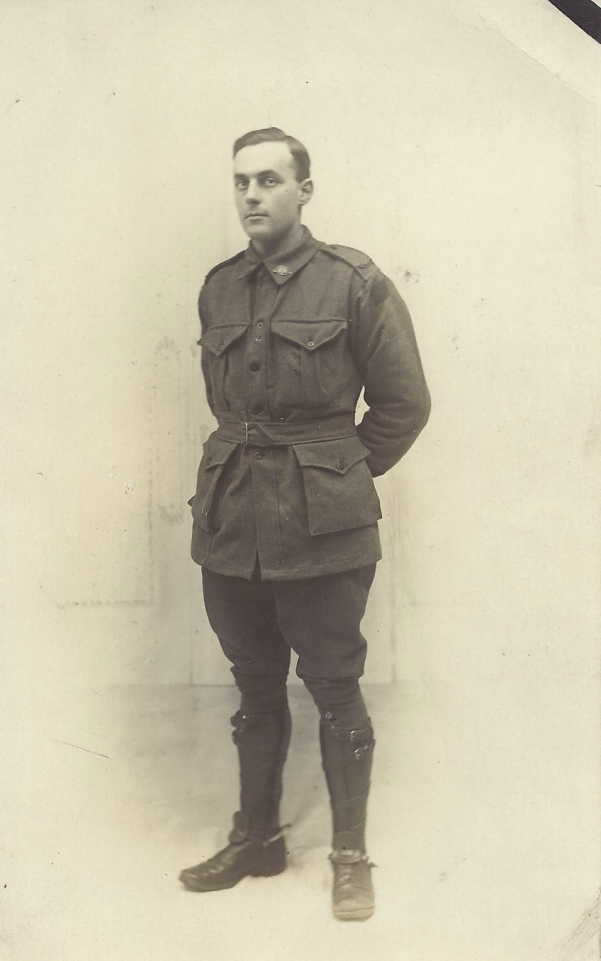
Reginald Hall (right). Source: AncestrySource: Kerri BarrettSource: Kerri BarrettSource: AncestryDavid Galbraith and Reginald Hall are listed at Heathcote PS.
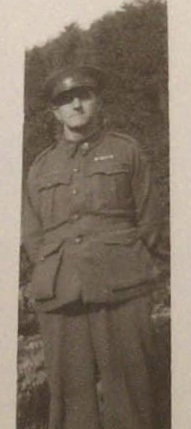
Perhaps Australia’s finest fighting soldier, Albert Jacka has the honour of being the first Australian to be awarded the Victoria Cross during WW1, the highest decoration for gallantry in the face of the enemy.
Albert Jacka is also one of twenty employees displayed on the Forests Department’s Roll of Honour that hangs at the Beechworth Forestry museum.
Albert was working at Heathcote when the war broke out and his career over the preceding three years had been along the southern side of the Murray River at Wedderburn, Cohuna, Koondrook, and Lake Charm. His work included fencing, fire break clearing and tree planting.
Jacka landed at Gallipoli on 25 April 1915 and received his Victoria Cross less than a month later amid frenzied fighting when the Turks launched a counter assault against a section of an Australian trench at Courtney’s Post.
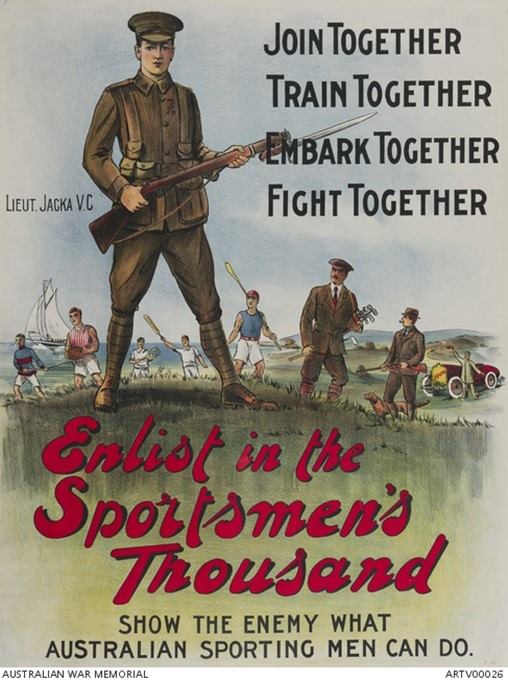
Following his outstanding act of bravery at Gallipoli, Jacka instantly became a national hero and recruitment poster boy for the Sportsmen’s 1000.
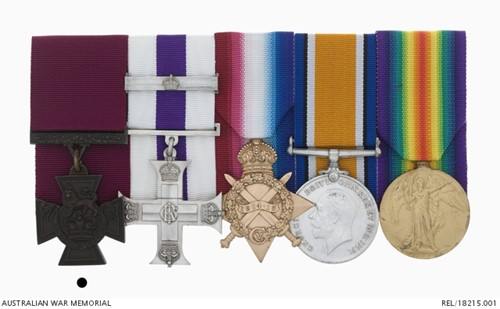
He later served on the Western Front where he was promoted, seriously wounded and decorated again with a Military Cross and Bar. Many prominent historians claim he should have received three Victoria Crosses.
On returning home, Jacka turned down the offer to return to the Forests Department and established an electrical business which was largely underwritten by the infamous Melbourne figure John Wren.
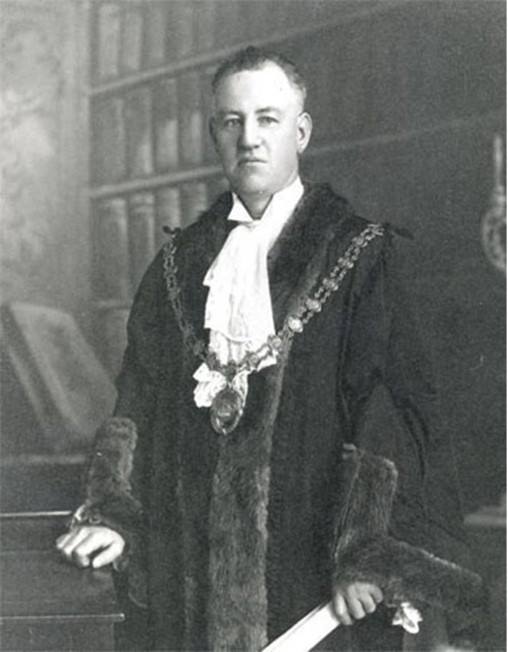
He was later elected Mayor of St Kilda and fought hard for the unemployed during the Great Depression. He died in 1932 and has been honoured at a special council service ever since.
The 14th Battalion regimental colours are laid up in St Kilda Town Hall while his Victoria Cross is displayed at the Australian War Memorial in Canberra.
Albert Jacka in 1914 when he was 21. This postcard was taken when he was working for the Forests Department at Heathcote.The Forest Department Honour Roll hangs at the Beechworth Forestry museum and includes Albert Jacka VC.
Over the next week or so I shall post short stories about some of the men from the State Forests Department* and the Victorian School of Forestry that served.
I can find some of their military records in the National Archives and the Australian War Memorial, but there are many things missing, as well as lots of anomalies in the official documents.
The names of the two honour boards don’t even line up.
For example, there is Ritchie W L is on the Forestry School honour board with Ritchie W S on the State Forests Department board, while his army records simply lists him as Ritchie W (with no second initial).
Then there is Galbraith D K and Weickhardt F C on the Forestry School board that dont appear to have worked for the department after the war.
Sometimes they don’t list their occupations as foresters on their enlistment papers. I think this was because forestry was a protected occupation.
But sadly, I can’t find much at all about some of them, or their stories, so I welcome any contributions to fill in the gaps.
* The Forests Commission Victoria (FCV) didn’t come into existence until after the war.
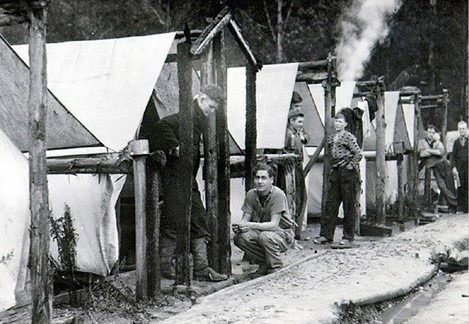
During the Great Depression of the 1930s, the Forests Commission ran a large unemployment program of firebreak slashing, building roads, erecting firetowers, silvicultural thinning, firewood cutting, weed spraying, soil erosion works and rabbit control. Importantly, most of the work was in country areas.
By 1935-36 almost 9000 men were employed for periods of up to eight weeks at a time. Their bush camps generally comprising 25 men with two-thirds being from the city. And despite the blisters, many remained in the country to make their future.
The Country Roads Board, State Rivers and Water Supply Commission and Melbourne Metropolitan Board of Works also employed large numbers of men known as a sussos, which was slang for sustenance workers.
However, there was a special need to provide opportunities for young people.
Newspapers warned of long-term consequences of enforced idleness of youth of the Nation, claiming that if nothing was done “many would become permanently unemployable and would settle down to a life on the dole or turn to crime”…
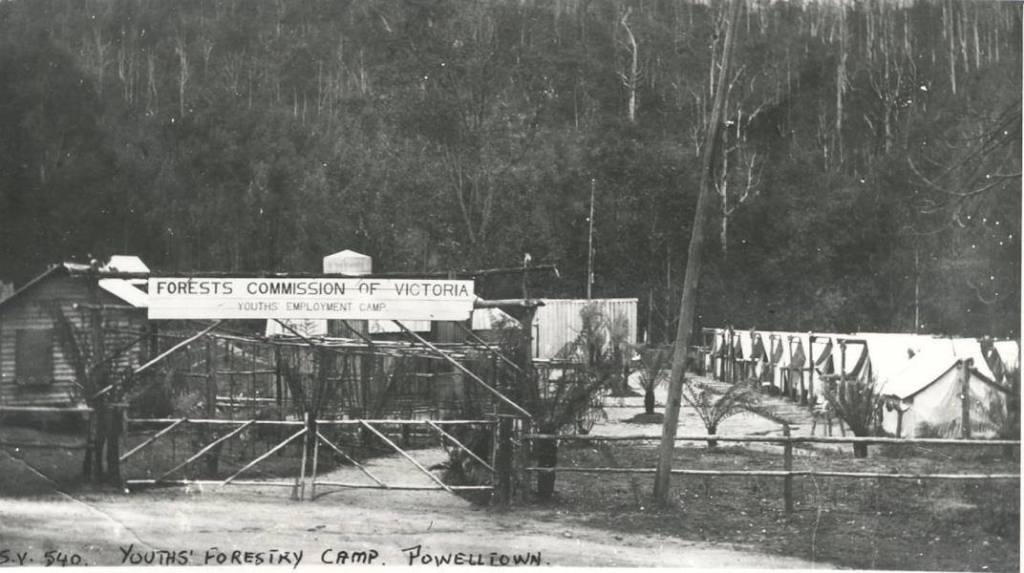
With the support of two prominent Melbourne businessmen and philanthropists, Herbert Robinson Brookes and George Richard Nicholas (of Aspro fame), together with Forests Commission Chairman, A. V. Galbraith and the Minister for Forests, Sir Albert Lind, a unique and enterprising “Boys Camp” was established at Noojee in 1933.
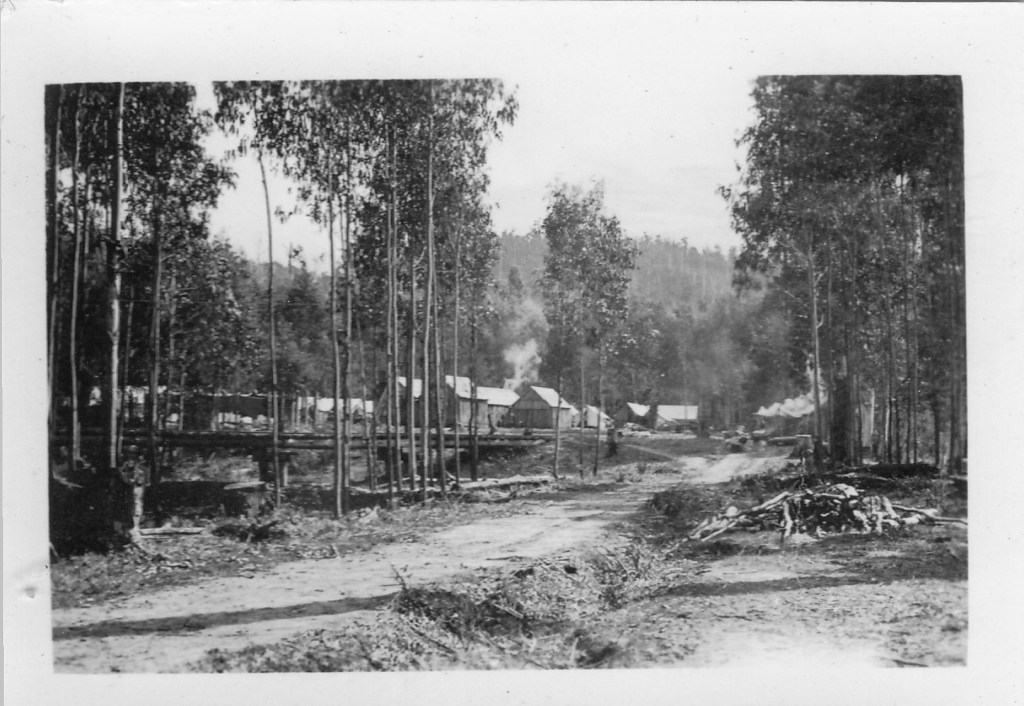
The Commission provided a timber hall and other facilities, but the boys camped in tents and there was initially no electricity. Commission officers also supervised thinning and ringbarking of young stands of messmate, silvertop and mountain ash together with fire protection works on the 2000 acres of private land purchased and donated by Brookes and Nicholas.
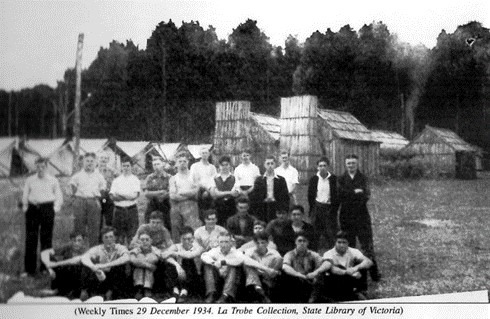
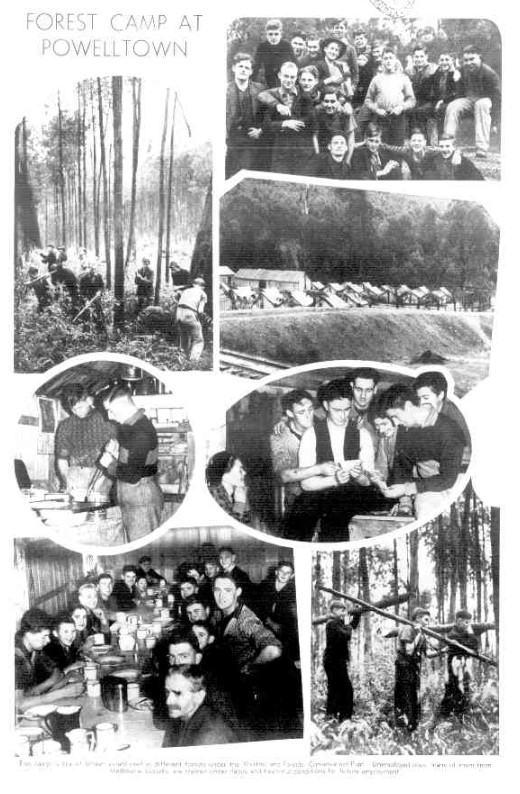
Groups of about 30 young boys, aged between 16 and 19, were at the camp at any one time and were paid at rates applicable to Forests Commission workers, but money was deducted for food, accommodation and medical support. And if they didn’t work… they didn’t get paid.
The idea was a success and extended across Victoria to another 15 sites including a second camp at Noojee.
By June 1934, the Forests Commission ran Boys Camps at Noojee (X2), Bruthen, Bairnsdale, Powelltown, Acheron/Marysville, Gunbower Island, Otways, St Arnaud, Maryborough, Bendigo, Beechworth, Macedon, Daylesford and Ballarat.
Some 1276 boys had passed through the camps by 1936.
For many, it was their first experience of country life and Boys Camp proved one of the success stories of the 1930s and it was later reported two-thirds of the boys found employment.
With the outbreak of the War in September 1939, there was no longer a need for a youth unemployment program, but some of the camps were used by high school and university students to produce emergency firewood for Melbourne until 1942.
After the war, the Noojee camp was once again occupied as a temporary home for immigrants fleeing Europe. But all trace is now gone.
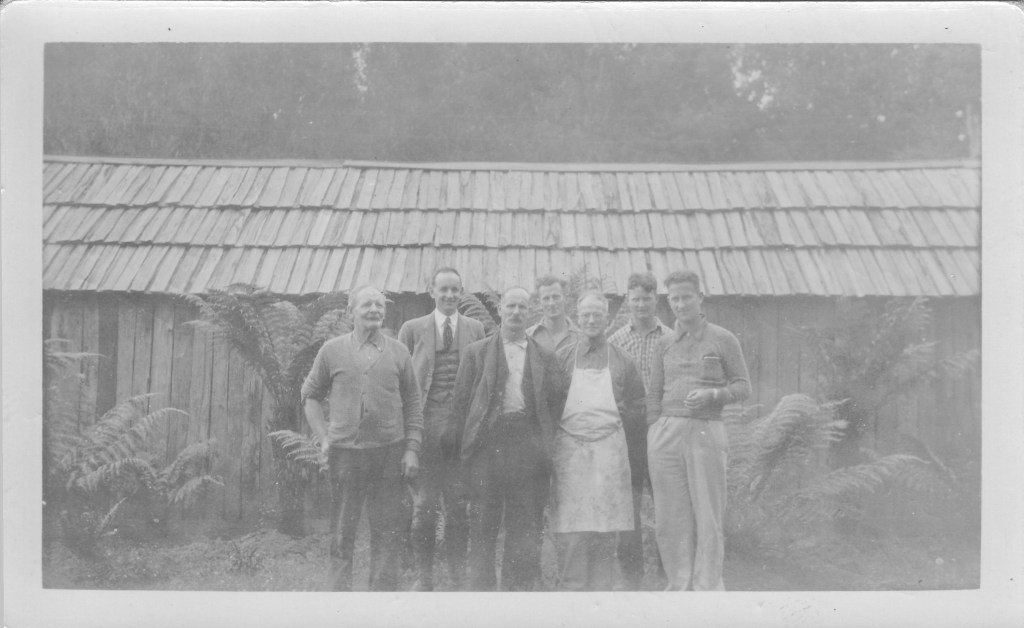
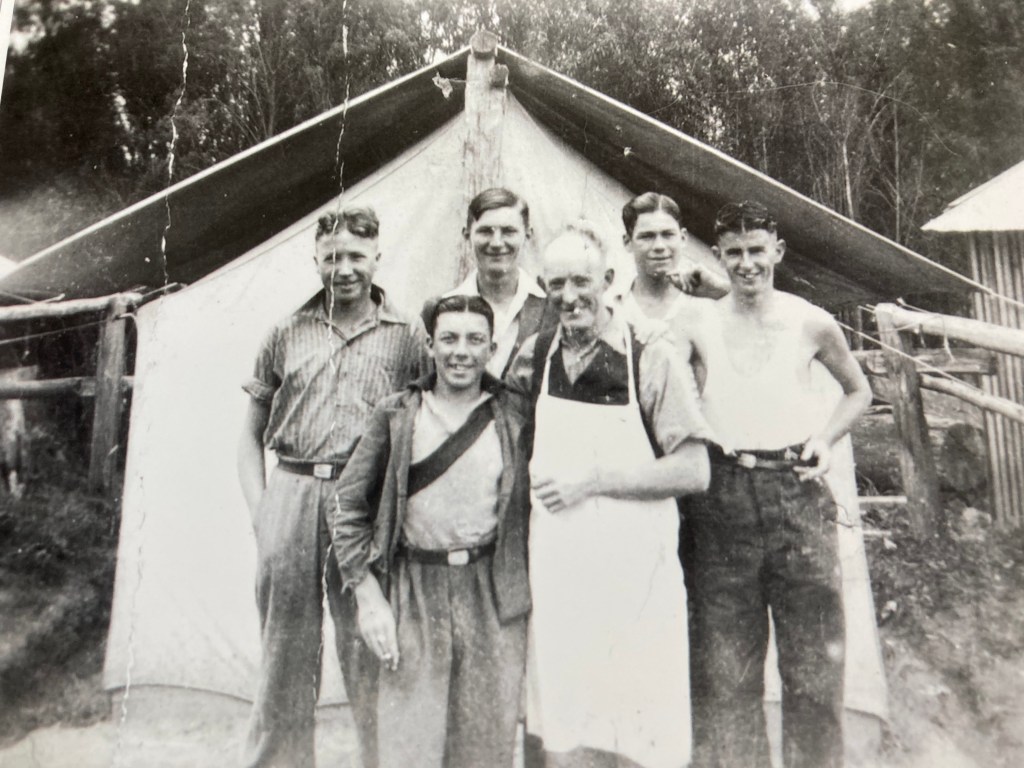
Richard (Dick) Mumford (in apron) was the popular cook at Noojee. He and his wife later lost everything in the 1939 bushfires. Photo supplied by his great-grandson, Wayne Mumford. Circa – 1936.Photograph taken in 1934 or 1935 (Source: R Graham via AL Benallack) : Noojee Boys Camp staff – R Mumford (Chief Cook), AL Benallack (Forester), D Williams (Foreman), F Noar ?? but caption on photo unclear, Asst cook, W Fisher (Senior Boy), B Fidler (Foreman)Groups of about 30 boys were at the camp at any one time. Source: Philippa Watt.The first batch of 30 “lads” departed by train from Flinders Street for the new Boys Camp at Noojee on 21 June 1933 but cold weather and winter rain in the wet forests hampered the camp’s establishment. Local community people supported the boys. Source: FCRPA collection.Photograph taken in 1934 or 1935 (Source: R Graham via AL Benallack) : Noojee Boys Camp – HeadquartersPhotograph taken in 1935 (Source: R Graham via AL Benallack) : Noojee Boys Camp – Source: – Ben Benallack FCRPA CollectionPhotograph taken in 1934 (Source: R Graham via AL Benallack) : Noojee Boys Camp – approaching from Noojee
Photograph probably taken in the mid to late 1930s at the FCV Olangolah Boys Camp (Source: Jim O’Dowd) : Back left – Tom O’Dowd (FCV Leading Hand & uncle of Jim). Front right – Wally Prosser (Camp cook & a grandfather of Jim)FCV Boys Camp at Olangola (Otways). Source: FCRPA Collection
The humble timber pallet (or, less typically, a plastic or metal one) has at some time or another, probably carried almost every type of object in the world.
For a mostly unseen and unnoticed item, pallets are everywhere, and there are said to be billions of them circulating through the global supply chain.
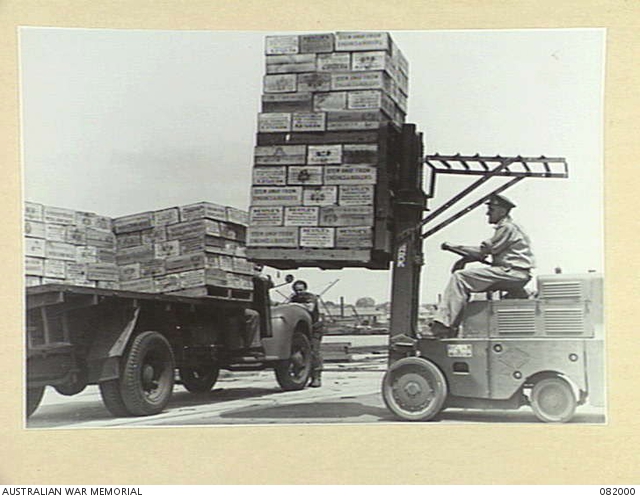
While there is some debate about their pedigree, pallets as we now recognise them, were not around until the forklift arrived in about 1915.
Australia was one of the first countries to develop the standard timber pallet. During World War 2 the United States as part of their huge logistics effort to supply allied troops, used pallets for transport on a scale never seen before.
When the war ended in 1945, the Americans left behind their materials handling equipment and a very large stock of wooden pallets. The Australian government seized upon the opportunity during the hectic post war reconstruction period and formed the Commonwealth Handling Equipment Pool (CHEP). It was a game changer.
The Government sold the assets of CHEP in 1958 to Brambles, which is now the largest pallet rental business in the world.
But despite efforts for global standardisation from the 1950s, the Australian standard pallet is rarely found elsewhere. But its square size (1165 mm × 1165 mm) fits perfectly into a standard RACE container used by the railways.
In Victoria, the largest producer of CHEP timber pallets is Dormit which began operating in about 1989, and now has modern sawmills at Dandenong and Swifts Creek.
The company sources low grade hardwood logs from State forest and private land that would have otherwise only been suitable for pulpwood.
From a small allocation of about 80,000 tonnes, the Dormit has grown into Australia’s leading manufacturer of over 1.2 million pallets in 2021.
However, the long-term supply of pallet grade sawlogs from State forests is under a cloud.
The timber pallet is possibly the single most important and under recognised object in the global economy, other than maybe the shipping container.
John Klunder Jensen was born in Bendigo in 1884 but had to leave school at the age of 11 to find work following the early death of his father in 1895.
He moved to Melbourne in 1898 and in 1900 took a job as a junior messenger boy in the Defence Department’s ordnance stores branch at Victoria Barracks, which at a time was dispatching large quantities of ammunition and equipment to the South African Boer War.
A self-educated man, John eventually forged a highly successful career with the Department of Munitions, including during the critical war years.
A compulsive worker he presided from his office flanked by a ‘tin hat’, Bren-gun and portable typewriter.
Sir John Jensen was appointed OBE in 1938, and knighted in 1950, for his services to Australia.
John was also an active member of the Melbourne Walking Club from 1922 to 1938 and continued his interest in walking and the Australian bush until his death in 1970 at the age of 85.
He regularly went long treks lasting from several days, and up to a week at a time, which covered between 70 and 130 miles.
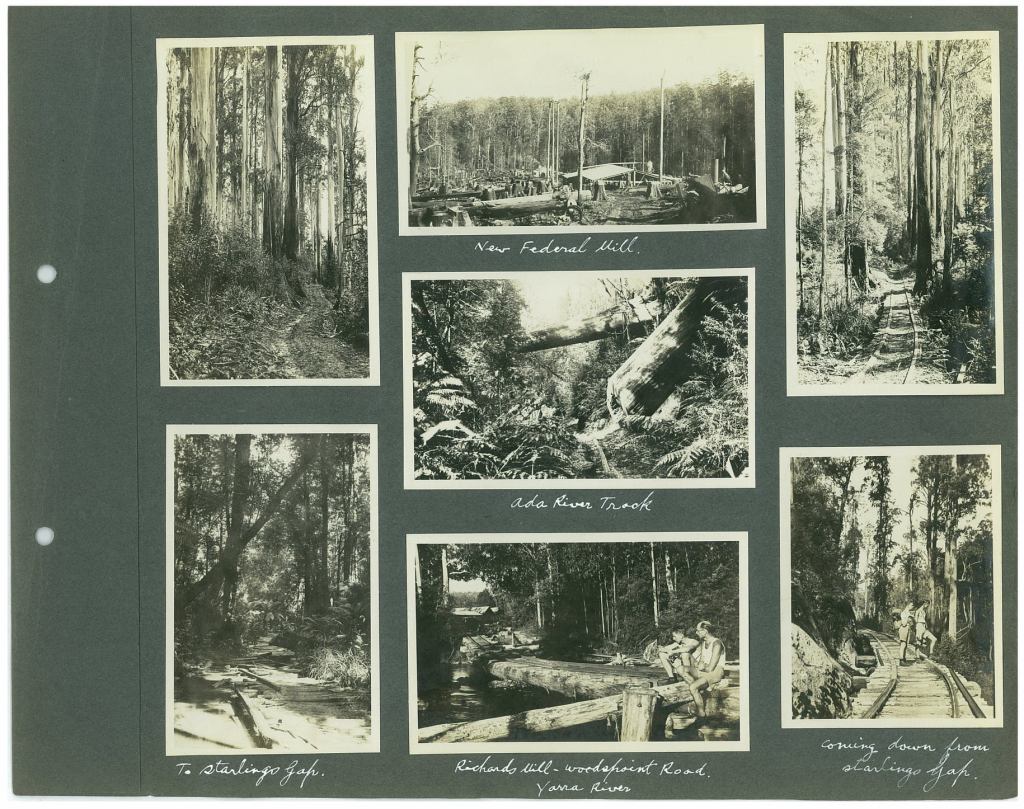
Luckily for us, John Jensen often carried a camera and tripod and fastidiously recorded his photographs in albums. But most significantly, his photos give us a glimpse into the forests before the devastating 1939 bushfires.
John Jensen sometimes contributed articles to “The Melbourne Walker” magazine and the club have generously placed his extensive collection bushwalking photo albums in the care of Royal Historical Society of Victoria.
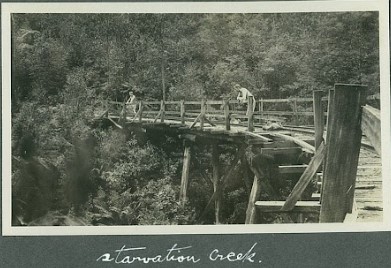
Here is a just a sample from the Starvation Creek – Federal Mills Walk near Powelltown c 1922.
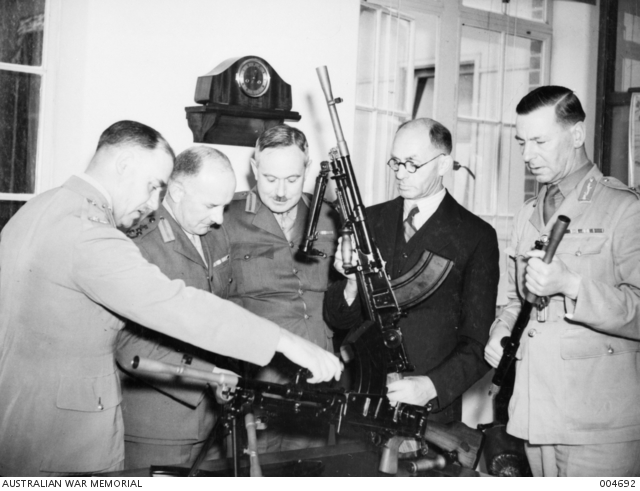
Victoria Barracks Melbourne – January 1940. The first bren gun made in Australia being inspected by (L-R) General Northcott, Brigadier Milford, Brigadier Combes, Mr John Jensen (controller general of munitions administration) and General Stantke. Source: AWM
Forty years ago, south eastern Australia was in the middle of a prolonged drought and facing a perilous bushfire season.
A new ebook provides a detailed account of the 1982-83 bushfire season from a Victorian forester’s perspective.
And while the bushfire season is best remembered for those on Ash Wednesday on 16 February 1983, where 47 people died In Victoria and a further 28 in South Australia, significant bushfires occurred right across Victoria from August 1982 until April 1983.
It was a long and hectic fire season for the Forests Commission Victoria (FCV) which attended 878 fires on State forests and National Parks totalling 486,030 ha, which was well above the 11-year average of 141,000 ha.
Over the 1982-83 fire season, 22 Total Fire Ban (TFB) days were declared. Close co-operation was maintained with the Victoria Police and Country Fire Authority (CFA) which attended nearly 3,200 fires during the summer fire danger period.
A large part of this document outlines the accumulated wisdom, achievements, planning and preparations undertaken by the Forests Commission (now DELWP / FFMVic) to build an effective firefighting organisation in the decades following the catastrophic 1939 bushfires leading up to the 1982-83 season.
Major campaign bushfires at Cann River together with a forensic analysis of the bushfire at Greendale on 8 January 1983 which killed two Forests Commission machine operators, Des Collins and Alan Lynch, is included.
The role of the Commission in major bushfires on Ash Wednesday is also described in some detail.
The aftermath of the bushfires is outlined as well as the major organisational changes introduced by the new Cain Labor State Government from mid-1983.
Sadly, very little can be easily found in old newspapers, in books, or on the internet about the significant role of the FCV.
This story of the 1982-83 fire season was assembled nearly 40 years after the momentous events using internet searches, newspaper accounts, coroner’s reports, FCV files held in the Public Record Office, witness statements, police reports, personal recollections and some limited interviews.
There remain significant gaps and sadly many of the key FCV staff are no longer alive or available to give their version of events.
My main hope is to tell some of the rich story of the Forests Commission during the 1982-83 fire season and place it on the public record in time for forthcoming 40th anniversary next year.
A free e-book has been lodged in the State and National libraries as an enduring record of the Forests Commission, and its staff’s, achievements.
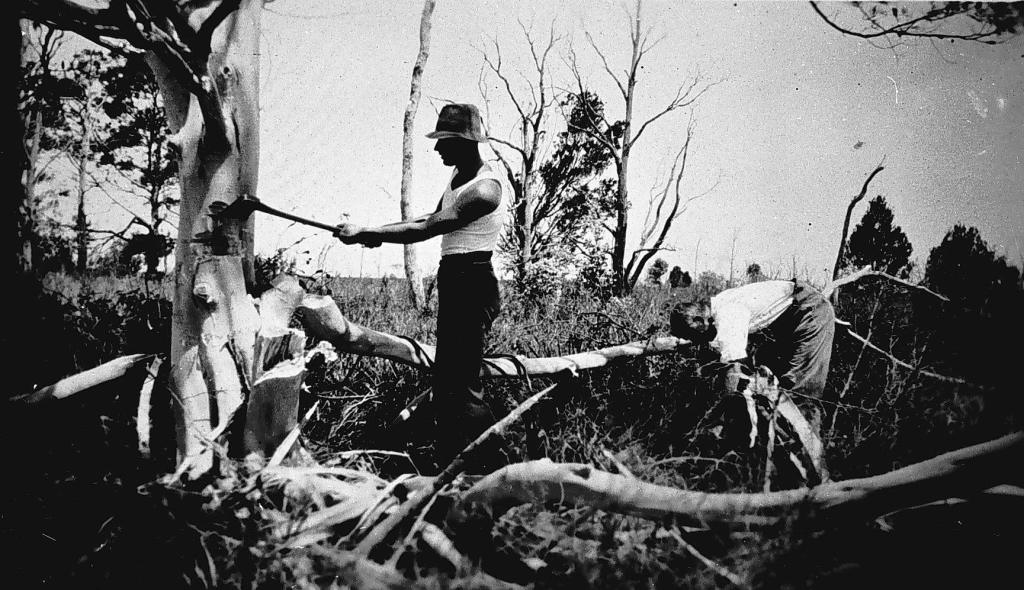
Harvesting of various wattle species began in Victoria and southern NSW around the time of the gold rush in the 1850s.
Black wattle (Acacia mearnsii) is a small, fast-growing, leguminous tree and was highly prized for tanning leather. The tannin is also used to produce waterproof adhesives in reconstituted wood products.
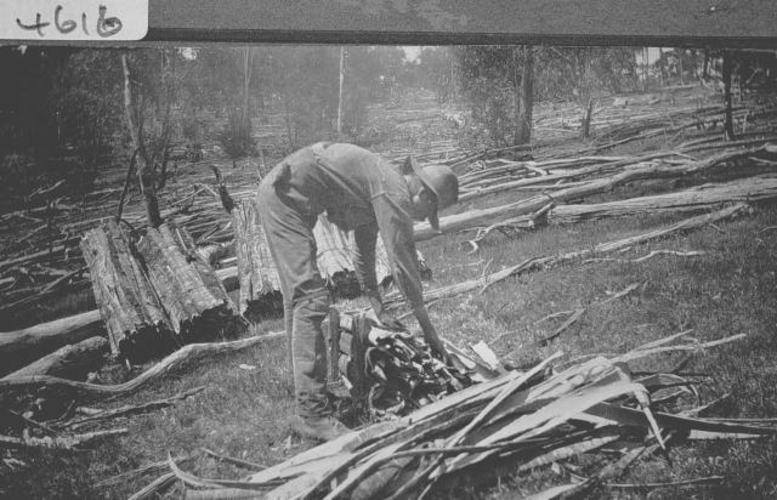
Bark was stripped from the wattles in spring and into summer when the sap began to flow which made it easier to remove. But harvesting killed the tree.
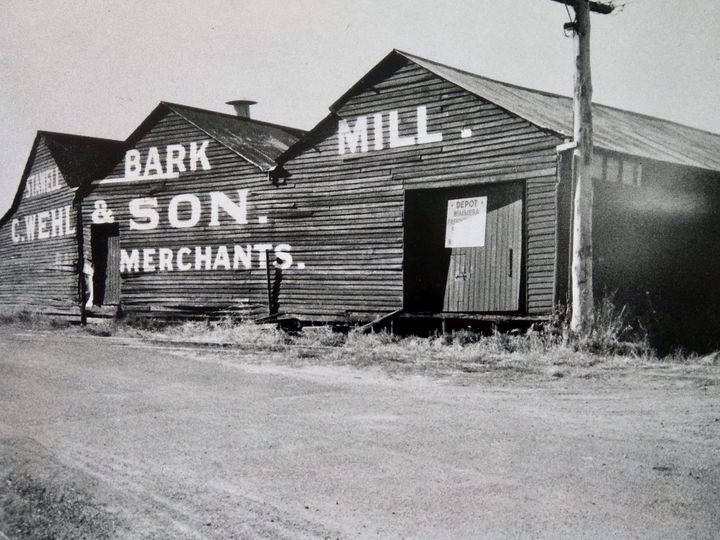
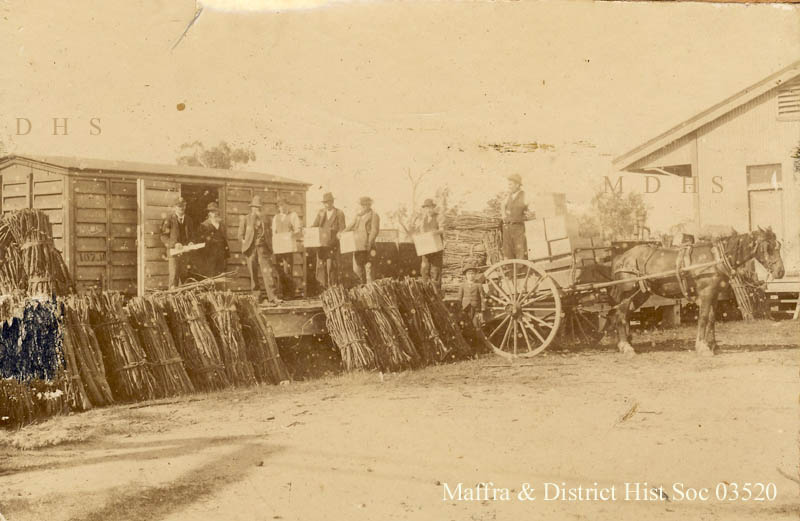
The bark was bundled and dried, then chopped and crushed by machine or by hand and mixed with water and other chemicals in deep pits to brew tannin liquor. Large hides, which had already had the hair removed by using a lime solution, were immersed in the pits until completely tanned. The hide was then stretched, dried and compressed by rolling between massive brass rollers.
Unsurprisingly, the left-over bark material was called “tanbark” and was often reused as a garden mulch or on pathways. The Tan, the 4 km path around the Royal Botanic Gardens in Melbourne, gets its name from its original wattle bark surface.
By the early 1800s, areas around Western Port and Portland were major centres for wattle bark stripping, but operations soon extended across Western Victoria and well into the southern estuaries of East Gippsland.
At Lakes Entrance bark was used to tan sails and season fishing nets to protect them from decay in the salt water.
The industry developed very rapidly and at one stage in 1868, there were 2000 tonnes of bark ready for shipment from Bairnsdale. During the period 1871 – 1884 nearly 20,000 tons of wattle bark was exported from Portland.
The establishment of tanneries at Sale, Stratford and Bairnsdale added to the demand and by 1875 wattle stripping had even extended to Orbost.
By 1882 a pound and a half of Black Wattle bark was said to make 1 lb of leather, and a ton of bark was considered sufficient to tan between 25- 30 bullock hides.
The strong demand for bark coincided with the selection of land for agriculture. Bark stripping not only helped farmers to clear their land but also provided much needed income.
State forest was also harvested by ex-miners and other itinerant workers. Bark stripping paid well but it was very arduous work.
Bakeries valued the left-over wattle branches, a by-product of bark stripping, because it produced a quick hot fire. The wattle timber also produced a very fine white ash, which could be blown out of the oven and the bread cooked in the residual heat.
Wattle was used as garden stakes.
But tanning required large quantities for fresh water and were always sited on waterways and usually close to towns. Tanneries had a reputation from being smelly and polluting waterways with effluent. Most of Melbourne’s tanneries were in the northern suburbs and along the Yarra.
But uncontrolled bark striping across the State forests nearly brought wattles to the edge of extinction.
The State Government’s concern about forest devastation and the potential impact on both the footwear and tanning industries led to the Wattle Bark Board of Inquiry in 1878.
The Inquiry had some distinguished figures including Joseph Bosisto, Member of Parliament and eucalyptus oil pioneer, and Baron Ferdinand von Mueller, the State Government botanist. The Board made many sweeping recommendations including licensing of wattle harvesting, seasonal restrictions and encouraging cultivation.
Attempts were made to grow wattle, with some degree of success. A Government financed plantation was planted in the Kentbruck area but was burnt out by a bushfire before it was harvested. Others were established at Majorca near Maryborough – 500 acres, Havelock – 300 acres, and the You Yangs – 1,080 acres
Forests Commission Annual Reports indicate an ongoing supply of tan bark from State forests at 1919/20 – 471 tons, 1929/30 – 614 tons, 1939/40 – 796 tons; 1949/50 – 424 tons and 1956/57 – 445 tons. Most harvesting had concluded by 1960 because of the increased availability of alternative chemical tanning agents.
Black Wattle is native to Australia but was introduced to South Africa in 1871 and now dominates what remains of the global market.
Report of the Wattle Bark Board of Inquiry – 1878.
Photograph probably taken late 1800s – early 1900s (Source: FCRPA) : Wattle bark stripped to be used to produce tannin.Stripping wattle bark, Meerlieu, 1925. Photo: MV – https://collections.museumsvictoria.com.au/items/769766Meerlieu, Victoria, circa 1925. https://collections.museumsvictoria.com.au/items/772828Three men with a wagon load of wattle bark. The load was 3 tons and was worth 11 pounds per ton. Balmoral District, Victoria, 1928. https://collections.museumsvictoria.com.au/items/769425Stripping wattle bark. Source: FCRPAWattle bark mill between Percy and Richmond Streets, Portland. Source: Vern McCallum Collection – FCRPABinding wattle bark, Bairnsdale district, 1923. Photo: https://collections.museumsvictoria.com.au/items/766941SLSA B15824, taken 1885 at Mount Gambier. “Bark mill and tannery in Edward Street, Mt. Gambier. “Source: Stawell Historical SocietySource: Vern McCallum Collection – FCRPA