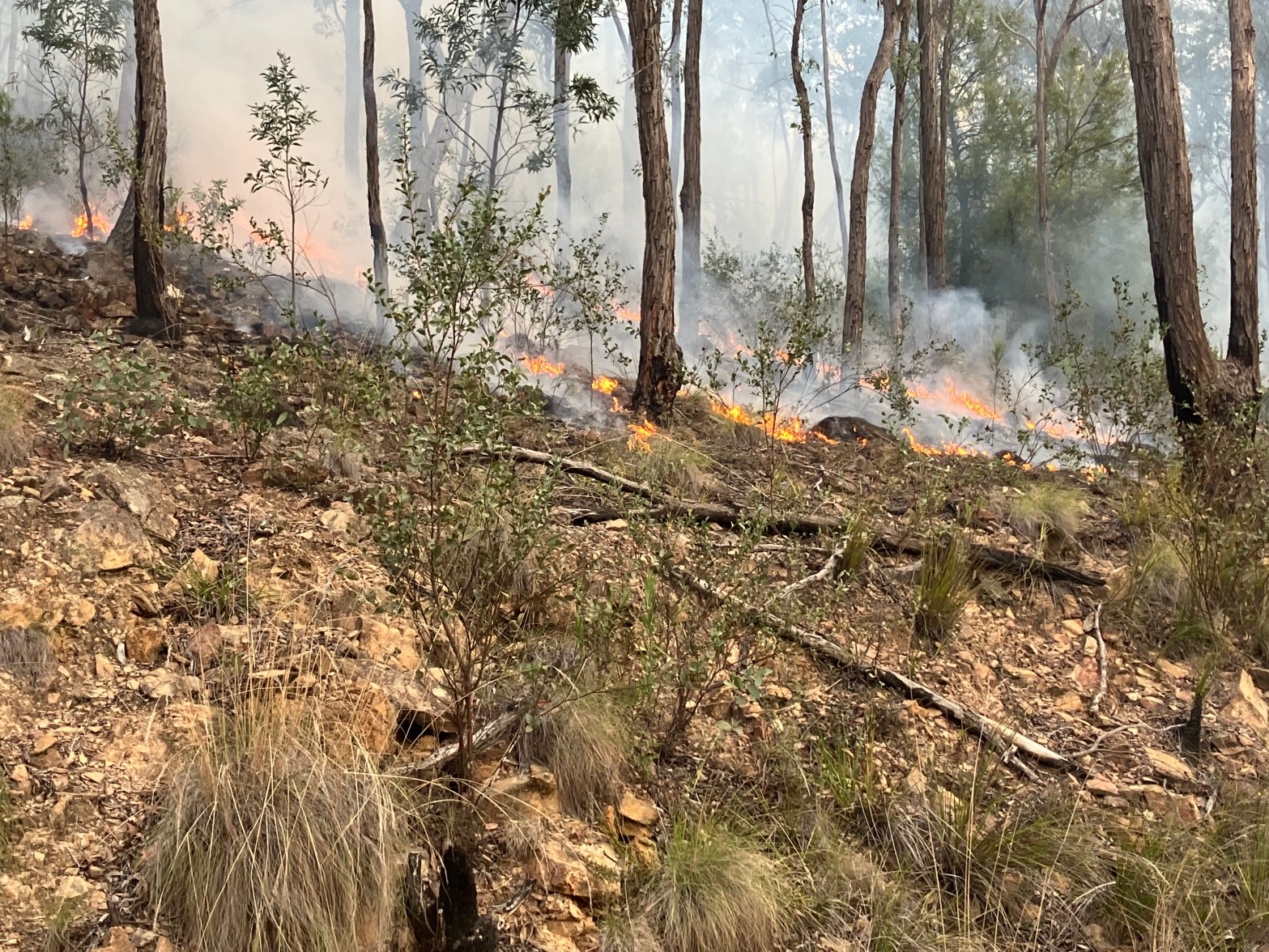
Fuel Reduction Burning / Mosaic Burning / Landscape Burning / Asset Protection Burning / Hazard Burning / Slash Burning / Patch Burning / Ecological Burning / Back Burning / Cool Burning / Indigenous Cultural Burning… are all these terms more or less the same thing?
Well… it depends on the objectives of the burn…
Fuel Reduction Burning on public land is contentious and much of the heated debate is often misreported and confused depending on terminology and the objectives of burning.
Furthermore, Fuel Reduction Burning has created an unrealistic and simplistic expectation that it offers some kind of “magic bullet” that can prevent and stop the run of bushfires and guarantee the protection of life and property.
Some of this misinformation has been driven by the media, and some by strident critics, who readily find examples to highlight where recent fuel reduction burns have failed to stop damage by running bushfires in adjoining areas.
But there is also plenty of evidence where fuel reduction has made a big difference to controlling bushfires and saving life and property.
There are also some reasonable concerns about long term ecological impacts, habitat tree loss, smoke and the possible regrowth of flammable understory after hot burns.
Bushfire and forest management is often about balancing competing demands, but for the avoidance of any doubt –
The 2009 Victorian Bushfires Royal Commission clearly established the principal of the “primacy of life” which dictated that the protection of human life and community safety must be the absolute highest priority in all bushfire policy, planning, and operational decision-making.
So how long does Fuel Reduction Burning last?
How the bush responds to fuel reduction burning is complex and depends on the forest type and the fire regime.
The fire regime is generally described in terms of the long-term cycles and patterns of fire intensity, fire frequency and season of the year when the burning occurs.
Kevin Tolhust’s research work in the Wombat State Forest is probably one of the best and most recent scientific studies addressing this.
The effectiveness of fuel reduction burning also depends on how recent it was, the proportion of the total area burnt, the extent to which bark, fine and heavy fuels have been reduced and the pattern of the burnt fuel.
Importantly, fuel reduction burning aims to reduce and not eliminate forest fuels and ideally to protect tree crowns.
It’s true that the effectiveness of fuel reduction burning on the fine and surface fuels diminishes quickly after about 3-5 years depending on forest type.
But although surface fine fuels can build up again quickly, the overall fuel hazard usually increases much more slowly over 20 years or more as bark and elevated fuels regrow and reestablish. (See: Understanding Fuel)
Also, the first burn in older and long unburnt fuels (aka – reset burns) is always more difficult to achieve without crown scorch, particularly if heavy bark fuel like messmate has been allowed to accumulate and there are plenty of elevated ladder fuels. But subsequent burns in the lighter fuels can be carried out over a wider range of weather conditions with less scorch.
Burning to reduce fire hazard is not set-and-forget, it needs ongoing attention and maintenance. Following up with low intensity burning a few years after the first reset burn can reduce the flammable scrub regrowth to produce a more open understory and mosaic of fuel ages.
Similarly, burning in young and dense eucalypt regrowth can be difficult.
The Tolerable Fire Interval (TFI) is used when planning burns. It is the recommended time span between successive fires in specific ecosystems to allow local plant and animal communities to recover, reproduce, and maintain their ecological health. For example, it takes mountain ash (E. regnans) about 15 years to establish after major bushfires and set seed.
Burning prescriptions & crown scorch.
Burning prescriptions for dry Victorian foothill forest (without wiregrass) are typically in the range – FFDI < 10 on day one and < 12 on day two, drought index < 50, stable atmosphere, temperature 18-27 degrees, RH 35-70%, wind speed < 20 km/hr and fine fuel moisture content 9-16%.
The prescriptions help to set the limits of weather and fuel, sometimes called the “window of opportunity”, for conducting safe and effective operations.
Depending on Victoria’s summer bushfire season, the number of days suitable for fuel reduction burning, is very short, averaging only 50 to 80 days per year.
Ideally, the burn intensity should be low enough not to damage the tree crowns.
As a rule of thumb, scorch height is about six to seven times the flame height.
A low fire intensity of 500 kw/m was traditionally recommended as a threshold to fuel reduction burning in foothill eucalypt forests…. This equates to about 1m flame height with very slow Rates of Spread (ROS). At this lower level of fire intensity, crown scorch is limited to approximately 10% of the burnt area.
However, in my opinion, some of the present fuel reduction burning, particularly in asset protection zones on public land, often results in fire that is too hot.
From what I have recently observed, it’s now very common to see the ignition of continuous lines of fire around the perimeter (rather than well-spaced spot fires), followed by adding more fire inside the planned area (sometimes with helicopters). This gets the task completed quickly and efficiently but can create a very hot fire with a large unstable convection column which inevitably leads to excessive crown damage.
Importantly, in most Victorian foothill forests, removing or damaging the overstory tree crowns lets the sunshine reach the ground which can lead to a pulse of understory regrowth. In no time, the leaf litter, surface, elevated and ladder fuels return which has a major impact on overall fire hazard. Although, bark fuel can take 10-20 years to return.
I appreciate that many are reset burns with high accumulated fuel loads. There are also operational pressures to complete a large burning program within a limited window and to restrict burn-out times to about 24 hours. This reduces smouldering fuels that could reignite, lowers patrol and blackout effort, which allows crews to leave safely and move on to the next burn.
But it takes training, patience and discipline for firefighters to let the small fires trickle slowly to reduce crown scorch which damages the forest overstory. A driptorch in inexperienced and poorly supervised hands can quickly cause significant damage.
Burning masterclass.
Firstly, it’s worth noting that no matter how well you planned it, once the first match is dropped, the fire and flames behave in accordance with the fundamental principles of the chemistry of combustion – heat, oxygen and fuel – and do not follow ideology or intent – you have just lit a bushfire. Greg McCarthy (AFSM), Legendary Fire Behaviour Analyst.
But it is possible to “steer” the fire by having a sound understanding of weather, fuel, topography and fire behaviour.
The lighting pattern and time of ignition are critical to minimising fire behaviour and crown scorch.
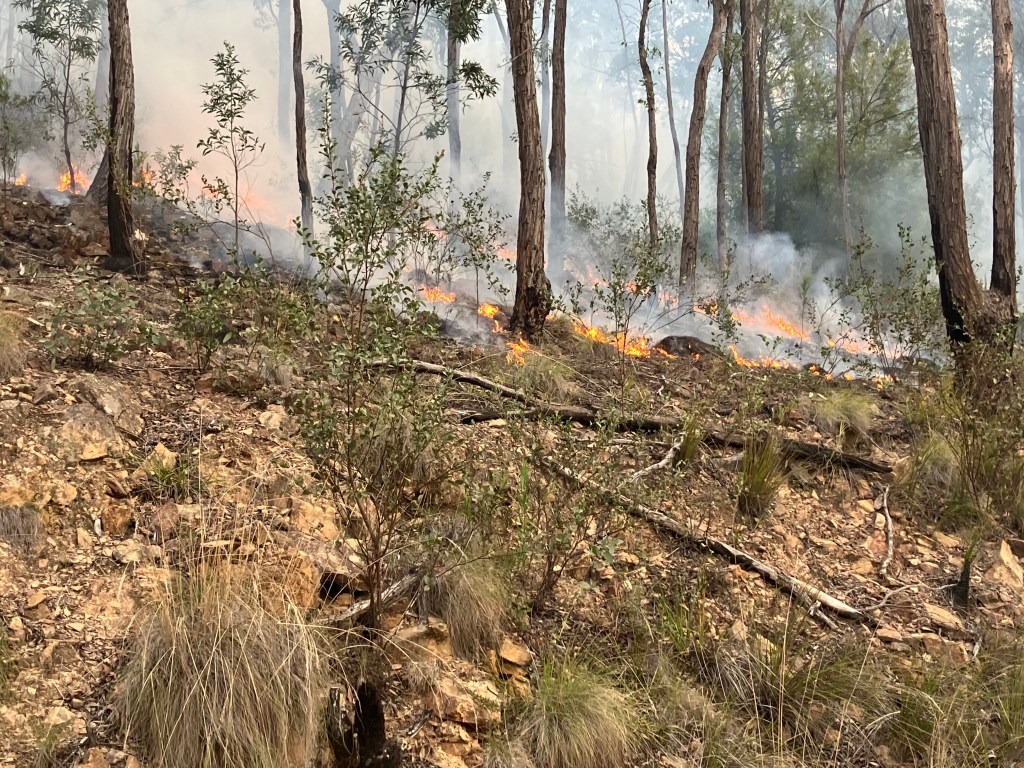
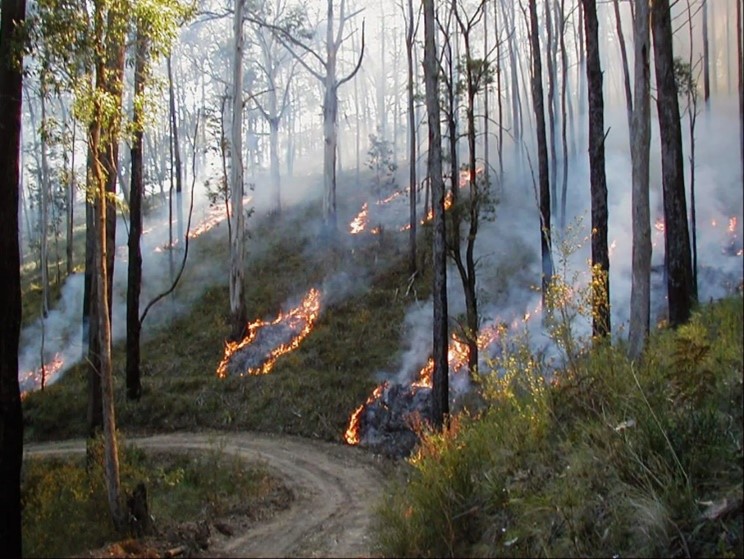
Igniting small, well-spaced spot fires, and letting the fire slowly burn outwards in expanding circles and then trickle downhill and against the wind in the late afternoon or early evening, and well past the hottest part of the day, when the Relative Humidity (RH) is beginning to rise and the temperature, wind and FFDI is beginning to fall, will reduce flame height and fire intensity. (e.g. landscape burning).
Leaving burns in Asset Protection Zones to trickle overnight, and often unattended where there may still be some residual unburnt fuel, is now way too risky, especially after the escapes near Lancefield in 2003 and 2015.
But in my experience, landscape protection burns, which are well away from houses and settlements, the prescriptions are another matter.
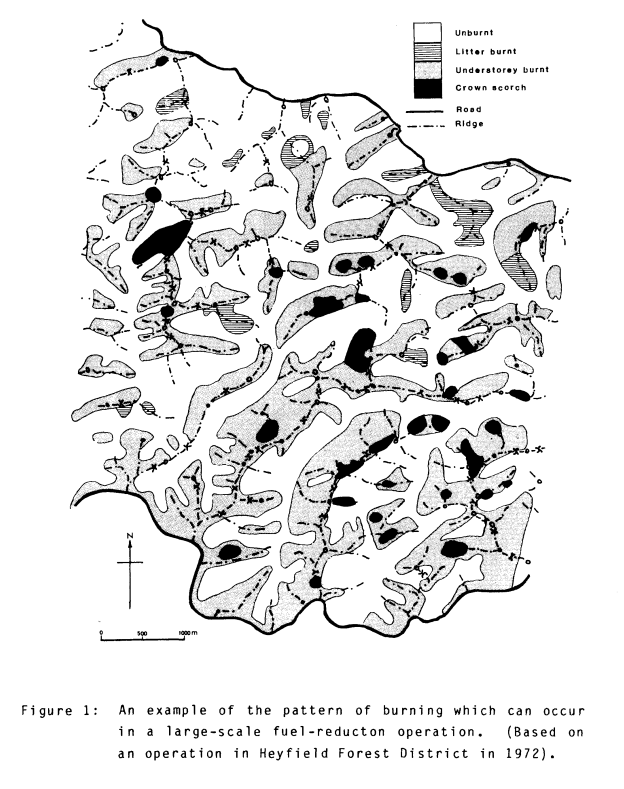
In broadscale Landscape Protection Zones, the prescriptions allow for a much lower fire intensity with a patchy end result and minimal crown scorch.
Landscape burning should be done in autumn, as the wet weather approaches, rather than spring and moving into a drier summer. The FFDI should be less than 8; the Relative Humidity should be more than 45%; the atmospheric conditions should be stable; fuel moisture levels should be greater than 10%; with an upslope wind as preferable but not always possible.
Asset protection burns tend to be smaller and take less time, but some landscape burns cover very large areas and are done in stages, so they may need one to two weeks of continuous stable weather to set up, light and patrol. They also often require moving crews, equipment and aircraft from across the State to take advantage of the weather conditions, which presents a bundle of logistical issues.
The boundaries for landscape burns do not need to be as hard (e.g. constructed control lines, major roads or strategic breaks) but rather can be left unbounded to extinguish against natural boundaries like rocks, damp creeks or shady areas on southerly aspects.
The areas targeted for ignition with landscape burns are generally a smaller subset of the gross area identified for treatment, with a focus on the top third of the ridges, on the drier north side.
Burning Risks.
Make no mistake, fuel reduction burning is complex and risky. Many considerations are made including – burning objectives, prescriptions, weather outlook, nearby community assets, fuel type, fuel quantity and arrangement, bark type, Rate of Spread (ROS), flame height, topography, burn area and perimeter, available resources, lighting pattern, ignition timing and techniques, smoke drift, hazardous trees, residual burn out time, areas to be protected, safety zones and fall-back options.
Prevention of bushfire is much cheaper and less damaging than bushfire suppression, but it’s very hard to judge the effectiveness of avoiding something that didn’t ever happen. It’s a bit like assessing preventative medicine.
The key to success is having all the preplanning and preparation done, with approvals and notifications in place, and then giving staff the freedom to nimbly take advantage of local burning opportunities when they occur, whatever the season, or time of day.
But the current requirement to notify neighbours and other authorities (e.g. VicRoads etc) at least 48 hours before ignition can considerably hamper any agility.
Fuel Reduction Burning can and does go wrong (but very infrequently) and the community, armchair experts, politicians and the media are quick to criticise and are very unforgiving.
A major turning point came on 19 November 1994, when a Fuel Reduction Burn at Moggs Creek on the Great Ocean Road got away. What had been intended to protect homes in the highly flammable coastal scrub, instead destroyed or damaged several of them. Hundreds of residents were evacuated, lawyers became involved, and the fire agencies were left ducking for cover.
The Moggs Creek fire rewrote the terms on which fuel reduction burns could be lit, effectively putting a damper on the practice for the next decade. And often, it simply became easier not to burn at all.
Other notable examples of escaped planned burns that reinforced organisational risk aversion include Cobaw in April 2003, Wilsons Promontory in March 2005 and Lancefield in November 2015.
Each escape was investigated and new systems and controls introduced (some would say too many).
Further Reading:
National Guidelines for Prescribed Burning Operations: Case Study 4 – Multi-year landscape mosaic burning in forested mountain terrain using natural boundaries https://knowledge.aidr.org.au/media/4876/afac_ops-guide_case_study_4.pdf
Ecological effects of repeated low-intensity fire in a mixed eucalypt foothill forest in south-eastern Australia summary report (1984–1999)
1985 FCV report for a set of 10 case studies.
More recent FFMVic case studies.
https://www.ffm.vic.gov.au/bushfire-science/planned-burn-case-studies
Fire research publications.
https://www.ffm.vic.gov.au/bushfire-science/fire-research-and-adaptive-management-publications
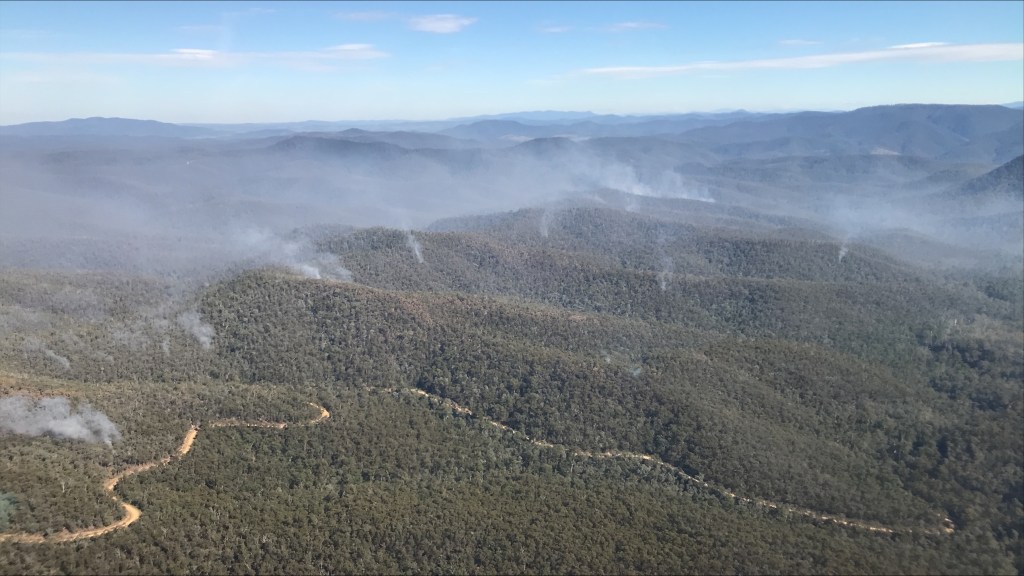
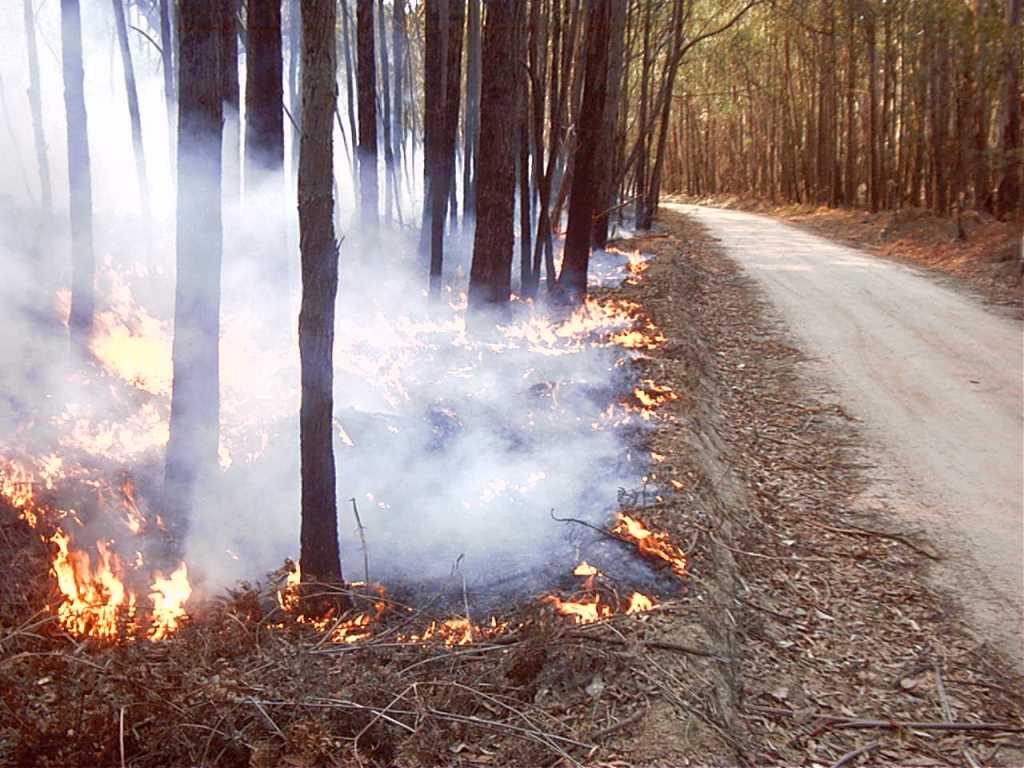
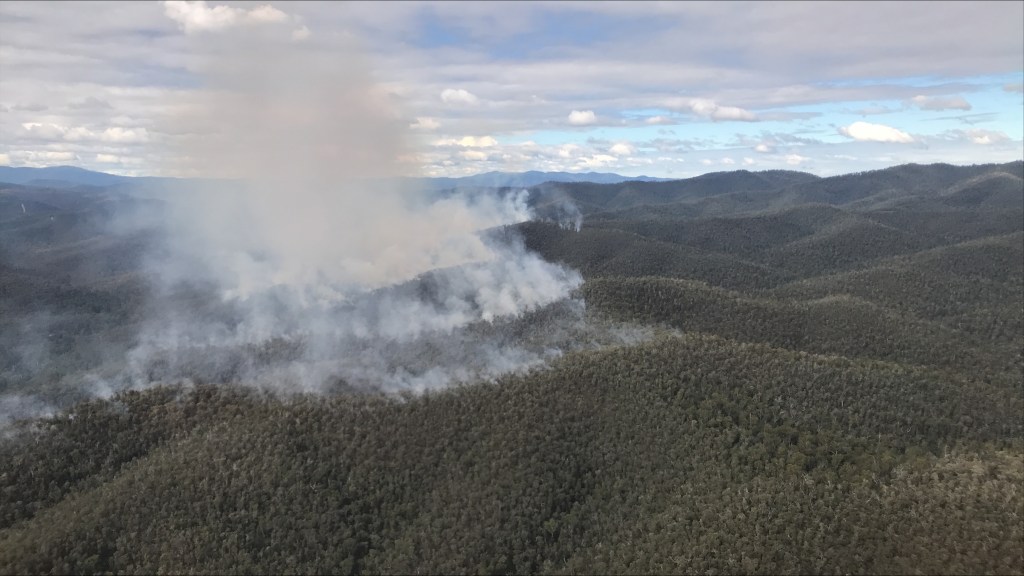
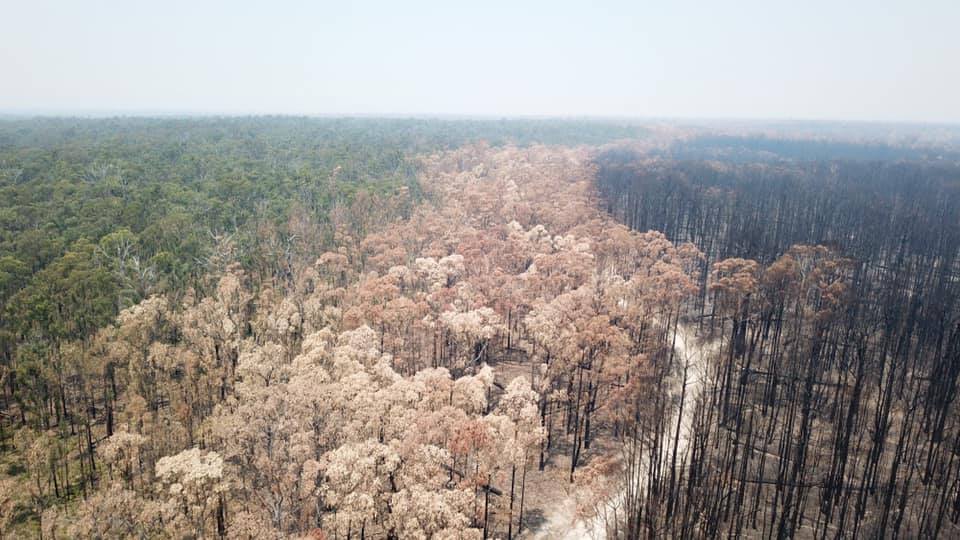
These DELWP photos are of Painted Line Track north of Orbost. The main bushfire was hot and burnt on 30 December 2019. The green areas on the left were subjected to a fuel reduction burn 20 months earlier in April 2019.
In this case the fuel reduction burn has completely stopped the run of the crown fire at the boundary of the fuel reduced area. There is about a 20-metre strip of trees scorched by the heat of the crown fire and then the fire went out. Crown fire cannot be sustained if the ground fuels are at low levels.
The effectiveness of fuel reduction burning as a firebreak diminishes quickly after about 3-5 years.

