Put simply – less fuel equals less fire.
Reducing the overall fuel load, particularly bark fuels, together with changing near surface and elevated fuel arrangement by burning or mechanical treatments like slashing or mulching are the only large-scale techniques that forest managers have available to them of lessening bushfire behaviour.
Fire weather cannot be controlled, whereas fuels can (with some caveats).
Section 62(2) of the Forest Act (1958) requires –
The Secretary must carry out proper and sufficient work in State forests, national parks and on protected public land –
(a) for the immediate prevention and suppression of fire; and
(b) for the planned prevention of fire.
This legal obligation on DEECA / FFMVic is very onerous.
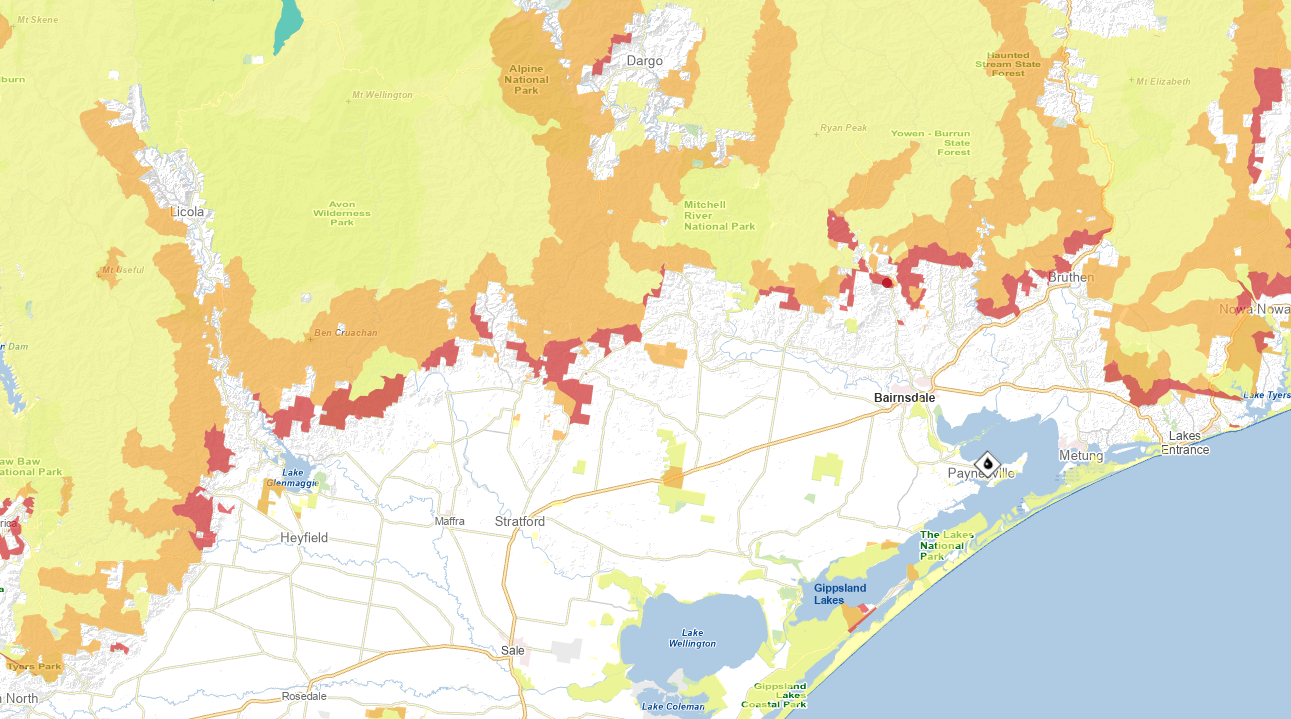
In Victoria, there are a couple of zones used to plan burns on Protected Public Land (National Parks and State forests).
- Asset Protection Zone – usually done more frequently close to private property and settlements to reduce radiant heat and ember attack. In addition to burning, the works may include road and bridge upgrades, strategic fuel breaks, mulching, mowing and treatment of dangerous trees.
- Moderation Zone – designed for the middle region to reduce the speed and intensity of bushfires and to reduce ember attack.
- Landscape Zone – fuel is reduced across a broader landscape, often on the dry ridges in the remote backblocks.
- Exclusion Zone – where planned burning is avoided, such as wet mountain forests, alpine meadows and rainforests.
There are two very important things that recent Fuel Reduction Burning (FRB) can offer fire fighters on the ground.
- Fuel breaks to stop or slow a running fire using direct attack.
- Lower fuel hazard to give more options for safe access, control lines and anchor points using indirect attack.
1. Fuel Reduction Burning as a fuel/fire break.
Fuel Reduction Burning to reduce fuel to create a fire break (or more correctly fuel break) is a well proven means of lowering fuel hazard.
However, the effectiveness of the fuel reduction burning to stop or slow the spread of bushfire depends on many complex factors. They include how hot the bushfire is at the time (flame height and fire intensity), how fast it is moving (Rate of Spread), how recently the fuel reduction burning was done, and what proportion of the fuel was removed.
The location, size, depth and shape of the fuel reduced area are also important, particularly if there is long distance spotting ahead of the main front.
The weather at the time of impact of the main fire, particularly temperature, wind speed and fuel dryness, is critical to the final effectiveness of the fuel break.
It’s also true that fuel reduced areas can be ineffective at stopping the run of fast-moving, high intensity bushfires where the weather, and not fuel, becomes the main driver of fire behaviour and long-distance spotting is evident (e.g. FFDI > 50).
No amount of heroic suppression effort by on-ground crews or aerial firebombers can overcome the deadly combination of extreme weather, rugged terrain and heavy accumulation of fuels when a bushfire escalates to landscape scale.
But these extreme fire conditions don’t occur as often as many might believe. It’s just when the media takes an interest.
While there is high variability over the summer danger period, benign weather conditions with Low to Moderate (FFDI < 24) are much more common than not. Nights are also generally cooler with moister air (high RH) and lower wind speeds leading to lower FFDI. Higher fire danger days occur more often in northern Victoria.
Average number of “Very High” fire risk days (FFDI > 25) in Victoria per year (1973-2016). Source: CFA
- Walpeup (representing far northwest Victoria) – 60
- Wangaratta (representing the northeast) – 17.5
- Bairnsdale (representing the southeast) – 3.5
- Mortlake (representing the southwest) – 12
- Melbourne (representing central Victoria) – 12.5
The summer fire season generally stretches over 5 or 6 months (150 – 180 days) with a peak generally from December to February when most of the Total Fire Bans (TFBs) are imposed. For example, during the 2023–24 season, there were 11 TFB days declared, which often coincided with Extreme fire risk (FFDI > 50), across the State.
Fuel reduction burning slows the spread of bushfires, reduces their intensity, and lowers the potential for spot fires – CSIRO.
But the critics of fuel reduction burning often focus on losses and damage caused during extreme weather conditions and readily cherry-pick to find examples to highlight where recent fuel reduction burns have failed to stop damage by running bushfires in adjoining areas.
However, there are plenty of examples where recent FRB has stopped or slowed the forward Rate of Spread (ROS) of bushfires and given firefighters a chance to gain access and control it. There are also some spectacular examples where it has stopped the run of a hot bushfire dead in its tracks (e.g. Painted Line Track, 30 December 2019 – Orbost).
In most cases, first attack is successful and bushfires are quickly contained without fuss or fanfare. But these impressive efforts by fire crews go mainly unnoticed by the community and unreported by mainstream media. For example –
In 2023-24, a total of 1,179 fires occurred on Victoria’s State forests and National parks and 92% were kept to less than 5 ha in size, and a whopping 96% were contained by 8.00 am on the day following detection.
There are also a handful of examples where long unburnt and wetter forests have stopped or slowed a running edge. During the Black Saturday bushfires in 2009, a slow-moving fire burnt slowly overnight through the thick undergrowth in the wet 1939 regrowth mountain ash forests on the Black Spur.
But conversely, the 2009 Black Saturday fire in the Wallaby Creek catchment burnt and killed ALL the old the mountain ash forest (some stands predating 1770), but in other nearby areas, there was a lower rate of spread, severity and crown scorch which occurred on the SW wind change later in the afternoon.
2. Fuel Reduction Burning giving options for safe access and control.
Once a bushfire becomes established in heavy and continuous fuels, under adverse weather conditions, the scope for safe direct attack rapidly narrows.
But weather alone does not shape bushfire destiny.
Preparedness, early detection, with quick access by crews, machinery and aircraft, combined with aggressive first attack, are proven keys to early success.
Very importantly, areas that have been recently fuel reduced can give a better chance of control using indirect attack as well as providing a safe refuge for on-ground fire crews.
In conjunction with roads and strategic firebreaks, areas that have recently been fuel reduced give options for anchor points for control lines and safe access for large scale backburning.
Fuel reduced areas can help stop a 1,000-ha fire becoming a costly and prolonged 100,000-ha campaign fire with a huge perimeter to be controlled.
Reducing fuel has been shown repeatedly to help keep bushfires small and contained on public land and stop them from threatening private land, farms, towns and settlements.
1985 FCV report for a set of 10 case studies.
More recent FFMVic case studies.
https://www.ffm.vic.gov.au/bushfire-science/planned-burn-case-studies
Fire research publications.
https://www.ffm.vic.gov.au/bushfire-science/fire-research-and-adaptive-management-publications
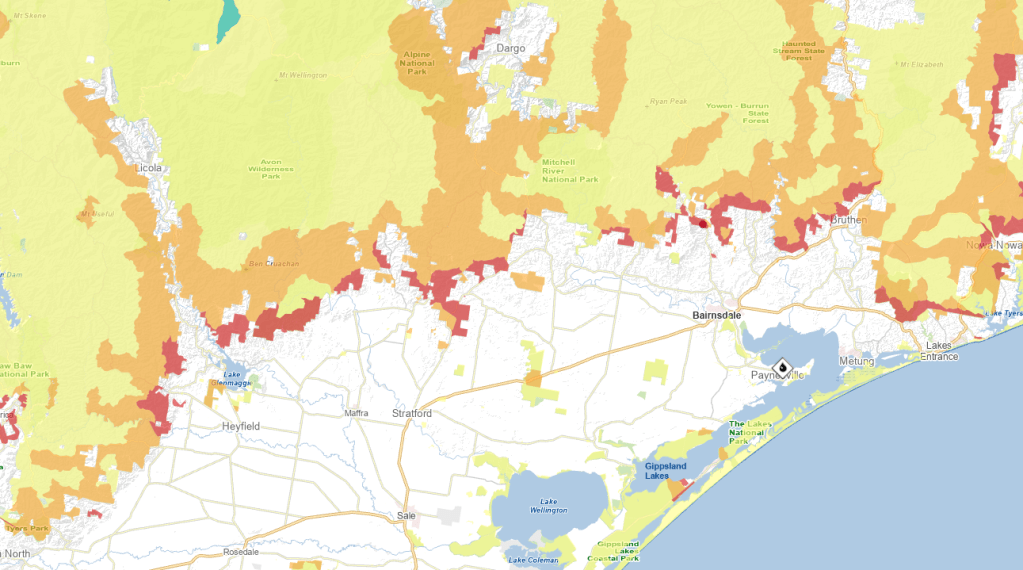
Asset Protection Zone – dark orange near settlements
Moderation Zone – light orange
Landscape Zone – yellow

