Late one summer afternoon in the early 1980s, a small fixed-wing firebomber was dispatched from Benambra to a smoke sighting near Gelantipy which had been reported by the local firetower.
The experienced bush pilot took-off in the fading light and lengthening shadows to try and locate the fire but couldn’t find it.
On the return trip, he caught a glimpse of a faint wisp of smoke deep in the Snowy River valley below and without hesitation, and with characteristic daring-do, flew straight down like a Stuka dive-bomber.
Because the small aircraft was fully loaded, and because the sides of the rocky gorge were so steep, the only way out was to dump the load then pull back sharply on the control stick to climb vertically out of the ravine under full throttle.
By now it was getting dark so without checking the drop he returned to the airbase to get ready for the next morning’s flight.
Yep… you guessed it… a day or two later there was a phone call to the FCV Orbost office from some very irate kayakers who had been fatefully drying their wet clothes around a campfire that afternoon. Not only did the load of retardant put their fire out and make it impossible to relight, but their clothes got smothered in the messy red gloop.
Among his many legendary and probably embellished shenanigans, the same pioneering daredevil is said to have…
Crash-landed in State forest on Mt Baw Baw in 1961 after the wings of his Piper PA-25 iced-up and then walked three hours through the thick scrub to safety…
Dropped a load of phoscheck retardant on a group of visiting Forests Commission and CSIRO dignitaries during the early 1960s firebombing trials at Mt Raymond, leaving red splattered cars and speckled white shirts…
Flown Australia’s first-ever operational firebombing mission from Benambra on 6 February 1967…
Barnstormed under the old Snowy River Bridge at Orbost in June 1975…
Swooped the Benambra football team and strafed them with fertilizer…
Landed and refuelled his plane at a service station at Ceduna in December 1973…
Performed unauthorised low-level aerobatics at ESSO’s Longford heliport in 1970…
Allegedly buzzed an offshore oil platform in the Bass Strait like “Top Gun” and bounced his wheels down on its tiny helipad…
Needless to say, his larrikin antics and escapades often got him into big trouble with aviation authorities.
But this affable knockabout bloke also selflessly airlifted many locals to hospital in Melbourne or Albury.
I’m reminded of a quote made in 1949 by pioneering American aviator, E. Hamilton Lee who famously said….
“There are old pilots… and there are bold pilots… but there are no old, bold pilots” ….
The 1926 Black Sunday bushfires are largely forgotten now, being overshadowed by the catastrophic 1939 Black Friday bushfires thirteen years later.
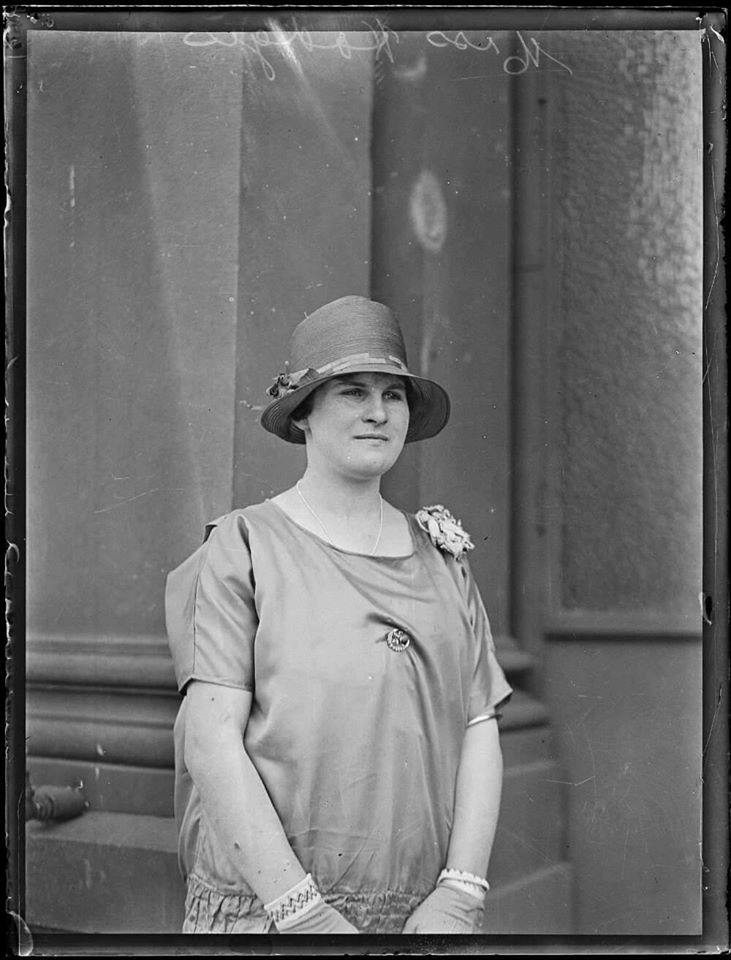
The amazing story of fifteen-year-old Florrie Hodges, who later captured the hearts of the nation, has mostly been forgotten too.
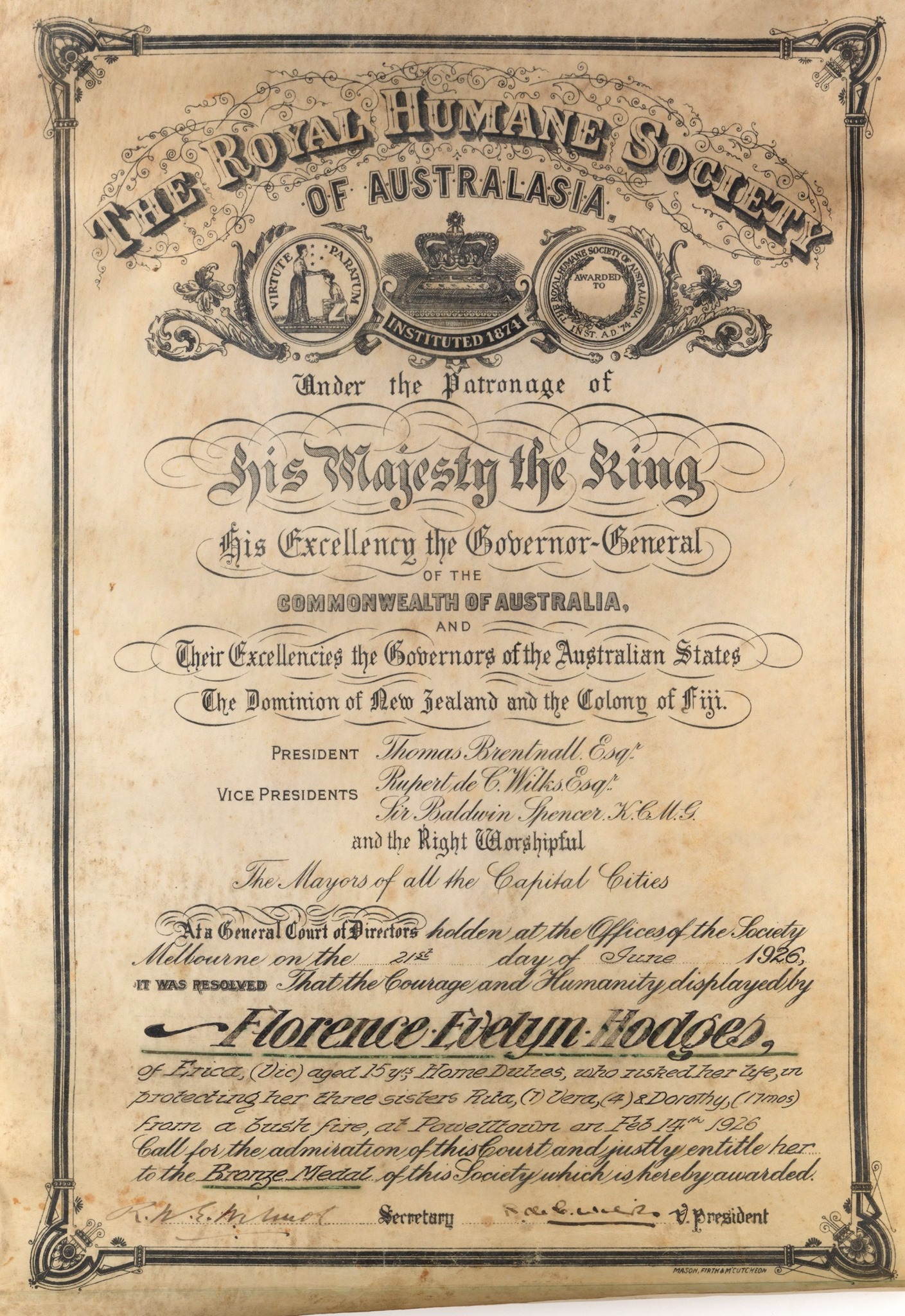
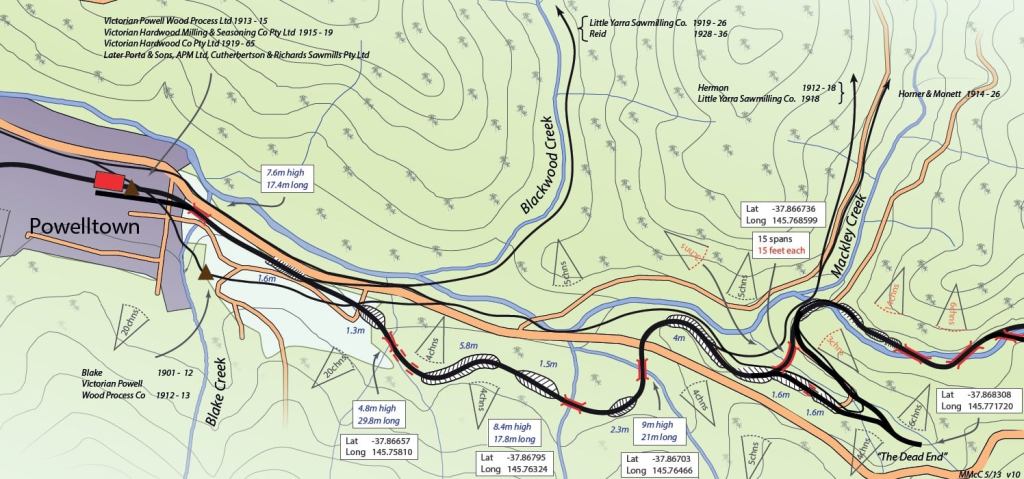
Florrie lived with her family at the small Horner and Monett’s sawmill, deep in the bush on Mackley’s Creek, about 7 miles east of Powelltown. There were no roads, only narrow timber tramlines.
On Sunday morning, 14 February 1926, she was at home when the bushfire exploded all around them and the mill caught fire.
Her mother instructed Florrie to go with some other families fleeing from the mill and take the children to safety at Powelltown.
Florrie walked through the bush for some miles with her sisters, Rita aged 7, Vera aged 4 ½ and Dorothy 18 months. Rita was on her back with Vera and Dorothy in her arms.
When she saw the fire ahead of her, they turned back and dropped into a small creek. Florrie soaked all the children’s clothes, but they could not stay long in the water because the trees and scrub growing along the edge of the creek were alight and branches were starting to fall on them. The water was getting hot, so they hurried out but there was fire all around them.
Trapped by flames and unable to reach safety, Florrie sought refuge on the timber tramway track. They huddled together, blinded by the thick smoke and scorching heat. Rita was then taken by one of the others in the party trying to escape.
Florrie was then all alone and frightened but remained with her two little sisters as the bushfire swept over them. She crouched on the tracks over the children to shield them from the flames.
Burning bark was falling on them. Her hair and clothes caught alight, and her legs were badly burnt.
They remained in the smouldering bush for two hours until the flames had passed. Her distraught father then arrived, searching, but not expecting to find his children alive.
All three survived but Florrie suffered severe burns and was hospitalised for many months at St Vincent’s Hospital in Melbourne. She was left disabled and disfigured.
Stories of the heroics of “the little bush girl of Powelltown” emerged and Florrie quickly became a national celebrity.
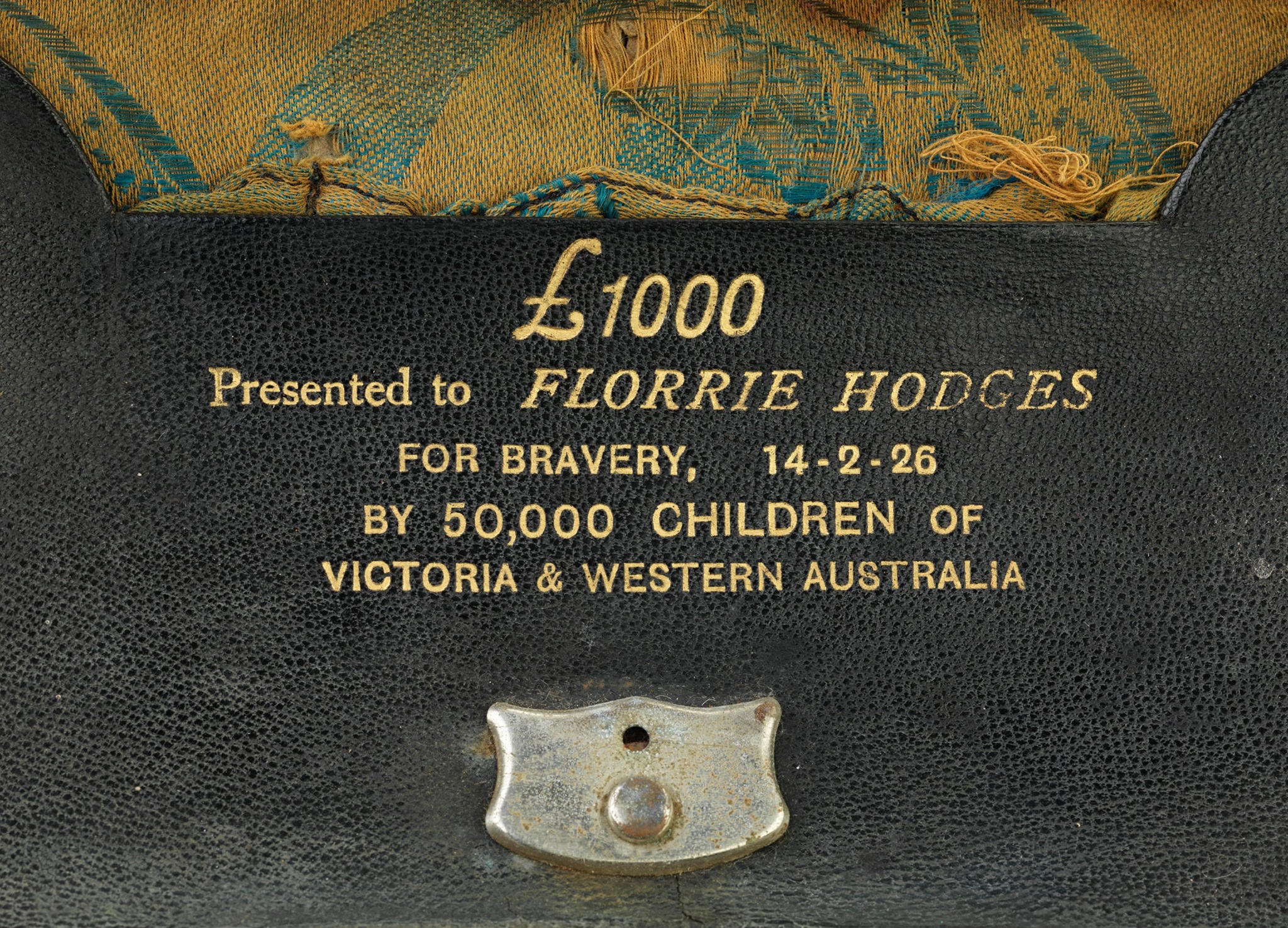
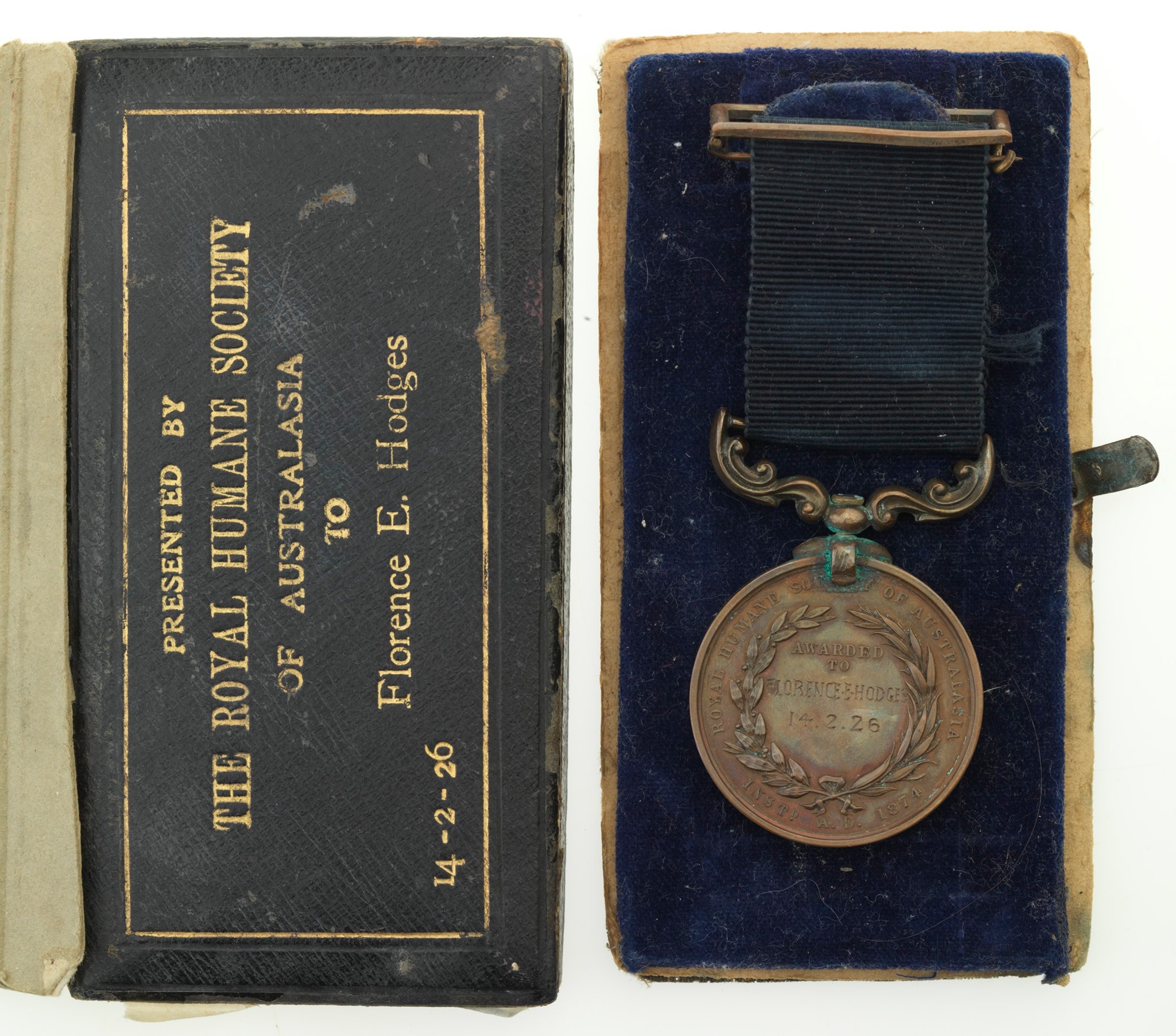
The Royal Humane Society awarded Florrie a bravery medal and the Timber Workers’ Union raised some £1,000… a huge sum which was held in trust until she turned 21. The money was presented in a special purse.
A souvenir booklet of her exploits was published, 100,000 photographs were distributed to school children across the nation, her story was retold in schools on Empire Day, and a gramophone record was released by the Columbia Company of Florrie telling of her heroic deeds.
Photographs of the “Australian Heroine” were presented to Queen Mary and the Duchess of York. A version of Florrie’s story as told by celebrated author Mary Grant Bruce was published in The School Magazine produced by the NSW Department of Education.
Politicians, unionists, even famous actors were all keen to share the stage with Florrie at various events held in her honour around Australia.
But when asked to speak, Florrie humbly replied that “she thought that any Australian girl would have done what she did”.
Florrie married soon after the accident when she was sixteen. Her husband Bill worked in the timber mill and had also been burnt in the fire. They lived a simple life together.
Florrie is remembered by her family as a tough, no-nonsense woman, who didn’t talk much about the fires of Black Sunday 1926. She passed away in 1972.
There has been a lot of talk about heroes in recent times, whether they be firefighters, police or front-line health workers. It’s become a bit of a throwaway line… but to my mind, the real heroes are the quiet ones like Florrie Hodges.
Nikki Henningham (2020) On being brave: Florrie Hodges and Lessons from the 1926 Bushfires
In early February 1951 a couple of small fires were burning unchecked near Yanakie, at the northern end of Wilsons Promontory National Park.
One was believed to have escaped from a campfire left unattended at Tin Pot Waterhole which was outside the northern boundary of the park.
They had been burning for almost three weeks, and in the words of one observer “the fires were not serious”.
But as the summer weather and hot northerly winds intensified one of the fires swept into the park and through the scrub and heathland towards the southwest.
The fire destroyed the remnants of the cattle fence on the northern boundary of the park along the way.
The fire was driven by a strong gale along the Vereker Range towards the lighthouse, a distance of approximately 22 miles, and was only halted by the ocean.
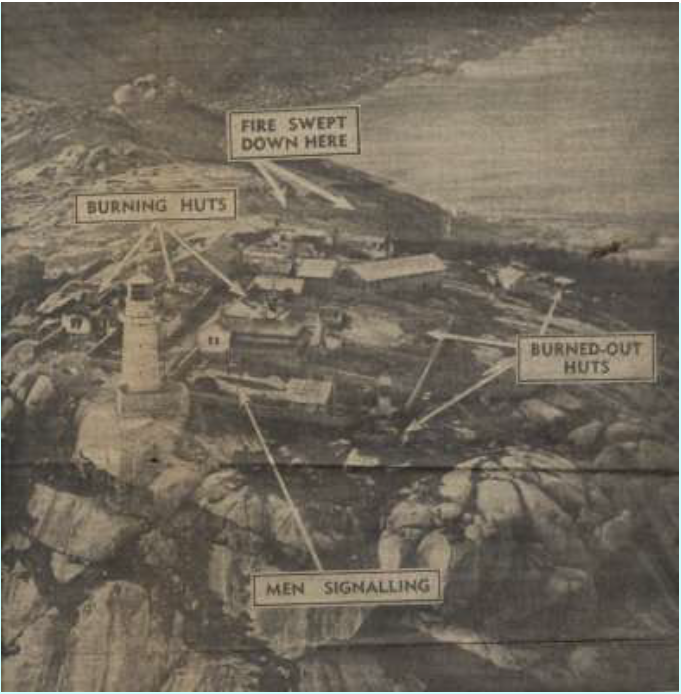
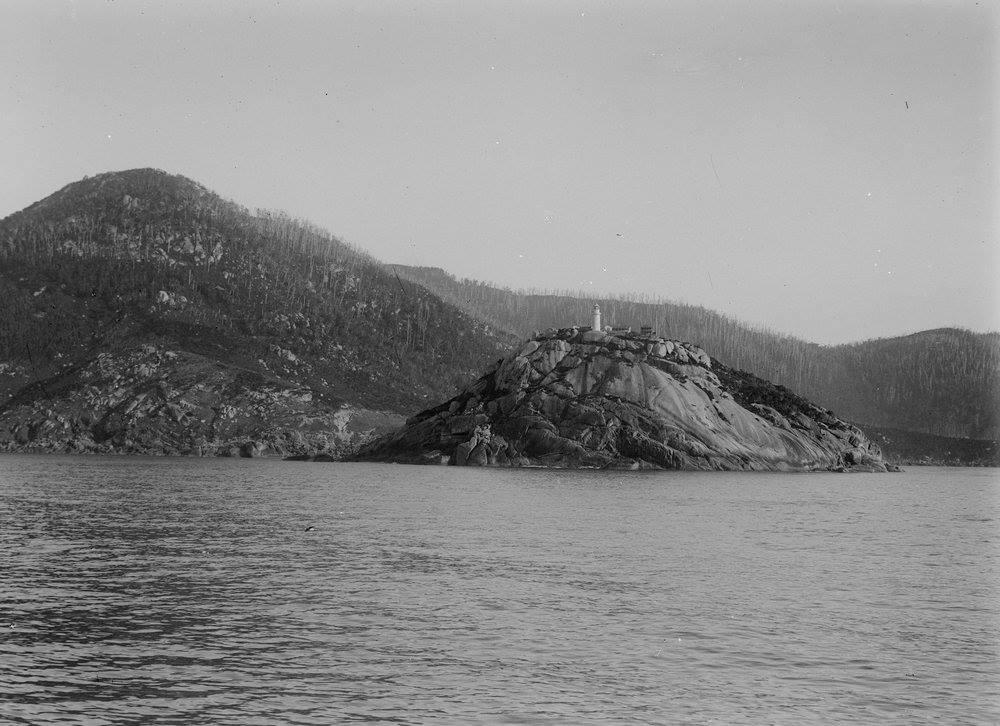
On Tuesday 13 February, at about 6 a.m., the bushfire began to burn like a wick along the small rocky peninsula towards the exposed lighthouse station.
The last radio message from the lighthouse was picked up by chance. Normally, all Bass Strait lighthouses communicated with each other by radio in the morning at 8.30 a.m. However, the light keeper at Gabo Island tuned his set 10 minutes earlier and heard the dramatic description of the fire by the Promontory wireless man, who stayed at his post to the last. His final message was just before the radio shack exploded into flames… “It is getting too hot to stay here any longer!”
There were grave fears for the safety of the lighthouse staff on the windswept headland jutting out into the sea at the remote and southernmost tip of mainland Australia.
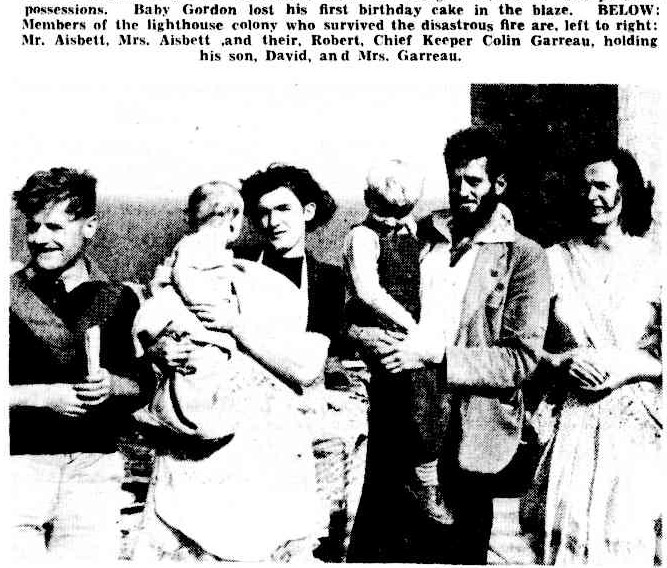
Personnel at the settlement were the acting head light keeper, two light-keepers, two workmen, one with his wife and child, and three employees of the Department of Works and Housing. The retiring head lightkeeper Mr Fred Banks, was at the settlement with his wife and son, packing his belongings ready for the lighthouse steamer to call.
Showing great courage while beating back the flames, the families huddled in a brick outbuilding as the fire swirled through the lighthouse settlement. Luckily, nobody was killed or seriously injured, although two men were slightly burned, and Fred Banks had a mild heart attack.
But the fire caused £40,000 worth of damage to six buildings, including three of its five homes and other installations including the rocket shed full of explosives, the petrol store, the wireless shack with its telescopes, binoculars and maps, and phone lines. The crane was spared but jetty along with a quarter mile of access ropeway used for transporting supplies from the bottom on the Promontory’s hazardous cliffs to the lighthouse, hundreds of feet above was also destroyed.
The wife of one of the lighthouse keepers, Mrs Margaret Garreau, was shaken by the ordeal but reported that it had rained at about 8.30 a.m. not long after the fire arrived.
A RAAF plane left East Sale at 11.30 a.m. to attempt to communicate with the staff, and an oil tanker proceeded to the lighthouse from Bass Strait. Earlier, the Department of Civil Aviation asked Trans Australian Airlines (TAA) to divert a plane over the lighthouse.
All the signal flags on the reserve were burnt but Mrs Garreau made a makeshift flag from bunting to signal to the circling aircraft.
Newspapers reported that later in the day the fishing launch Stella Maris reached the lighthouse to take off the women and children, but they decided to stay with their menfolk.
The day after, the lighthouse engineer, Mr. E. L. Ault, sailed 35 miles to the lighthouse from Port Albert and reported that the facility was out of danger. He had been unable to find a doctor to go with him.
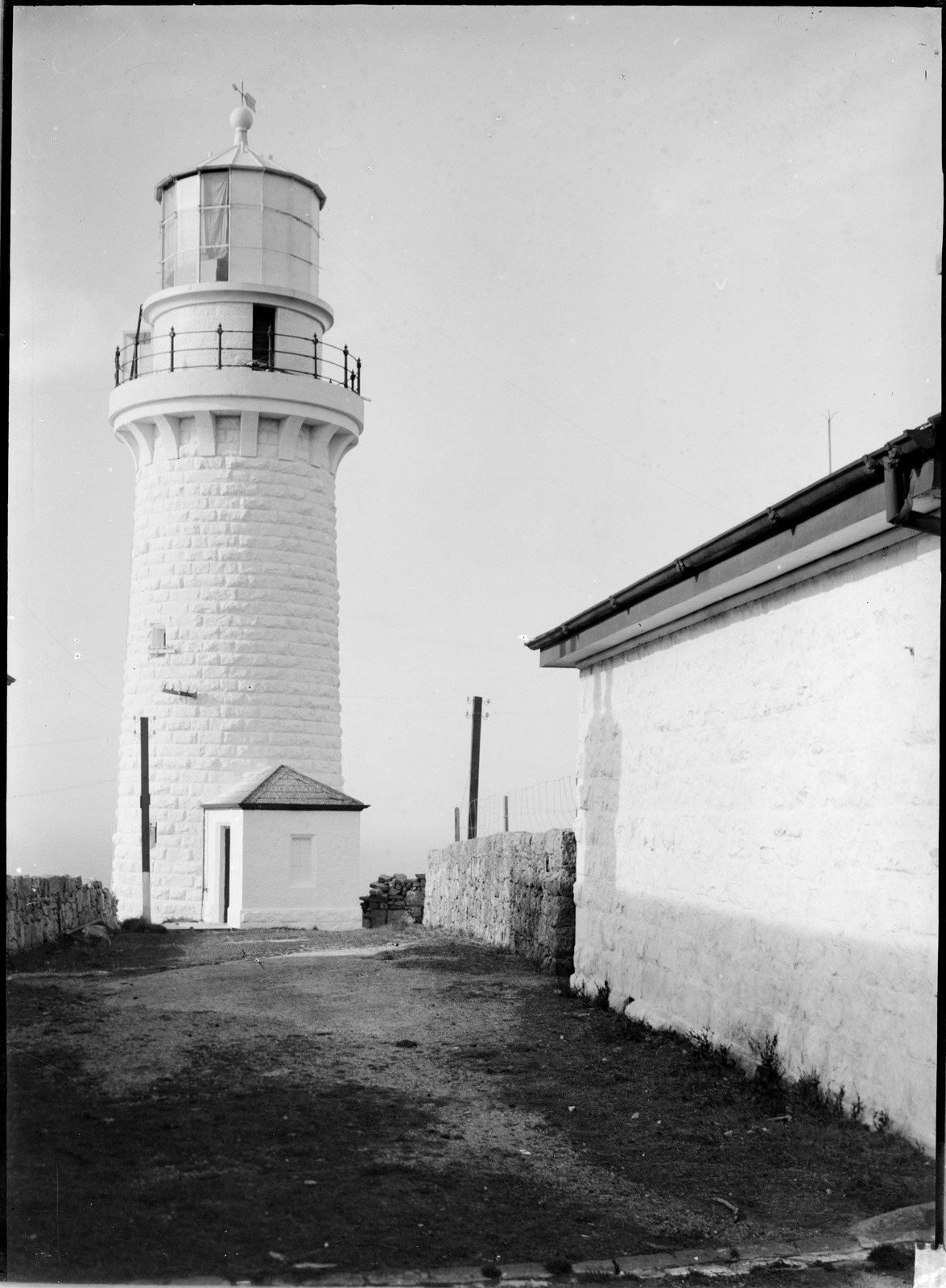
The famous stone lighthouse, which was built in 1859 and lit by kerosene, remained miraculously unscathed and continued to work normally after the fire.
At least 75,000 acres—almost three quarters of the entire National Park—had been thoroughly burned. The ecological impact was massive and long term.
There was the usual political posturing after the bushfire with the Victorian Minister for Transport saying the Federal Government would have been to blame had there been fatalities because Canberra had refused to make a special grant available to complete a road to the lighthouse.
There were very few tracks and firefighting appliances at the time but a relatively small bushfire in the previous summer of 1949–50 had caused the park managers to press on with their track clearing program.
It was reported that sixty campers, including eight children, narrowly escaped when the bushfire trapped them at Tidal River Camping Ground. They huddled together in a small clearing while the fire roared past on all sides towards the lighthouse, 14 miles away.
But Chief Ranger, John Sparkes, later discounted the danger to the Tidal River settlement and the campers as “ridiculous rot” because he had burned firebreaks around the camp in the previous year. But some question this assessment and say the Tidal River was only spared because of the direction of the winds.
The fire protection and suppression responsibility for Wilsons Promontory National Park, which at the time was administered by a Committee of Management as “Occupied Crown Land” under the Lands Act, was complex and confused.
Reg Torbet — Chief Fire Officer of the Forests Commission, and seasoned specialist in fire prevention and control — joined the Committee in 1950 to provide guidance. But some believed that it wasn’t so much advice that was needed but cash for on-ground fire protection works. Reg Torbet died in 1956 and his place was taken by Bob Seaton.
It’s interesting to note that the Wilsons Promontory fire doesn’t even rate a mention in the Forests Commission’s 1950-51 annual report because it wasn’t under their direct jurisdiction. However, the Chairman of the Commission, Finton Gerraty, backed calls for greater coordination of fire protection on National Parks.
There was justifiable public and political outcry in the wake of the Wilsons Promontory fire, which ultimately led to new National Parks Legislation being passed in October 1956.
The National Parks Bill aligned with a major revision of both the Forests Act and Country Fire Authority Act in 1958 which clearly enshrined the role of the two agencies and the Chief Fire Officers into complementary legislation.
The CFA took responsibility for fire suppression on “Country Victoria” leaving the Forests Commission to focus on the public land estate such as State forest and National Parks, which amounted for the remaining one third of the State.
More importantly, it shaped and cemented Victoria’s deep-seated approaches towards bushfires outside Melbourne for decades to come.
Both the Forests Commission and the CFA adopted clear policies to detect and suppress all bushfires and became very focused and skilled at doing it.
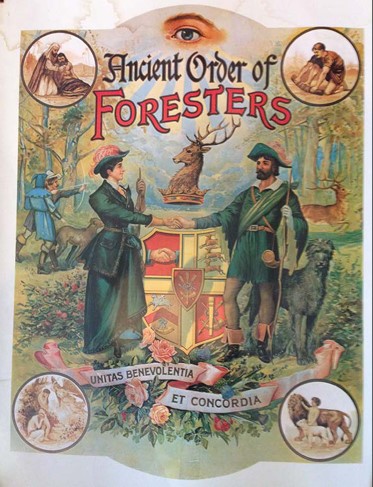
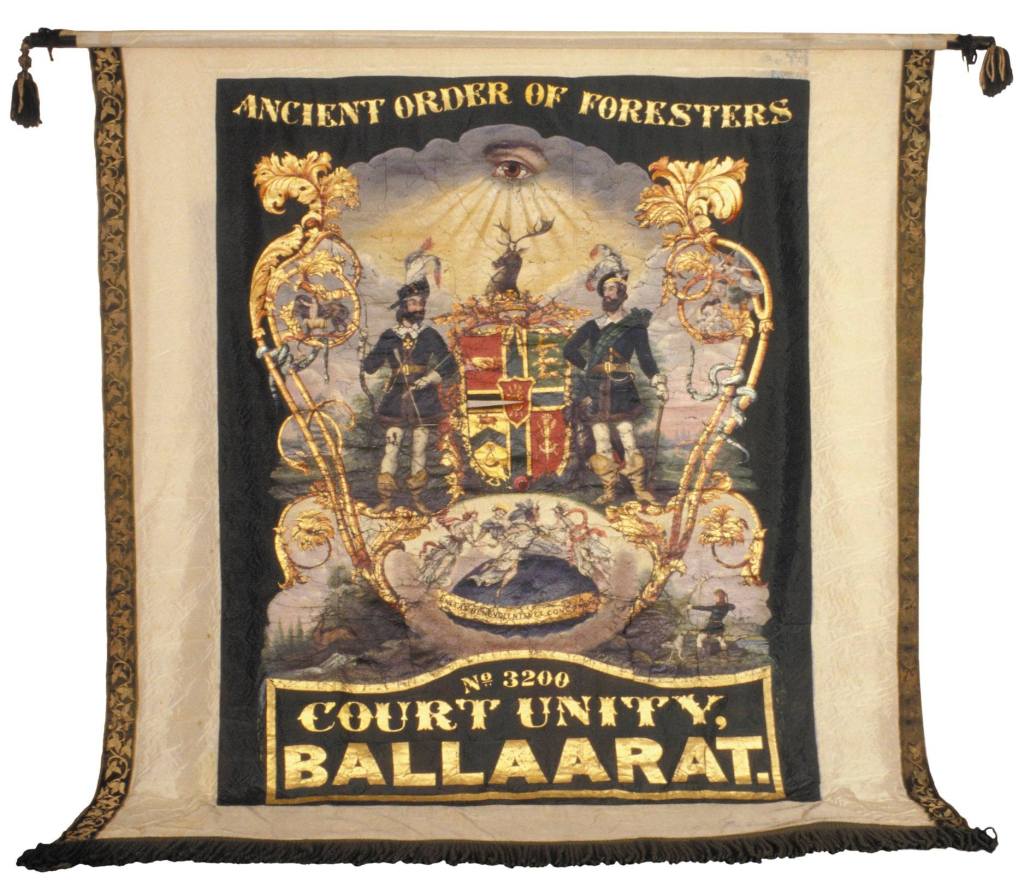
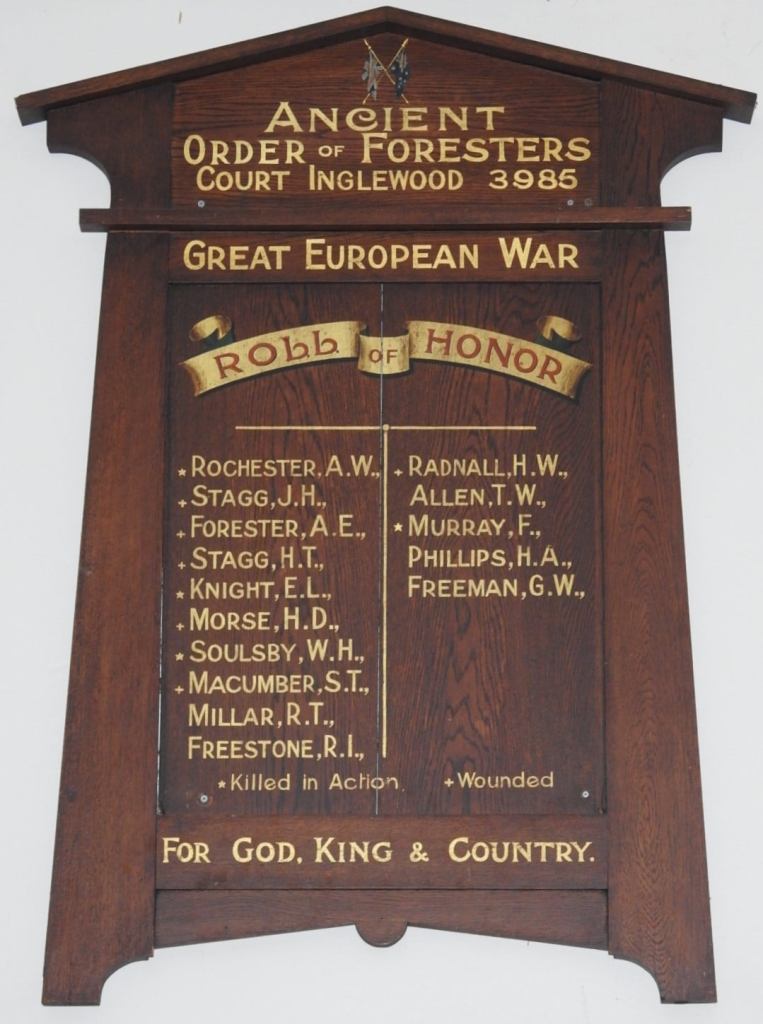
The Ancient Order of Foresters originated in England in 1834 and established its first “Court” in Victoria in 1849.
Courts quickly sprang up in Melbourne along with major cities and towns across the Colony.
Distinguished by its Latin motto “Unitas Benevolentia at Concordia” meaning Unity, Benevolence and Harmony.
The Ancient Order of Foresters was established as a non-profit organisation with its founding principles being to provide financial and social benefits, as well as support to members and their families in times of unemployment, sickness, death, disability and old age.
When a worker was injured in 19th century Australia, their prospects were bleak. They wouldn’t receive sick pay or worker’s compensation, and often faced starvation or relying on charity.
These types of benevolent organisations were essential in the days when families needed to be self-reliant, and before government social security like Centrelink, Medicare, Unemployment Benefits, Workcover or private investments such as Life Insurance and Superannuation… all the modern things we have come to know and enjoy.
By 1913, over 50% of people in Victoria, South Australia and Tasmania were covered and protected by benefits from the friendlies. In Australia overall, 46 per cent of people were covered.
The Melbourne Sawyers Friendly Society protected timber cutters, the Melbourne Operative Cordwainers’ Society was founded for shoe makers.
Forestry was seen as a noble and worthy profession so was a natural choice of name for a mutual benefit organisation of this kind.
The Ancient Order of Foresters was run by members solely for the benefit of members and the senior roles rotated around.
Members paid a small subscription, a form of insurance, which would entitle them to benefits should they ever need them.
The Ancient Order has now morphed into a friendly society offering things like savings accounts, bonds and home loans.
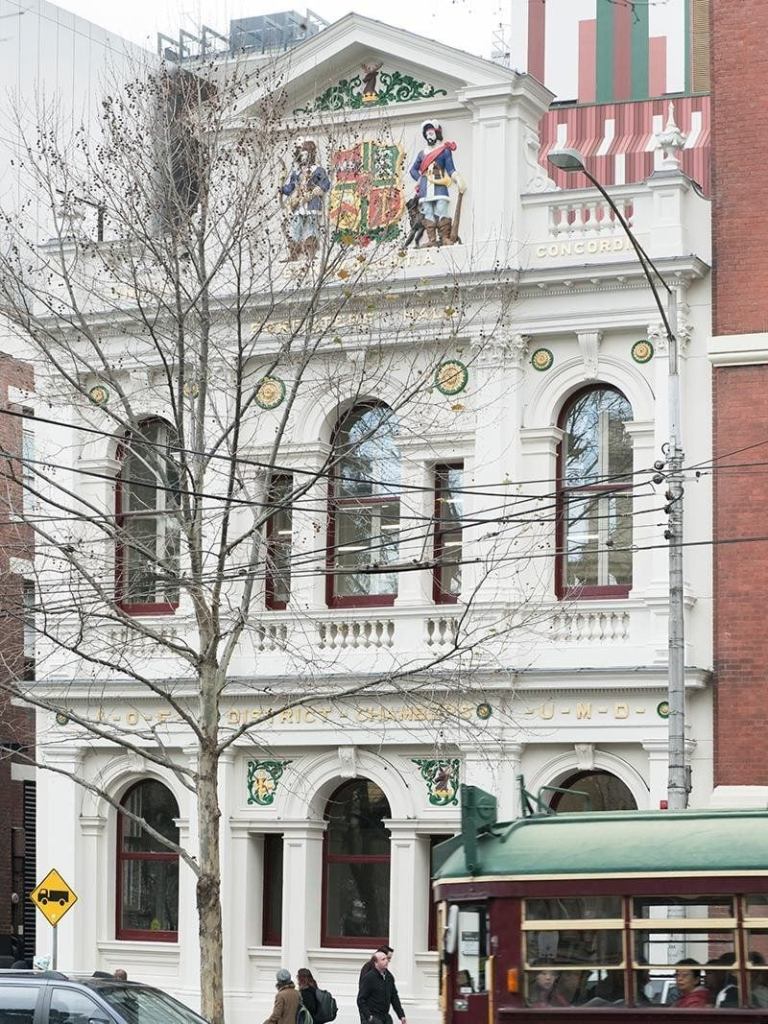
This magnificent building is now part of RMIT at 168 LaTrobe Street and has the Latin motto and emblem of two foresters (Little John and Robin Hood) aside a shield on its balustrade.
The building was designed by architects Ravenscroft & Freeman in 1888, who also built the nearby Oddfellows Hall, a similar benevolent society from the time.
The building was purchased in 1969 for the RMIT Student Union. A place I remember well when studying my matriculation, a very long time ago.
It’s listed on the Victorian Heritage Register
I’m occasionally asked about the Ancient Order of Foresters, but it doesn’t really have anything to do with the modern meaning of forestry, bushfires and land management.
The poster features Maid Marion and Robin Hood, a clue that the poster was printed after 1892 being the year in which women were admitted as members. Prior to admitting women, the standard bearers were Little John and Robin Hood. The shield is quartered with: • Clasped hands – mutuality and reciprocity. • Three stags – strength, power and leadership. • A chevron, a lamb and flag above the chevron and a bugle horn below. • A quiver over a bow, arrow and bugle horn. From: The Influence of the Friendly Society Movement in Victoria, 1835–1920 by Roland S. Wettenhall (2019)Foresters Hall 168 La Trobe Street Melbourne, Source: SLV http://handle.slv.vic.gov.au/10381/300303Banner. Source: Museums Victoria. https://collections.museumsvictoria.com.au/items/253378William Rees Miller, Secretary of the Ancient Order of Foresters Friendly Society, c 1892. Source: SLV.The facade was restored in 2015 by RMIT.Source: Tim Fitzgerald
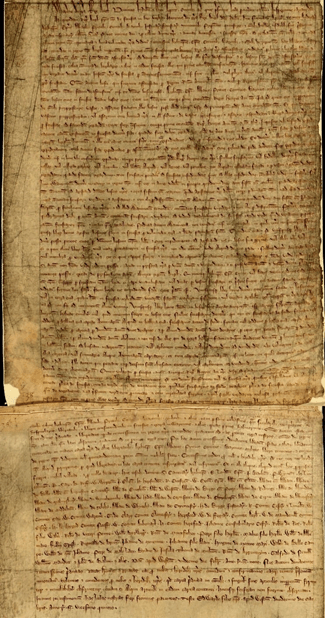
Over 800 years ago in 1217, all the rules that were contained in the Magna Carta which related to the Royal Forests were put into a separate “Charter of the Forest”.
It begins ….
Henry, by the Grace of God, King of England, Lord of Ireland, Duke of Normandy and Guyan and Earl of Anjou, to all archbishops, bishops, abbots, priors, earls, barons, justicers, FORESTERS, sheriffs, provosts, officers, and to all his bailiffs, and faithful subjects which shall see this present charter, greeting.
“Forest” to the Normans meant an enclosed area where the monarch, or sometimes another aristocrat, had exclusive rights to animals of the chase and the greenery on which they fed.
The Charter established rights of access to the royal forest that had been eroded by William the Conqueror and his heirs. It was originally sealed in England by the young King Henry III, acting under the regency of William Marshall, 1st Earl of Pembroke.
Many of the Charters provisions were in force for centuries afterwards.
An innovative School Endowment Plantation Scheme was initiated in 1922 as a joint venture between the Education Department and the Forests Commission Victoria (FCV).
Mr William Gay, the former Principal of the Victorian School of Forestry resumed his role with the Education Department in 1922 and took responsibility for the Scheme under the guidance of Owen Jones, the new chairman of the Forests Commission and Frank Tate, Director of Education.
While some plantations were established on private land donated or leased for the purpose, most were established on Crown Lands or Reserved Forest made available to schools, without cost, by the Forests Commission.
Areas ranged from about 5 to 50 acres and were planted up at the rate of 1, 2, 3 or more acres per year, according to the planting strength of the school.
The plantations were vested in trustees, who then became responsible for their care and control. The trustees consisted of the Chairman of the School Committee or Council, the Head Teacher of the school, the District Inspector of Schools and two additional members nominated by the School Committee and the Head Teacher and approved by the Minister of Public Instruction.
The Forests Commission assisted by providing technical support and a subsidy for fencing materials of 80%. Some specialist tools such as pruning saws were proved to schools by the Commission.
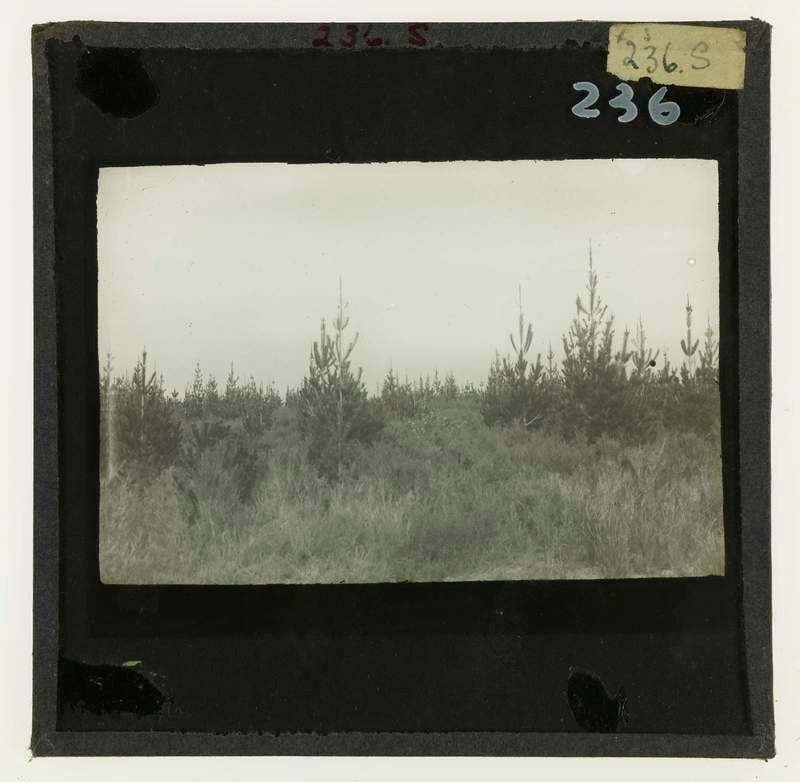
The Forests Commission also supplied free of charge from its Macedon and Creswick nurseries all the trees required for planting, including Pinus radiata, Pinus ponderosa, Pinus laricio, Douglas fir (Pseudotsuga menziesii), Eucalyptus cladocalyx, E. botryoides, E. sideroxylon, E. leucoxylon, E. hemiphloia, E. ficifolia and many poplars.
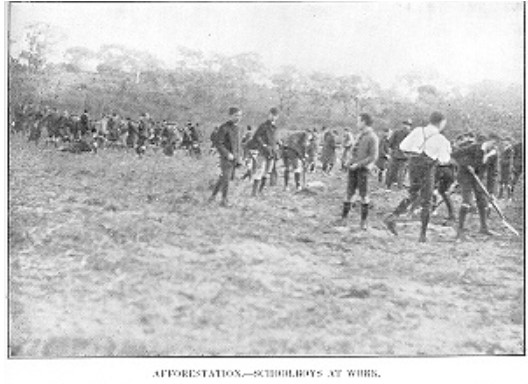
Planting was done by the school children under the guidance of teachers and the local forest officer. Heavier work such as fencing was often done by parents.
Metropolitan schools, where land was unobtainable, joined with rural schools to establish partnership plantations.
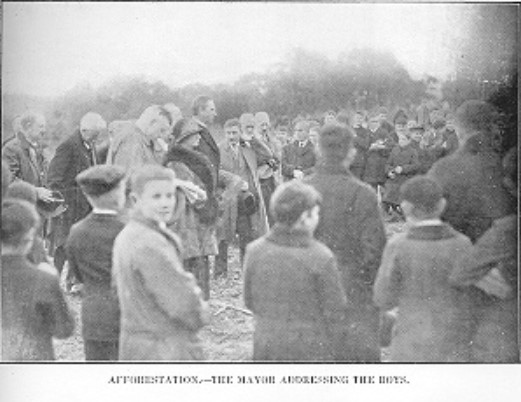
On 21 July 1925 about 350 school children from Prahran travelled by train to Frankston and then walked to a 10-acre plot of Crown Land allocated for them to plant 2500 trees.
The exact location is unknown, but it was a brisk 30-minute walk from the railway station, so it was likely to have been part of the newly established State Pine Plantation.
The Mayor of Prahran, J C Pickford, had to argue hard to get the Council to support the visionary plantation scheme for local schools, and to invest £30 of shire funds outside the municipality. The local tanneries wanted wattles to be planted instead. The planting day at Frankston was a major event and was attended by many dignitaries.
It was expected that the 10-acre plot would eventually yield as much as £2500 for the Prahran schools when it was harvested after 25 or 30 years. It’s not known if the plot survived the fire at the Frankston Plantation in January 1955.
By 1936 three hundred and forty-eight (348) plantations had been established across Victoria with an area of 3550 acres.
Proceeds from the sale of harvested trees were put into the School Plantations Endowment Fund to be used for school purposes.
It was not only designed to provide a financial return to the school, but also to instil a sense of civic pride as well as an understanding of the value of land, conservation, together with developing a forest conscience by younger generations for benefit of the nation.
By 1961 there were 492 school endowment plantations in Victoria covering a total of some 4,300 acres and involving 546 schools.
And by 1966, the number had increased to more than 600 schools, planting 120,000 trees per year. The school plantations produced about 2 million super feet (6000 cubic metres) of mill logs and 800 cunits (> 2000 cubic metres) of pulpwood; yielding some $30,000 in profits for participating schools.
The benevolent forestry program also had a strong emphasis on community involvement, and when reviewed in 1966 was assessed as being a great success.
But from the early 1980s it seems the Land Conservation Council (LCC) wasn’t a big fan of school plantations and believed those not needed or that were unsuitable for teaching purposes should be terminated when the pines were harvested.
This LCC attitude, on top of the massive school rationalisation and closures of the early 1990s, no doubt resulted in a number of orphaned plantations across rural Victoria.
The program continues today for some rural schools, although in a much-reduced form, and is partly supported by Hancock Victorian Plantations (HVP).
Main Photo: The Mayor of Prahran had to argue hard to get the Council to support the visionary plantation scheme for local schools, and to invest £30 of shire funds outside the municipality. The local tanneries wanted wattles to be planted instead. Source: Stonnington Local History Archives.
There are very few native softwoods in Victoria, and those that do exist, like cypress pine, grow too slowly to be suitable for large scale commercial plantations.
From its earliest days in the 1830s, Victoria imported large quantities of softwoods, mostly from north America and Scandinavia.
The need for local sources of softwood for furniture and joinery was apparent.
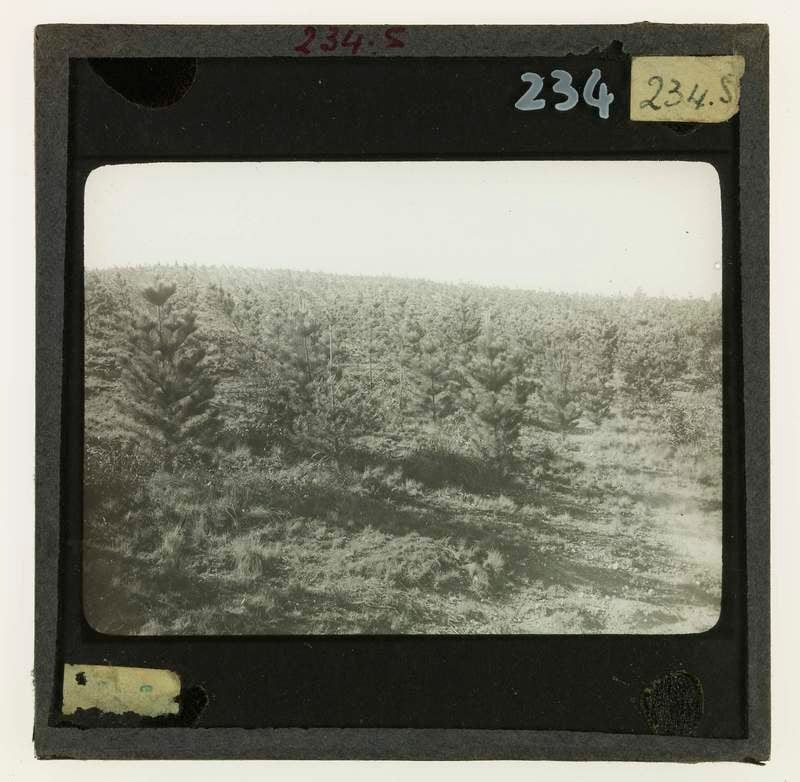
Monterey Pine, then named Pinus insignis and now known as P. radiata, is native to the central coast of California and Mexico, was first planted in gardens and windbreaks at Doncaster during the 1860s and grew well.
Seedlings were raised at the Macedon nursery in 1872 by William Ferguson, Victoria’s first Inspector of Forests, and planted across the goldfields to rehabilitate land damaged by mining. Planting was extended at Creswick by John La Gerche in 1888 and the You Yangs later in 1899.
Its success partly gave rise to the fallacy that radiata pine could grow anywhere.
Meanwhile, between 1860 and 1885, various Victorian Acts of Parliament led to the sub-division and sale of Crown Land along the Mornington Peninsula near Frankston.
But by the early 1900s most of the best land in Victoria was being selected and alienated for agriculture. The Lands Department was very powerful at the time and had little interest in allocating valuable Crown Land for forestry or plantation purposes.
There were however large areas of coastal heathlands which were generally unsuitable for farming and considered useless for any other purposes that were made available.
As early as 1876 Crown Land at Frankston had been identified as a site for Melbourne General Cemetery, but Springvale was chosen instead in 1901. One of the reasons Frankston was rejected was because it was a long way for mourners to travel and Catholics and Protestants would need to share the same train.
In October 1909, the Lands Department granted a “Permissive Occupancy” over 1370 acres of the land to the State Forest Department for the “Preservation and Growth of Timber”.
The land was primarily on poor quality coastal sand dunes and these so-called maritime “wastelands” included low woodland, heathland and swampland.
They were planted, not only because the Crown Land was available, but also because labour was accessible and costs of roading, clearing, planting and tending were relatively low.
So in 1909, the State Forests Department embarked on its first major coastal plantation project at Frankston.
Other plantations followed at Wilsons Promontory (1911), French Island (1916), Korumburra (1917), Port Campbell/Waarre (1919), Anglesea (1923), Mt Difficult in the Grampians (1925) and Wonthaggi (1927).
A senior officer, Mr W. L Hartland transferred from the Commission’s Creswick Nursery to take charge of the new plantation at Frankston.
Progress was quick, and by 1909 a 10-acre portion had already been fenced and planted.
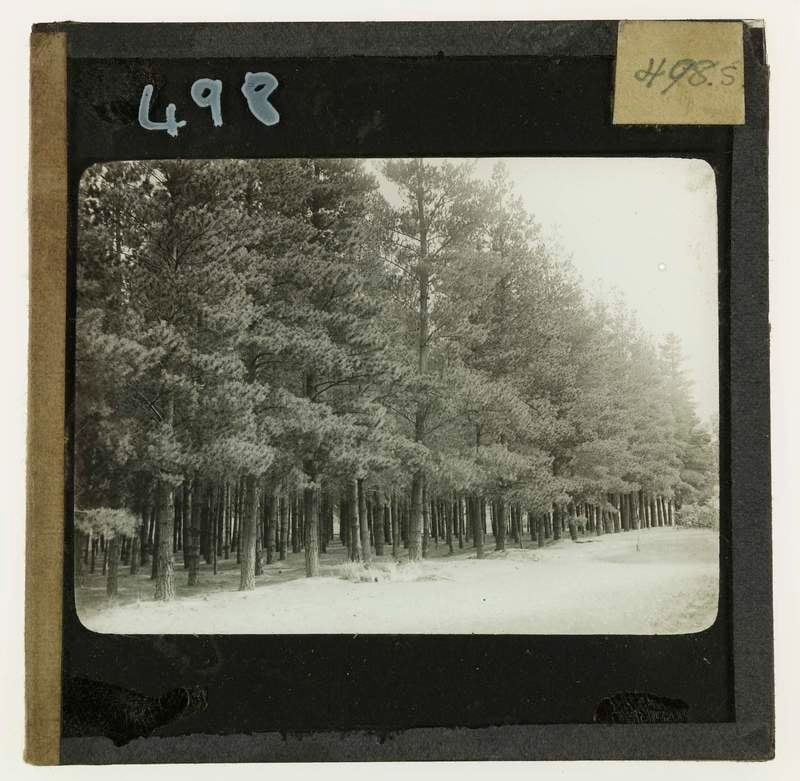
By 1914, 300 acres had been planted with Corsican pine (Pinus. laricio and P. laricio taurica), Douglas fir (Pseudotsuga douglasii), Japanese red pine (P. densifiora), Cluster pine (P. pinaster), Red pine (P. resinosa) and Monterey pine (P. insignis var. radiata) which proved the most successful of the various species planted.
Labour shortages during the war years slowed the rate of planting so that by 1916-17 the area had increased to only 445 acres.
On Monday 16 February 1920, there was a Vice-Regal Visit to the state plantations by his Excellency Sir Ronald Munro Ferguson, Governor-General, accompanied by Capt. Duncan Hughes, aide-de-camp; Mr. Owen Jones, Chairman of the Forests Commission; Mr. A. D. Hardy, President of the Field Naturalists Club; Mr. John. Johnstone, Chief Superintendent of Plantations and Mr. P. R. H. St. John, Head Gardener of the Melbourne Botanical Gardens. The vice-regal party was met by the plantation’s superintendent, Mr. W. L. Hartland. They all agreed the Frankston plantation to be the finest in Australia.
Then in 1922, on Easter Monday, a bushfire burnt some 350 acres of the plantation when the temperature reached 94 degrees. The fire was started from outside the plantation when a spark blew across from an adjacent property where burning off had been in progress in the windy weather. But the damage was not as severe as first thought, and not all the trees died. They were later salvaged.
During the mid-1920s, Mr James Brown was appointed as the second forest officer to take charge. I have read that a house was built on Dandenong Road for him and his daughter by the Forests Commission and that this house still exists.
During the 1920s and 30s the Frankston Plantation often hosted “Arbour Day” festivities on the last Friday of July where local school children came and planted trees.
And despite all the setbacks, about 20 years after the first plantings, the 1928-29 Forests Commission’s annual report records that approximately 300,000 super feet (700 cubic metres) of pine was cut from Frankston Plantation and sold for conversion to case material.
In July 1933, during the depression years, it’s reported that 30 local men were engaged under the sustenance program to work the plantations.
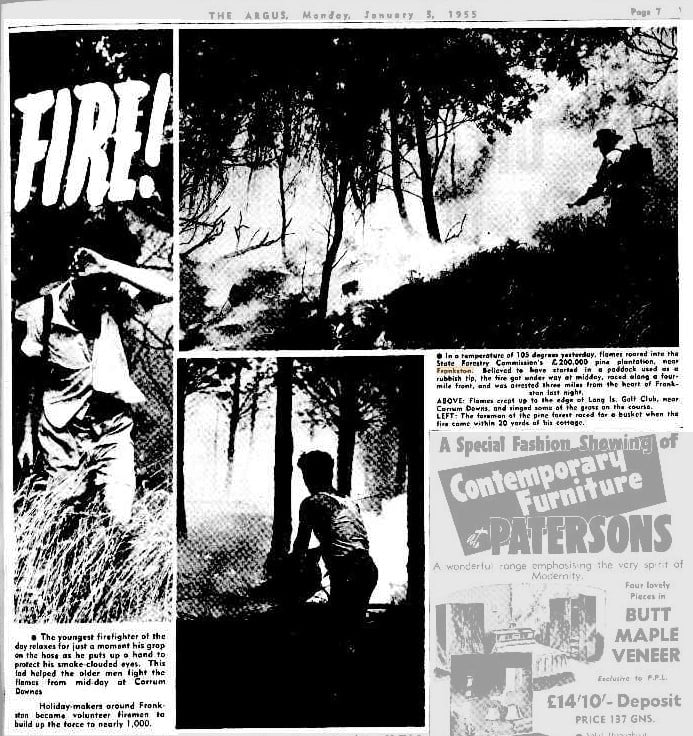
On 2 January 1955 there was another serious bushfire in the plantation. On a very hot day of 105 degrees, a fire which was believed to have started in a nearby paddock around midday, very quickly grew into a 4-mile front. Holiday makers around Frankston became volunteer firemen to boost the firefighting force to nearly 1,000 people, teaming with firemen from six CFA brigades. The fire was stopped 3 miles from the centre of Frankston.
A total of 630 acres, or £200,000 worth of pines were killed in the blaze and the trees were salvaged over the next 18 months.
This bushfire effectively spelled the end of the Commission’s interest and investment in the Frankston plantation, and by 1958, it relinquished its Permissive Occupancy back to the Lands Department. However, fire protection responsibilities remained with the Commission.
From 1946 the State Pine Plantation had been run by Mr Harry Firth who stayed long enough to wind up of the Commission’s operations in 1956, and then chose to retire.
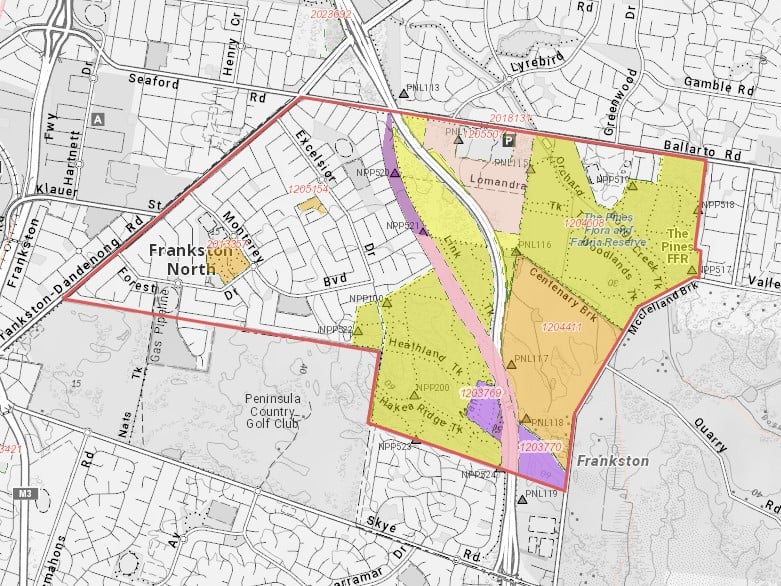
Then in 1956, a large wedge of some 296 acres was excised from the western side for the Victorian Housing Commission to build homes for low-income families. And by 1957 the first stage was completed with the Pines Forest Post Office being opened on 12 October 1959.
The Housing Commission planned neighbourhood units of about 500 houses for each primary school and designed access roads for pedestrian safety. They had grand plans for the entire area to be subdivided for housing.
Many of the new streets were given names reflecting the species planted in the previous plantation. For example, the first street constructed was Pine Street, leading to Plantation Street and Forest Drive. Other names included Monterey Boulevard, Radiata street and Aleppo court.
Native trees were represented as well, with stringybark, candlebark and manna courts as well as longleaf street.
Many species of flowering eucalyptus were planted on the street verges.
In 1965 the second wave and eventual completion of the building program began east of Excelsior Drive and extended as far as the proposed Mornington Peninsula Freeway to the east. The freeway zone acted as a buffer between the houses and the Frankston Municipal tip.
In June 1959, the Victorian Vegetable Growers Association approached the Minister of Agriculture, Sir Gilbert Chandler, with the request to establish a vegetable research station in the sands area. As a result, 280 acres of Crown Land in the north-eastern corner of the former Frankston pine plantation was set aside.
There was also a turf research station on a site now occupied by Flinders Christion School.
A further 189 acres of land on Ballarto Road was set aside in 1966 for the Vermin and Noxious Weeds Destruction Board to establish the Keith Turnbull Research Institute.
A large parcel of 166 acres was also set aside in 1969 as the Centenary Park public golf course, which is managed by the Frankston Shire Council.
There is also a council tip site in the southern part and a freeway and a MMBW reserve running right through the middle.
During the 1970s there was proposal to allocate more Crown Land as a sand quarry, but local opposition blocked the move.
In about 1989, following years of community agitation, remaining areas of public land eventually became the Pines Flora and Fauna Reserve managed by Parks Victoria. The 544 acres (220 ha) is one of the last remaining habitats for some species, such as the endangered New Holland Mouse and the Southern Brown Bandicoot.
Although the Frankston plantation was not viable in the longer term, it was of value because it provided the platform for developing plantations in other parts of the State. It could be said they kickstarted the highly successful softwood plantation program that eventually made such an important contribution to the regional economy of Victoria.
And despite its chequered history, there is absolutely no doubt that if the land had not been set aside as a timber reserve and used as a softwood plantation that the entire area would have been progressively subdivided for housing and there would be no remnant bushland left at all. There are many other similar examples across the State, such as Sherbrook Forest, the You Yangs and Mt Beckworth.
But like many other parcels of remnant bushland on the fringe of major towns and cities there is a perpetual problem of deliberately lit bushfires, anti-social behaviour, and rubbish dumping.
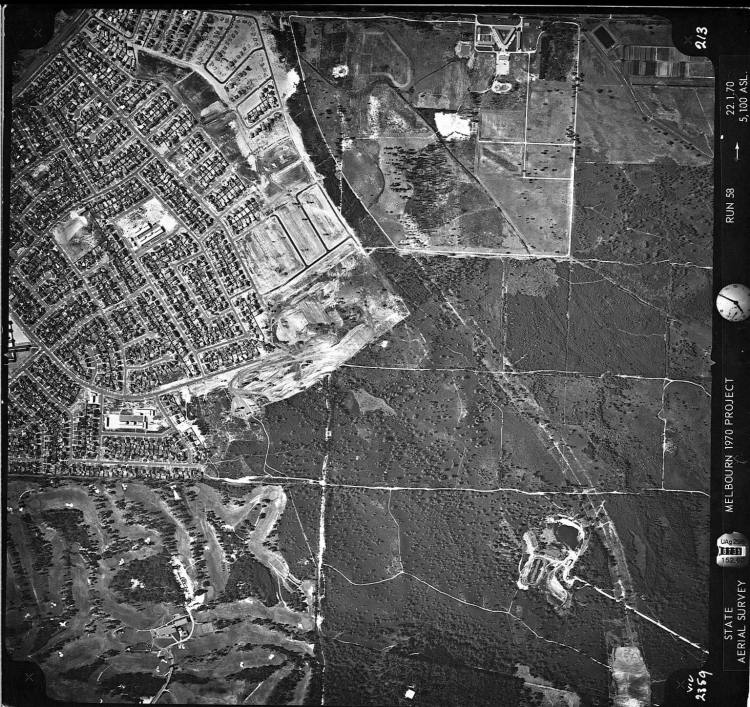
In October 1909 the Lands Department reserved 1370 acres for the “Preservation and Growth of Timber” near Frankston and granted a ”Permissive Occupancy” to the State Forest Department. Map by the Department of Crown Lands and Survey 1938. Source: SLV http://handle.slv.vic.gov.au/10381/102706The parish plan holds a wealth of information. https://mapwarper.prov.vic.gov.au/maps/1453Planting Pinus Insignis (P radiata).Planting Pinus Insignis (P radiata)Pinus Insignis (P radiata) at Frankston, showing unhealthy growing conditionsHousing Commission of Victoria dated March 1958, showing parts of the first two original streets, Pine St and Plantation Ave, with the service road along Frankston-Dandenong Rd. Source: State Library Victoria. http://handle.slv.vic.gov.au/10381/170361It seems the Housing Commission drew up plans in 1958 to subdivide the entire parcel of Crown Land for housing. http://handle.slv.vic.gov.au/10381/114842Typical Housing Commission Home at Frankston, 1960.This second major bushfire spelled the end to the Forest Commissions interest in the Frankston Plantation. Argus Monday 3 January 1955. https://trove.nla.gov.au/newspaper/article/71687593Melbourne Herald, 25 April 1922. https://trove.nla.gov.au/newspaper/article/246765642Remnant bushland at the Pines Flora and Fauna reserveFires and anti social behaviour have always been a problem on Crown Lands and State Forest near major cities and towns1970 Aerial photo of the north east section of the Pines. The KTRI buildings, the freeway easement and the new housing can be seen.
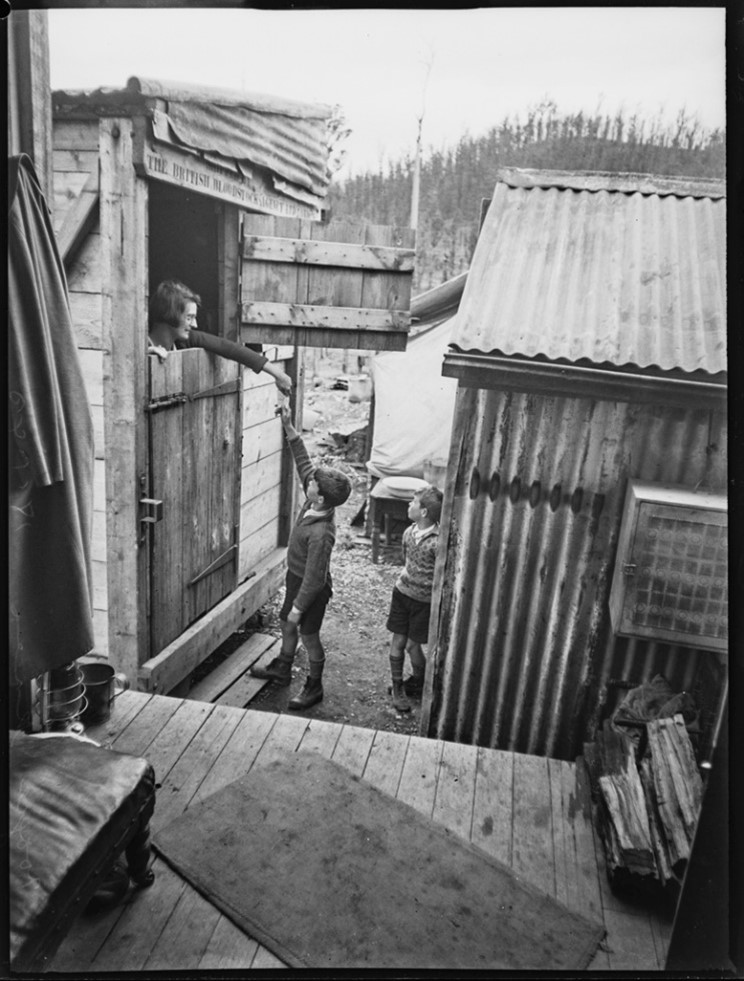
Gladys Elizabeth Sanderson was the relieving Post Mistress at Noojee during the devasting Black Friday bushfires on January 13, 1939.
She became famous for her unwavering bravery by continuing to keep the phone lines open and making calls to the Warragul Post Office, which she prefaced by the phrase “Noojee Calling”.
The only person in the town who could operate the telephone switchboard — the sole link with isolated families which were in danger of being cut off in the hills and burned to death by the swiftly-advancing fires — she stayed at her post until the town was ablaze, and after seeing to the evacuation of her sick father and nine-year-old daughter. She refused to leave until pushed out of the post office by a policeman, Constable Earnshaw.
The Herald Newspaper reported on ”The Angel of Noojee”..
The Noojee postmistress, Mrs Gladys Sanderson refused to leave her switchboard until the Post Office caught fire. Half an hour earlier it had started to burn but volunteers extinguished the flames.
Before she joined other residents in the precarious shelter of the creek, Mrs Sanderson locked the money and valuables in the safe and had her brother wire the keys to her wrist.
If the worst comes to the worst, she told the postmaster at Warragul in her last call from Noojee, they‘ll find the keys on my wrist.
“It was close on 2 o‘clock when I left the post office. I got into a pool behind the hotel. There were about 60 people there. We just crouched in the river. It was about 20 feet wide and the edges were burning. Burning leaves and debris were falling in the water. We stayed in the water until about seven o‘clock.”
She was taken to Warragul to sleep that night. But the next morning she was back on the job at Noojee, operating a temporary switchboard mechanics had rigged up in a tin shed which escaped the blaze. Noojee, or what was left of it, was in touch with the outside world again.
After the new Post Office was rebuilt in 1940, she was inundated with phone calls from The Age, The Argus and The Sun newspapers because King George had awarded her The Medal of the Civil Division of the Most Excellent Order of the British Empire – the British Empire Medal for gallantry and devotion to duty.
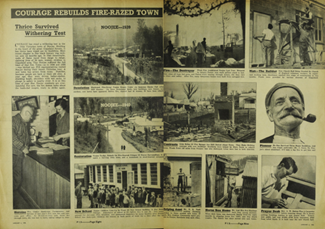
Some of the photos were used in a Pix Magazine article about the town and its recovery. Vol. 5 No. 1 (6 January 1940) https://nla.gov.au/nla.obj-471232380
Alfred Vernon Galbraith, or AVG as he was more commonly known, was a highly regarded and visionary leader of the Forests Commission Victoria (FCV).
Galbraith trained as an accountant and became assistant town clerk at the City of Geelong at the age of 21, and later appointed chief clerk at the Country Roads Board.
During World War One, Galbraith enlisted in the Australian Imperial Force (AIF) and served in both England and France but was gassed at Messines. He returned to Australia in 1919 and discharged but suffered ongoing medical problems as a result of his injuries.
Upon his return from military service, Galbraith was recruited as the Secretary to the newly established three-person Forests Commission, headed by a young Welsh forester, Owen Jones. The other Commissioners included Hugh Robert Mackay and William James Code.
In September 1924 Owen Jones resigned and moved to a new position in New Zealand and Galbraith was appointed as one of the three Commissioners, with Code as Chairman.
When Code retired in 1927, Galbraith was elevated to Chairman, a position he held for the next 22 years.
Under Galbraith’s leadership the trajectory of the Forests Commission was one of periodic political conflict, varying budgets but almost continuous organisational expansion and relative autonomy.
From its earliest days, the Commission had promoted using forest and sawmill waste to produce wood pulp. Industry eventually began to show some interest and in 1936 under Galbraith’s Chairmanship, the Commission and Australian Paper Manufacturers (APM) reached an agreement and the company proceeded to establish a plant at Maryvale in Gippsland for the manufacture of Kraft papers.
The Black Friday bushfires on 13 January 1939 were a major turning point in the story of Victoria’s State forests.
The subsequent Stretton Royal Commission has been called one of the most significant inquiries in the history of Victorian public administration, and its recommendations led to sweeping changes and increases in funding and responsibilities for the FCV.
Galbraith, who survived as Chairman of the Commission, was described by Judge Stretton as “a man of moral integrity”
Galbraith subsequently appointed Alfred Oscar Lawrence in December 1939 as the new Chief Fire Officer to lead and modernise the Forests Commission’s shattered fire fighting force.
In the wake of the 1939 bushfires, Galbraith oversaw a massive timber salvage program in the Central Highlands that took nearly 15 years to complete.
On top of the loss of experienced senior staff and forest workers to the armed services, Galbraith confronted major issues on the home front including provision of desperately needed timber supplies, charcoal for cars, secret production of guncotton for munitions, a firewood emergency and managing war time internee camps.
It was soon after the war ended in 1945 that Galbraith articulated his vision for the future of the forest and timber industry in rural Victoria, in what has been termed the “Grand Design”.
It was at this time that Australia experienced a prolonged housing boom associated creating huge pressure on native forests. Galbraith increased the intake of graduates at the Victorian School of Forestry (VSF) to meet these demands
Following the earlier withdrawal from strained arrangements with the Australian Forestry School in Canberra in 1930 Galbraith personally took responsibility for raising standards at and building closer ties with the University of Melbourne.
His efforts culminated in the University establishing a Bachelor of Science in Forestry in the mid-1940s and VSF students being able undertake two years at the University after completing the three-year Associate Diploma course at Creswick.
Galbraith was not trained as a forester himself. He possessed the Diploma of Commerce from Melbourne University and was an Associate of the Institute of Chartered Accountants. However, while Chairman he wrote a major thesis “Eucalyptus regnans- its silviculture, management & utilisation in Victoria” which he submitted in July 1935 to earn the very first Diploma of Forestry (Victoria).
Galbraith was also widely known throughout Australia and overseas. He took a leading role in organising the 1928 British Empire Forestry Conference in Australia and represented Victoria at a similar conference in 1935. He planned to attend the 1947 conference in England but was forced to withdraw due to failing health.
Alfred Vernon Galbraith died suddenly on 29 March 1949, while still Chairman of the Forests Commission. He was 58.
In April 1949, Finton George Gerraty, who began his forestry career at Creswick in 1915, was appointed as the new Chairman. When Gerraty also died suddenly in June 1956, Alf Lawrence was appointed as Chairmen, a role he maintained until his retirement in July 1969.
Among his many legacies, the student accommodation block, AVG House at the Victorian School of Forestry was named in Galbraith’s honour in 1961.
Photo: Looking more like mobsters than foresters. c 1935 A.V..Galbraith, FCV Chairman, Finton George Gerraty, then Inspector of Forests and Herbert FitzRoy OIC Boys Camp at Rubicon. Finton Gerraty had earlier been Niagaroon district forester based at Taggerty and was appointed Chairman FCV on Galbraith’s death in 1949. Herb FitzRoy was later Alexandra Shire President. Photo: Allan Layton