The State Forest Department (SFD) was established in 1907 following several scathing inquiries leading to a Royal Commission (1897-1901) into the destruction and waste of Victoria’s forests which followed the gold rush of the 1850s.
Foresters were a lonely voice advocating for conservation and the combined principles of sustainability, multiple use and economic development of the timber industry in rural Victoria.
The more independent Forests Commission Victoria (FCV) followed in 1918 and for the next 65 years remained a relatively stable and independent authority responsible for management and protection from bushfire of a vast forest estate.
The structure, policies and operations of the Forests Commission was initially based on European and British models of forest administration.
The major turning point for the Commission and for the staff was the catastrophic 1939 bushfires and the subsequent Stretton Inquiry. Later in 1950, the Chairman of the Forests Commission, Alf Lawrence, wrote of the staff…
“they were totally dispirited… their work of years lay in ashes… all the protection, planning and works had proved futile”…
The Commission then faced the huge challenge of rebuilding a highly organised and motivated fire fighting force in the busy post-war reconstruction period.
Describing the structure and function of an organisation is relatively easy, but defining its culture is more challenging. And what is organisational culture anyway? Another meaningless corporate buzzword perhaps? I think of culture as:
the shared values, beliefs and behaviours that characterise the staff. It’s best seen in how they support and work with each other, how they deal with highs and lows, and how they interact with external groups and communities.
Culture is sometimes described as the “personality” of an organisation, or “just the way we do things around here”. Perhaps the FCV’s culture could best be described as:
A big extended family with friends, foes, factions and frustrations, but always with a strong sense of purpose and belonging.
The Forests Commission relinquished its discrete identity from mid-1983 when it merged into the newly formed Department of Conservation, Forests and Lands (CFL), along with the Crown Lands and Survey Department, National Park Service, Soil Conservation Authority and Fisheries and Wildlife.
At the time of the merger, the Commission employed some 300 foresters, plus a further 500 overseers and administrative staff and well over 1000 works and fire crew. People were spread across country Victoria in 48 districts and 7 divisional offices. Most of them lived and worked in small country towns or larger regional cities.
The culture of the FCV was shaped over many years, by many people, and by many things, including:
- The long-serving Commissioners of the FCV, all having come up-through-the-ranks and all with years of practical field experience, ensured a smooth transition at the top as they forged a legacy of organisational culture to be handed down to its successors.
- Professional foresters within the Forests Commission were largely graduates from Creswick, with only a few from Universities at Melbourne, Canberra or overseas.
- In response to the post-war housing boom and the pressure of the State’s forest during the 1950s and 1960s to supply timber there was a major increase in Forests Commission employees with larger intakes to the School of Forestry at Creswick.
- Pranks, ribbing and rites of passage were all part of Creswick life, reinforcing bonds and preparing new foresters for the demands of the work.
- Creswick graduates, which dominated the professional ranks, tended to form close-knit and long-standing groups. They were generally identified by their graduation year and sometimes carried student nicknames throughout their entire careers. This camaraderie was both good and bad.
- The early FCV overseers and foremen were often war veterans, especially in the post–WW2, Korea and Vietnam eras, creating a culture that prized toughness, resourcefulness and directness.
- Foreman schools were established in 1946 for hands-on technical training to lift and maintain skills.
- A set of core values and a common approach to problem-solving became evident. These values were reenforced in the workplace.
- A strong “can-do” culture of “getting stuff done”, taking measured risks and a willingness to innovate was strongly encouraged. The fire equipment workshop at Altona and pioneering innovations in bushfire aviation are just a couple of examples.
- The Commission seemed to have an appetite for risk which allowed new ideas to develop. It enabled (or maybe tolerated) “creative thinkers”, “square pegs in round holes”, or simply those who “coloured outside the lines” to flourish.
- The Public Service (Transfer of Officers) Act 1937 brought Forests Commission staff under the umbrella of the Public Service Commissioner. The move created some angst at the time but was in response to complaints since 1918 that recruitment powers held by the FCV were without external oversight and standards.
- The Commission emerged after major turning points of the Great Depression, 1939 bushfires, the Stretton Royal Commission and the disruptions of WW2 to rebuild an organisation with substantial expertise. It demonstrated an ability to adapt, innovate and achieve complex objectives in fire protection, softwood plantations, industry relocation, research, recreation, and professional training. From the late 1940s to the early 1970s the Commission was relatively stable and independent authority that became increasingly confident, politically powerful and well resourced.
- Morale was generally high, and staff felt justifiable pride in being the long-term stewards and custodians of the State’s public forests.
- Loyalty to the department and the community was deep-seated. The State government and the community appeared to have confidence and trust in the Commission.
- Until the early-1970s, archaic the rules of the Public Service Board meant that married women were not allowed to be given permanent employment status in the professional stream or have access to superannuation. Although they held admin jobs such as typists and registry. There were a couple of notable “work arounds” including Maisey Fawcett and Gretna Weste. Men were deemed to be the breadwinners.
- The FCV became central in organising the structure in professional employees’ lives.
- The Commission favoured a “promotion from within” policy, which prided itself that any professional employee with enough talent (and luck) could aspire to become a Commissioner. This was also bad and good.
- Until the late 1970s “seniority” was king in the public service. While jobs were advertised in the Public Service Notices, appointments were decided centrally, and promotion was mostly in order seniority.
- Some staff scoured the Public Service List (aka the “Jews Bible”[1]) which had all the details of every person in the public service, their age, classification and the date they were appointed. It was used as a guide to see “who’s turn” it was to get the next promotion, or when someone was going to be forced to retire at age 65.
- Creswick academic results and order of graduation within the class cohort also determined a forester’s place in the queue.
- The non-competitive, age-based, promotion system resulted in nearly of appointments being based on seniority rather than merit. This had the effect of some people being promoted beyond their level of competence while supressing others with talent.
- By the early 70s, all Districts had the same classification for District Foresters (F4). However, not all Districts were equal in terms of complexity and workloads.
- Foresters were required to move frequently if they wanted to advance professionally. Some of these postings or “tours-of-duty” were to head office and larger regional centres. These moves expanded professional experience, but the compulsory nature was often resented, particularly for those with families and school-aged children and was successfully challenged by the VPSA staff association in the late 1970s.
- Threats of postings to Bendoc, Matlock or Wedlock for single foresters was a long-running inside-joke among staff.
- Major changes occurred with the Cain Labor Government in 1982. Jobs were advertised and often open to external non-public servants. Appointments and promotions were merit-based with written applications, interviews and referee checks. Seniority was no longer grounds for appeal.
- Many other disruptive rule changes followed regarding restructures, recruitment, redeployments, relocations and redundancies.
- There was a strong tradition of passing knowledge and mentoring through example, with experienced foresters and overseers stressing the importance learning and earning respect through action and reliability.
- There was decentralised decision-making with considerable discretion given to field-based District and Divisional Foresters who had already acquired considerable on-ground and practical nous.
- There were only three layers of bureaucracy with clear reporting lines from Districts to Divisions, and then to Head Office.
- Most FCV staff were based in field districts. Melbourne and the Divisions had relatively small numbers.
- A delegated model was well suited to remote locations and poor communications that existed in forest areas at the time.
- Many of the senior managers in Head Office had previously worked in the field as District Foresters, or in assessment, earlier in their careers.
- There were opportunities for short-term “tours of duty” to either the field, research or Head Office.
- Staff formed long-term relationships with each other and knowing the right person to talk to in town or the field and being able to put-a-face-to-a-name made life so much easier.
- District foresters were undisputed kings of their domain, particularly during bushfires. At other times, they were allocated resources and given some flexibility to adapt to local conditions. Although, the records of the State Foresters Association record many grumbles about petty controls for relatively minor matters, such as purchases of local stores. Some creative District foresters were adept and finding ways to circumvent the rules to get things done.
- Like Warrant Officers in the Army, Overseers and Forest Foreman were seen as the backbone of the Districts and tended to stay in one place for longer periods and developed strong local knowledge as well as relationships with communities. They often played tricks on wet-behind-the ears foresters straight out of Creswick.
- The Commission initially provided subsidised low rent housing to facilitate staff movements until the Kennett Government started to sell them off and privatise the housing stock. This made movement for families to remote places like Cann River unattractive, and it became almost impossible to recruit staff to these positions.
- Staff housing in small and remote communities where rentals were limited and the quality of departmental housing was the source of many complaints.
- Housing in Melbourne was relatively affordable until the mid-1980s. But for most country staff it then became well out of reach to move into town.
- One ongoing bone of contention was the lack of FCV corporate uniform which didn’t exist until 1970, when a polyester dress shirt, epaulet slides and tie was issued, but not made compulsory. The divisive debate was always very vocal at VSFA staff meetings.
- Documents such as staff circulars, technical bulletins, research updates, standing instructions and newsletters were regularly issued, updated and well-read.
- Bushfires brought people together. The sense of belonging and shared mission was paramount. Firefighters were like extended family, supporting each other through challenges both on the job and off.
- The radio system, VL3AA, kept the people informed and together.
- Perhaps borrowing from the US Forest Service, the Forests Commission began progressively using quasi-military terms, disciplines, structures, and tactics at bushfires. These included incident controllers, sector commanders, direct attack, water bombing, deployment orders, intelligence gathering, situation reporting and logistics.
- Staff in field offices seemed to “prickle” with bushfire readiness on hot windy days, particularly if lighting was forecast before the cool change.
- The Forests Commission valued its heritage. The longevity of staff led to high levels of continuity as information and history was passed down the various layers of the organisation.
- The staff organisation, the Victorian State Foresters Association (VSFA), had been formed in 1900. Finton Gerraty, Alf Lawrence, Frank Moulds and Alan Threader all served as President of the Association prior to coming up through-the-ranks to be appointed as Commissioners, while Ron Grose served a term as Secretary.
- In 1983, the VSFA represented FCV staff with a membership of 400, or well over 90% of those eligible. It had existed for over 50 years, evolving an internal form of governance that served the widely dispersed and often isolated membership.
- The VSFA voluntarily disbanded at its Annual General Meeting in mid-1986. Staff were offered the opportunity to join the more generic Victorian Public Service Union (VPSU), but it didn’t have the same comradery.
- The Association also produced a regular, informative and frequently irreverent newsletter. See – David Parnaby cartoons.
- Among the most popular social activities of the staff and the VSFA were cricket matches, regional golf days, end-of-fire season balls and regular Friday night drinks at the local watering hole.
- Many long-term friendships where formed, not only between employees, but also their families.
- The VSFA had accumulated a sizable Provident Fund to provide immediate assistance to the families of deceased, or those members in difficulties
- The remaining VSFA funds were transferred to CFL to continue an annual forestry travel award.
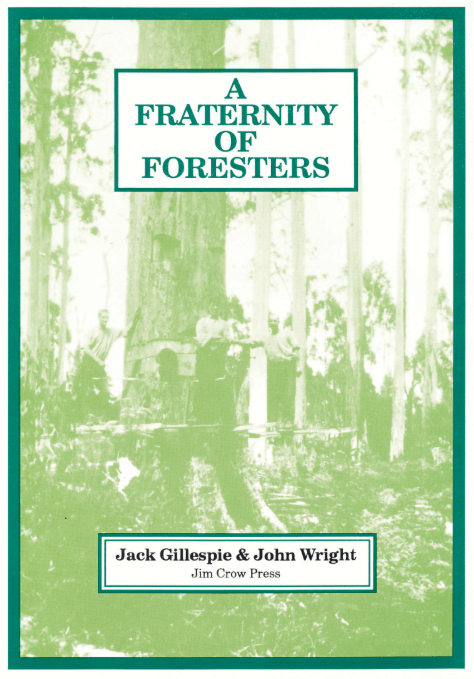
- In 1993, foresters, Jack Gillespie and John Wright wrote the history of State Foresters Association in the “Fraternity of Foresters”, which gives valuable insights into the culture of the FCV.
- The Commission was frequently derided by its external critics as a sexist “Boys Club” and being too PMS – Pale, Male and Stale, while being primarily governed by insular white male foresters and overseers. But the post-war Australian society was changing rapidly with immigration, the baby-boom, women’s liberation and a rising tide of environmental awareness. Maybe the Commission hadn’t fully kept pace, but it had acquired many internal strengths that were a product of its long and stable evolution.
- It was also said during the CFL amalgamation that the Commission’s single mindedness was reflected in the homogeneity of background and training of its professional staff, and this was one of its greatest weaknesses.
- In fairness, the Commission had been actively and genuinely perusing change. For example, young women had commenced at the Forestry School in 1976 and were beginning to occupy important roles as they progressed through the ranks. Graduates from other non-forestry disciplines such as flora and fauna, soils, economics, hydrology and entomology, along with foresters from overseas and interstate were actively being recruited. Some foresters were supported to gain higher academic qualifications overseas. Many staff were either on secondment or had transferred to-and-from the LCC, SEC and MMBW.
But the changes brought about by the new Cain Labor government in April 1982 were swift and profound. It seemed the accumulated culture of the Forests Commission staff was not particularly valued, and in fact, was seen by some as a hindrance.
Many senior staff felt threatened or disheartened by the new CFL arrangements. Some chose to leave voluntary, while others were “encouraged” to consider their options. In the damaging restructure process, there was a large loss of corporate knowledge and memory.
Many older staff that remained were “gun-shy” and unwilling to commit to CFL in the way they might have to the FCV. It was the same in other statutory organisations such as the powerful MMBW.
The era of the “specialist” was replaced by one favouring the “generalist”.
The culture of the new Department of Conservation Forests and Lands (CFL) presented unique challenges, and some foresters and technical staff from the FCV struggled to make the transition from a powerful, highly regularised and homogenous culture to the new blended organisation.
However, some staff saw CFL as a career opportunity to diversify and were ultimately appointed to many of the senior policy, conservation, operational and regional manager roles in the newly emerging organisation.
It would be very easy to reflect nostalgically, but I have never considered the FCV as the good-old-days, but rather, they were just the old days. Some things are better, while others are not.
So how do you measure success of staff culture? Well, here are a couple for the FCV…
- The rate of staff turnover of the FCV prior to CFL was well-known to be one of the lowest in the Victorian Public Service and many made the Commission a “career for life”.
- The Forests Commission Retired Personnel Association (FCRPA), which was formed in 1977 primarily as a social club, has persisted long after the end of the FCV. The Association still boasts about 150 members, some in their 80s and 90s, who keep in touch and enjoy a bevvy at the annual Christmas function.
- And while the museum at Beechworth has recently closed, a small group of long retired and enthusiastic foresters has built a considerable on-line legacy with social media, websites, blogs, digital photos, documents, Collections Victoria and several eBooks lodged safely in the State and National Library.
Despite all the changes, there remains a strong sense of pride among staff in Victoria’s rich forest and bushfire heritage.
[1]It’s said the term “Jew’s Bible” originated in the 1930s during the Great depression when banks were loath to lend money. Appearing in the Public Service List demonstrated continuity of employment which the Jewish Community used as a basis of lending.

 Victoria’s Forests & Bushfire Heritage
Great job Pete – it came together very well I reckon. Cheers – M.
LikeLike