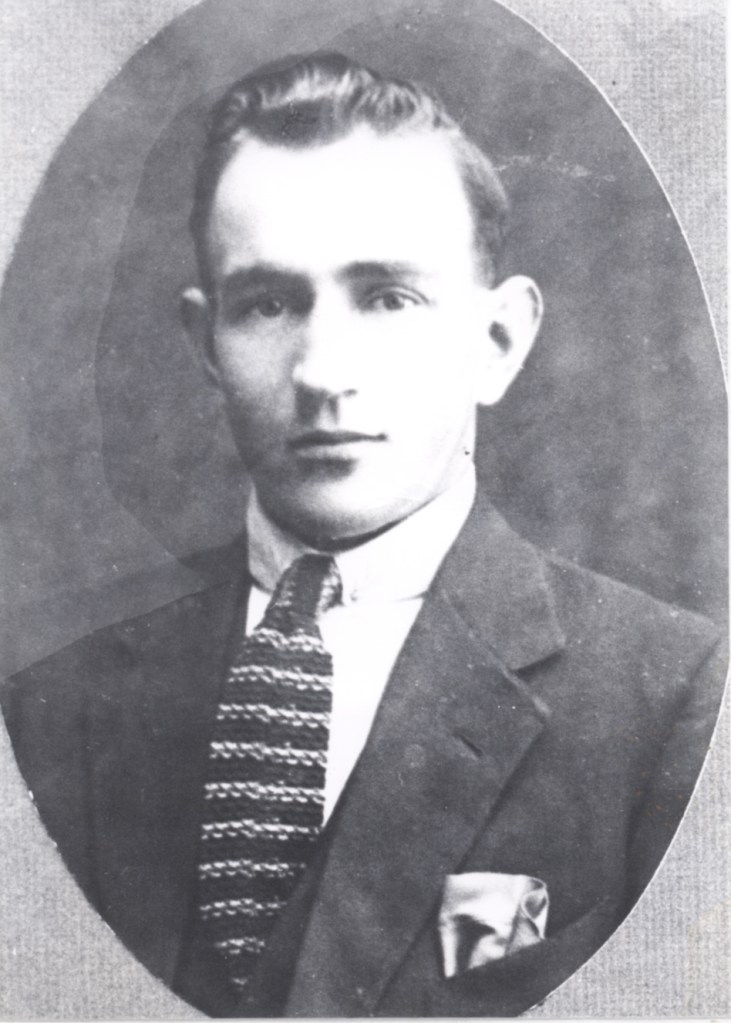
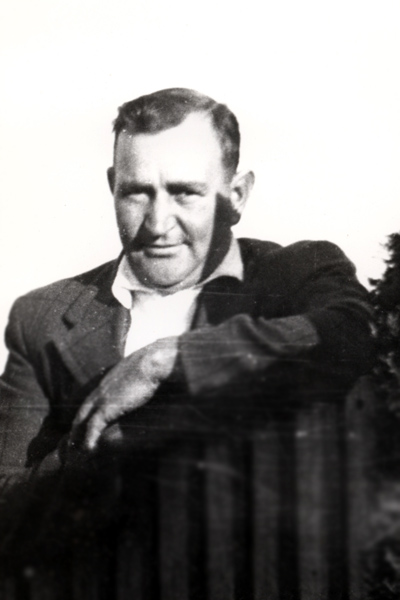
Harold Aldridge (AKA Stringy) worked for the Forests Commission Victoria (FCV) at Heywood in far south western Victoria, firstly as a labourer in 1930, and later from the early 1960s as a forest foreman and overseer.
Stringy also served as a driver in the CMF during the war years.
During the 1950s and ‘60s forest overseers were undisputed kings of their domain with overall operational control of the bush.
The men working at Heywood included Stringy Aldridge at Narrawong, Central Cobboboonee, Dunmore and Tyrendarra, while Tim Hodgetts was at Gorae, and Alec Murphy looked after Greenwald and Dartmoor. Bob Riley was responsible for Digby and Hotspur while Stanley Oswald (Dick) Aldridge had charge of Drumborg, Annya and Myamyn.
Dick Aldridge, a returned RAAF serviceman, was Stringy’s younger brother and joined the Forests Commission at Heywood in 1940. He also rose to become Forest Overseer and retired in 1976.
In addition to firefighting, road maintenance and other operational works, one of the main tasks of a forest overseer was marking trees to be felled in the bush before they were snigged out and loaded onto trucks to be delivered to local sawmills.
The silvicultural operation tended to be selective harvesting and thinning of the larger trees, rather than clear felling.
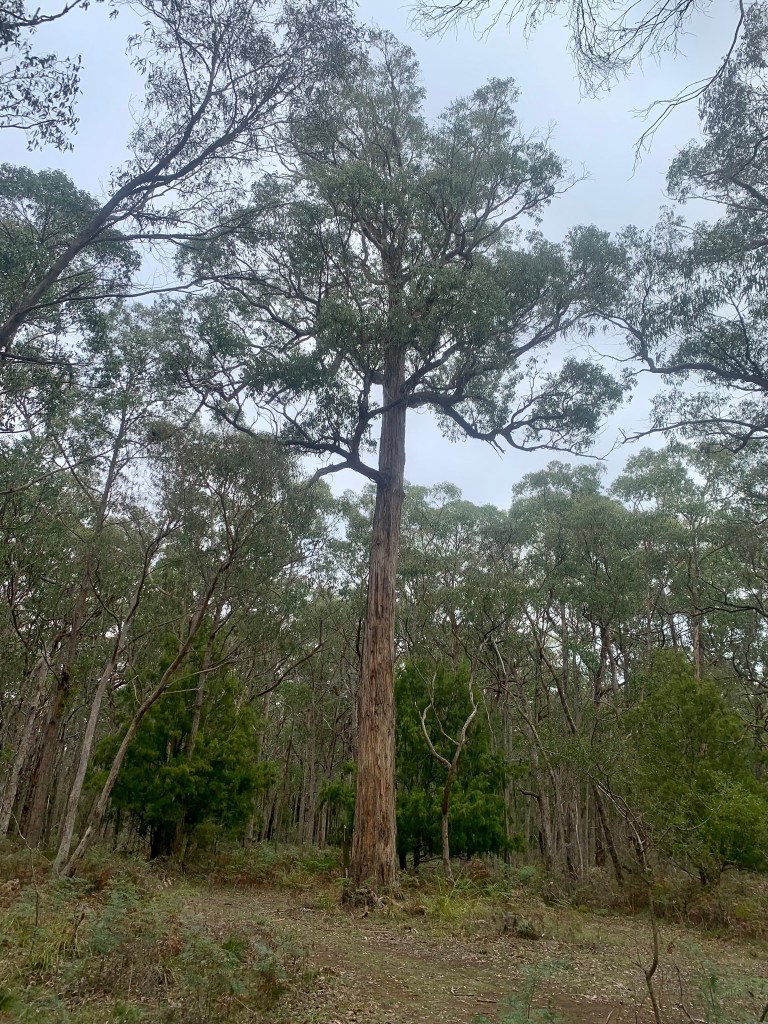
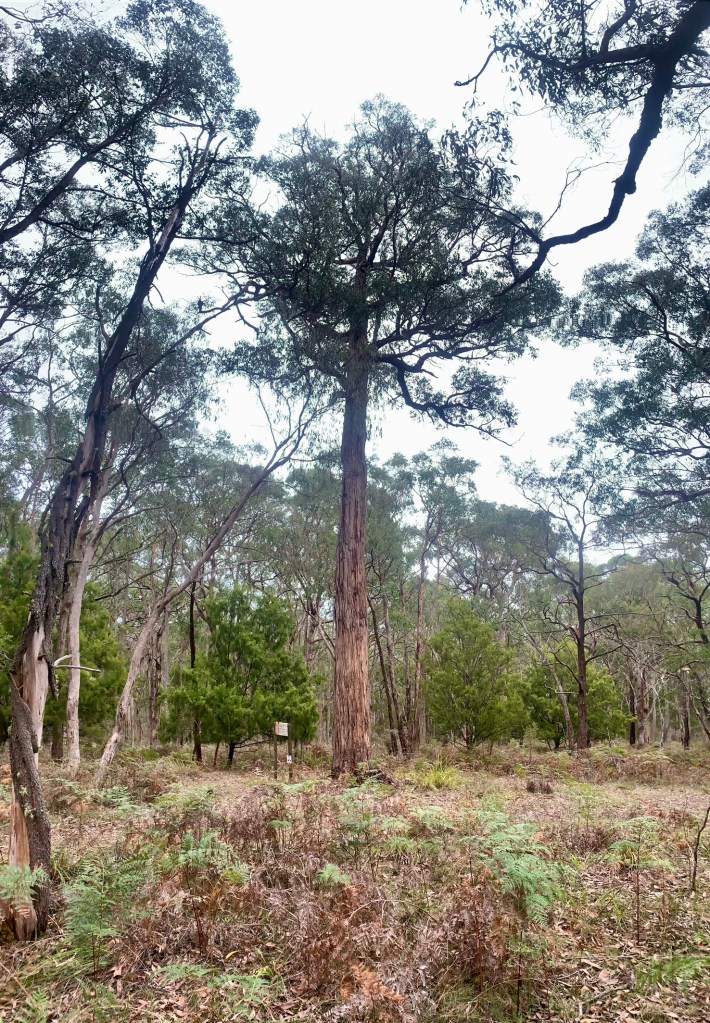
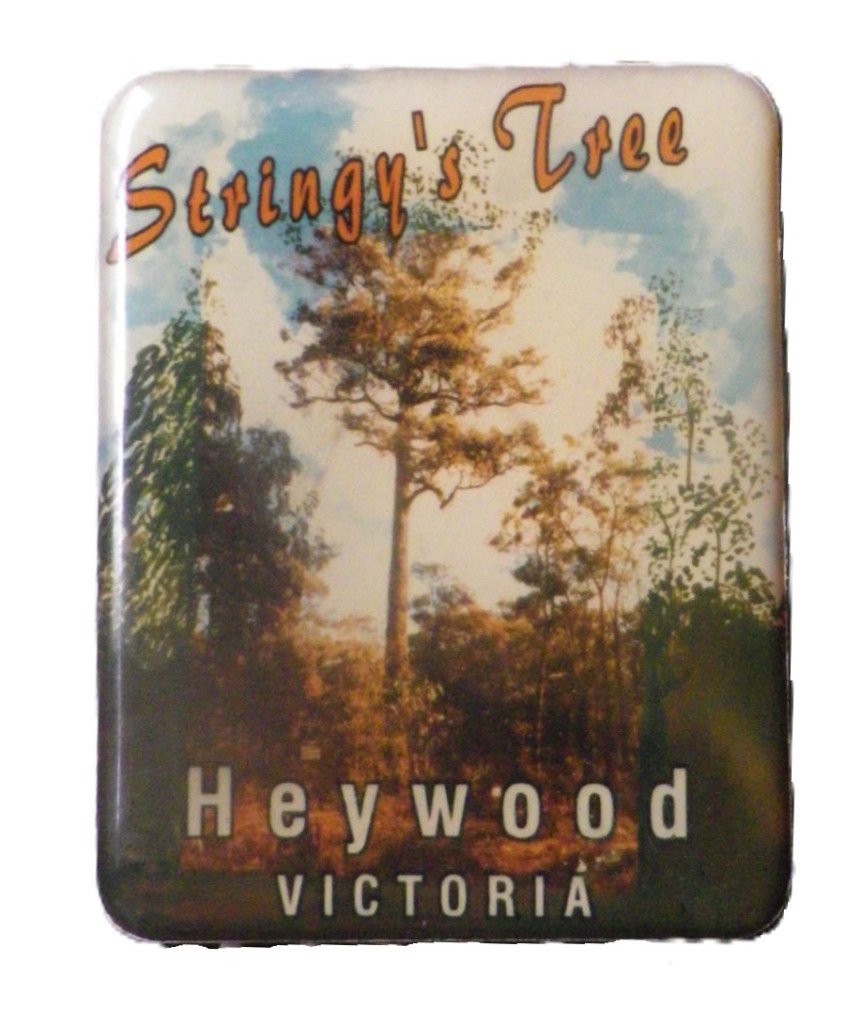
Stringy Aldridge is noted for protecting a large messmate (E. obliqua) in the Cobboboonee State forest, just west of Heywood,
The tree is said to have germinated as a seedling in 1834 when the Henty Brothers first settled at Portland, making it about 190 years old.
Rumour also has it that an occasional bag of fertilizer was spread under the tree. The crown and stem certainly look very healthy.
Stringy Aldridge died suddenly at his home in Heywood on 29 December 1968, aged 64, and he is buried at the Portland South Cemetery.
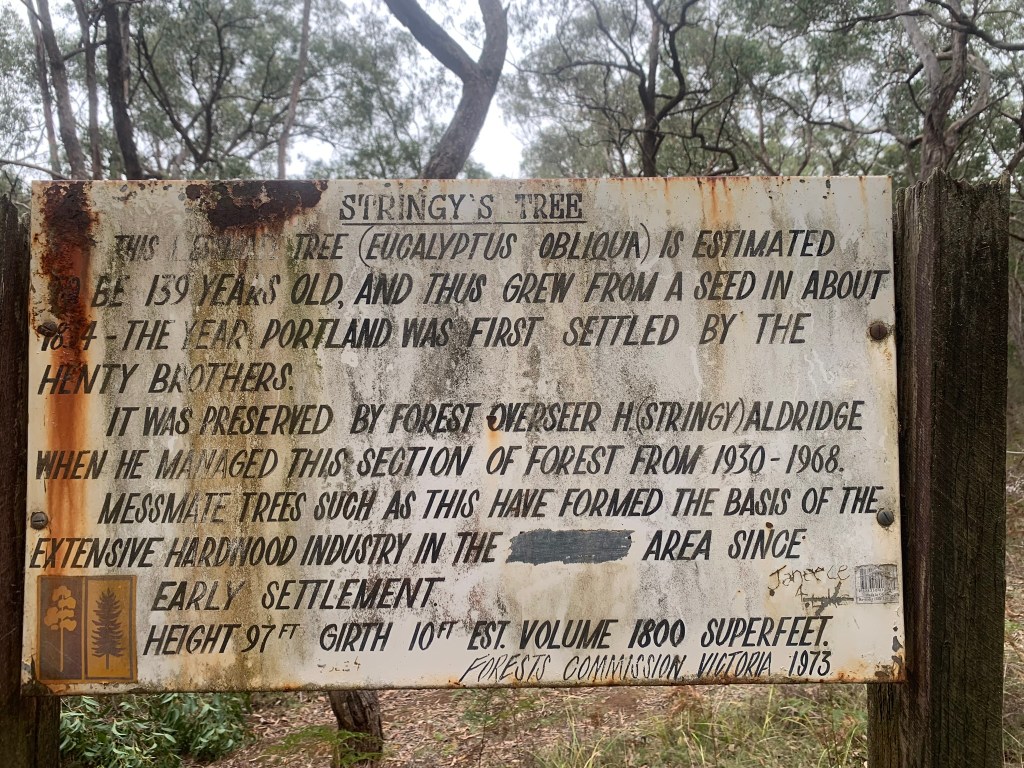
Later, in 1973, local Forest Commission staff from Heywood erected a large interpretive sign at the tree in Stringy’s honour. The sign is looking a bit tired and worn now, although surprisingly, there are no bullet holes in it, and it would be nice to see it refurbished.
In June 2024, I personally remeasured the height of Stringy’s Tree with my trusty tape and clinometer at 31.25 m (102.5 feet). This represents an increase of 1.7 m (5.5 feet) over the last 51 years since 1973.
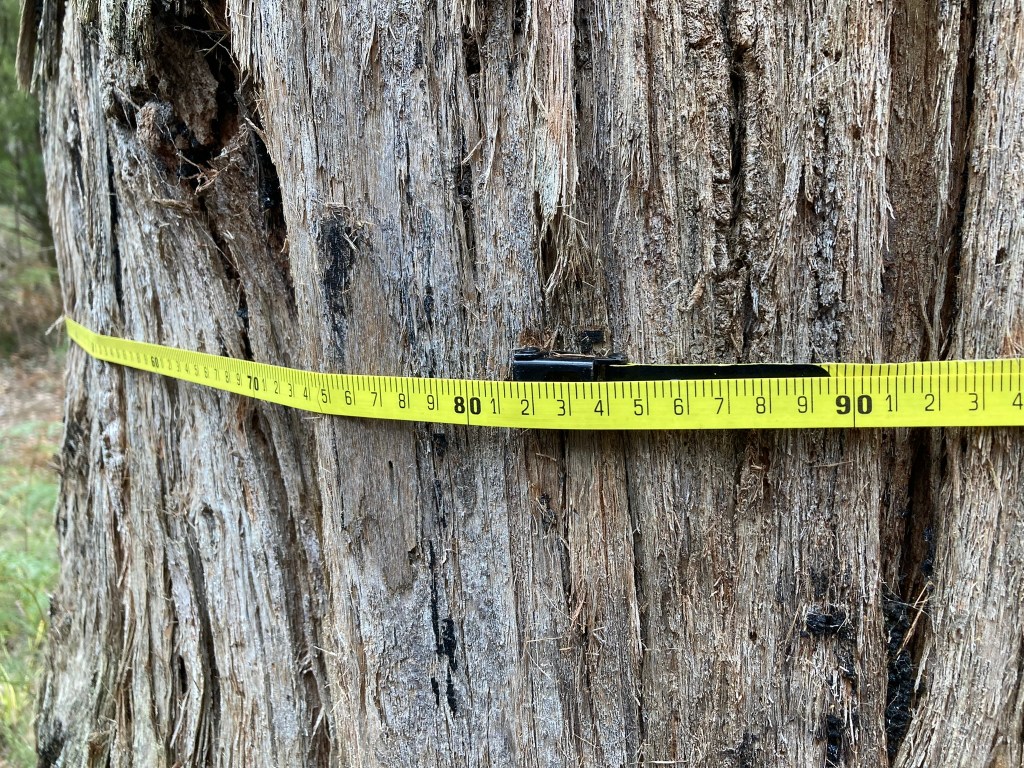
The weathered sign also states that the tree was 10 feet in circumference in 1973. This equals a girth of 305 cm, or a Diameter Breast Height Over Bark (DBHOB) of 97 cm.
In 2004, I also remeasured the circumference of Stringy’s Tree at 381 cm, which equals a DBHOB of 121 cm.
The increase in DBHOB of 24 cm (121 – 97) since 1973 equates to a growth rate of 0.47 cm/year. (which seems very low for a messmate on good soils).
If we assume an average diameter increment of 0.47 cm per year over its life, and then working backwards, Stringy’s Tree might be 257 years old (121 cm ÷ 0.47), rather than the 190 as claimed on the sign board.
I accept there are lots of assumptions and flaws with this method, and without cutting it down and counting the rings, or taking core samples, it’s impossible to tell. And maybe it doesn’t really matter because Stringy’s Tree is still a magnificent specimen.
Ref: Garry Kerr. (1995) A History of the Timber Industry in Victoria’s Far Southwest.
https://drive.google.com/file/d/1-1sUrxaop-Qe-8DQ4CWSrBlAFf-L61Ju/view
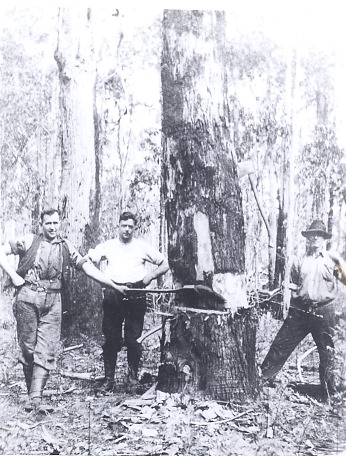
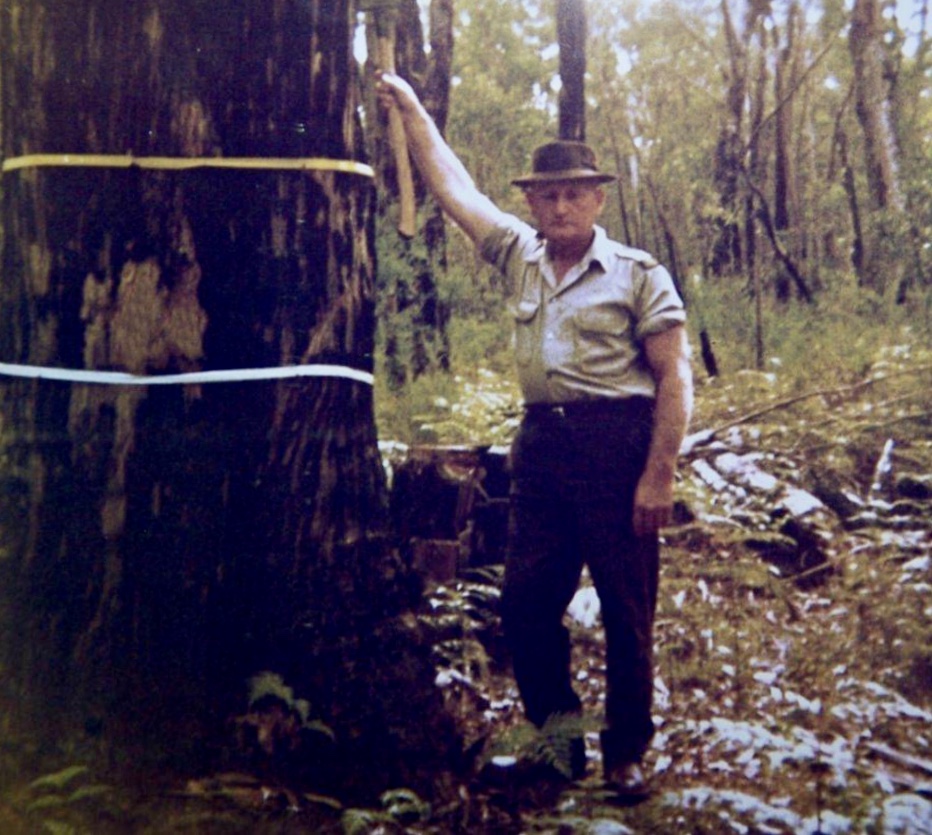
Photo: In the Heywood bush. Harold “Stringy” Aldridge, Alf Telford and Harry Perkins. Photo: Vern McCallum Collection
 Victoria’s Forests & Bushfire Heritage
Hello Peter
Thanks for the great story. I notice that you listed some of the overseers and the areas they were responsible for. Is there an accessible government record where I can get lists of overseers and other FCV staff for the Rushworth area?
With thanks
Tony Ford
Flora Hill
LikeLike
hi there. We have a list of FCV overseers but I cant guarantee it 100% correct but it may have what you are looking for. Cheers
https://docs.google.com/spreadsheets/d/1Cmb0C2yewFvkRbIpqWp3RRlNFE9R80qErb-5llxKJF8/edit?gid=568481047#gid=568481047
LikeLike