
As they say… the days are long… and the years are short… but where did those 10 years go?
On Saturday 8 February 2014, I was acting as a mentor in a Level 3 Planning Team at the Traralgon Incident Control Centre (ICC). We were working on a small but complex bushfire in the Hearn’s Oak / McDonald’s Track area to the west of Morwell which had started the day earlier and was thought to have been deliberately lit.
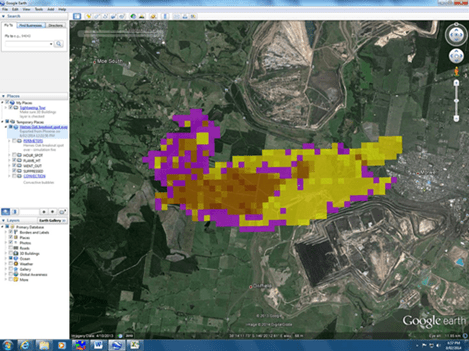
There was serious concern about the Bureau of Meteorology’s weather forecast for Sunday of high temperatures and strong north winds, followed by a south west change around midday. The State Control Centre in Melbourne was requested to prepare a bushfire behaviour prediction map using the sophisticated Phoenix computer models.
The prediction map confirmed the planning team’s suspicions, that if the fire broke its containment lines it would spread to the east and impact Morwell as well as both the Hazelwood and Yallourn coalmines.
The possible fire scenarios, maps, warnings and advice were all given to the Police, SES, Latrobe Shire, coal mine representatives and others, at a briefing late on Saturday afternoon. This was the day before the fire broke out. Unfortunately, I don’t think Hazelwood coalmine owners (GDF Suez) fully understood the gravity of the map they were given and probably failed to adequately prepare for Sunday.
The rest of Saturday afternoon and evening were spent with Senior Sergeant Peter Fusinato from Victoria Police, Lance King from Latrobe Shire and the SES preparing a detailed evacuation plan for Morwell, just in case.
Public information meetings were held in the town and warning advice relayed to ABC radio.
The next day, on Sunday 9 February at around 1.15 pm, the fire Hearns Oak which had been contained overnight, but not fully blacked-out, broke out as feared under the influence of the strong south-westerly wind change and rapidly spread east towards Morwell.
About 30 minutes later, there were more smoke sightings south of Hazelwood on the Strzelecki Highway in the Driffield area. Arson was suspected and the Police were immediately notified.
Fire investigators discovered three kerosene-soaked toilet rolls which had been lit and chucked by the side of the road. It was almost as if someone had lined up the mine with the wind direction to maliciously cause the maximum damage. I understand that people were later arrested and charged.
The fires spread quickly and took hold in an unused part of the Hazelwood mine on upper levels of the coal batters. It also impacted the southern rehabilitation areas of Yallourn open cut.
It’s hard to be certain, but I believe it was the deliberately lit fires at Driffield which had the main impact on the Hazelwood mine rather than the fire originating from Hearns Oak. Not that it really matters now.
All effort was immediately thrown into a desperate and complex firefight. The priority was life and property in Morwell but, where possible, resources were sent to the mine to assist.
The Traralgon ICC was seriously understaffed. Normally for a large complex bushfire there would be a planning team of 8 to 10 people including a mapping officer, resources officer, air observers, weather specialists, fire behaviour analysts, intelligence officers etc., but everyone was already deployed to the East Gippsland fires.
The ICC worked frantically with the Police, CFA and SES to trigger the evacuation plan for the western edge of Morwell township we had jointly prearranged but there was no time for people to respond and move. Shortly before 4 pm, a State Emergency Warning (SEWS) was issued for Morwell to warn people they were in immediate danger.
The plan included the closure of the Princes Highway and main railway line. But the driver of the V/Line passenger train bound for Melbourne from Morwell mustn’t have got the message from his control centre and luckily just made it through to Moe before the tracks were engulfed in smoke and flames. Lots of wooden sleepers were burnt and it took weeks to reinstate the line.
High voltage power lines to Melbourne, substations, and the Hazelwood power station itself was also under threat. There were safety concerns about using helicopters to drop water on high voltage electrical equipment.
In addition to protecting Morwell, other priorities were the Maryvale Private Hospital and the Gippsland Water Factory. The fire destroyed conveyor belts and a large stack of pulpwood at the Maryvale paper mill.
By early evening, around 5.30 pm, the fire had grown to about 2800 Ha with extensive spotting at multiple locations.
Thankfully, nobody was killed or seriously injured that afternoon, but some houses, HVP plantations, farm fences and stock were lost while a large chicken farm was also threatened.
I’ve been involved in lots of major blazes over my forestry and firefighting career, but nothing like this.
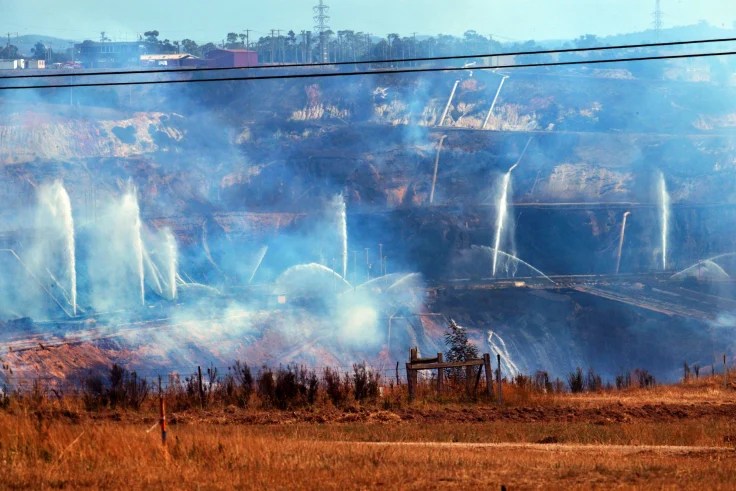
The burning coal seams needed to be flooded with water and foam but the big water main which the SEC had installed years ago around the rim of the mine to run sprinklers over the coal batters and suppress the dust had been removed and sold for scrap by the new owners.
Also, the pumps in the bottom of the pit that could have been used to douse the blaze in the early stages didn’t operate because they were electric, and the power had been cut.
As the coal batters burned, they collapsed, and at one stage threatened some major mine buildings.
Specialist fire trucks with long booms that could spray huge quantities of compressed air foam were accessed from across Australia. But firefighters could only work down in the pit for about two hours because carbon monoxide would build up to dangerous levels in their blood. Crews had to be tested and rotated continually and a few ended up in the Traralgon hospital. Twenty firefighters were treated for smoke inhalation and there were complaints of severe health problems over the duration of the fire.
It was a dreadful place with the sulphurous smoke and dust, but the glow looked fantastic at night. I went down into the pit once for a look but didn’t stay long.
Remote control drones with cameras were used for aerial reconnaissance for the first time. The MFB had a new one and was able to fly through the acrid smoke and because it was fitted with an infra-red camera it could pick up any hot spots.
The fire lasted 45 days and was the largest and longest mine fire to occur in the Latrobe Valley. More than 7000 firefighters from Victoria, interstate agencies, the ADF and the mine owners were deployed.
But the main impact was the large amounts of acrid smoke and ash that settled on the adjacent townships of Morwell and Traralgon.
The Environment Protection Authority (EPA) and the Health Department were slow to act about the toxic fumes and smoke. It took nearly three weeks for the residents of Morwell to be officially advised to evacuate their homes and some limited government support was belatedly made available.
Local people were demanding answers about why this had been allowed to happen as well as who was responsible for regulating the mine and paying for the capping and rehabilitation of the worked-out coalfaces.
Additional ICC teams were flown in from other parts of the State over the following few days and weeks and the Incident Control Centre at Traralgon was overrun as we gave endless briefings on what was going on.
Big wigs, the Brass, and countless hangers-on seemed to immediately descend from everywhere into the cramped office space at Traralgon. They included lots of senior government honchos from Melbourne; Police Commissioners; the SES; Sharon Gibson – Latrobe Shire Mayor, councillors, John Mitchell – CEO and council recovery staff; CFMEU and UFU representatives; Red Cross; Ambulance Victoria; Environment Victoria; Rosemary Lester – Chief Health Officer; Dept of Human Services (DHS); Kylie White – Earth Resources; John Merritt – EPA Regional Manager; Craig Lapsley – Fire Services Commissioner and all the Fire Chiefs including, Alan Goodwin – DEPI, Peter Rau ? – MFB and Steve Warrington – CFA.
There were also visits from the State Premier – Denis Napthine; the Deputy Premier – Peter Ryan; the Opposition Leader – Daniel Andrews; and all the local state and federal politicians with their advisors and media entourages in-tow wanting a briefing. I can’t remember if the Prime Minister, Tony Abbott, came or not. It was manic and all a bit of a blur now.
Meanwhile there were still huge bushfires brewing in far East Gippsland. There were also major fires at Devon north near Yarram, in the Grampians, Wyperfeld, the Big Desert and Kilmore. It was hard to find people to fill key IMT roles and additional fire crews.
The fires in East Gippsland developed into a major campaign effort and burnt for over two months. They became so huge and could be seen from space.
To add to the stress levels, there was another departmental restructure underway with senior staff being targeted for redundancy. But that’s another story…
The Victorian Government held the Hazelwood Mine Fire Inquiry from late February to September 2014. There was a further WorkSafe court case. The mining company lawyers tried to claim that they hadn’t been warned that the Hearns Oak fire might enter their coal pit. But I knew they had received a personal briefing and Phoenix fire prediction map the day before and lucky for me there was an email trail, and my logbook was up to date. All my material was subpoenaed, and I gave a witness statement to departmental lawyers and waited to be called.
Ironically, after all the inquiries and court cases were over and the government had shelled out nearly $100M to extinguish the fire the French company that owned Hazelwood finally closed it in March 2017.
Top Photo: The main media and political interest in 2014 were a bushfire north of Melbourne at Mickleham and the Hazelwood coalmine which burnt for 45 days and cost a staggering $100 million. But just look a bit further east…. the snowy river complex lasted for over two more months and grew to 165 800 ha or roughly the same size as Melbourne.
NASA image – 10 February 2014 https://earthobservatory.nasa.gov/images/83117/city-sized-fire-in-australia



 Victoria’s Forests & Bushfire Heritage
This is another fantastic, factual, historical document
It was a horrible time and it seemed like the big wigs were just waiting for it to just go away ( it’s only the Latrobe Valley )
I’m glad this has been produced from your perspective including stresses involved and inadequacies experienced!
LikeLiked by 1 person
Gre
LikeLike