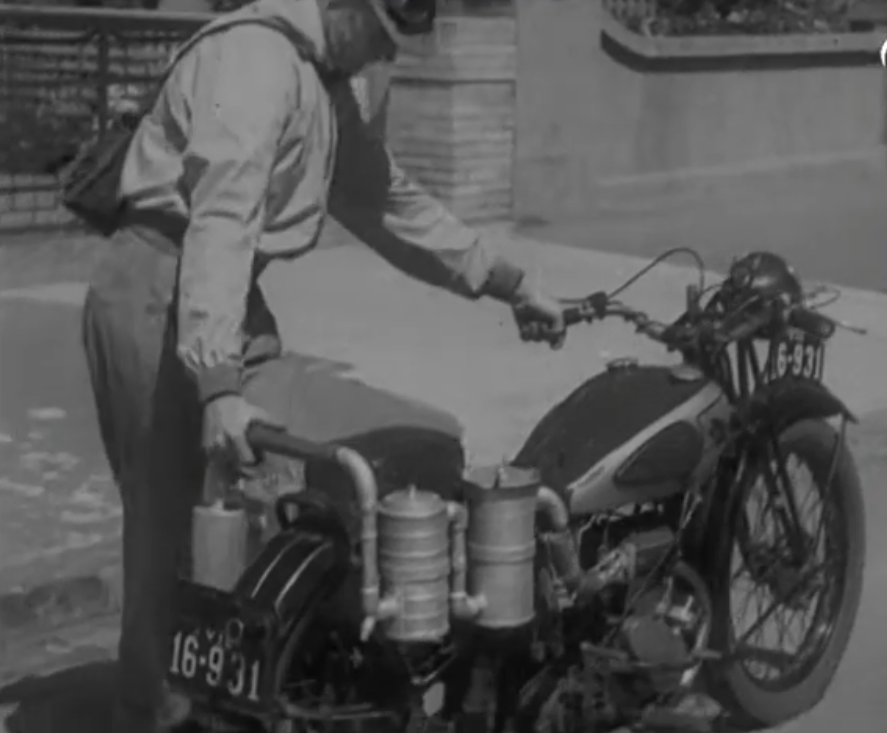
At the outbreak of the Second World War in September 1939, Australia had only three months’ supply of fuel and was totally reliant on imports.
The Victorian Government response was to severely ration petrol and turn to charcoal as an alternative fuel for motorists.
The Victorian Premier, Albert Dunstan, directed the Forests Commission to establish the State Charcoal Branch (SCB). The SCB was headed by the Chairman of the Commission, A. V. Galbraith, with the support of an industry advisory panel.
There was a strong sense of urgency, and the SCB set up its operations in the railway buildings at Flinders Street. Transport and logistics were always going to be a bottleneck.
The SCB worked closely with the Emergency Firewood Branch, which was also coordinated by the Forests Commission.
It was initially estimated that 2,000 tons per week was needed to use in gas producer units fitted to a large number of trucks and cars to replace rationed petrol.
Many options were canvased including encouraging farmers and country people to produce the charcoal, while also guaranteeing a stable market and underwriting the scheme with the government purchasing all good quality charcoal at a profitable floor price.
The current producers were supported to quickly increase production while technical advice was freely provided to those that wished to enter the industry.
Shire Councils and FCV District Offices acted as agents and directly paid spot cash for the charcoal delivered from producers.
Many rural councils like Horsham quickly seized the opportunity to be included in the scheme. Others like Cranbourne, which were closer to Melbourne with different forest types, were more concerned about preserving their own meagre supplies of firewood for local residents.
The price for ungraded charcoal was set at £6/10/ per ton delivered to either a depot, agent or railway station in the country. This increased to £7/10/ per ton when delivered to a State Charcoal Branch Depot in the metropolitan area.
Graded (sieved) charcoal increased in price and was transported in 50 Ib canvas bags which retailed to motorists at between 6/- to 10/- per bag.
The main areas producing charcoal were in a broad arc across Central Victoria at places like Beaufort, Trentham, Lionville, Macedon, Broadford, the Dandenongs and Gembrook. Charcoal was also produced in East Gippsland, mainly at Nowa Nowa and Bruthen close to the railway line.
The best trees were durable species like red ironbark (Eucalyptus sideroxylon), red box (E. polyanthemos), grey box (E. microcarpa), yellow box (E. mellidora), red gum (E. camadulensis) and for lighter grades of charcoal, yellow stringybark (E. meullerana).
The program was a success and by the middle of 1942, an estimated 221 kilns and 12 pits were producing charcoal on State forests. At least 50 to 60 private charcoal retorts were set up in the Barmah Forest alone. There were also over 600 commercial kilns operating on private property. All at a time when labour was critically short.
Demand settled at 3,300 tons of charcoal per month by mid-1942 which required burning nearly 24,000 tons of dry wood. Victorian production of charcoal peaked at 38,922 tons in 1942-43.
While charcoal was relatively simple to produce it had a well-deserved reputation for being inconvenient to use for short trips, inefficient, under powered, dirty, belching black smoke, catching fire and occasionally exploding.
Also, the cost of installation of a heavy and cumbersome gas producer kit was about £100, or the equivalent of 16 times the average weekly wage, and a 50 lb bag of charcoal only lasted between 30 and 60 miles.
There were also higher quality standards for charcoal for use in cars. Gumming of engine valves and the controls in the gas lines could be caused by condensation of tar. Steel kilns as well as concrete and brick lined pits were preferred to avoid contamination with dirt.
But many motorists simply put their cars up on blocks in storage for the duration of the War.
Meanwhile at Gembrook, the Commission invested heavily in some new technology at Kurth Kiln to help solve the shortage.
Wartime enemy aliens were later directed to the task of producing charcoal to solve the scarcity of labour.
At the end of the War and the resumption of petrol supplies the charcoal industry quickly collapsed leaving many abandoned relics on State forest.
With petrol hitting $3 per litre we might need to dig out the plans again…
In the meantime, check out this amazing 40 second film about a charcoal powered motorbike from Footscray in 1942.
 Victoria’s Forests & Bushfire Heritage