Uncontrolled bushfires had been burning from early October 1925 in many places such as Olinda and Sassafras in the Dandenong Ranges and at Healesville in the Yarra Valley.
The forests at Powelltown, Noojee, Toorongo Plateau and the Baw Baw Ranges were then swept by fire on 14 and 15 February 1926, killing stands of mature mountain ash and creating extensive areas of young regrowth.
The mountain forests of Eucalyptus regnans, E. delegatensis and E. nitens are very fire sensitive and were readily killed.
These tree species are also “obligate seeders” meaning they only regenerate from seed and not coppice or lignotubers. They take about 10-15 years to set seed again so are therefore very vulnerable to being killed by more bushfires in that period.
Significant bushfires again in 1932 and 1939 killed some of the young 1926 eucalypt regrowth before it was old enough to produce enough seed and the area was replaced by wattle, scrubland and bracken to create a long-term reforestation problem.
But other stands of 1926 regrowth miraculously survived both the 1932 and 1939 blazes.
The silvicultural knowledge of Victorian foresters was then put to the test. Considerable effort went into reforestation at Powelltown and the Toorongo Plateau near Noojee during the 1940s and 1950s.
A FCV nursery near Noojee in the Loch Valley, which had been growing pines, then switched to eucalypts.
It proved a costly exercise to reforest these areas. After site preparation they were hand sown at the rate of 4 oz of mountain ash seed per acre. Some 600 acres were broadcast sown in this manner in 1932. More than 200 lb of seed were collected that year from ash trees, growing in the same general locality, for future sowing.
New surveys of unproductive forest sites were carried out in 1969 to determine the extent of loss of productive sites. It was found that some 32,000 ha of prime mountain ash forest sites were unproductive, mainly as the result of repeated bushfires over the previous eighty years.
These were all within 150 km of Melbourne and a cost/ benefit analysis showed that reforestation investment was justified. Reforestation plans were submitted to the Australian Forestry Council.
Major reforestation works at Powelltown required the construction of an airstrip at Sumner Spur in 1970.
Reforestation was achieved by clearing the scrub using heavy machines, then burning the slash and either broadcast seeding, or planting with seedlings.
The program lapsed but was renewed in the late 1980s and early 1990s with funding from the Timber Industry Strategy.
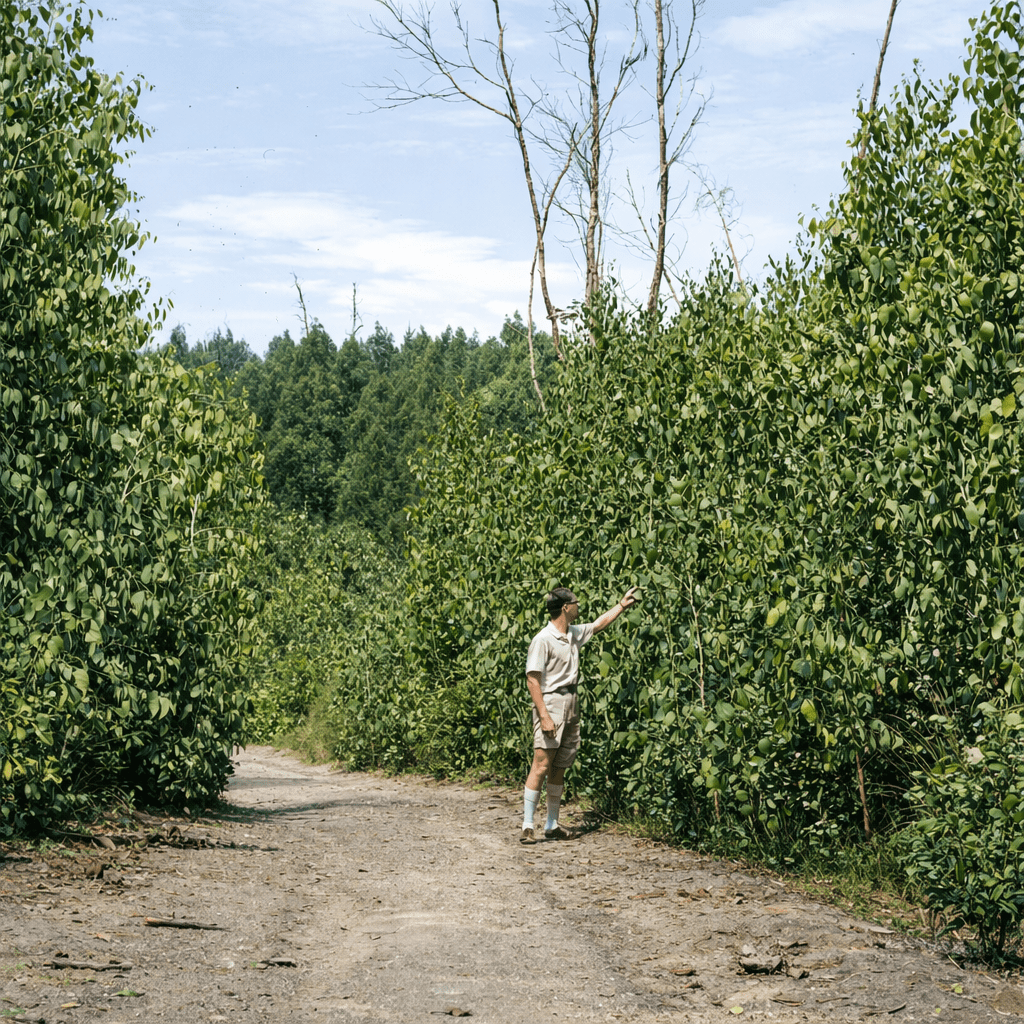
Main Photo: E. delegatensis, Dowey Spur, Powelltown, Clear felled followed by aerial seeding. Frank May 1970, Colourised.
 Victoria’s Forests & Bushfire Heritage