In the early part of last century, there was limited road access to the extensive mountain forests, particularly in the remote and uninhabited eastern ranges, so there was strong enthusiasm amongst Victorian foresters for aerial reconnaissance.
The first Chairman of the Forests Commission, Owen Jones, had been one of Britain’s pioneering aviators in the Royal Flying Corp during World War One. He fully understood that aircraft had three main advantages: speed, access and observation.
Experience has consistently shown that early detection and aggressive first attack are the keys to keeping bushfires small and gives the best chance for control.
Discussions took place with the Air Board as early as 1926 following the bushfires, and then over a period of years prior to 1929-30, with the view to commencing regular fire patrols using RAAF aircraft, but a lack of safe landing areas over the remote forest proved the main obstacle.
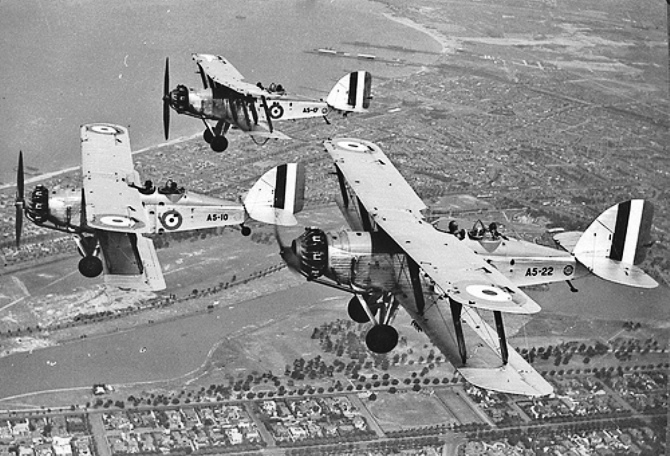
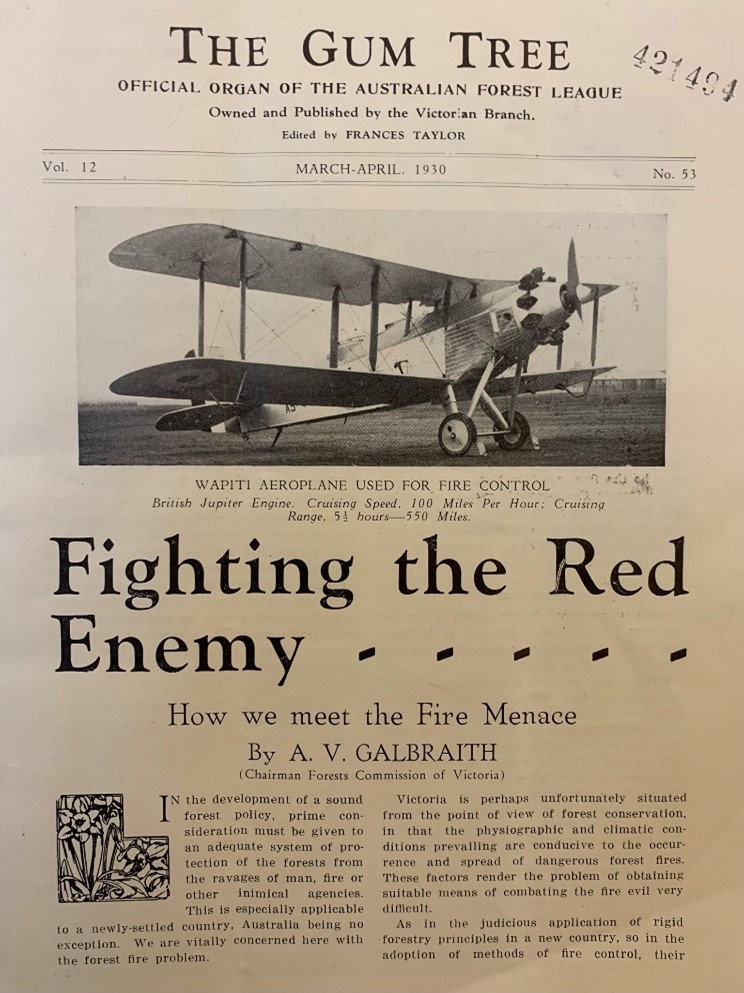
The first fire spotting aircraft in Australia was deployed on 18 February 1930 when a Westland Wapiti from RAAF No. 1 Squadron at Point Cook flew over the nearby Dandenong Ranges.
Communications were sent in Morse Code back to the RAAF base who then quickly passed information on to FCV fire controllers.
But poor communication systems with the ground hampered their effectiveness. It was not until the summer of 1939-40 that an aircraft was able to directly communicate by radio with the FCV District Office at Powelltown.
The use of RAAF aircraft was expanded after the Stretton Royal Commission into the 1939 bushfires.
By the summer of 1945-46, 114 flights were made with up to eight RAAF aircraft in the air on bad fire days. They operated from bases at Point Cook, Ballarat, East Sale and Bairnsdale, and reported 438 outbreaks.
The following year, RAAF Consolidated B-24 Liberators and Avro Lincoln Bombers were made available, supplemented by Avro Anson’s and DC-3 Dakotas.
A major risk to all air fire operations is reduced visibility due to dust, smoke, fog and even low cloud. It was reported on 22 March 1945, that visibility was reduced to zero and all RAAF reconnaissance aircraft were grounded with the result that a fire near Toolangi reached a considerable size before being detected.
However, by 1959-60 the use of chartered cheaper flights from private operators in light aircraft became more common and the last RAAF patrol took place in 1963-64.
By the 1982-83, fire season aerial reconnaissance flights were routine. Most fixed wing aircraft were hired by forest districts from local aero clubs using FCV observers and radio operators.
 Victoria’s Forests & Bushfire Heritage