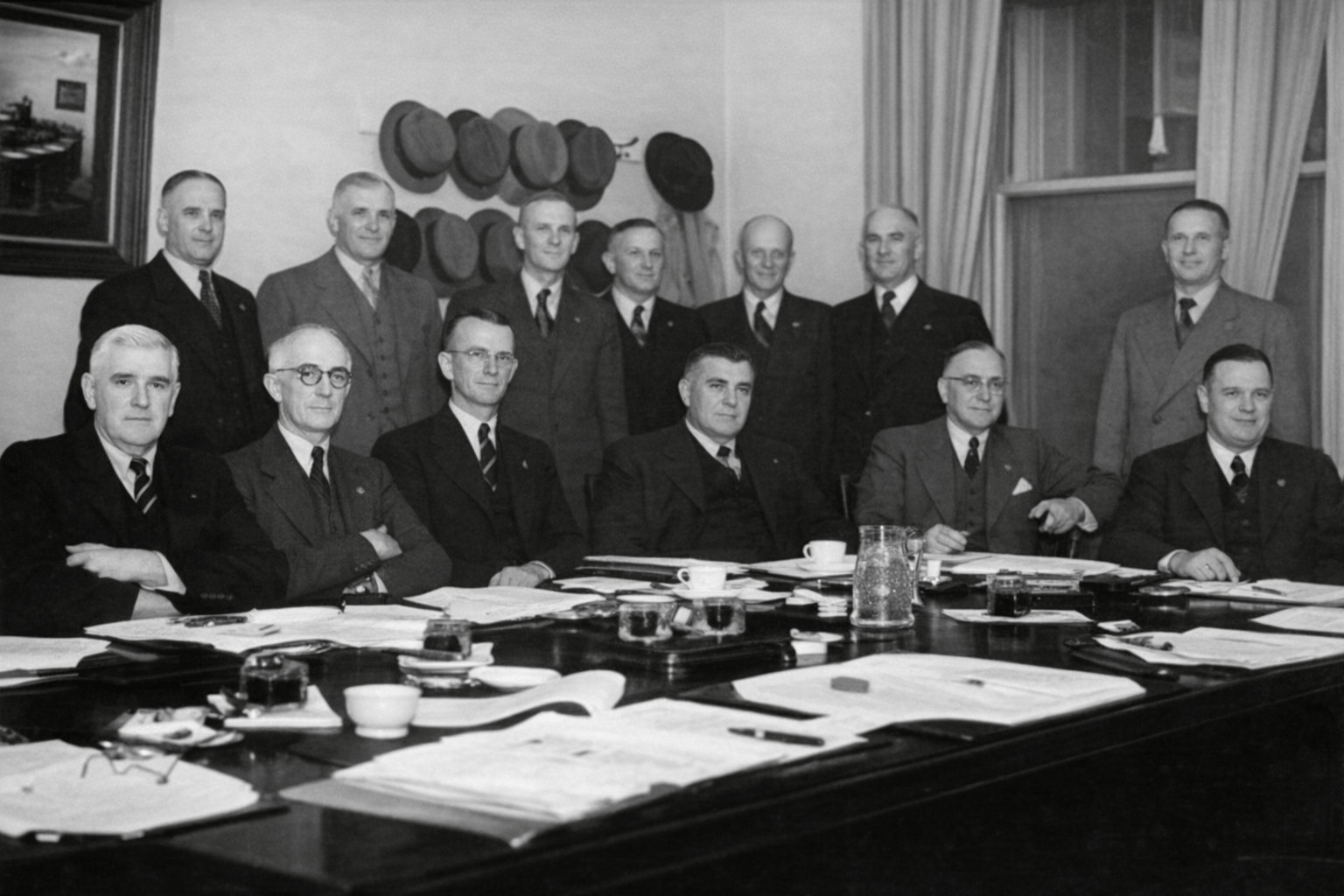
Considered in terms of loss of property and life, the Black Friday bushfires on 13 January 1939 were one of the worst disasters to have occurred in Australia, and certainly the worst bushfires up to that time.
The 1939 bushfires killed 71 people and burnt 2 million hectares, 69 sawmills, and obliterated several towns.
They eclipsed the earlier 1926 bushfires causing their memory to fade from view.
The subsequent 1939 Royal Commission conducted by Judge Leonard Stretton has been described as one of the most significant inquiries in the history of Victorian public administration. He also drew from the 1926 experience.
One of Stretton’s key recommendations was to create a single fire service for country Victoria.
The war years then intervened from September 1939, and arguably the legislative reforms recommended by Judge Stretton moved to the back burner.
Then later in the summer of 1943/44 there were more deadly bushfires where 51 people were killed, 700 injured, and 650 buildings were destroyed.
In particular, the loss of 13 lives at Yallourn on February 14, 1944, and the impact on the State’s electricity supplies when the critical brown coal fields caught alight, brought these bushfires into sharp focus.
There was justifiable public outcry at the lack of government action after similar events five years earlier in 1939.
The Premier, Sir Albert Dunstan, and Minister for Forests, Sir Albert Lind, who had both delayed legislative changes in Parliament, decided there was no alternative but to ask Judge Stretton to chair a second Royal Commission.
Stretton’s report returned to his earlier themes and once again highlighted the lack of cohesive firefighting ability outside the Melbourne area.
After nearly 6 months of debate and argy-bargy in State Parliament, legislation to establish the Country Fire Authority (CFA) was finally passed in two stages on 22 November and 6 December 1944.
On 19 December, the State Premier, Albert Dunstan, announced that Mr Alexander Mercer King of Ballarat was to be appointed Chairman of the CFA Board for the first year, along with 12 members. The Board of the new authority met for the first time shortly after on 3 January 1945.
On 2 April 1945, the Country Fire Authority Act came into effect, and all previous entities ceased to legally exist.
The Forests Commission held two seats on the new CFA Board with Herbert Duncan Galbraith (the man behind Stringers Knob firetower at Orbost) together with Joseph Firth. The FCV Chief Fire Officer, Alf Lawrence, was appointed later in 1946.
The Board then divided Victoria into 24 Regions and appointed 17 Regional Officers, but the organisation had very rocky first beginnings.
All the existing urban and rural brigades were invited to join the new CFA… most did… some reluctantly… but nobody seemed particularly happy with the new arrangements.
Some of the rural brigades were so incensed they proposed an alliance with the Forests Commission rather than ceding autonomy to the newly formed CFA.
Maybe to appease the rival factions, the new CFA Board initially appointed two Chief Officers, with Alexander McPherson representing the urban brigades and Charles Alfred Daw heading up the batting for the rural brigades.
McPherson retired at the end of June 1950, leaving Daw as the sole Chief Officer of the CFA.
In its 1944/45 Annual Report, which was at the time of the formation of the CFA, the Forests Commission noted-
“The Commission is satisfied with its efforts in building up a virile organization of 768 brigades with approximately 35,000 members and over £100,000 worth of equipment, and it desires to record its great appreciation of the valuable services that have been given voluntarily, year after year, by the bush fire brigades in the preservation of the State forests. It is, therefore, with regret that our official connexion with this excellent organization has been concluded.”
The CFA then took responsibility for fire suppression on “Country Victoria” leaving the Forests Commission to focus on the public land estate such as State forest and National Parks which amounted to the remaining one third of the State.
The legislation also required that each country municipality appoint a ”Proper Officer” empowered to permit lighting of fires during the proclaimed summer period and to order removal of fire hazards.
So, in the end, Stretton’s 1939 grand vision was finally realised…
A major revision of both the Forests Act and Country Fire Authority Act in 1958 clearly enshrined the role of the two agencies and the Chief Fire Officers into complementary legislation.
More importantly, these events shaped and cemented Victoria’s deep-seated approaches towards bushfires outside Melbourne. Both the Forests Commission and the CFA adopted clear policies to detect and suppress all bushfires and became very focused and skilled at doing it.
Robert Murray and Kate White (1995). State of fire: a history of volunteer firefighting and the Country Fire Authority in Victoria. Hargreen Fitzroy, Vic.
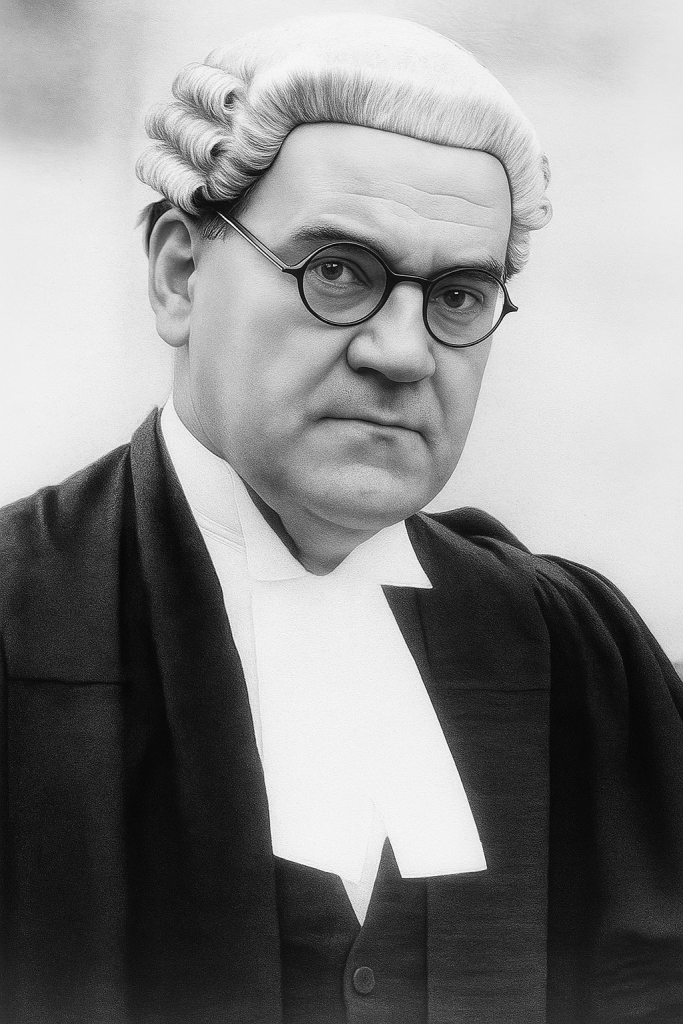
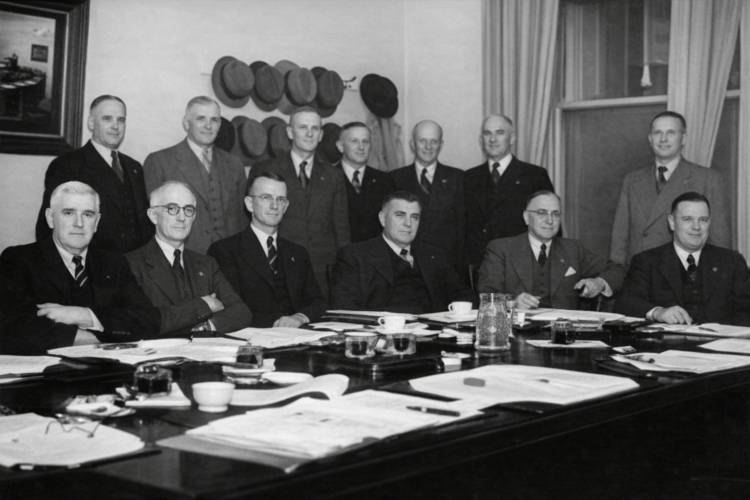
Photo: L-R: Back Row – Geoffrey Graeme Sinclair (Secretary), Angus A. Cameron, E. Buckland, George Stewart, Joseph Firth (FCV), Charles Alfred Daw (Chief Officer – Rural), Alexander McPherson (Chief Officer – Urban). Front Row – T. H. Grigg, W.S. Slater, Herbert Duncan Galbraith (FCV), P. Slouch, W. Charles Moyle, Alexander Mercer King (Chairman). Source: State of Fire.
https://trove.nla.gov.au/newspaper/article/11375460
 Victoria’s Forests & Bushfire Heritage