
Soil erosion was identified as an emerging problem across rural Victoria almost immediately after the gold rush of the 1850s.
The Royal Commission of 1897-1901 into the destruction and wastage of Victoria’s forests also identified the importance of protecting soils and forested water catchments.
A Sludge Abatement Board was appointed in 1905, charged specifically with the responsibility of controlling the amount of sludge permitted as effluent into streams from mining operations.
In 1917 an Erosion Inquiry Committee was formed by the Minister for Public Works, but little seemed to come from its deliberations.
The State Rivers and Water Supply Commission (SR&WSC) established its own River Erosion and Flood Protection Branch in 1931 to carry out minor river stabilisation works.
As early as 1922, the Forests Commission had taken a strong interest in the protection of soils and water on forested catchments as well as private land. Specialist nurseries at Macedon, Creswick, Mildura and Wail near Horsham grew plants for country landholders to help restore the land.
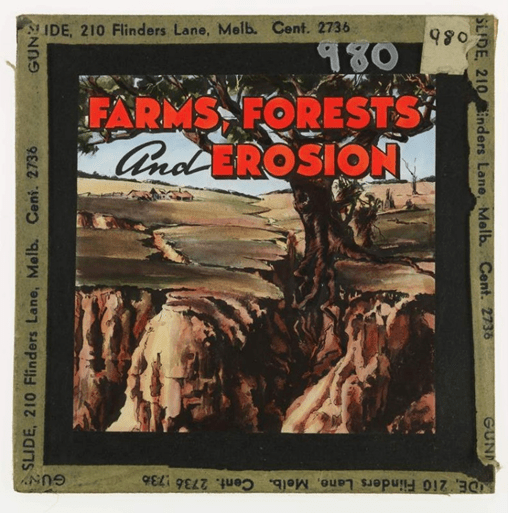
Soil erosion came into very sharp focus during the droughts of the 1940s across the Wimmera and Mallee deserts where the sand from bare paddocks drifted across railway lines, roads and into irrigation channels. And huge dust storms were common.
In 1930 the Government appointed a sand-drift control committee to examine the problem, but once again it resulted in little action.
The important step came when Charles Tate Clark, Staff Surveyor in the Lands Department, was elected President of the Victorian Institute of Surveyors.
In 1939 he organised a symposium in collaboration with the Institutes of Engineers and of Agricultural Science to examine erosion control.
The symposium ran for four weeks and told a compelling story. Harold Hanslow, for many years a farmer and since 1935 a Commissioner of the SR&WSC was also concerned with the problem of erosion throughout the state and gave a graphic picture of the deterioration of the Mallee.
Removal of the Mallee scrub followed by excessive cultivation was damaging the fragile soil structure, plus the impact of rabbits was having a disastrous effect on the land.
The sand, so readily lost from the farmer’s property, drifted across railway tracks, overflowed roads, and filled up the irrigation channels.
The cost of maintenance works climbed as gangs of men were employed to shovel soil from permanent structures. In at least one case, an irrigation channel was completely abandoned due to sand-drift and another constructed in an entirely new location to replace it.
But the problems in the northwest were only the tip of the iceberg. Laanecoorie Reservoir on the Loddon River had been reduced by 47% of its capacity within 50 years because of siltation.
The Tambo River in East Gippsland had become so gorged with sediment that the new bed was now only a few feet below the rail track of the original trestle bridge.
The recommendations of the symposium were forwarded to the Premier, Albert Dunstan, in 1940 but he immediately put them into a file and forgot all about them. The Melbourne Press which promptly labelled him Albert the Ostrich.
Hanslow set himself two major tasks: to convince Victoria’s farmers to change their methods so as to promote soil conservation, and to persuade the government to pass legislation which would provide a framework for tackling the broader aspects of the matter.
Hanslow was a fiery protagonist and determined to see an erosion control programm instituted. He was also a prominent member of the Country Party and addressed meetings of members throughout the State with the aim of enlisting political support for the scheme which proved very persuasive.
By 1940 the pressure on the Government to do something was increasing, and Dunstan appointed a Cabinet Sub-Committee to examine the problem again. The committee recommended new legislation and appointment of a Board.
Cabinet once again ignored the recommendations. Hanslow was infuriated and wrote a stern letter to “The Countryman” highly critical of the Government. The Editor arranged to withhold publication until Dunstan had seen it and the Premier then threatened to sack Hanslow if he did not withdraw the letter. Hanslow retorted that unless Dunstan undertook to introduce soil conservation legislation the letter would not be withdrawn.
The stage was set and Hanslow retired to the country to await results. After a series of fierce rows, the Premier capitulated and agreed to the passage of legislation on the control of soil erosion.
The Soil Conservation Act 1940 created a Soil Conservation Board of seven members. The Chairman, Harold Greve Strom, was employed fulltime with staff to assist with the work. Beginnings were small but at the end of the first year the Chairman had a staff of three — the Departmental Secretary, a draughtsman and a typist.
In 1940, Hanslow donated a cup for the Mallee farm showing the best application of soil conservation principles.
https://adb.anu.edu.au/biography/hanslow-harold-10418



 Victoria’s Forests & Bushfire Heritage