
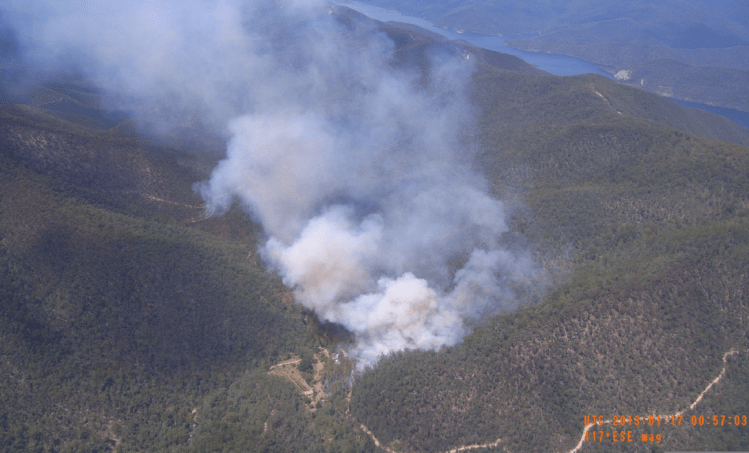
A major fire started at Aberfeldy just near the edge of the Thomson Reservoir at about 11.30 am on Thursday 17 January 2013.
The bush had been severely burnt only 6 years earlier in the Great Divide fires of 2006-07, so the forest had lots of dead trees and had grown back with a thick understory of tall oat grass.
The fire swept through the State forest in the afternoon and through the night under the influence of a strong north-west wind.
I was on duty as DSE’s Agency Commander when it started and worked through the night trying to figure out what was going on, predict where it was headed, deploying resources from across Gippsland and getting advice messages and warnings out to communities.
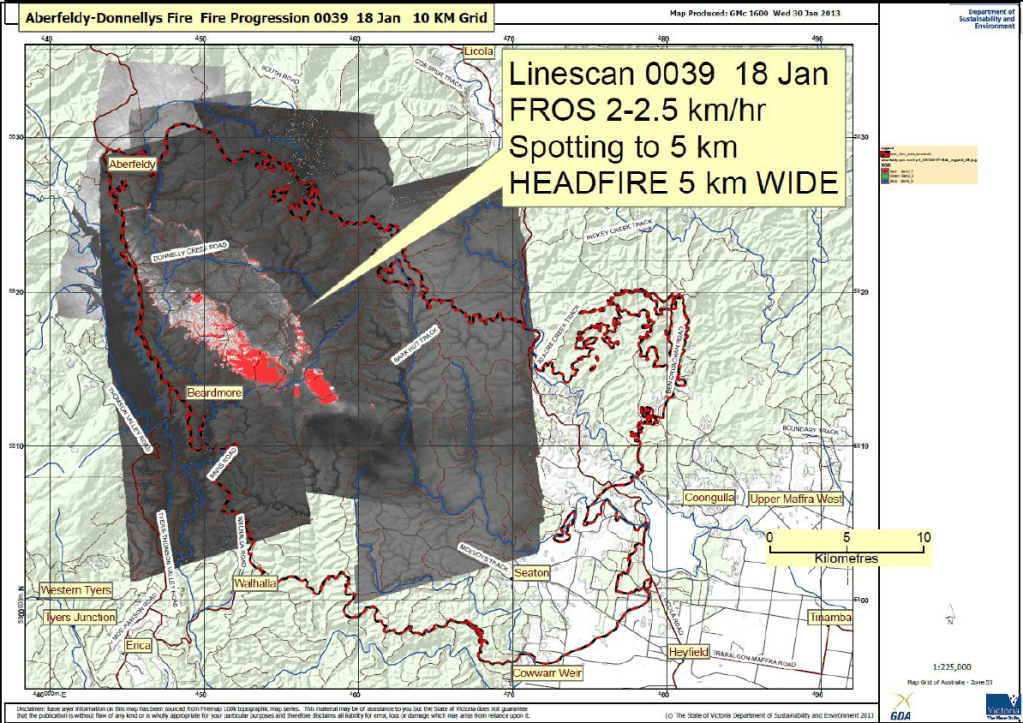
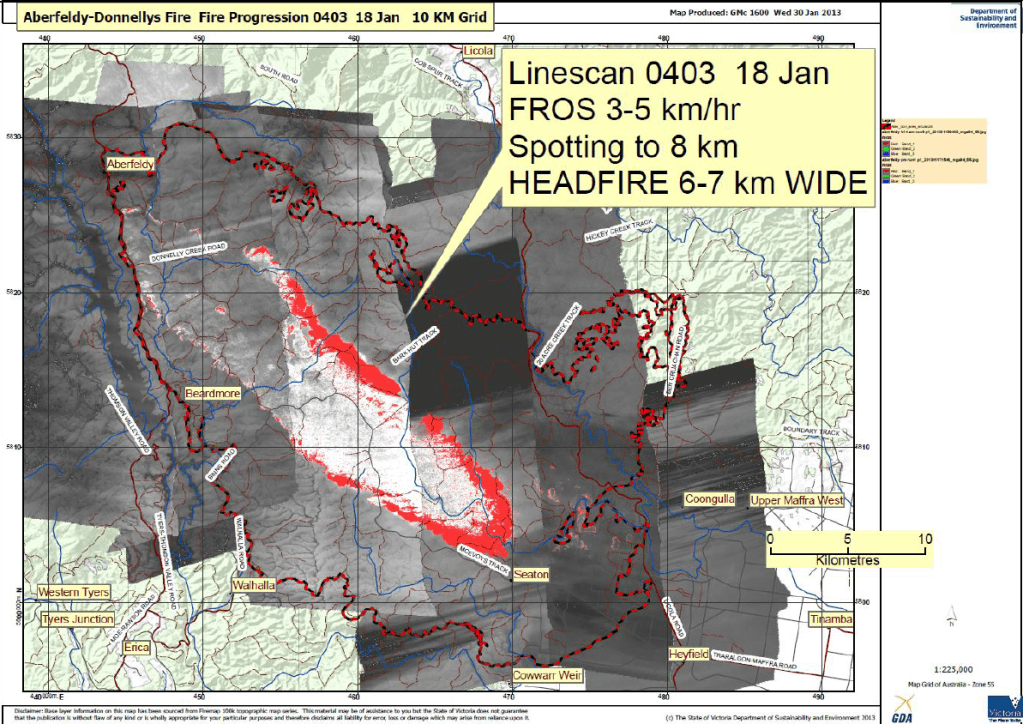
I had never seen fire move so fast and so hot during the middle of the night. There were strong upper atmospheric winds, which combined with very dry air, “dragged the fire along” at much higher speed than predicted. At 4 am the fire was moving through the bush at an astonishing 3-5 km per hour and spotting up to 8 km ahead of the front.
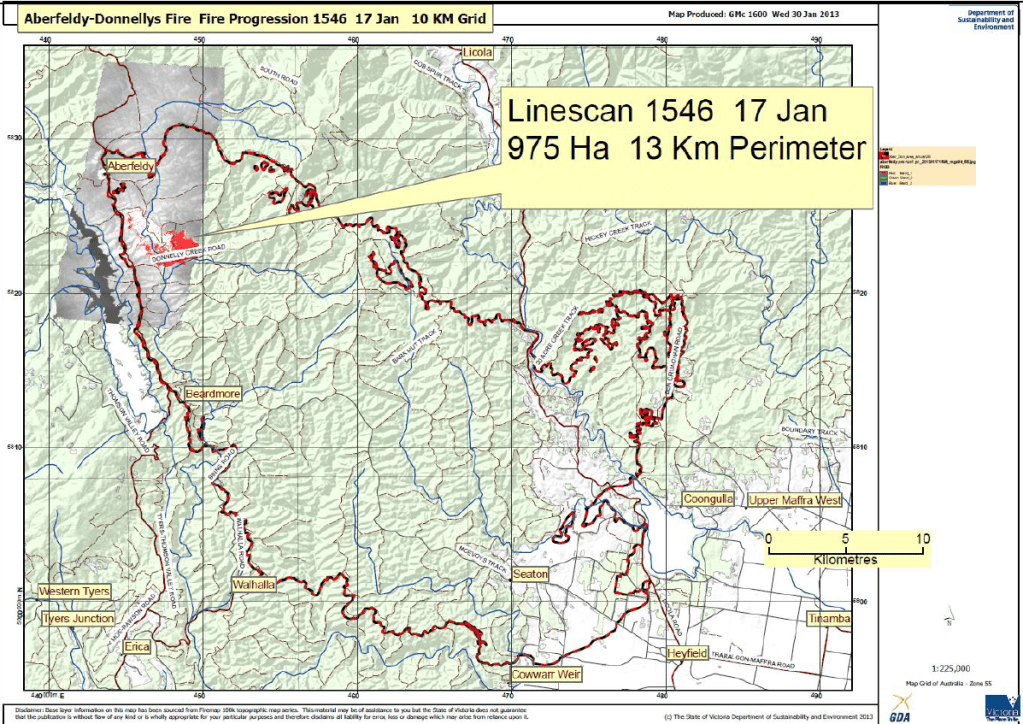
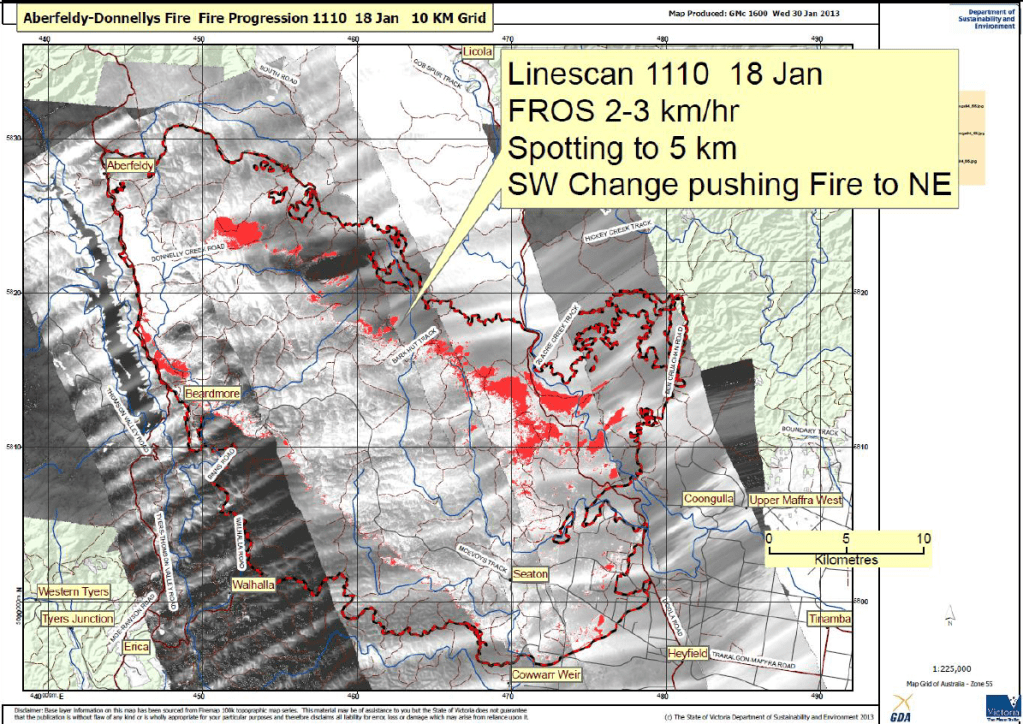
A series of infrared linescans and maps prepared by Fire Behaviour Analyst, Greg McCarthy, shows the progress of the fire overnight.
By daybreak, the fire had spread about 35 kilometres towards the south-east with spot fires starting on cleared farmland at Seaton, Dawson and Heyfield.
With the arrival of a south westerly wind change at around 10 am on Friday 18 January, the fire burned an additional 25,000 ha in eight hours towards Coongulla and Lake Glenmaggie. People at Licola were under potential threat.
Twenty-two houses were destroyed as well as a number of sheds and vans at the Glenmaggie caravan park. Sadly, Stanley Hayhurst, died after being found in a burnt-out vehicle.
Some 760 firefighters from DSE, CFA, Parks Victoria and Melbourne Water were deployed, together with 180 appliances, and 23 bulldozers, supported by 13 aircraft.
Over 87,000 ha were burnt, and it took nearly two months to finally control.
Keeping locals out of burnt areas and clear of falling trees was also a major safety issue which always caused grief and angst in the community. They usually found ways around the Police roadblocks we put in place.
Poorly supervised and overzealous shire contractors knocked over far too many burnt trees in my opinion and changed the rural landscape forever.
The subsequent rehabilitation project ran for months into the following spring.
Hundreds of kilometres of fences were lost and the new government fences policy, which I wrote, that provided 50% of the costs of materials to landholders for a replacement fence was implemented for the first time.
There was a subsequent court case, and Grahame Code, who admitted burning papers on his Aberfeldy property, was charged with recklessly causing a bushfire. But this charge was later dropped, and he was found guilty of leaving a fire without taking all reasonable precaution to prevent it spreading.
I worked back-to-back 14-hour shifts for weeks without a break in Traralgon and Heyfield and was caught up in endless meetings, briefings, tours for dignitaries and teleconferences. I was tired and all I wanted to do was go home and sleep.
Our house was full of soot and ash like it had been during Black Saturday and I didn’t have time to clean up the mess, mow lawns or spend time with my family.
Then more fires near Mt Hotham came over the Great Divide into Swifts Creek.

 Victoria’s Forests & Bushfire Heritage