
A fuel reduction burn near Tidal River in the Wilsons Promontory National Park escaped on Friday 1 April 2005.
It was the second time the burn, which had been ignited 12 days earlier in thick tea-tree, had escaped its containment lines, and was now bearing down on the popular campsite.
The burn had been initially lit at 1 pm on Monday March 21, under mild conditions, with an FDI of 3 (low), temperature of 17.4 degrees and east-north-east winds of 11.3 km/h, with gusts up to 29. The burn was not completely extinguished at the end of the day (which is not uncommon with heath fires) and continued to smoulder.
Four days later, on 25 March, the burn escaped its containment lines and crossed the main road into Tidal River, but it was under control quickly within 12 hours.
Fierce winds then saw it flare up again on the following Monday and Tuesday, but within its boundaries. Aircraft and more firefighters were deployed from Gippsland to suppress the flames.
Everything went quiet again for a few days, but then temperatures rose to the high 20s with north-west winds of about 100 km/h, which saw the situation escalate on April Fool’s Day.
Two rangers were rostered that evening to patrol the fire in conjunction with their normal duties. They reported at 9.00 pm that they could see sparks within the perimeter of the burn.
At about 11.00 pm, the duty officer was informed that the fire had spread and jumped the river. The fire quickly crowned under the influence of strong northerly winds with significant spotting in several locations. It was initially reported to be behind the Parks Victoria works depot.
At approximately 11.30 pm, staff activated the warning siren at Tidal River, which only operated for about 3 minutes before cutting out. Attempts to reactivate the siren were unsuccessful. Some 30 minutes had elapsed since residents and visitors first noticed the fire and the activation of the siren.
It was during the Easter school holidays so there was a rushed evacuation of more than 500 visitors from Tidal River to Norman Beach, which took approximately 20-25 minutes.
While the evacuation was underway the incident controller and two Parks staff removed Jet A1 fuel, tractors, boats, and vehicles to an open area.
The CFA at Yanakie was notified via 000 at 11.37 pm and several brigades responded. Four CFA tankers gained entry to the village and were deployed to directly fight the fire threatening the works depot and cabins and to steer the fire away from the residential area.
Police were also notified around 11.30 pm and arrived at the Mt Oberon turn off at approximately 12.20 am
The SES arrived at Norman Beach at 4.30 am and provided hot drinks and blankets to the campers. Between 6.00 am and 7.00 am police authorised the clearance of Norman Beach, allowing evacuees to collect their belongings and leave the Park.
The Premier, Steve Bracks, was one of those evacuated.
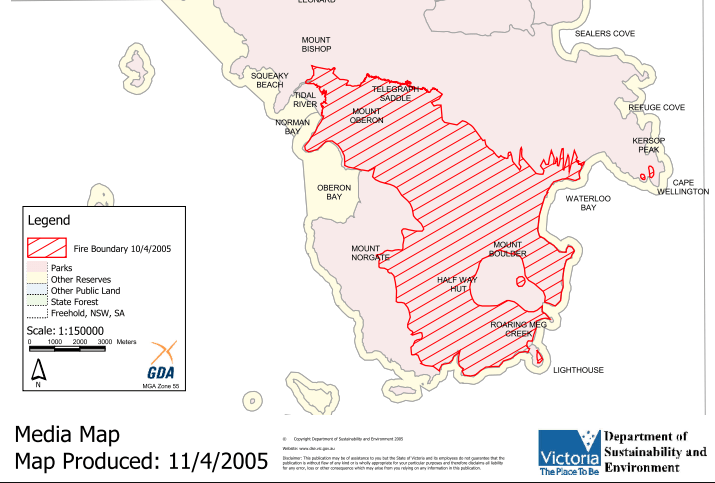
The fire swept out of control to the south and east of Tidal River and across the top of Mount Oberon towards the lighthouse at the southern tip of the Prom.
Another 100 people, scattered in campsites at Refuge Cove, Sealers Cove, Waterloo Bay, and the lighthouse were either flown to safety in the Police Helicopter or rescued by boat.
Without vehicle access to the wilderness area, boats, motorbikes and helicopters were used to transport crews and equipment to reach the bushfire in more remote areas.
An epic 18km handtrail was cut through the thick scrub over the next 14 days to contain the northern edge.
Over 6,000 ha, or 13% of the Park was burnt and it was controlled 17 days later. It was the first time the southern part of the Park had been burnt since February 1951.
The escape triggered five separate Government reports including DSE and the Emergency Services Commissioner, Bruce Esplin, who found the burn was poorly planned and inadequately patrolled.
The escape of the burn reignited age-old debates on the merits of fuel reduction burning and there were armchair experts aplenty offering gratuitous advice.
Politicians in Spring Street also joined the “pile-on” and couldn’t help themselves from having a crack from afar. State Opposition Leader, Robert Doyle, questioned how a controlled burn could get out of control, (very funny, ha, ha), while the shadow Minister for Environment, Phil Honeywood, described it as “the height of lunacy” to schedule burns just days before the Easter and school holidays.
Disgruntled holidaymakers didn’t hold back either.
The Minister, John Thwaites, defended the timing, saying autumn was the only time substantial fuel reduction could be undertaken, and that risks could never be eliminated.
Ironically, the aim had been to burn 20 hectares to protect the Tidal River campsite from future bushfires and rejuvenate the heathland vegetation.
But to put things in context, during the season, only 9 of 363 (2.4%) of the burns undertaken by the Department during its autumn burning program escaped control lines, with the one at Wilsons Promontory being the largest in terms of area. Diverting crews and equipment to the Prom disrupted the remainder of Gippsland’s burning program.
With hindsight, the burn had relied too heavily on a fuel moisture differential against the adjoining wet heathland as one of its main control boundaries, rather than a constructed track, but the heathland dried out over subsequent days, allowing the fire to escape.
But significantly, the investigation found that fuel moisture differential measurements were not undertaken along the southern flank as intended.
Emergency Services Commissioner (2005) Examination of prescribed Burning Practices. https://vgls.sdp.sirsidynix.net.au/client/search/asset/1266499

 Victoria’s Forests & Bushfire Heritage