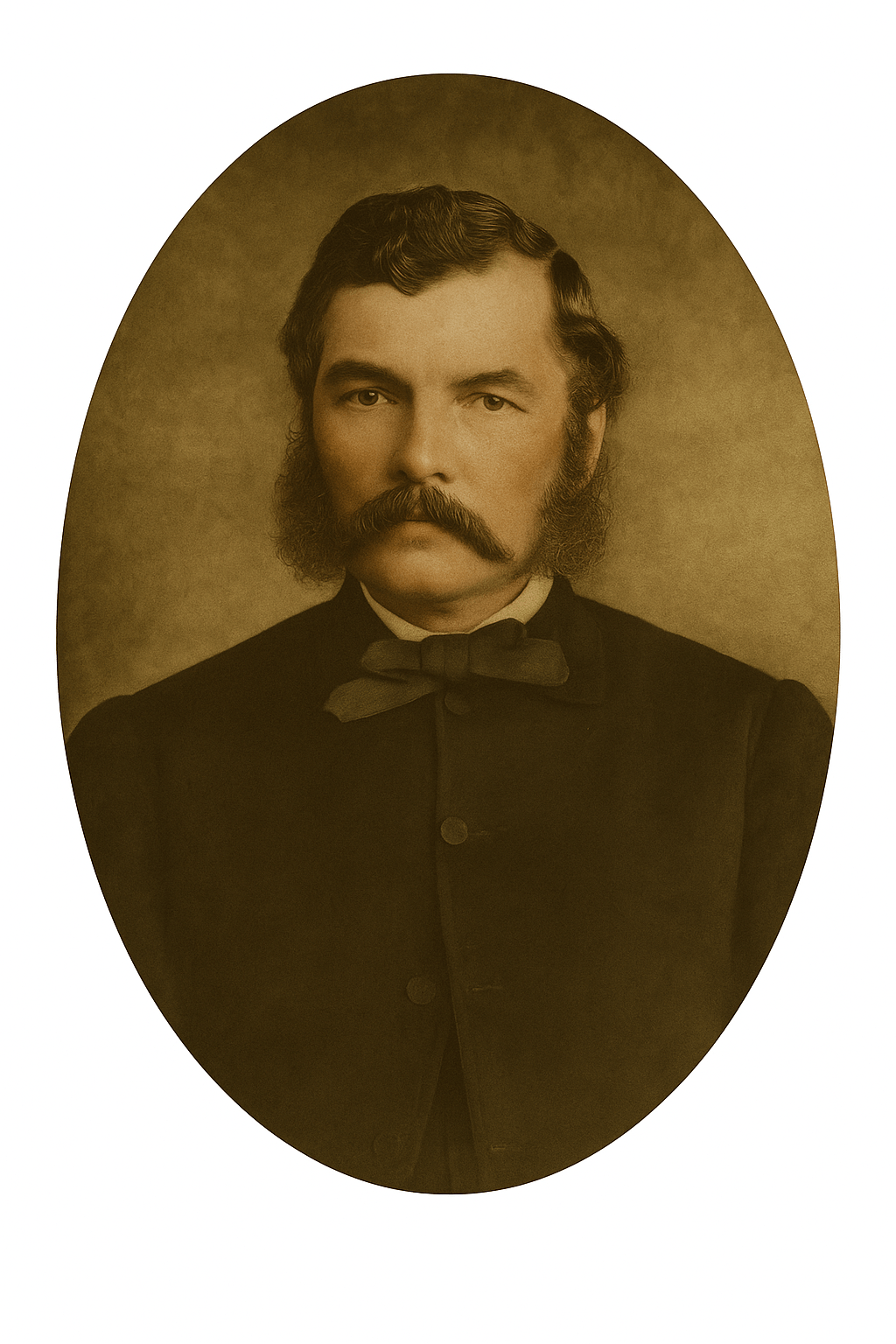
Howard Loftie Allan Stoney was the first forester in East Gippsland. He was one of the original 16 appointed and took up his position as Inspector in Bairnsdale in 1883, aged 24.
Originally from Bairnsdale, Howard had no forestry experience or training but had worked in the Lands Office at Sale as a Crown Land Bailiff, having first joined the service as a junior clerk in 1874.
Other appointments included John La Gerche at Creswick, William Code at Heathcote, Thomas Orde at Beaufort, Moses McCann at Sandhurst and Robert Leech, W.F. McNamara, M.F. Hennessy and M. Griffin. There was also Joseph Firth (Macedon), John Blair (You Yangs) and J. H. Love (Gunbower) as plantation officers.
Although the forests of East Gippsland were different, Stoney faced similar problems to the other foresters across the State
His first priority was to stop illegal cutting. In his report for 1883, he noted 15 successful prosecutions for cutting without a licence and the seizure of several lots of wattle bark. The forests were closed to bark stripping at that time as a result of the Wattle Bark Board of Inquiry in 1878.
At Lakes Entrance, bark was used to tan sails and season fishing nets to protect them from decay in the salt water. The industry developed very rapidly and at one stage in 1868, there were 2000 tonnes of bark ready for shipment from Bairnsdale.
Howard also commented in 1883 on the excellent growth of young wattle on the closed areas and the valuable forests near Lakes Entrance and in the Snowy River District. By 1886, Stoney recommended reopening the areas closed to wattle stripping.
But Stoney had problems with court cases. In 1886, when one case was dismissed, the Magistrate suggested that the Crown Lands Department should provide him with legal assistance.
East Gippsland (beyond Bairnsdale) was one of the last places to be settled in Victoria.
The Koo Wee Rup Swamp was a significant barrier, so access to Gippsland was primarily by boat through Lakes Entrance or Port Albert until the arrival of the railways.
Sawmilling boomed in the 1880s coinciding with the construction of railway lines to Heyfield in 1883, Sale in 1887, Bairnsdale in 1888, as well as the Sale─Stratford link in 1888 and Maffra─Briagolong branch line in 1889.
The first record of sleeper-hewing in East Gippsland was from 1887 in the Coongulmerang Reserve near Lindenow.
Many small and itinerant sawmills were built across the Red Gum plains cutting large volumes for bridges and heavy construction, sleepers, as well as wood blocks to pave Melbourne’s roads.
Meanwhile, the Forest Conservator, George Perrin, was at constant loggerheads with the Railways Department over the wasteful cutting of sleepers. He urged that sleeper hewer(s) should be excluded from the forest and made clear his belief that individuals hewing timber bore the majority of responsibility for the destruction of Victoria’s timber, not sawmillers.
Perrin also believed that sleeper cutters posed a fire risk and he directed Stoney to cease all hewing by November 1897, and that no permits were to be issued in January. Not surprisingly, this was strongly condemned, and the Bairnsdale Advertiser described it as arbitrary and unnecessary, claiming that sleeper cutting did not increase the fire danger; men would be thrown out of work and the railways deprived of sleepers.
By November 1911, the demand for sleepers was particularly strong, with large loads being sent from Bairnsdale with the majority for the Cressy-Maroona line. The construction of the Bairnsdale-Orbost line between 1910 and 1916 also created a substantial demand. Many were cut from the forests adjacent to the new line.
In 1887, Howard forwarded a wide-ranging report detailing the level of sawmilling activity, timber products and their uses. On average, 20 licences for ordinary wood and 12 to 14 for red gum and ironbark were issued monthly.
But the demand for timber collapsed with the onset of the economic depression in the 1890s associated with a post-goldrush hangover, and very few of the mills from the 1880s, survived.
In 1889, Stoney was finally provided with an assistant forester, Robert Austin Leach, who was first stationed in Bruthen, then Cunninghame (Lakes Entrance) from 1890─1894.
In the Colquhoun State forest in 1901, Stoney, with the assistance of Foreman W. Hogg, who had replaced Forester Leach in 1895, started a small nursery raising the highly prized Gippsland grey box (Eucalyptus bosistoana) which was not regenerating satisfactorily. Stoney eventually persuaded the Department to fence off 20 acres, then he collected and sowed seed to produce a healthy crop of young trees.
In 1905, the nursery was inspected by the Acting Conservator, Augustus Warren Crooke, who was impressed and promised to follow up with more funds.
The Bairnsdale Shire Council commended Stoney for his initiative, and the next year the Bairnsdale Advertiser supported Stoney’s request for funds to clear a larger area of vermin and enclose it with wire, so the seedlings he had raised could be planted out. But it doesn’t appear that the funds were provided and there is no record of where the sown plot was located.
Foresters also had the responsibility for bushfires on State forests and Timber Reserves but had limited resources to tackle them.
The Bairnsdale Advertiser reported in 1890 that the Stoney sent a telegram to the Conservator of Forests, George Perrin, notifying him that a large fire was burning in the Colquhoun Forest and that settlers in the vicinity were suffering severely from the fire. A gang of 40 sawmill hands, who were in the vicinity, were engaged in fighting the fire and every effort was made to reduce the damage to a minimum.
By 1904, Stoney had overall responsibility for the Briagolong, Bruthen and Cunninghame Districts with subordinate staff of James Firth at Briagolong and W. Hogg at Cunninghame. In 1905, Assistant Forester, Thomas Hayden, was appointed to Bruthen. Later in 1910, to cope with the expansion in the hewing industry, another officer, H.W. Bridle, was appointed to Genoa.
Howard’s name appears regularly in the local newspapers as an official associated with the Bairnsdale horse racing club.
Howard Stoney continued as the Inspector of Forests at Bairnsdale, but in 1916 after serving in East Gippsland since 1883, he transferred to Melbourne and retired shortly after. Chief Forester H. D. Ingle, stationed at Wiseleigh (Bruthen), then took over.
Howard Loftie Allan Stoney died in Bairnsdale on 4 January 1924, aged 76.
Note: I’m not sure if Howard had any connection with Gippsland’s famous Stoney Creek railway bridge, or if it’s just a coincidence.
Moray Douglas (2007). A History of the Forests and Forestry in East Gippsland. https://nla.gov.au/nla.obj-2586554133/view


 Victoria’s Forests & Bushfire Heritage