
The Wombat State forest straddles the Great Dividing Range and stretches from Daylesford to Macedon. It has a very fragmented public land boundary and complex private land interface. There are many small settlements surrounding, and also as inliers, in the forests.
The Wombat forests are close to Melbourne and have been important for tourism and recreation for decades. The Hepburn Springs were discovered during the gold rush and a large number of Swiss and Italian immigrants lobbied the State Government in the 1860s to preserve them. Gold mining was thought to be irreversibly changing the underground water tables.
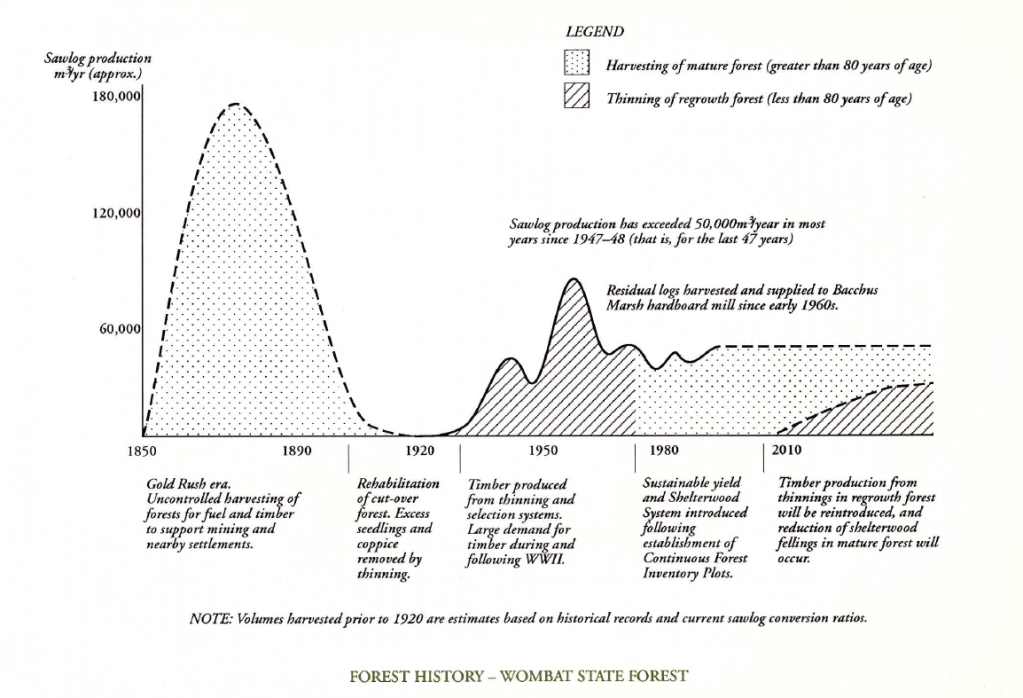
Uncontrolled timber harvesting began with the discovery of gold in 1851. During the gold rush there may have been as many as 190 sawmills, in and around the Wombat, cutting timber and producing fuel to support the mines and towns. The peak was in 1878 when 138,000 cubic metres of sawn timber alone was produced from more than 40 sawmills.
At the time, the forests were considered by many to be limitless “Wastelands of the Crown”. Timber cutters harvested the best trees and destroyed many more than they used. It also was common practice to strip bark from standing trees to clad buildings.
Overcutting continued despite repeated condemnation by the Conservator of Forests, George Perrin.
The soils and streams were also heavily disturbed in the quest for gold. The Government Botanist, Baron Ferdinand Von Mueller, is often credited with the spread of blackberries to stabilise soils disturbed by goldmining, which now uncontrollably chokes the bush and waterways.
In 1872, the first government nursery was established at Macedon by William Ferguson with the aim to restore land degraded by gold mining. Another soon followed at Creswick, opened by John La Gerche.
At the same time, the powerful Lands Department was alienating and selling as much public forests as it could, in a mad scramble to raise revenue and establish new settlements and farmlands.
By 1873, some 1150 steam engines in the Victorian gold mining industry were indiscriminately devouring over one million tons of firewood.
In May 1897, the Surveyor General – Samuel Kingston Vickery and the Inspector of Forests – James Blackburne, reported to Parliament on the “Permanent Reservation of Areas for Forest Purposes in Victoria”.
During their deliberations, they wisely remained mindful of interfering “as little as possible with further settlement” while at the same time giving particular attention to the needs for mining industry timber.
They finally recommended and defined more than one hundred areas across Victoria, except for the Mallee, to be permanently reserved as State forest. The most important of these was the Wombat Forests (Daylesford—Trentham) —145,000 acres.
Vickery and Blackburne estimated that since the discovery of gold at Ballarat, timber for building, mining and fencing purposes worth at least seven million pounds had been removed. During the year 1896 alone, the Daylesford and Creswick railway conveyed 90,000 tons of firewood, 35,000 tons of laths, 5000 tons of mining props, 1000 tons of poppet heads, telegraph poles etc, together with 7,000,000 super feet of sawn timber. They also assumed that miners would continue to expect ongoing access to all State forests.
But the scale and unsupervised nature of the early timber harvesting, which was similar across all western Victoria, resulted in the forests being exhausted by the late 1890s.
The deadly bushfires, the indiscriminate clearing of Victoria’s public land, and the wastage of its forests and timber resources during the 1800s could no longer be ignored. In late 1897, the State government gave a very wide-ranging brief to a Royal Commission to examine the destruction of the State’s native forests.
The Wombat Forest was considered by the Royal Commission to be Victoria’s “most important forest” because of Its location and immense supplies of young timber, particularly messmate, stringybark, manna gum and peppermint, combined with its rapid growth rate.
The Commission’s Report number 4, “Wombat Forest: Its Resources, Management, and Control”, was released in June 1899, and described the Wombat as a “Ruined Forest”.
The Royal Commission recommended the permanent dedication of over 80,000 acres for forest purposes. But this was against considerable pressure for more alienation and selection.
The Wombat forests were finally identified in the 1907 legislation to create the new State Forest Department, the forerunner to the Forests Commission.
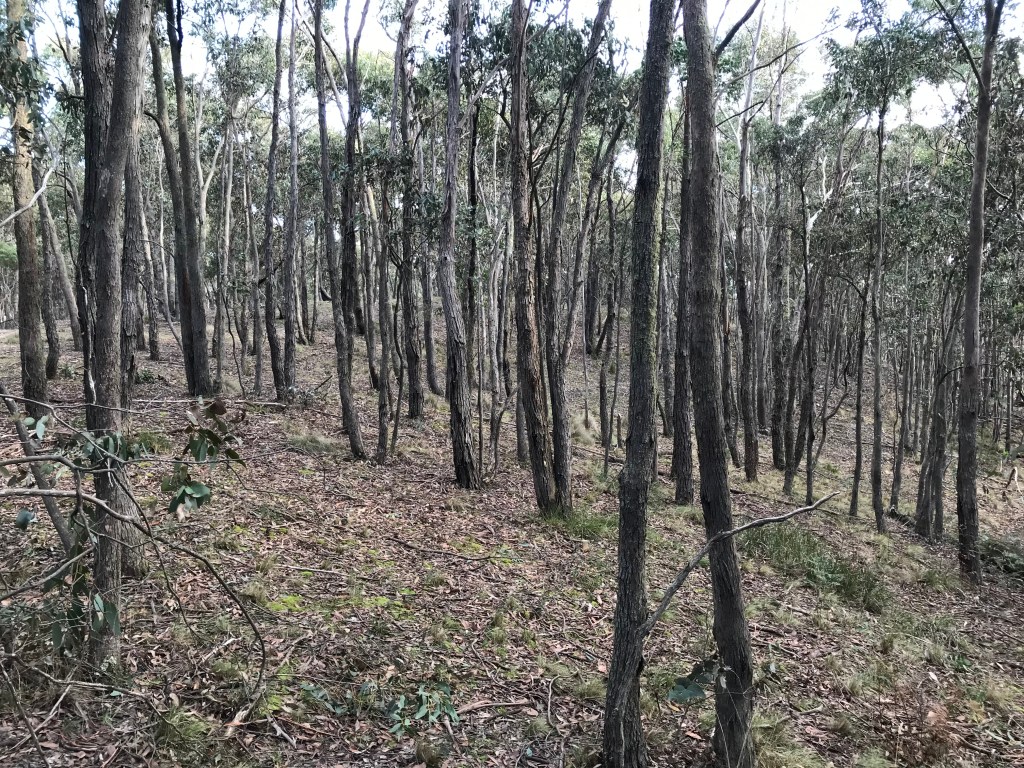
But it was too late, the once magnificent stands of messmate (Eucalyptus obliqua) had been destroyed and converted into stunted mixed species coppice (multiple stems which sprout from cut stumps), useful only for firewood and small mining props.
Subsequent silvicultural improvement works by the Forests Commission during the 1920s and ‘30s, rehabilitated the cut-over and badly degraded forests by removing defective overstory trees to encourage regeneration of new seedlings, together with thinning excess saplings and coppice. These works helped the forests return to reasonable levels of productivity and gave them time to recover.
Low intensity timber harvesting recommenced in the 1920s based on the thinning. In some areas single large trees were harvested so that new trees could replace them. This was known as the Single Tree Selection System.
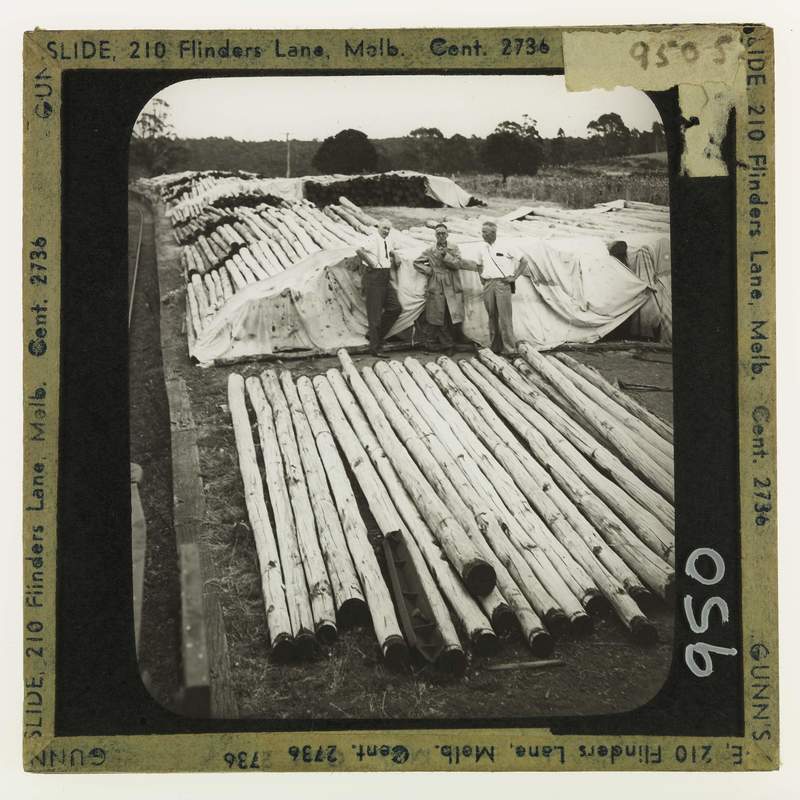
In September 1939, at the same time as the outbreak of WW2, the Egyptian State Railways placed a huge order to supply 26,455 messmate and brown stringybark (E. baxteri) telegraph poles. The poles ranged in length from 22 feet to 60 feet and totalled over three million superficial feet of timber. (>7000 m3).
The poles were supplied by thinning the stringybark forests at Daylesford and Trentham after they had grown back as a direct result of the Forests Commission’s earlier silvicultural programs to repair the damage to the bush caused by gold mining.
But the post-war housing boom led to a big increase in the level of timber harvesting from all the state’s forests. Political pressure from municipalities, local parliamentarians and the Returned Services League (RSL) was intense, which saw many new sawmills given log allocations from the Wombat.
The demand for timber was high, and small groups of large trees were harvested, a practice known as Group Selection. But after concerns by local foresters, in 1948, the Single Tree Selection System was reintroduced.
In 1954, the Wombat Forest yielded almost 70,000 cubic metres of logs, but the District Inspector doubted whether this level could be sustained.
Meanwhile, Victoria’s timber industry progressively moved eastwards after the war, coinciding with the completion of the salvage in the Central Highlands forests which had been burnt in 1939.
This move eased the pressure on the Wombat forests and allocations were trimmed by 7% from 1959 and further cut each year to 1961. Some 60% of Wombat sawmills closed or merged during the 1960s and 1970s. Many continued to operate with logs sourced from the considerable area of private forests.
In 1963, Continuous Forest Inventory (CFI) plots were established across the Wombat to determine forest growth. Measurements again of these plots in 1968 were used to estimate the level of growth in the whole forest over the previous five years, and then to determine sustainable harvesting rates. But the CFI plots only sampled a very small selection of the complex mixed-aged and mixed-species Wombat forests. The figures therefore had high levels of inherent uncertainty.
But the CFI measurements indicated that only the larger, older trees were showing any reasonable growth, and it appeared that the Single Tree Selection System prevented younger trees from growing satisfactorily.
Therefore, in 1973, a two-stage harvesting and regeneration process called the Shelterwood System was introduced.
In the first stage, most trees were harvested, but several of the best trees were retained and allowed to grow on, while producing seed and shelter for regeneration. The Basal Area retention for the first shelterwood cut was 9-11 m2/ha.
The second stage involved harvesting the retained trees before they began to slow the growth of the regenerating forest. But because of operational reasons many of the second stage cuts did not proceed.
The Land Conservation Council (LCC) conducted its study of the Ballarat area in 1982, which recommended that most of the Wombat State forest remain managed for a balance of multiple uses including timber harvesting and recreation.
The Timber Industry Strategy was released in 1986 and set a Sustainable Yield (SY) of 60,000 m3/yr of sawlogs from the Wombat Forest.
This figure was later reduced to 41,100 m3 during the Regional Forests Agreement (RFA) process, and the addition of more conservation reserves.
However, following an external review, this figure was further reduced by 79% to 8,600 m3, coinciding with the announcement of the Our Forests Our Future (OFOF) program in February 2002.
Controversially, additional State Government announcements and decisions such as creating new National Parks in the Otways and Cobboboonee, saw the cessation of all timber harvesting in western Victoria. The last major sawmill to cut sawlogs from the Wombat Forest was Black Forest Timbers at Woodend, which closed in 2007.



 Victoria’s Forests & Bushfire Heritage
One thought on “Wombat State Forest.”