The Heytesbury State forest was once on the western side of the Otway Ranges, south of Cobden and Terang.
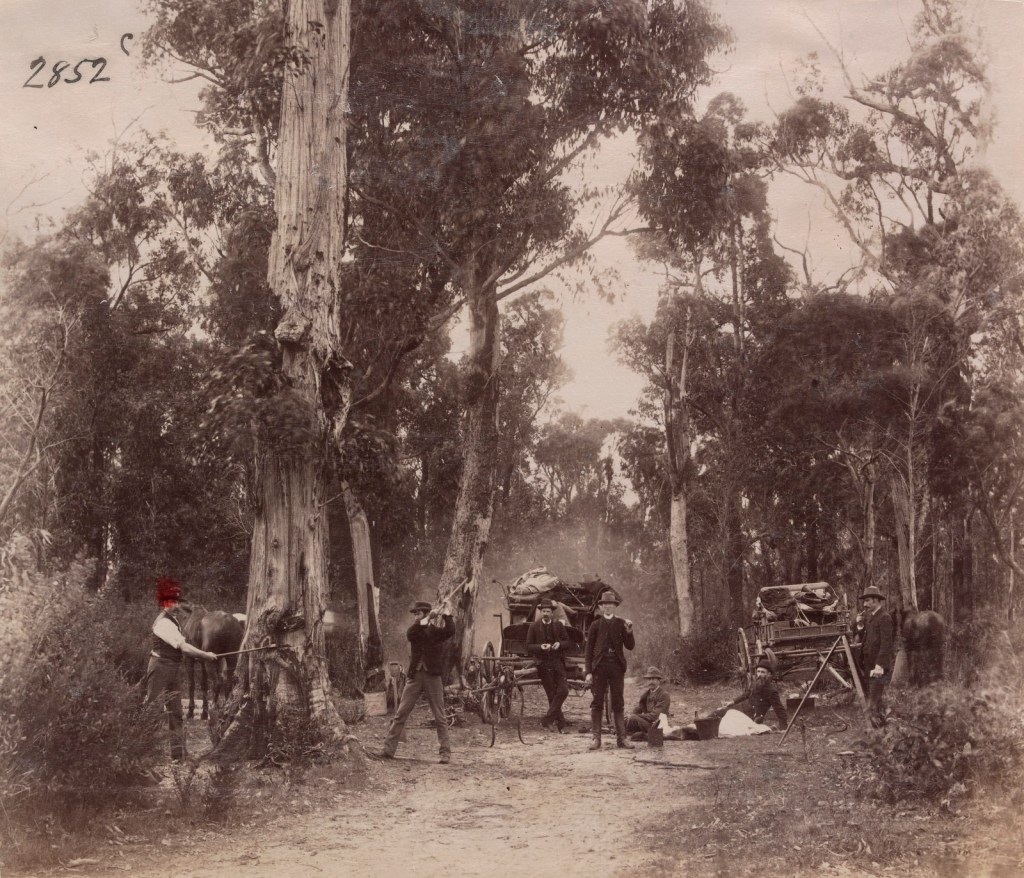
The first timber mill was established in the 1850s by James McLure between Curdie Vale and Timboon.
In 1882, the Victorian Inspector of Forests, William Ferguson, made a field survey of the Heytesbury Forest. He estimated there were 60,000 acres of grasstree plains thought to be of little commercial or agricultural use.
There were big bushfires in 1886.
In 1892, the Curdies River area became accessible by a railway from Camperdown to Timboon which enabled market access for timber and dairy produce. But life was hard, farms struggled, and many families just drifted away to other districts.
In about 1908, the Victorian Department of Agriculture cleared 1,000 acres of the grass tree plains to establish an experimental farm. As a result, some land was made available for selection, but it was flat and became easily waterlogged, so farming was not a big success.
The State Government and the Minister for Lands, David Oman, tried to sell 27,000 acres of State forest in the southern Otways for farming in 1923. The proposal faced formidable opposition from sawmillers, the community as well as the new Chairman of the Forests Commission, Owen Jones. The plan was eventually shelved but Jones became a political casualty of the saga and left for New Zealand not long after in 1925.
Other government relief schemes had major impacts on the Heytesbury forests. These were the building of the Great Ocean Road, and the establishment of the Bailey Settlement between 1928-33, where some of the forests east of Timboon were cleared for 50 dairy farms and over 70 miles of roads were grubbed. The Education Department opened five new schools and the CRB built main access roads.
The scheme was the brainchild of Henry Stephen Bailey, local Labor MP and member of the Legislative Assembly for Warrnambool, who also had been recently appointed as the Minister for Crown Lands. The scheme is sometimes also known as the Heytesbury Closer Settlement Scheme.
But in 1931, the local Shire Council condemned the Minister for Lands for opening up the Heytesbury forest to settlement without some provision and protection for forest reserves.
The second and much larger Heytesbury Land Settlement Scheme began in the 1950s and was strongly supported by the State Premier, Henry Bolte, who grew up in Ballarat and owned a farm in the western district. The Heytesbury Scheme was sometimes known as “Bolte’s Blunder” by its critics.
At the beginning of 1951, the Soldier Settlement Commission began considering developing three major areas of Crown land at Heytesbury, Yanakie and Nyora.
By December 1953, the Land Settlement Act created farming opportunities for young civilian men without previous war service.
In response to the proposed clearing of Crown land, the Forests Commission conducted an extensive aerial and ground reconnaissance of about 150,000 acres at Heytesbury, including the parishes of Waarre, Latrobe, Coradjil, Wiridjil, Cooriejong, and Natte Murrang.
The following year in 1954, the Commission reserved 9,000 acres which carried good stands of messmate and stringybark as Permanent Forest under Section 52 (1) of the Forest Act 1928.
The remaining 70,000 acres of unused Crown land (i.e. Protected forest) in the Heytesbury district were then set to be cleared for 200 new farms, each with a family of five people.
Clearing of the first 7,000 acres began in 1956, by which time Victoria’s WW2 Soldier Settlement program was starting to wind down.
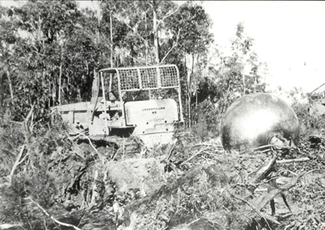
Access to heavy and more powerful machinery enabled effective clearing. There were about 80 crawler and wheeled tractors pulling ploughs, drills and rakes.
Two large 220 hp bulldozers attached a long steel chain to an 8-foot diameter steel ball to smash down the forest. The trees were then pushed into windrows and burnt. The cleared land was smudged, harrowed, raked and seeded. After two or three years of grazing the land, it was allocated to settlers.
But the clearing was entire and left almost no remnant forest undisturbed. And it seems there were few voices of opposition.
A prison farm had been established at Cooriemungle in 1940 to house 60 low-risk prisoners who were near the end of their sentences. The inmates helped with the land clearing, and for a while they worked in a nursery raising seedlings for FCV plantations in the Otways. They also did some planting work but the travel time each day was too long. The prison closed in 1977.
By 1958, the land developed at Heytesbury, Yanakie and East Goulburn was ready for transfer to civilian settlement.
The first section of the Heytesbury was opened in late 1959 by which time it was no longer part of the Soldier Settlement Scheme and had been transferred for civilian settlement under the Land Settlement Act.
The first 25 families arrived in 1960 and were allocated a 200-acre farm, a 3-bedroom house, 29 cows, a bull, plus 10 water troughs, two water points, a hay shed, dairy, tool shed and garage. They could purchase the farm outright or arrange finance through the scheme.
In 1962, the township previously known as Heytesbury was renamed after Hugh Leslie Simpson, Chairman of the Rural Finance and Settlement Commission.
By 1963, the local community had grown to 50 farming families, followed soon after by another 40. The community became big enough to support a football club and other social activities. The Heytesbury scheme eventually created 378 farms.
Dairy farm development at Heytesbury ceased in the 1970s and during the 1980s the remaining land was gradually sold publicly in various-sized lots. The Rural Finance Corporation held its final clearing sale on 24 May 1989.
Despite initial scepticism, the land became one of Australia’s most successful dairy regions.
The next time the State Government attempted such a large-scale conversion of crown land into farmland was in the late 1960s in the Little Desert. But that’s a different story.
In March 1988, an area of 1,039 ha was transferred to the Department of Conservation, Forests and Lands (CFL) for softwood production.
Around the time of the release of the Timber Industry Strategy, the State Government spruiked agroforestry as the future at Heytesbury.
Ironically, the forests at Heytesbury which had been cleared and converted to farmland in the 1950s and 60s was purchased and replanted with plantations of blue gum (E. globulus) and shining gum (E. nitens) for woodchip export from Portland.
In 2003, the Midway company bought 4 farms at Heytesbury totalling 400 ha and others followed. The area became incorporated into the “green triangle” in southwest Victoria with about 160,000 ha of softwoods, plus another 110,000 ha of short-rotation hardwood plantations.
This plantation conversion was not universally welcomed by the community, and loud protests soon followed and are ongoing.
Rosamund Duruz, (1974,) Death of a forest: a story of the Heytesbury Shire. https://drive.google.com/file/d/1ZS0r8_Qk_VF-05qNHzvwEPy7kD2L77vL/view




 Victoria’s Forests & Bushfire Heritage