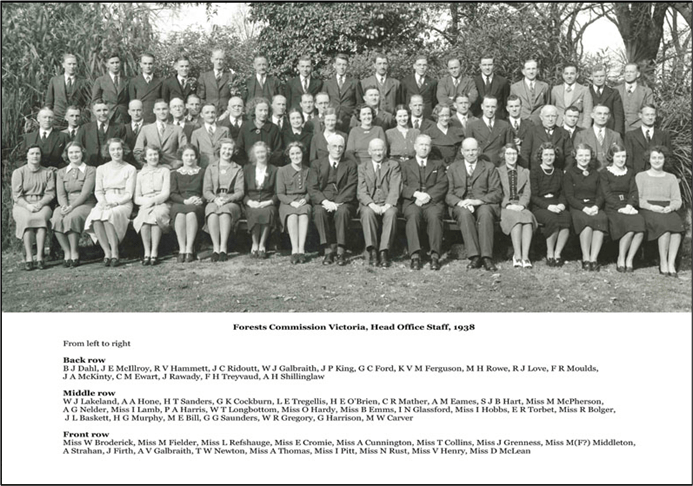
By the early 1980s, the Forests Commission employed some 300 foresters, plus a further 500 technical and administrative staff, and well over 1000 works and fire crew, spread across country Victoria in 48 districts and 7 divisional offices.
Most of them lived and worked in small country towns or larger regional cities. Head Office was small by comparison.
More importantly, there was a recognition by the Commission and the State Government of the significant social and economic contribution that departmental staff, and their families, made by simply living in the country and being part of the fabric of rural society.
Families sent their kids to local schools… shopped locally… drank at the local pub… bought coffee at the local café… picked up fish ‘n chips on the way home from work on Friday night… and just sorta fitted in…
Significantly, many of the big departmental purchases like fuel and hardware were also made locally too…
Along with other professionals such as schoolteachers, bank managers and the police, departmental staff often volunteered, or were coopted, for important community leadership roles in local sporting clubs, social and civic groups such as CFA brigades, or service organisations like Rotary or Lions.
As soon as a new forestry family arrived in a small town they were approached by the footy, netball or cricket club to be part of the local team.
And it wasn’t uncommon for the tanker, or tents and pumps from the fire store to be used at a local community event like a school fete, or the grader to quietly run a firebreak around the local footy ground or the golf course on the edge of town.
Some chopping blocks supplied to a country showground in time for the annual fair. Or maybe a load of dry firewood delivered by the crew to the old folk’s home in winter which was always welcomed with fresh scones and cups of tea.
There were unstated boundaries to this philanthropic largess, but the District Forester was a respected figure in the community and allowed some discretion.
When I was the Gippsland Regional Forests Manager, I instituted an annual “Give-Back-Day”. The staff and crew then chose and organised an activity in their local community as a gift. But importantly, there was no media and no fanfare.
Integrity is about doing the right thing, even when no one is watching – C.S. Lewis
The kindergarten at Erica received a lick-of-paint and their garden tidied up, while a cancer respite centre near Powelltown had some dangerous trees felled as chainsaw practice and a bit of earth works done with the D4 to create a walking path. Some simply went en masse to give blood at the Red Cross caravan.
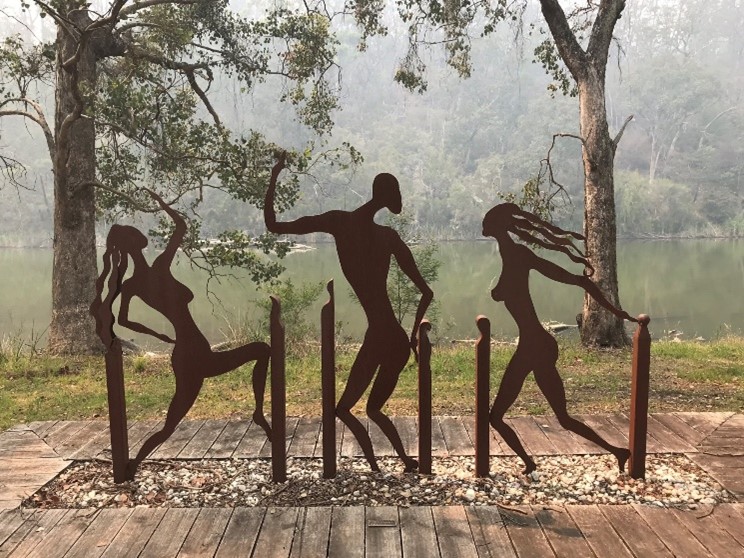
The Nowa Nowa Nudes Festival was quietly sponsored, with a few raised eyebrows and muffled giggles, to support the local community arts project.
But best of all, the winning sculpture was selected by a panel including the local staff at a gala evening, complete with burley blokes in Blundstone boots wearing checked flanny shirts, ladies in colourful frocks, lots of noisy kids, and a “nosh-up” feast of party pies, canapés, chilled bubbles or a cold frothy beer. It was always a fun occasion…
The winning entry was then mounted by the local crew in a section of walking track on a bit of State forest near the river. But more importantly, everyone in the town enjoyed a stronger “Pride of Place”.
I have been fortunate enough to study community forestry in the UK, Canada, Sweden and Indonesia, and have seen the power of partnerships when forestry staff and their families are encouraged to do stuff together with the community.
| Building successful long-term partnerships in country towns was not a quick fix of engaging external PR consultants and media managers, or sausage sizzles, or public meetings with sticky labels on whiteboards, or pointless strategic workshops to talk endlessly about stuff… or even about handing out grant money to others for stuff… but it was about planning, sharing, taking risks and doing stuff together to create lasting and meaningful relationships… |
Taking a few risks and investing in local relationships takes time and energy but “paid-off-in-spades” when things got difficult or tough. People thought twice before writing a nasty letter to the Minister or contacting the local paper when they were cranky about something.
However, the progressive reduction in the numbers and seniority of forestry and parks staff living in small country towns over the last few decades, together with the progressive centralisation of services, resources, power and decision-making, has fuelled a stronger disconnect between the country and city. It has certainly not helped deal with the growing list of rural grievances.
In the years since the amalgamation of the Forests Commission and other agencies into the Department of Conservation Forests and Lands (CFL) in mid-1983 there has been eight more major departmental name changes including DCE, CNR, NRE, DPI, DSE, DEPI, DELWP and finally DEECA.
I can’t remember exactly how many other minor internal changes and convoluted job titles have been wrought but I seemed to have accumulated a large collection of name tags and business cards.
Furthermore, there has been 15 Government Ministers, 13 Secretaries and 9 Chief Fire Officers.
It was sometimes very difficult to remain buoyant while getting used to yet another tongue twister acronym.
Staff became the butt of so many tiresome jokes like CNR = Constant Name Review, DSE = Dept. of Sparks & Embers while NRE became No Rational Explanation.
But the family ancestry of the current organisations such as the Department of Energy, Environment and Climate Action (DEECA), Forest Fire Management Victoria (FFMV), Parks Victoria, VicForests (until recently), Alpine Resorts, Catchment Management Authorities (CMA), Hancock Victorian Plantations (HVP), and even the Country Fire Authority (CFA) can all be traced back to an earlier era.
Importantly, there is a strong legacy of tradition, camaraderie and spirit of innovation which remains embedded in the DNA of these modern organisations today.
But for most older bushies, all the corporate branding was lost on them because as far as they were concerned, we still worked for “The Forestry”.
 Victoria’s Forests & Bushfire Heritage
Well written and engaging. A pleasure to read from start to finish.
LikeLike