In my experience, there are three topics that are guaranteed to upset staff. 1. rearrangements to office accommodation, 2. allocation and use of vehicles, and 3. uniforms.
The matter of uniforms in the Forests Commission has a long and fraught history.
A motion was raised at the 1966 meeting of the Victorian State Foresters Association (VSFA), that a free uniform should be issued by the Commission for firefighting and other official duties, and also to give greater public recognition. It was noted that CFA staff wore a distinctive uniform.
But the matter of uniforms was divisive, and many staff rejected the idea altogether. I’m told one delegate stood up at the conference during the debate and burst out in frustration…
If I wanted to wear a uniform, I would have been a bloody bus driver.
Final voting at the meeting resulted with a small margin in favour. A sub-committee was duly formed to report at the next annual conference.
They examined uniforms in other forest jurisdictions around Australia, and also from Europe, the USA and Canada.
Their final recommendation was for a full-dress uniform of jacket, shirt, tie and trousers, with alternative shorts and long socks in summer. A field uniform was also suggested, but protective bib-and-brace as well as blue protective coveralls were already provided for the crew.
The matter was debated again at the 1967 conference. This was followed with a survey of all staff which was supportive of the proposal.
But it took until the 1968 VSFA Conference before the staff association formally approached the Commission.
Costs and setting precedents were obviously major considerations, but approval was subsequently given for a partial uniform for fire duties, consisting of a polyester shirt, departmental shoulder flashes (epaulets) and a tie. Reflecting the mood of some staff, wearing the uniform was not made compulsory.
The new uniforms became available from 1970, and most foresters and overseers adopted them. They continued throughout the 1970s and into the 1980s, with the Commission’s policy remaining substantially unchanged.
In 1972, a special uniform was issued, which included trousers, but only for rangers at recreational areas such as Sherbrooke Forest.
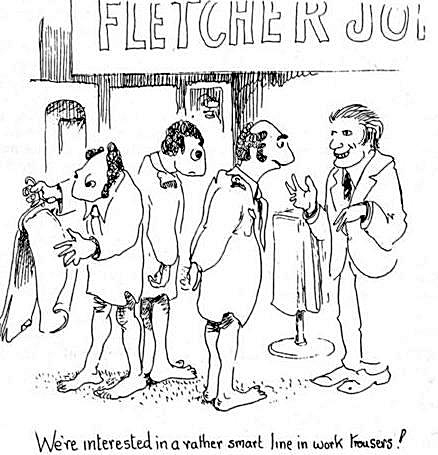
Repeated requests for trousers to be made available for all staff were unsuccessful, so many District Foresters often purchased their own dark green pants from the renowned clothing manufacturer and retailer, Fletcher Jones.
However, there were some complaints about the quality and fabric of the shirts, and the brand was changed to the equivalent of the dress shirt provided to airline pilots.
In 1978, the Association also became concerned about the flammability of the polyester uniform shirts, but it was not until 1984 that they were replaced with a cotton one.
The rancour associated with a uniform policy did not subside with the formation of Conservation, Forests and Lands (CFL) in 1983.
Fisheries and Parks staff had a strong culture of wearing uniforms, while ex-Lands Department… not so much.
If anything, uniforms became more fragmented as different variations were developed and adopted by staff.
The matter bubbled away for decades with work pants, jackets and polo shirts, falling in-and-out of favour.
The formation of Forests, Fire, Management Victoria (FFMVic) in 2014 was a strong catalyst for renewed standards of uniforms.
Source: Jack Gillespie & John Wright (1993). A Fraternity of Foresters. A history of the Victorian State Foresters Association.
David Parnaby graduated from the VSF in 1940 and was an accomplished cartoonist. He often provided humorous and insightful commentary in the Victorian State Foresters Association (VSFA) Newsletter. The lack of trousers in the FCV unform provided an ideal subject for his cartoons.


 Victoria’s Forests & Bushfire Heritage