
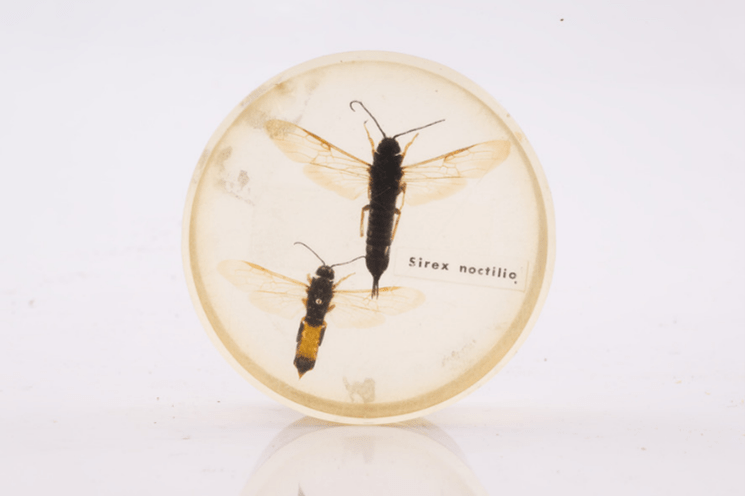
The Sirex Wood Wasp (Sirex noctilio) attacks softwood species particularly, Pinus radiata, which is planted extensively across southern Australia to supply timber.
Originally from Northern Europe, the wasp was found in softwood plantations in New Zealand in the early 1900s.
In 1949, the Commonwealth Forestry and Timber Bureau proposed a national planting program to make Australia more self-reliant in timber products after the shortages experienced during the war.
But the threat of the introduced sirex wood wasp brought the softwood plantation program into question.
Detected in Tasmania in early 1952, Commonwealth and State forestry authorities moved quicky to eradicate sirex as early as possible to protect the extensive plantations of softwood on the Australian mainland which were at risk.
A National Sirex Fund was established for surveys and eradication of the insect, and later for research into its control.
Sirex was confirmed in Victoria on 20 December 1961 in some pine logs at a sawmill east of Melbourne. The logs were later traced to a small privately-owned plantation on a dairy farm near Woori Yallock.
The Forests Commission immediately introduced strict quarantine to restrict the movement of potentially infested timber.
Charles Irvine, the Commission’s Chief Forest Biologist, managed about 15 two-man teams, which included many young graduate foresters from Creswick, to inspect all radiata pine trees within a zone centred around the initial infestation.
FCV crews then cut, heaped and burnt the infected material, but the Sirex insect pest continued to spread.
But the insect was soon confirmed in commercial plantations in the Latrobe Valley. It then spread across the remainer of Victoria, Mt Gambier, southern NSW and the ACT.
The worst outbreak was between 1972 and 1979 in nearly 2000 ha of the Delatite Plantation in northeast Victoria.
Search and destroy efforts were not practical on such a wide scale. Biological control was the only feasible option using parasitic nematodes which were later raised in cages by John Morey at the Forests Commission’s Mountain Forest Research Station (MFRS) in Nicholas Gardens near Sherbrook.
It was eventually found that tending of plantations by thinning to encourage vigorous growth, in combination with regular surveys and rapid suppression tended suppress the insect.
The pest became economically unimportant by the mid-1980s, and very little biological control work was required, but the overall threat of another major outbreak remains.
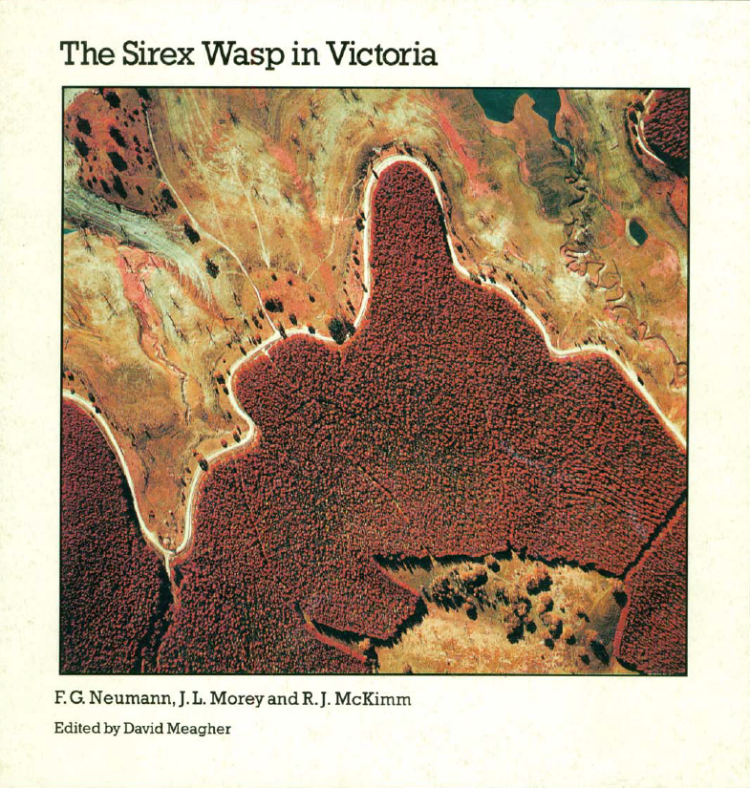
Fred Neumann, John Morey and Robert McKimm (edited by David Meagher). (1987). The sirex wasp in Victoria. Bulletin 29. Lands and Forests Division, Department of Conservation and Lands.
https://drive.google.com/file/d/1W0vhlXO7hjYrExNT9VK48KB4UPLY3-tR/view

 Victoria’s Forests & Bushfire Heritage