
The idea of independent certification and labelling of timber began to take hold in Europe and north America during the early 1990s. Retailers and suppliers wanted to promote their products to consumers as complying with sustainable and responsible forestry practices.
Certification also fitted neatly with an idea, that was pervasive at the time, of timber companies having a “social licence” (without defining exactly what that meant, or how it was measured).
A number of certification schemes began with the Forest Stewardship Council (FSC) in 1992, and the Programme for the Endorsement of Forest Certification (PEFC) later in 1999. These eventually emerged as the dominant global certification organisations.
The FSC and PEFC schemes both operate in Australia and compete in the marketplace. They are slightly different in how they are derived and assessed, with both having supporters and detractors. In some cases, there has been open hostility between the two certification camps.
The Forest Stewardship Council (FSC), which is based in Germany, offers forest certification and licences for the use of its logo. The FSC model requires environmental, industry and community groups to reach consensus.
PEFC is a global organisation based in Switzerland and is the world’s largest. It is marketed in Australia under the Responsible Wood (RW) logo as the dominant certification standard. In 2023, there were nearly 12 million hectares of RW-certified forests and plantations in Australia.
The Australian Forestry Standard (AFS), which recognises existing forestry practices like clear felling and woodchips, as well as standards like Codes of Practice and RFAs, was developed in 2002 under the umbrella of the PEFC.
Timber certification schemes all involve a set of written forestry standards, independent and third-party auditing and reporting, as well as a traceable chain of custody from the producer to the consumer.
Environment groups tend to support FSC because they have greater influence over outcomes, while the timber industry prefers PEFC/RW, but retailers and consumers probably don’t care.
Major Australian hardware retailer, Bunnings, instituted its “Responsible Timber Sourcing Policy” in 2003 with a revision in 2018. Bunnings gave a commitment that forest products would originate from certified forests in all its 513 stores across Australia and New Zealand by December 2020.
Bunnings required timber products be independently certified to either the Forest Stewardship Council (FSC), Programme for the Endorsement of Forest Certification (PEFC), or another equivalent.
Currently, Victorian businesses certified under either PEFC or FSC, include – VicForests, Midway, Pentarch Forestry, PF Olsen (Aus) and Hancock Victorian Plantations (HVP), among others.
VicForests had been a FSC member from 2011 until 2020 but ongoing disputes with some environmental groups, which remained intractably opposed to native forest harvesting, resulted in failure.
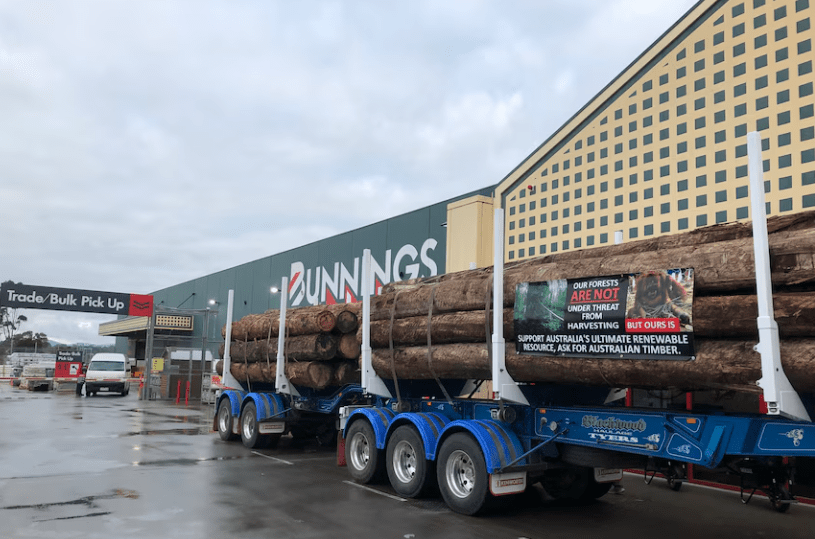
But despite VicForests having achieved certification under both the Australian Forestry Standard and the PEFC in 2007, Bunnings dumped Victorian native timber products from its shelves after the Federal Court ruled in 2020 that timber was felled illegally.
Gippsland timber workers and the Construction Forestry Maritime Mining and Energy Union (CFMMEU) blockaded the Bunning’s store at Traralgon in July 2020 over the company’s decision.
The Court decision was partially overturned in a successful appeal by VicForests in 2021 to the full Federal Court.
And while Bunnings was not a major retailer of VicForests products, it was a symbolic blow due to the company’s high profile.

 Victoria’s Forests & Bushfire Heritage