
Sir Wilhelm Schlich noted in his 1922 summary of Forest Policy of the British Empire that while progress was being made Australia lacked many of the skills to undertake inventory needed to prepare proper working plans.
Responding to the shortage, the Chairman of the Forests Commission, A.V. Galbraith, made concerted efforts in 1926 and 1927 to recruit trained foresters from Norway (Bjarne Dahl, Bernhard Johannessen and Kristian Drangsholt) as well as from the United Kingdom (William Litster and Karl Ferguson from Scotland with Mathew Rowe from the Forest of Dean).
Kristian Drangsholt finished school in 1916 and then was employed in practical forestry in the southern part of Norway till the Spring of 1918. From 1921 he studied for three years at University towards a Master of Science as a Forest Engineer, this was followed by a Diploma Forest Engineering in Spring 1924.
He served six months in the Norwegian Kings Guard, followed by a year on a whaling expedition to the Antarctic. Norway is a country bordered by sea with a proud heritage of Vikings, ships and ship builders, and it seems that many young Norwegians went to sea at an early age.
On 5 February 1927, Kristian arrived with Bernhard Johannessen onboard the same ship into Australia. Bjarne Dahl arrived a year later in March 1928.
Together, the three Norwegians formed the nucleus of the FCV’s new Forest Assessment Branch to begin systematically mapping and measuring Victoria’s vast forest estate.
Despite Kristian’s formal forestry qualifications and mastery of English, his initial posting was at Bright and Creswick as chainman earning a measly 14s 6d per day.
But Kristian and Bernhard were soon appointed as Forest Assessors in November 1928 at a higher salary of five pounds ten shillings per week, plus 3d per day camping allowance and a horse allowance of 40 pounds per year.
Their first major assessment projects were in 1928 with Drangsholt taking the Rubicon Valley and Johannessen the adjoining Royston Valley.
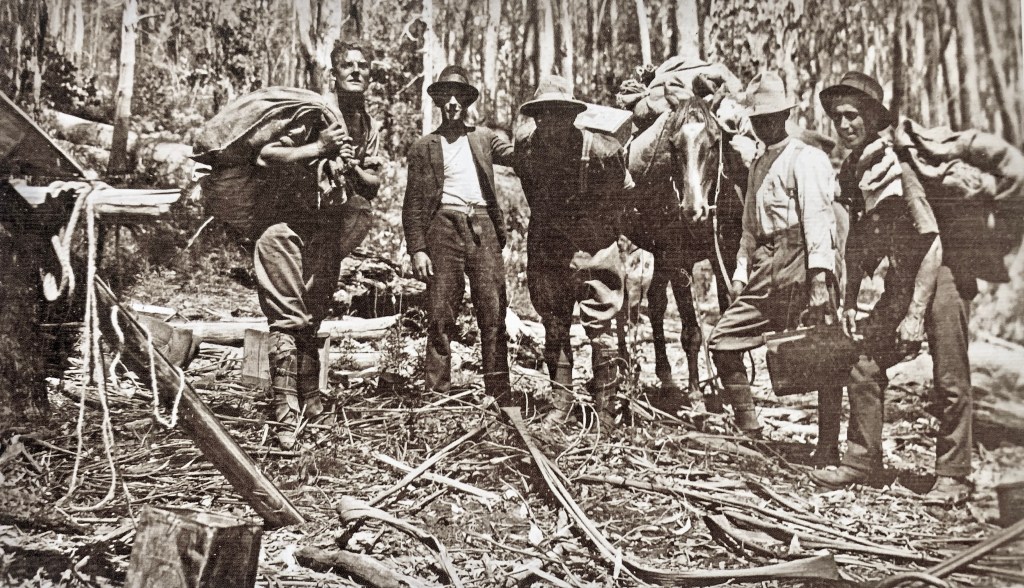
Both men employed a chainman and an axeman as assistants, and their camps consisted of bush or cattlemen’s huts (if there were any) or drafty tents.
Accidents were common in the harsh conditions and help was far away.
The assessment crews also lived off the land, hunting and fishing to supplement their meagre and repetitive rations.
The assessment teams conducted “base line surveys”, which were long transects of one-chain wide strips separated at five chain intervals. This equates to a 20% sample of the forest. Within each transect, plots were set out where trees were counted, measured and aged, and their condition and species noted.
The diameter and height of the standing trees was measured and an estimate made of the output of sawn timber.
Assessment crews often worked in trackless bush and produced some of Victoria’s first topographical maps of the State forest.
Maps were produced using survey tapes, Gunter’s Chain and prismatic compass. Steep slopes were surveyed using an Abney level and elevations at fifty feet intervals were taken with an Aneroid barometer.
Twenty thousand acres were surveyed and mapped in the Rubicon valley using this laborious manual technique. It had to wait until 1944 before the first aerial photographs taken by the RAAF became available.
After Rubicon, Kristian assessed forests at Powelltown, Mount Horsfall, Castlemaine, Maldon, Lal Lal, Brisbane Ranges, Brittania Creek, West Tanjil, Upper Thomson, Mount Donna Buang, Daylesford, Blakeville, Cobaw, Moondarra, Orbost, Nowa Nowa, Waygara, Tyldesley, and Tostaree.
Bjarne Dahl moved into Head Office in about 1930 and by the 1940s was appointed Chief Forest Assessor for the FCV. In early 1945, he established an Assessment School at Kalatha Creek near Toolangi. The school later moved to Kinglake West in 1947 to the site of the POW camp established during the war. Dahl eventually left the FCV in 1948 to establish plantations in Gippsland for APM forests Pty Ltd.
Bernhard Johannessen took a job with the Dutch Forest Service in Java in 1930 and was never seen again after the war.
With increasing the availability of rugged 4WD vehicles during the 1950s, which could operate on a rapidly expanding forest road network, assessment work progressively became more mobile. Portable radios like the RC-16B also became available after the war.
During the colder winter months, the assessors returned to Head Office to prepare maps and write up reports.
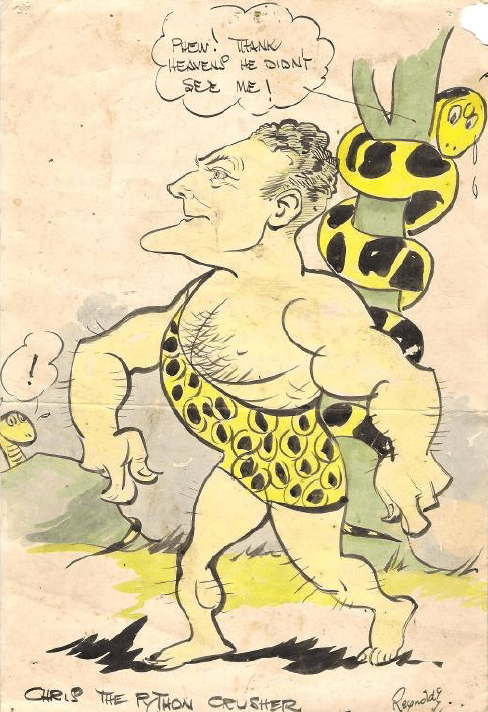
Like his fellow Norwegians, Kristian Drangsholt would have seen more of Victoria’s forests than most ever did. He was a man of exceptional strength and sense of purpose and preferred the bush to the office.
Kristian was undoubtedly one of the Forests Commission’s “larger-than-life” characters who spent most of his career in the bush as a forest assessor, but in 1957 he built a family home in the Dandenong Ranges and worked as a forester based at Kallista. He retired in 1964 and died in 1968.
Kristian’s fascinating story, “Man of the Forest”, was written by his son, David, in 2014.
https://drive.google.com/file/d/13hzVbyfnD-ZzYLd83CKBZxOomU8M44MI/view
 Victoria’s Forests & Bushfire Heritage