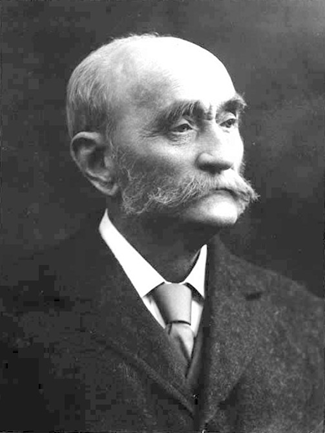
Wilhelm Schlich was from the Prussian school of forest management in the 1890s. He worked extensively in India for the British and later became a professor at Cooper’s Hill forestry school near Surrey in England, where he influenced generations of foresters across the British colonies.
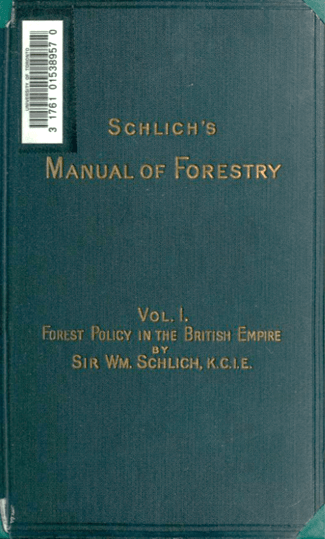
He advocated the use of working plans in his five-volume “Manual of Forestry” which were written between 1889 and 1896. The first two volumes covered silviculture while the others dealt with forest management, forest protection, and forest utilisation. They became standard and enduring texts for all forestry students.
The idea of working plans spread throughout the British Empire and were recommend by Ribbentrop in his report to the Victorian State Government in 1895. This was echoed in the Royal Commission and the then stipulated Forests Act (1918), which created the Forests Commission.
The founding Chairman of the Forests Commission, Owen Jones, had trained under Schlich in Germany and had also prepared a working plan. This no doubt this influenced the decision by State Cabinet to recruit him from England.
There was no set formula, but working plans covered a range of things including timber harvesting, silvicultural thinning and pruning of younger native forests, establishment of exotic softwood plantations, construction of tramways, roads and bridges to enable licensed sawmillers to access timber stands, the maintenance of fire breaks and the operation of patrols to control illegal timber cutting and prevent fires.
The Commission pursued the idea of mapping, assessment and working plans with some vigour but lacked the skills and resources to fully implement them.
Schlich pointed out in his summary of British Empire Forest Policy in 1922, that Australia lacked many of the skills to undertake inventory needed to prepare proper working plans.
This shortage was one of the main reasons why the new FCV Chairman, A.V. Galbraith, recruited trained foresters from Norway (Bjarne Dahl, Bernhard Johannessen and Kristian Drangsholt) as well as from the United Kingdom (William Litster and Karl Ferguson from Scotland with Mathew Rowe from the Forest of Dean) in the 1920s.
To cope with the growing workload the Commission also restructured in 1926, dividing the State into five Divisions each with a Chief Inspector and four inspectors, and a total of 51 Districts.
A Forest Engineering Branch was also added in 1926 in the Head Office to deal with an expanding works program.
The Commission always saw itself as the champion of forest reservation and conservation and constantly advocated for an increase in permanent reserves.
It also had a very clear intent to move forests management from the chaotic “cut and run” approach of the 1800s to a more orderly and sustainable one.
BTW – The Forest Management Planning process which began under the Timber Industry Strategy (TIS) in the late 1980s fell under Section 20(a) of the Forest Act (1958) which required the Department to produce working plans.
Handwritten working plan for the Woohlpooer State Forest prepared by R S Code, Inspector of Forests, in the late 1930s.
https://drive.google.com/file/d/1yZ66WgjWQEhC1t9bmYPd130ITjcndbrj/view]

 Victoria’s Forests & Bushfire Heritage