The magnificent River Red Gum (Eucalyptus camaldulensis) has the widest natural distribution of any of the Australian eucalypts.
Specimens have also been planted across the globe, including Sicily where I have just returned from.
It seems that River Red Gum was widely planted by Italian authorities after the war for timber and to stabilise soils, and some locals now consider them an invasive weed.
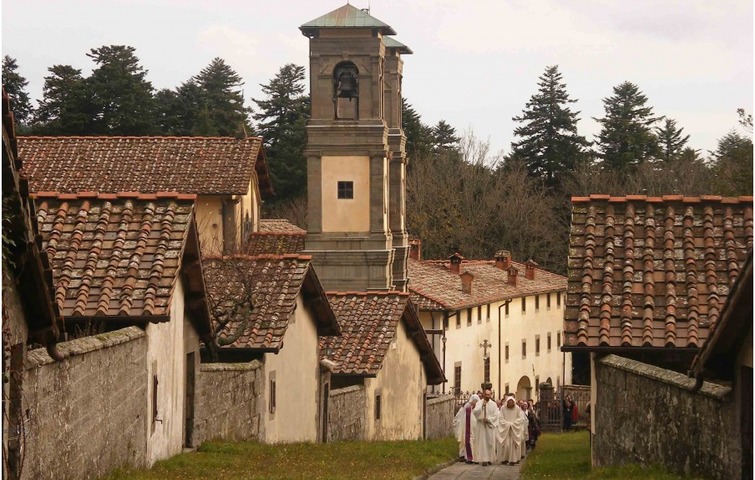
But more interestingly, its botanical name can be traced back to an ancient religious hermitage in the mountains near Naples which was constructed in 1585 by the Camaldolese congregation of Monte Corona.
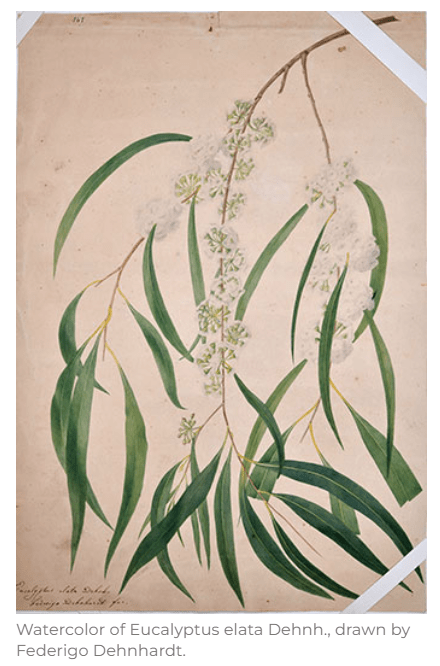
In 1816, the distinguished Italian gardener, and Director of the botanical garden of Naples, Federigo Dehnhardt, was engaged to develop a private garden for a local nobleman, Count Francesco Ricciardi Camaldoli. The Count had been gifted some of the original lands of the Camaldoli Hermitage by the new Bourbon Government.
The garden was known as L’Hortus Camaldulensis di Napoli.
Dehnhardt propagated some River Red Gums in 1818 with seed that had been collected and sent over by Allan Cunningham, the famous NSW government botanist.
The trees grew so well that Dehnhardt described and named the species, Eucalyptus camaldulensis after the hermitage where the trees had been planted. His description appeared in the 1832 edition of a catalogue which recorded the names of all the species growing in the gardens, but his book was largely unknown to the botanical community. His specimens are housed in the Natural History Museum in Vienna.
Dehnhardt’s work was overlooked, and the River Red Gum was initially named Eucalyptus rostrata by the NSW botanist, Diederich von Schlecterindahl in 1847.
But Schlercterindahl’s name was declared invalid because it had already been given to the Swamp Mahogany in 1797 by a Spanish botanist.
In 1853, the Victorian government botanist, Ferdinand Von Mueller renamed the River Red Gum Eucalyptus longirostratis ( after the ancient Greek word for the long point, or beak on the cap that covers the developing flower)
But finally in 1934, notable Australian botanist William Blakely recognised Denhardt’s original work and the name Eucalyptus camaldulensis for River Red Gum was accepted.
In 1922, the River Red Gums planted by Frederick Dehnhardt were sadly cut down and the Camaldoli gardens were abandoned. The garden is now completely incorporated into urban expansion near Naples.
https://www.recreatingthecountry.com.au/river-red-gums-and-the-tuscan-monks.html

 Victoria’s Forests & Bushfire Heritage
Thanks for this Pete…most interesting. And welcome back to you both – a great trip I trust, and a successful wedding (of course). Now, just in time for Winter. Cheers – Mike
LikeLiked by 1 person