
With the generous support of the Dahl Trust I have been busy over the last few months writing a new eBook titled “The Working Forests”.
The project about Victoria’s rich forest and bushfire heritage is due to be finished by the end of the year.
I had to break it up into two volumes because of problems with MS Word and instability of big files.
Attached is a link to a draft of Volume 1.
It contains about 200 short stories spread over nearly 600 pages with lots of pictures, maps and white space. It takes up about 140 MB in size.
Volume 1 roughly covers the chaotic period from colonisation in 1803, the 1850s gold rush, the trashing of the forests leading to the Royal Commission in 1897, the formation of a State Forests Department in 1907, through to the 1939 bushfires and the war years in the 1940s.
It also includes a big section on tall and remarkable trees which hopefully dispels some of the myths.
Volume 2 is in advanced draft and is about the same size.
- It will start with the post war reconstruction and A. V. Galbraith’s “Grand Design”.
- Building an effective fire fighting agency and major bushfires will be in there
- Post war forestry and staff training to build a professional organisation.
- Plantations, reforestation and silviculture.
- It will tackle the rise of environmental activism in the 1970s.
- Formation of CFL and the Timber Industry Strategy was a major turning point.
- Changing community and political attitudes leading to the demise of the timber industry in 2024 will be tricky to write (but I have a few insiders to help).
- The wide range of uses and values of State forest will also be covered.
- And the great outdoors.
- I have a long list of notable people too
I’m interested in your thoughts –
- Is anything missing ?
- Are there any major errors or bloopers ?
- Does it look and feel right ?
- It doesn’t have a comprehensive index because in electronic format it’s easy to skim, search and scroll. Is this a problem?
- I have cited my main references and used lots of links but have stuck to my normal conversational (e.g. non-public service speak) style of writing. There will be a list of “further reading” at the end
- It also hasn’t been proofread so please don’t focus on typos and wordsmithing at this stage.
- I have linked to the main stories on the FCRPA website and tried to minimise duplication. The long term stability of these links is a concern.
- It will be far too expensive to print. It was always planned to be a free eBook that could be safely stored in the national library to be downloaded and shared online.
I’m going off-line for a month and won’t be back till early June. I’m happy to take comments by email, but I might not be too quick in responding.
theworkingforests@gmail.com
Thanks once again for your support and encouragement.
https://drive.google.com/file/d/1HsH7WzEQBpwhk0GKnVWzIKn6ZAJHpC-m/view?usp=sharing
Or
https://1drv.ms/b/c/58c25200497bbbca/Efq5dotbk1FEq5np9ybPUEgBIdrJ9p9_19EOBuNZ9I1PRg
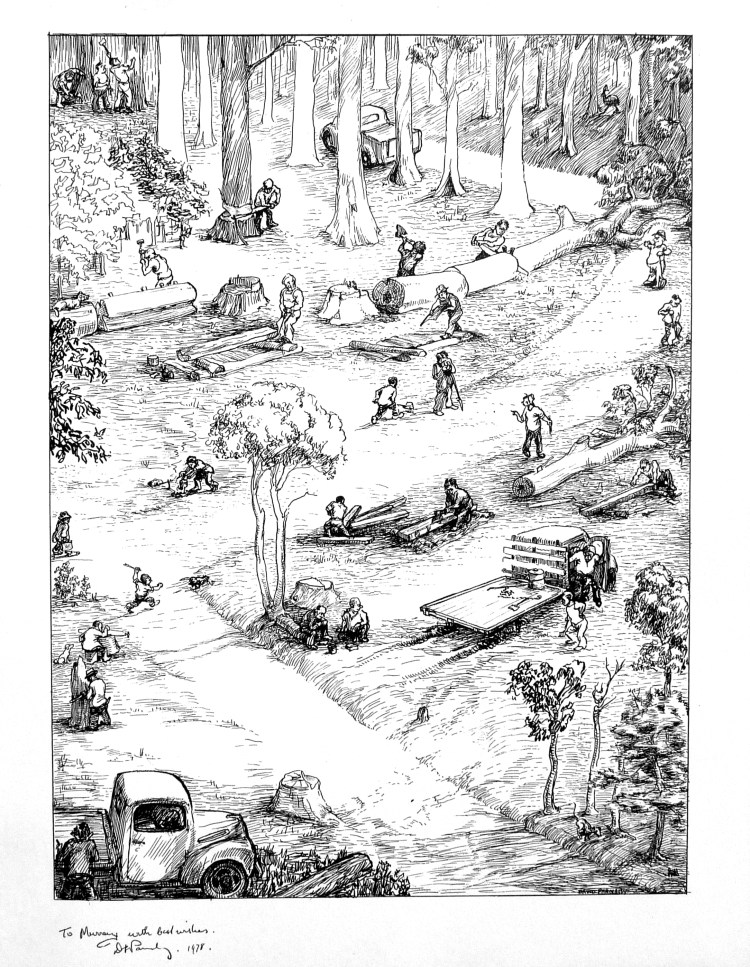
David Parnaby graduated from the Victorian School of Forestry in 1940 and initially worked in Assessment Branch.
He later had District postings at Heathcote, Powelltown, Dandenong Ranges, Bruthen and Beechworth.
Promoted to District Forester in 1951, David was moved to Cann River, then Heathcote (1955), Castlemaine (1958) and Daylesford (1971). Following a period with Forest Protection in Melbourne he retired in 1980.
David was an accomplished cartoonist who provided insightful and humorous commentary through the Victorian State Forester’s Association Newsletter.
His keen eye for the antics of sleeper cutters at Cann River in the 1950s remains a classic. The more you look at this, the more you will see.
This copy was a gift to the FCV’s Chief Forest Assessor, Murray Paine, in 1978 and is now with Gregor Wallace.
 Victoria’s Forests & Bushfire Heritage
Good stuff.
Glanced through and wondered about coverage of the following issues:
Importance of active and adaptive management, I note you covered multiple use.
Broad coverage of infrastructure, forestry was critical for developing the state.
Low intensity burning.
Forest health and eucalypt decline.
The period covered by Part 1 I believe wasn’t all chaos.
LikeLike
Thanks.
Many of those are covered in volume 2.
I hope to have a draft for comment by October
Cheers
LikeLike
Peter
Thank you so much for putting your time and effort into this. I can imagine how much of your life you have dedicated to this and its going to be the only place in the future that the history of the Forests has been documented so well. I have printed out everything you have done so far, that’s just me I like to read off the page rather than the screen, this will take some time to digest and I’m looking forward to volume 2 when its ready.
All the best
Karen Christensen
LikeLike
Thanks Karen. When I started writing short stories for facebook I genuinely thought nobody would be interested. Volume 2 is going to be harder to write because it covers some tricky topics like the closure of the timber industry. Im still hoping to get up you way later in the year to have a good look around Mt Disappointment. Cheers
LikeLike
Peter, when I was growing up here my dad did a lot of what we called twitch sticks, they were straight lengths of saplings about 6 foot long that would fit into a railway truck. At the time there was a lot of shunting here, and a fair amount of pulp wood was being taken out of Mt Disappointment. I believe the twitch sticks were used by the railways to tighten ropes holding the canvas covers on the railway trucks. I don’t have any photos of it but we spent a lot of time helping dad cut and load these as a way to make a bit extra money to keep the family. I’m wondering if there’s any records of that activity in the forest anywhere, and I never see much about the pulp wood, but I imagine it must be recorded somewhere in the Forestry records.
Let us know if you are coming up we do have a secret spot that’s interesting to see.
Cheers Karen
LikeLike
Hi there. I have never heard of “twitch sticks”. I haven’t seen any FCV records but I will keep a lookout now. They make sense. Lots of FCV overseers and crew had side “hustles” like collecting seed. The dept never paid well. Im also interested that pulpwood was taken from Mt Disappointment. Its a long way to Maryvale. I wonder if it went to the Masonite plant at Bacchus Marsh. We used to cut wood when I was a student at Creswick for beer money. I wont be able to visit until spring but I will let you at Trevor know well in advance. Cheers
LikeLike