Driven by a deep philanthropic desire to provide employment for some of the more seriously maimed returned soldiers, several prominent Melbourne citizens, together with the support of Department of Repatriation, established the Tobacco Pipe Manufacturing company in Leicester Street Carlton in 1918.
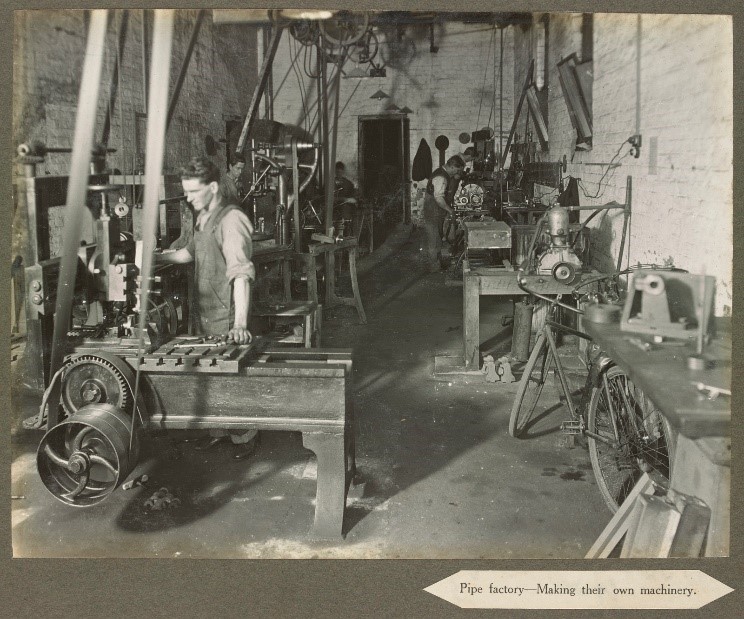
The factory needed to not only invent, but also build its own machinery, and even had its own wood testing laboratory, while the Commonwealth Institute of Science and Industry was engaged to investigate the suitability of various Australian timbers because little was known at the time.
Timber was selected for its low flammability qualities.
The ideal wood for making pipes needed to be even grained, dense and heavy and with long and firm structural fibres that could take a highly polished finish.
Some species contained essential oils and tannins that tainted the pipe smoke which ruled them out.
The famous wood technologist Richard Thomas Baker in his important work published in 1919, “The Hardwoods of Australia and their Economics”, refers to the combustibility and suitability of certain pipe woods.
Southern Mahogany (Eucalyptus botryoides) from Gippsland proved most popular, while other species included Swamp Mahogany (E. robusta) and Jarrah (E. marginata). Somewhat surprisingly, River Red Gum, then known as E. rostrata was rejected.
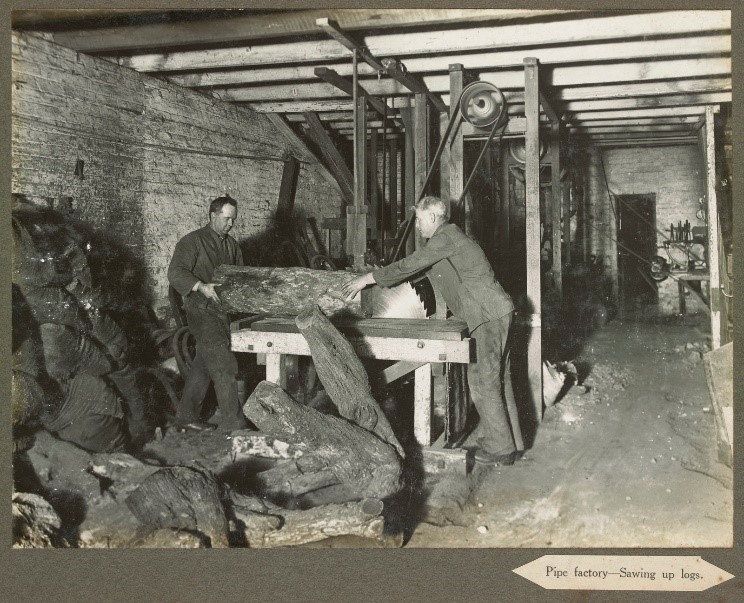
Logs were first broken down at the circular saw bench, and after passing through numerous cutting, docking, and shaping machines, pipes were finished off by hand.
Photos: State Library of Victoria (Pipe Factory)
https://nla.gov.au/nla.obj-7270009
https://trove.nla.gov.au/newspaper/article/25317603


 Victoria’s Forests & Bushfire Heritage