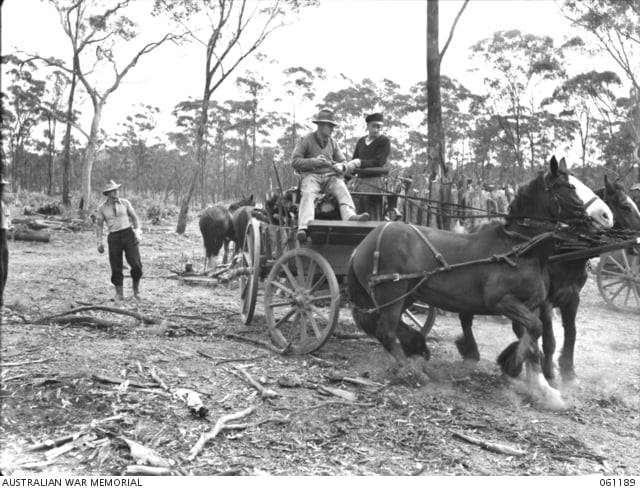
One of the pressing requirements placed on the Forests Commission during World War Two was to organise emergency supplies of firewood for heating and cooking because of shortages of coal, briquettes, electricity and gas.
Employing Prisoners of War was one part of the solution
The Forests Commission had first occupied a 14-acre site at Graytown, east of Heathcote in 1919, firstly as a worker’s camp, and then later as a sustenance camp during the 1930s Depression.
The site was acquired by Department of External Affairs and the Army in 1943 and converted into No. 6 Labour Detachment, also known as Camp #6, to house Prisoners of War to cut firewood for Melbourne.
The Graytown camp was surrounded by a double row of barbed wire fences about 6 feet high, with guard towers on each corner. The men were housed in tents with wooden floors. It had barracks, cookhouse, dining room and ablution block for communal use. There was a large sports field and a priest from Murchison visited every two weeks to hold Mass. Some men were allowed to visit a nearby church.
Camp #6 was first occupied on 30 March 1943 by 253 Italian prisoners captured in North Africa, plus a handful of Finnish merchant seamen who arrived on 21 July 1943.
Sailors were captured from the German raider Kormoran, which sunk off the Western Australian coast in November 1941 after a fierce battle with HMAS Sydney where both vessels sank.
The Germans were first housed at Harvey Camp WA, then Murchison Camp. On 4 September 1943, the crew of the Kormoran moved into Graytown to replace the Italians and Finns.
The Italian POWs had set a record for best day’s cutting of 110 tons of 12-inch blocks, but the German POWs raised the bar to 120 tons – using equal numbers of men and four saw benches.
It’s reported that the Germans at the Graytown camp initially enjoyed the outdoor work but became progressively dispirited as the war dragged-on, and their weekly productivity dropped dramatically.
To help improve morale an orchestra was formed by the POWs who also waited on tables rather than cutting timber.
Meanwhile, the German navy officers were housed separately at the nearby Dhurringile mansion. Tensions boiled over leading to a breakout in January 1945 when 20 prisoners tunnelled under the barbed wire. They were all later found.
All the German prisoners left Graytown on the 14 November 1946 and were repatriated back home to Europe when they eventually sailed from Melbourne on-board the Orontes in January 1947.
Like many other FCV camps, Graytown was used after war to house immigrants from the Baltic states.
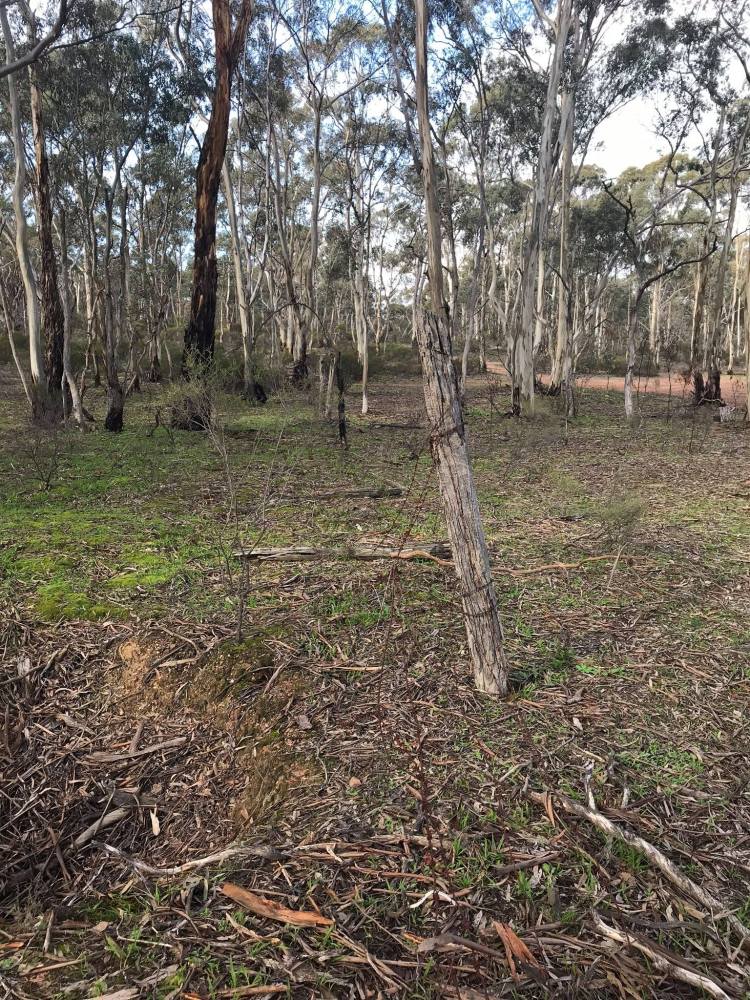
Many buildings were still there until the late 1980s, but now only concrete footings and segments of barbed wire fence can be found.
Photos: AWM
http://livinginballan.blogspot.com/2014/01/graytown-and-pow-camp.html
https://trove.nla.gov.au/newspaper/article/206871122
https://trove.nla.gov.au/newspaper/article/22403646



 Victoria’s Forests & Bushfire Heritage
Peter – I was going to do a story on Graytown camp for my Forest Yarns column in the Rushworth paper.
Could I please use this material? I would quote the reference so readers can find your blog.
With thanks
tony
LikeLike
happy to share the story. Cheers
LikeLike
My grandfather ran the camp when the Kormoran crew were there. We still have and use a kitchen table made by the prisoners, of painted hardwood glued with potato glue.
LikeLiked by 1 person
Thanks. Must be great to have.
LikeLike