
There were at least 17 bush camps operated by the Forests Commission which held smaller groups of CAC workers. Over the period of the war its estimated that about 700 men cut firewood and produced charcoal to help ease Victoria’s energy shortage.
Probably the best-known camps used by the Forests Commission during “Emergency Firewood Project” were in the Mt Disappointment State forests, which was then part of the Broadford District. Charles Pavey was the newly appointed District Forester.
The Commission engaged enemy aliens registered with the Civil Aliens Corps (CAC) at its firewood camps, not Internees, which is a subtle but important difference. Although, from 19 June 1944, POWs were accommodated at Mt Disappointment and Kinglake West.
Confusingly, different names are often used to describe the same camp. The records of the forestry camps are also patchy, and shrouded by wartime secrecy, so unravelling the sequence of events is difficult, but the six firewood camps included –
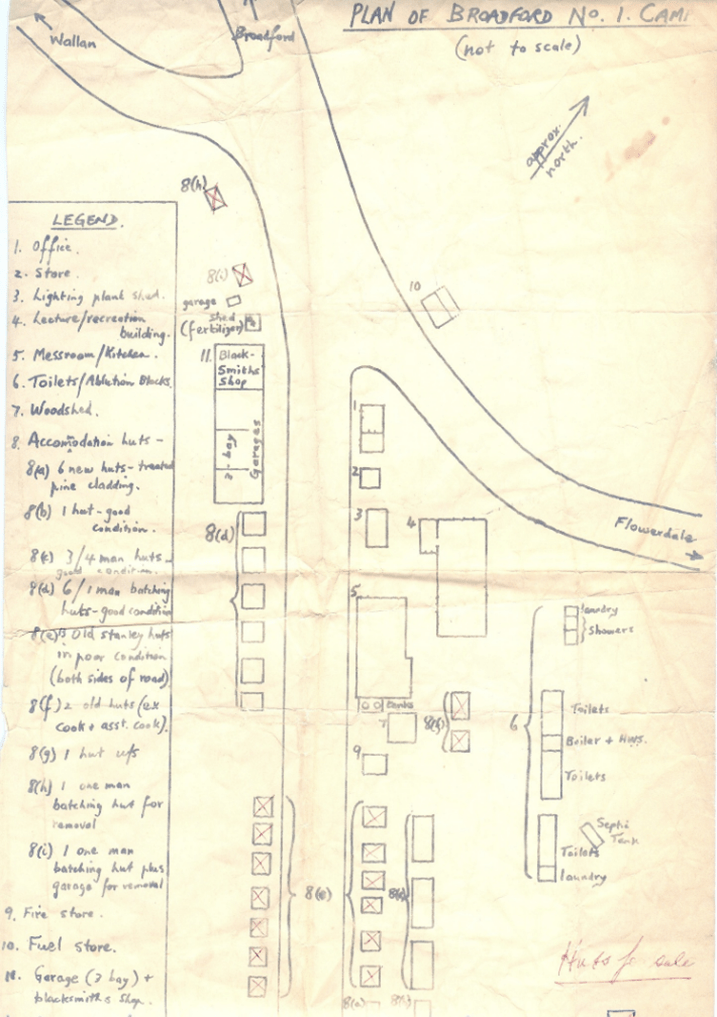
- Camp No. 1. – was at the intersection of Allison Road, Flowerdale Road and Two Tees Road.
The land was flat, and it had a good supply of water.
It was built by the Forests Commission before the war to house unemployment men (sussos) during the Great Depression. At the beginning of the war the camp was being used by FCV crews, but they were required to move to “Regular Camp”, which is situated on the corner of Flowerdale and Main Mountain Roads.
Camp No 1 was converted to accommodate 60 Civil Aliens Corp (CAC) workers and was occupied in May 1943. It was sometimes referred to as the “Strath Alien Camp”.
There were no security fences or guards. The men were not permitted to leave the precinct without permission but were known to visit other camps or make their way into Wallan.
A bushfire dugout and charcoal kilns were constructed, and in 1944, a powder magazine was added to store gelignite used to construct roads.
POWs moved into the camp on 19 June 1944 (see V12 Broadford Hostels below). It was then often simply referred to as “Broadford Camp”.
After the war the camp was repurposed as the FCV’s overseer school until about 1968. All the buildings are now gone, and the site is a popular picnic ground. - Camp No. 2. – was on Bakers Flat at the corner of Two Tees Road and Tree 15 Road.
It was purpose-built in about 1943 and designed to house 50-60 men. It was occupied by CAC workers on 19 March 1943. It was sometimes called “Reedy Camp”.
The camp had in-ground charcoal kilns and would have included a bushfire dugout.
Like Camp No. 1, Italian POWs moved into the camp during October 1944 after it was upgraded. (see V12 Broadford Hostels below). Camp No. 1 was also simply referred to as “Broadford Camp”. - Camp No. 3. – was built on Mill Range Road next to a small dam, about a mile south of the junction with South Mountain Road. It was occupied in September 1942 and designed for about 35 men.
- Camp No. 4. – was on South Mountain Road, near the Kilmore water supply reservoir. It was built for 60 men and was occupied on 25 October 1943.
- Camp No. 5. – was established at Broadford in about October 1943 and housed about 15-20 men in sawmilling operations near the railway yards.
- V12 Broadford Hostels. – Two major POW camps were built in 1944 over the existing sites of Camp No. 1 and Camp No. 2. The first opened on 19 June 1944 and the second followed on 29 October 1944. The two camps were designed for 75 men each.
- V18 Kinglake Hostel. – The new POW camp was built at Kinglake West. There were 10 large buildings including accommodation and ablutions blocks, a kitchen and dining room. It was occupied on 29 November 1944 by up to 150 men and was discontinued on 27 August 1945.
With all this activity, firewood production from the Broadford District peaked in 1943-44. But not long after the completion of the five camps, the District Forester, Charles Pavey, complained in his annual report that the best of the CAC men had been drafted to northern Australia and production dropped, and never recovered. This was the main reason to rebuild the existing camps to house POWs, who arrived in 1944.
Firewood Production.
The workers in the CAC camps cut an average of five tons a week, whilst an experienced axeman could cut 20 tons. Allegations were often made that the aliens were on a “go-slow”.
As Melbourne was still suffering from a severe firewood shortage and experiencing fuel rationing, the Forests Commission and the Power, Fuel and Water Supplies Committee felt that it was necessary to examine the issue of pay for the alien wood cutters.
Under the existing arrangement with the CAC, single men were to receive no less than one pound per week, while married men were to receive no less than £4-11-0- per week. However, the aliens were not permitted to be paid more than £5-10-0 per week, regardless of how much firewood they cut.
In one account, the wife of Antonio Silvio wrote to authorities advising she had three children, and her husband only received £4-11-0 per week, less 15 shillings for the camp mess. She complained it wasn’t enough to live on.
On 9 October 1942, higher rates of pay were issued to replace the military rates set in April. But under the new terms the aliens were to be paid in accordance with their output, at the rate of 6/3 per ton of firewood cut.
The new order was introduced on 21 October 1942, and immediately the Forests Commission saw the firewood output improve, so that by the end of February 1943 the men were cutting an average of 9.2 tons per man each week
But it was still felt that the men were capable of cutting more wood, but that the ceiling on their potential earnings £5-10-0- per week was a big disincentive to improve output.
A Forests Commission report on the “Employment of Aliens on Firewood Cutting” identified that many of the men cut their maximum amount of firewood in three days and then made very little effort to cut any more.
The Commission estimated it would need 500 experienced axemen, 800 quality CAC workers, plus another 1500 POWs to meet the demand for firewood. These numbers were simply not available.
Kinglake and Broadford POW camps.
The loss of manpower to northern Australia in late 1943 was the impetus for the Forests Commission to ask the Federal Authorities and the Army to change the emphasis from CAC Camps to Prisoner of War camps. The decision was made in April 1944 to convert the existing No. 1 and No. 2 camps to house low security Italian POWs.
Three POW hostels were built, with two at the existing camp sites No 1 & No 2 at Mt Disappointment which were rebadged V12 – Broadford Hostels and another new camp, V18 at Kinglake West.
Ex-army buildings were transported to Kinglake West from Ballarat with labour from a CAC camp at Eden Park near Whittlesea. FCV Forester Murray Thomson oversaw the new camp.
The POW camps had to meet the higher standards of the Geneva convention and needed more work. The extra construction work required to make the change to POW facilities meant that firewood production again dropped off, which was made worse by a cold and wet winter.
By 19 of June 1944 the conversion of the existing No. 1 camp was complete and was occupied by 75 prisoners of war. No. 2 camp followed soon after.
The camps were officially termed “Prisoner of War Control Hostels (PWCH)” and were approved for specific projects such as cutting firewood or producing charcoal. There were no barbed wire fences, but remoteness in the bush was the main security measure for the POWs.
The first group of Italian POW arrived at V12 Broadford on the 19 June 1944. The second group followed on the 14 August 1944 and on the 5 October 1944, Chaplain Viriglio Zubiani arrived to provide for the spiritual welfare of the Italians. The next group arrived on the 29 October 1944 while the last group arrived at Broadford on 3 December 1944.
An advance party of Italian POWs arrived V18 Kinglake West on the 29 November 1944. A second group arrived on the 3 December 1944, with some being transferred from V12 Broadford. The main group arrived at Kinglake West on the 10 December 1944.
It was noted that although the prisoners had no previous experience in firewood cutting and were unable to speak English they readily adjusted to the task at hand and seemed to “take a great interest in it”.
By the end of 1944, there were over 300 Italian POWs in the camps. In addition to cutting firewood, they improved roads, built water supply dams and water races, maintained fire breaks and dug outs. They required very little supervision.
But by the second half of 1945, and the end of the war in sight, the camps were being progressively closed.
As the “employer”, the FCV was required to pay the Army one pound per week for each man, as well as the cost of food. The Army was to supply all food at contract rates, plus 15%, and together this was to form the minimum payment. The Commission was not responsible for security, insurance, medical attention or accidents, and the Army was required to equip the men with blankets, clothing and mess utensils.
The Italian Consul to Melbourne, Mario Luciolli, reported that conditions were excellent as far as hygiene and other facilities were concerned in a camp which he visited. His preliminary report regarding the employment of prisoners of war cutting firewood said that preparations for the camps were proceeding well. But he reminded the Forests Commission of the importance of conforming very closely with the rules laid down in the Geneva Convention.
There were also some Australian Army staff at the prisoner of war camps in addition to Forests Commission staff, who acted as supervisors and trainers.
At the Kinglake West camp there were at least two interpreters, one of whom was an alien who had been sent to construct the camp. He stayed on to help supervise the wood-cutting gangs.
Forests Commission officers learnt enough rudimentary Italian to communicate basic instructions to the prisoners, as well as some of the distinctive regional words for different tools.
Two Italian Sergeant Majors, Raffaele Sbarra and Pasquale Greco, were valuable inclusions. They maintained good order and conduct of the men, and it was reported the relationship between FCV staff, and the POWs was mostly cordial, although there is an incident of a POW threatening a forestry supervisor with an axe.
It appears that discipline was not a problem, as the forest camps offered a relief from the monotony of confinement; and the prospect of escaping and “going bush” was filled with too many uncertainties.
But local wildlife sometimes supplemented the monotonous rations.
Although, after starting well, the Commission found that the prisoners of war were not performing according to expectations.
By June 1945, the Forests Commission proposed curtailing the POW operations. With the end of the war in sight, the prisoners showed little promise of improving their productivity, reflecting the problems that the Commission faced throughout this period trying to motivate non-voluntary and unpaid labour.
In 1945, with a mild winter, and good production in other parts of the state, the overall State firewood situation improved.
POW Escapes.
There were two groups of Italian POWs who made a break for freedom from V12 Broadford. The first group of four men escaped on the 17 February 1945 after leaving camp a rabbiting trip and were captured four days later on the 21 February, on the Hume Highway, 14 miles from Seymour. They were returned to Murchison Camp and given 28 days detention.
The second group of five escapees from V12 Broadford were “at large” from the 24 September to the 26 September 1945. Their records show they were “recaptured and marched in V12”. There is no disciplinary charge on their records, and they continued to serve at V12 Broadford until the hostel closed on the 15 December 1945.
Meanwhile, German officers were housed separately at the nearby Dhurringile mansion. Tensions boiled over leading to a breakout in January 1945 when 20 prisoners tunnelled under the barbed wire. They were all later found.
Post war camps.
The war in the Pacific ended on 2 September 1945, but 66 Italian prisoners at Camp No. 1 (also known as V12 Broadford) were given approval on 16 October by the Director General of Manpower to stay with the Forests Commission to continue cutting firewood.
However, Camp No. 1 finally closed to the POWs on 15 December 1945 when the last of them left.
But cutting of firewood continued from Camp No. 1 with the arrival of postwar immigrants and refugees from Lithuania, Latvia, Estonia, Poland, Czechoslovakia and Yugoslavia, or “Balts” as they became known.
It was reported in the Argus newspaper in July 1949 that Camp No. 1 had all the modern conveniences. Workers lived in army-type huts with electric light, comfortable beds, plenty of blankets, and a mess that turned out three-course dinners under the direction of Chef Frank Chute who had previously served with the 2/8th Bn in the AIF.
Camp No. 1 was later transformed into the Forests Commission training facility for overseers from about 1946 and remained in use until the early 1970s. The site is now a popular camping ground.
Camp No. 2 (also known as V12 Broadford) was vacated by the POWs on 7 August 1945. It was used briefly used by the FCV before being leased to Camberwell Grammar in 1963 as the Bambara school camp. The site was destroyed in the 2009 Black Saturday bushfires. The Salvation Army took over the site in 2003.
The fate of Camps 3, 4 and 5 after the war is not known.
The last of the V18 Kinglake West group departed on the 26 and 27 August 1945. The site was used after the war by the Forests Commission as its assessment school. It later became a commercial school camp but the last of the original buildings were lost in the 2009 bushfires.
Summary
At the end of the war in 1945, the use of alien labour through the CAC scheme and prisoners of war based at Broadford and Kinglake West was finished.
The men had given a valuable service to the people of Melbourne through their efforts to maintain firewood and charcoal supplies.
For the Government, the Forests Commission proved itself an effective organisation for engaging enemy aliens and the prisoners of war.
The Commission which was by then well experienced in the management of labour camps, both before and during the war, offered the ideal opportunity to absorb some of the of post war refugees.
Thanks to Joanne Tapiolas, Trevor Viénet and Karen Christensen for their assistance with this complex story.
Eleanor Bridger (1994). Labour and internment camps in the Victorian forests, 1930-1945. Thesis Master of Arts in Public History. VGLS.
https://www.ozatwar.com/pow/pow.htm
Footprints of Italian Prisoners of War in Australia | 1941-1947. https://italianprisonersofwar.com/


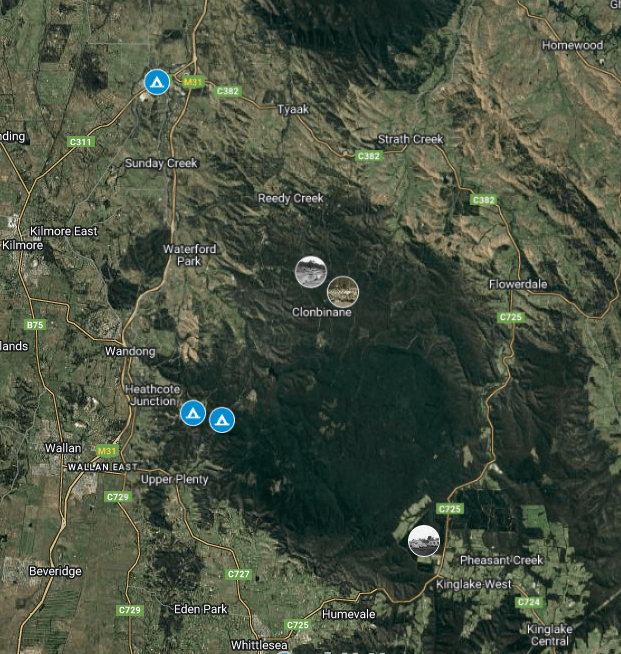
The locations of the 6 camps are shown, including the one at Broadford station. https://www.google.com/maps/d/u/0/edit?mid=1AKjxZh0KoT3Eb–sNUsyI6PYE7Rlg_E&usp=sharing
 Victoria’s Forests & Bushfire Heritage