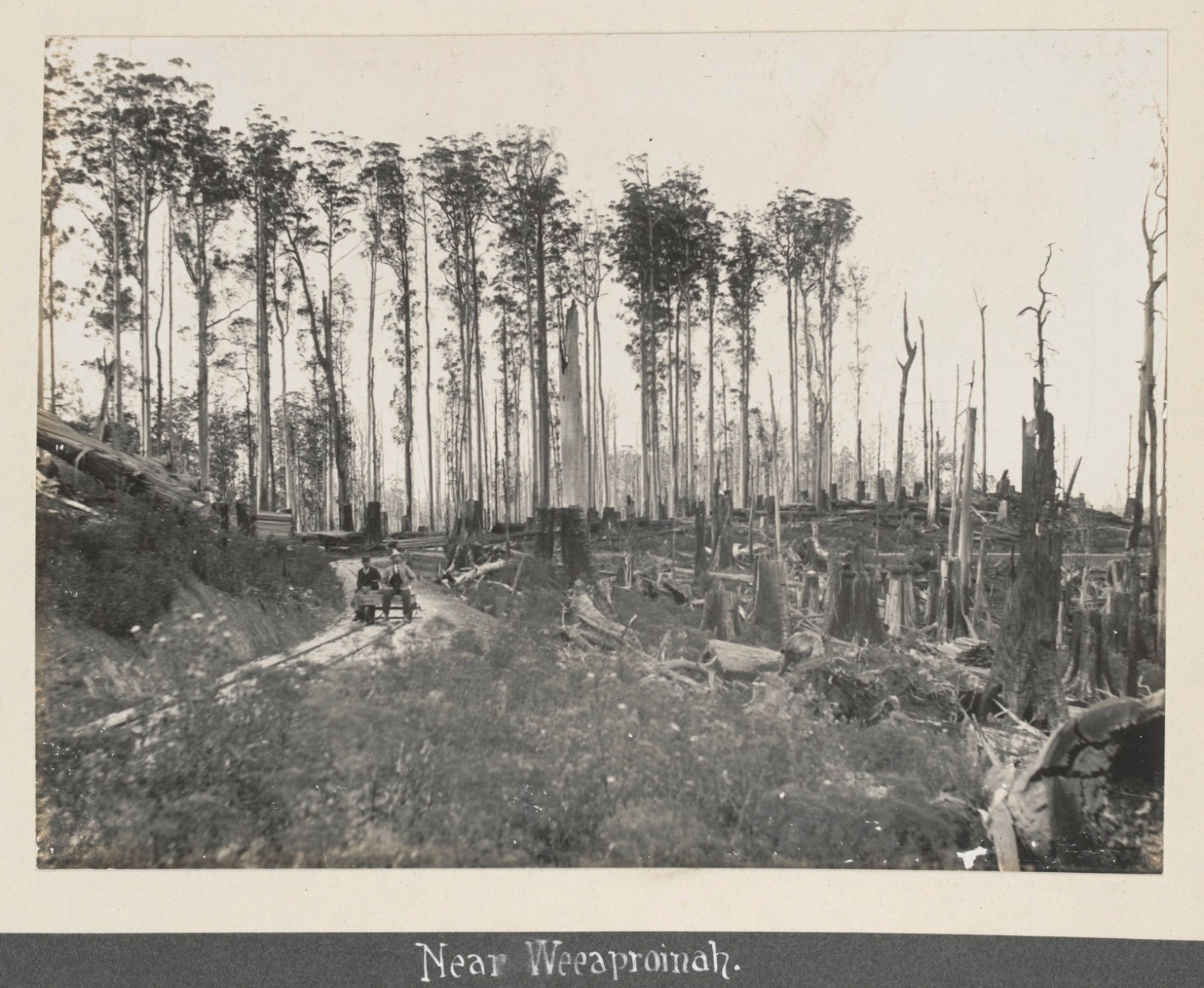
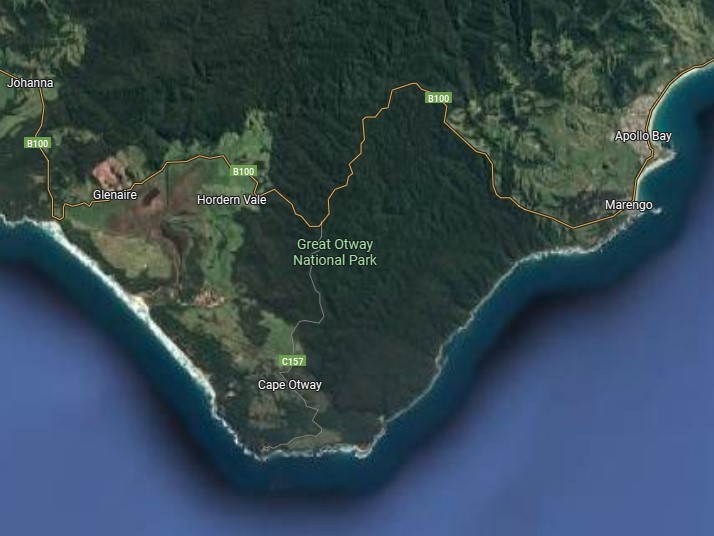
A large chunk of the Otways State forest between Apollo Bay and Hordern Vale was the focus of a bitter dispute in the early 1920s.
It was only saved from clearing and sale for agriculture by the determined efforts of foresters, sawmillers, the media and the community.
The land is now part of the Great Otway National Park.
Early last century State forests were still commonly regarded by the general public, and by most of their parliamentary representatives, as inexhaustible “Wastelands of the Crown” and ready for disposal via alienation into freehold property for the purposes of agricultural settlement.
The Lands Department was a dominant government organisation with alleged political affiliations to vested landholder and pastoral interests inside the Parliament.
The sale of Crown land was also a major source of revenue for the State Government.
The Forest Service on the other hand was the poor cousin and beleaguered foresters like George Perrin constantly struggled to combat the political manoeuvring to release more of Victoria’s State forests for agriculture.
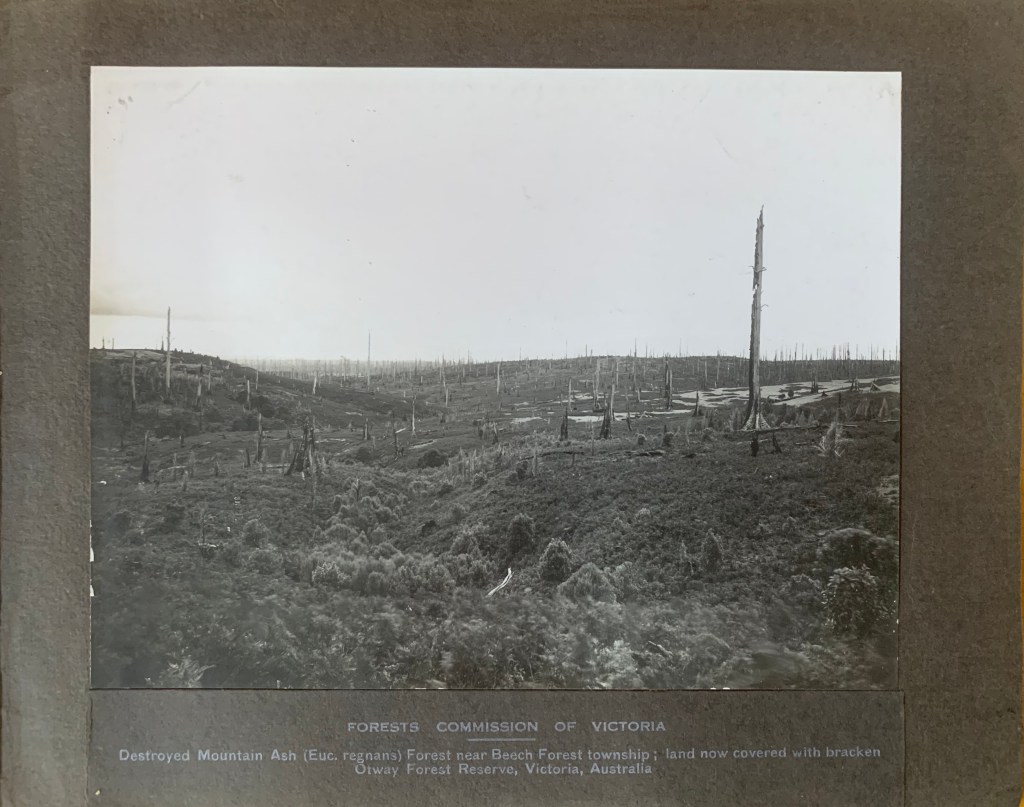
Importantly, large sections of the Otway Ranges had been unsuccessfully cleared for agriculture in the 1890s and the loss of productive forests and waste of timber had been a subject of the 1897-1901 Royal Commission.
The Forests Commission Victoria was created in 1919 and saw its mission to increase Otway forest reserves by “reclothing with the timber of which it had been denuded” and jealously guarded the thousands of hectares it had acquired from bankrupt, abandoned and voluntary sale blocks.
Local municipalities were not big supporters of State forests or reforestation because the land didn’t generate rate revenue.
In the 1920s the Lands Department sought to acquire access to the Hordern Vale forest with a view to converting it to farmlands.
Ironically, the area proposed for clearing was surrounded by 90,000 acres of abandoned farmland from previous settlement attempts in the 1890s.
Despite being required under the legislation, the Lands Minister, David Oman, stated in 1921 that he would no longer even consult with the Forests Commission over land settlement.
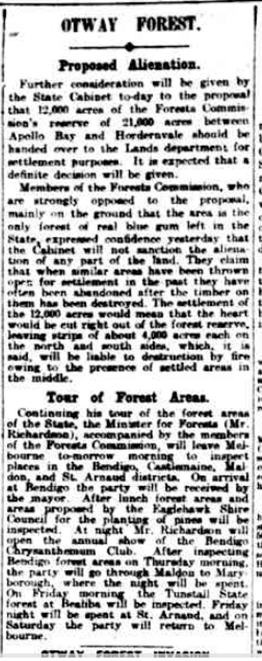
The first test case came in June 1923 when Oman announced a proposal to excise 26,850 acres (subsequently reduced to 12,000 acres) of State forests for farming in the densely forested Otway Ranges west of Apollo Bay.
The Forests Commission and the Minister for Forests refused to hand the area over to the Lands Department.
Political agitation to support the Forests Commission’s opposition to the scheme was swift.
In November 1923, deputations from the Australian Natives Association (ANA), the Australian Forests League (AFL), the Hardwood Miller’s Association and the Australian Women’s National League implored the Minister for Forests, Sir Alexander Peacock, to prevent the proposed excisions. They all pointed to earlier futile attempts at farming in the 1890s and suggested some forests were best left unsettled.
Sawmillers pointed to the substantial reductions in employment, income and royalties that the clearing of a sustainable forest industry would cause.
Local Apollo Bay interests pushed the settlement scheme, while the Geelong Timber Merchants emerged as a powerful pro-conservation lobby.
The Melbourne Press, led by the Argus, Australasian, and the Age thundered that the scheme was deeply flawed and lacked due process.
The revival of the idea that forests influenced climate and rainfall was particularly notable during this dispute. The need for water supply schemes for Colac, Camperdown, Terang, Warrnambool and, eventually, Geelong led to the expulsion of farmers from the heads of Arkins Creek, the Gellibrand River and the West Barwon River in the period 1910 to 1960.
In June 1925, after nearly two years of heated exchange, and in the face of so much opposition, the Premier John Allan and State Cabinet finally rejected the proposal and shelved the scheme.
But one major casualty was the resignation in December 1925 of the first Chairman of the Forests Commission, Owen Jones, who moved to New Zealand and bitterly attacked the Victorian State Parliament’s neglect of forestry from afar.
The furore over Jones’ resignation together with the proposed amendments by Albert Lind to the Forest Act to, in effect, turn the clock back and allow the Governor-in-Council to excise land permanently from any Reserved Forest became a major issue in the metropolitan press with numerous articles, editorials and letters.
The Argus documented the long history of political interference in Victorian forestry and noted that the Parliament’s traditional “passive resistance” to forest reservation had shifted to one of “positive hostility”.
The Forests Commission’s 1924-25 annual report once again highlighted the constant pressure, backed by the influence of selfishly interested parties who do not hesitate to nibble still more of the forests away. But it also commented on its small but significant victory.
This adverse influence culminated during the year in a determined effort to alienate from the Otways an area which would virtually have meant the extinction of this famous forest. After a stern fight the interest of the forest won the day, and for the time being, at least, the Otway forest is saved.
But the political agitation to clear and sell the forests in the Otway Ranges wasn’t over yet and bubbled up from time-to-time over the ensuing decades.
The last great clearing of the western Otways was from 1956 to 1970 under the Heytesbury settlement scheme centred on Simpson. About 43,000 ha of forest vanished in this operation. Gellibrand sawmillers asked for the opportunity to cut through the forest ahead of the bulldozers dragging the clearing chains and balls but were told it was none of their affair and the trees were pulled over, piled into windrows and burnt.
Legg (2016). “Political Agitation for Forest Conservation: Victoria, 1860–1960”. International Review of Environmental History.
Owen Jones (1926) Forestry in Victoria. Empire Forestry Journal, Vol. 5, No. 1
https://drive.google.com/file/d/1NyoyDmC6KS4A1C17cOIKunzibZFCMyK5/view


https://trove.nla.gov.au/newspaper/article/2073461
 Victoria’s Forests & Bushfire Heritage