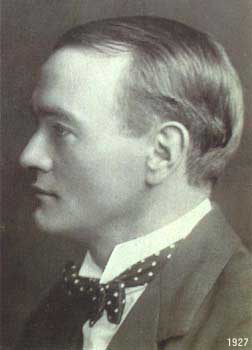
Charles Edward Lane-Poole was born in England in 1885 into an intellectual and widely travelled family. He began studying engineering in Dublin but lost his left hand in a shooting accident when he was 19, and felt he could not continue as an engineer so turned to study forestry at the prestigious National Forestry School in France at Nancy, graduating in 1906.
At the time, the British Empire was parading its prestige, power and influence across the world and its distant dominions. The Colonial Office functioned as a central recruitment and employment agency that sent foresters to India and the colonies where they were appointed to positions by the authorities of the various territories.
Lane-Poole was first placed to Transvaal in Africa in 1906 and later to Sierra Leone in November 1910. Palm oil was the main export and there were some trial plantings of rubber, but it was a small, backwater posting, with little trade and an unhealthy climate on the “Fever Coast”.
Lane-Poole left Sierra Leone in 1916 to take up a new appointment as Conservator of Forests in Western Australia.
He applied for the Chairmanship of the Forests Commission Victoria in 1919 when it was first formed. However, the English forester, Owen Jones, was subsequently appointed and Lane-Poole was offered a role as one of the Commissioners, but he turned it down to remain in WA.
Lane-Poole then had a major falling-out with the State Government in WA over forest policy and offered his resignation in July 1921. The Premier, James Mitchell, was not reluctant to accept it.
Lane-Poole spent the next three years surveying the Papua and New Guinea forests, from the lowlands to the highlands, on behalf of the Federal Government.
In 1924, the Commonwealth Government took a positive step towards involvement in forestry with the appointment of Lane-Poole as its Forestry Adviser, ironically on the recommendation of Western Australian Senator George Pearce.
Royal Commission on the Constitution – 1927.
In August 1927, a Royal Commission was established to examine the powers of the Commonwealth under the Constitution which had operated since Federation in 1901.
Forests and bushfires were a state responsibility but there had been positive moves for greater cooperation with the development of a national forest policy following the first interstate forestry conference in Sydney in 1911.
Lane-Poole held strong views on many things and was one of the first to give a statement at the Royal Commission. He pointed to the unsatisfactory area reserved for forestry purposes which was less than half of what was needed to meet national timber requirements. The 1920 Premiers Conference in Hobart had adopted a goal of 24,500,000 acres of reserved forest across the nation based on the estimates provided by Lane-Poole. He also highlighted a critical shortage of softwoods, which were being made up by expensive imports.
Lane-Poole also wanted to centralise power with the Federal Government to reserve and control an expanded national forest estate, and to eliminate political interference by State Parliaments and Ministers.
He possibly had a good point, but Lane-Poole clearly had trouble building relationships and was openly critical of the management of native forests by the states, which didn’t win him any friends.
His assertion that there were only ten trained foresters in Australia caused great offence to those running the States’ forest services, particularly in Victoria which had been operating the Forestry School at Creswick since 1910.
The Royal Commission closed in 1929 without making any firm recommendations about the control of forests.
Forestry & Timber Bureau.
However, as part of his earlier recommendations to the Federal Government on forest policy in 1924, Lane-Poole drew up a plan for a Forestry Bureau with five branches to:
- Advise on forestry matters in Commonwealth territories such as Canberra, Northern Territory, Papua New Guinea and Norfolk Island.
- Provide a financial and professional link between the Commonwealth and States.
- Improve professional training for foresters at a new Australian Forestry School.
- Build a research centre to investigate silvicultural and management problems. In 1933, the legendary Max Jacobs was appointed a research officer and carried out an investigation into timber supplies and the eucalypts of the Northern Territory.
- Create a forest products laboratory. The CSIR was established in 1928. This later became the Division of Forest Products within the CSIRO.
- Collecting and distributing forestry information including the publication of reports and bulletins.
It took until 1930 for the legislation to pass and Lane-Poole headed the Bureau from its inception until 1944.
Lane-Poole later led the Commonwealth Government’s involvement in forestry the Empire Forestry Conference held in Australia and New Zealand in 1928, then throughout the Great Depression of the 1930s and WWII, but he never had adequate funds or staff.
He was called as an expert witness to the Stretton Royal Commission into the 1939 bushfires and clashed with A.V. Galbraith.
The end of the war, and Lane-Poole’s retirement, prompted a review of the Federal Bureau’s powers and functions. The value of information-gathering and planning functions of Commonwealth Timber Control during the war had convinced the government that they should be continued in peace time. A rebadged Forestry and Timber Bureau operated, in cooperation with the states, from 1946 onwards with a range of new functions.
Australian Forestry School (AFS).
A national forestry school had been supported at successive interstate forestry conferences since 1911. It was announced by the Prime Minister, Stanley Bruce, in May 1925 and was initially located at Adelaide University, with Norman William Jolly as Professor.
The Australian Forestry School (AFS) provided two years of additional study for students who had already completed two years in their state universities and was based upon the model of the French Forestry school at Nancy where Lane-Poole had studied. It was not associated with any established university and therefore could not confer degrees. Students qualified with a Diploma in Forestry from the AFS and a BSc from their home universities.
The Australian Forestry School moved from its temporary home in Adelaide to Canberra in 1927 and Lane-Poole was appointed acting Principal at the Yarralumla campus which he had long been a zealous crusader for.
The state forest services were expected to nominate a steady flow of students, provide them with fully funded cadetships, and employ them once they graduated. But the number of students sent by the states never met expectations, in part due to the Depression, and the Canberra school was often threatened with closure.
Victoria initially sent Alf Lawrence and Charlie Venville in 1926 to attend their first year of study at Adelaide. Ben Benallack and Reginald Torbet attended Canberra from 1928 to 1931, and John Barling and Frank Incoll followed between 1930 and 1931.
Alf Lawrence later travelled to Oxford in 1934-35 to study for a Diploma of Forestry at the Imperial Forestry Institute on the prestigious Russell Grimwade Prize. Returning from England he was one of the most highly qualified foresters in the country.
Lane-Poole remained adamant that the newly established forestry school in Canberra should take over all responsibility for training of Australia’s professional staff and pressed Victoria to close the School of Forestry (VSF) at Creswick.
While other states cautiously relinquished their fledgling forestry schools, the Chairman of the Victorian Forests Commission, A.V. Galbraith, refused to close Creswick. This rejection was in part due to the acrimonious dispute with Lane-Poole, over his allegations of lower professional standards of Victorian foresters.
The prickly relationship soured irretrievably when Lane-Poole wrote to the Argus newspaper on 14 December 1929, slurring Victorian forestry training by suggesting that Creswick was a “woodsman” school rather than a legitimate tertiary institution.
With the support of Melbourne University Professor, Alfred James Ewart, Victoria abandoned the fraught arrangements with Canberra and reverted all its training back to the School of Forestry at Creswick.
Victoria then chose to go its own way and forged strong and lasting academic relationships between Creswick and the University of Melbourne.
And that is why there are three forestry institutions in Australia, rather than one.
The bitter split also created a rift within the Institute of Foresters of Australia (IFA), which was only formed in 1935, because of its refusal to grant full membership to foresters holding only the Victorian Diploma. This petty dispute took many years to heal and undoubtedly proved a major setback to the advancement of professional forestry in Australia.
Lane-Poole held both roles as Head of the Federal Forestry Bureau and Principal of the Forestry School at Canberra until the end of 1944.
After Lane-Poole’s retirement, enrolments at Canberra’s beleaguered Forestry School rapidly increased and flourished under the new direction of Maxwell Ralph Jacobs.
However, the Yarralumla campus eventually closed at the end of 1964 with the opening of the Department of Forestry at the Australian National University (ANU) which developed a four-year Bachelor of Science in Forestry degree and postgraduate research degrees.
Summary.
A picture emerges of Lane-Poole as an energetic, committed and sometimes controversial forester. His overzealous principles, abrasive manner and intolerance of his state counterparts regularly brought him into conflict with employers and colleagues.
His temper and contempt for foresters without his level of professional training, together with his lack of political acumen marred his career.
However, Lane-Poole’s persistence in the face of great difficulties was remarkable, his unquestionable commitment to the advancement of scientific forestry, training and conservation ensures his rightful place in the history of Australian forestry.
Source: Leslie Thornley Carron (1985), A History of Forestry in Australia. ANU press.
 Victoria’s Forests & Bushfire Heritage
As an ANU trained forester, I recall Lane Poole’s character and reputation was rather legendary arounds the hallways of the forestry faculty, as retold by some of our veteran lecturers. I’d always assumed the (friendly) rivalry between the 2 schools of forestry in the 1990’s was just friendly banter (certainly how I always took it). This chapter suggests it may have originated in more colonial times!!
It sounds similar to my experience of the rivalry (friendly?) between Gippsland-based foresters and those based anywhere else.
LikeLike
I suppose it depended on where you sat at the time. I agree it was friendly rivalry in the 1970s but the scars created by Lane Poole over his comments and exclusion from the IFA for Creswick foresters with only a diploma were deep. Not a problem for later graduates who all went to Melb Uni. Had he played his cards right there might have ben only one forestry school in Australia. Not that it matters now. Cheers
LikeLike