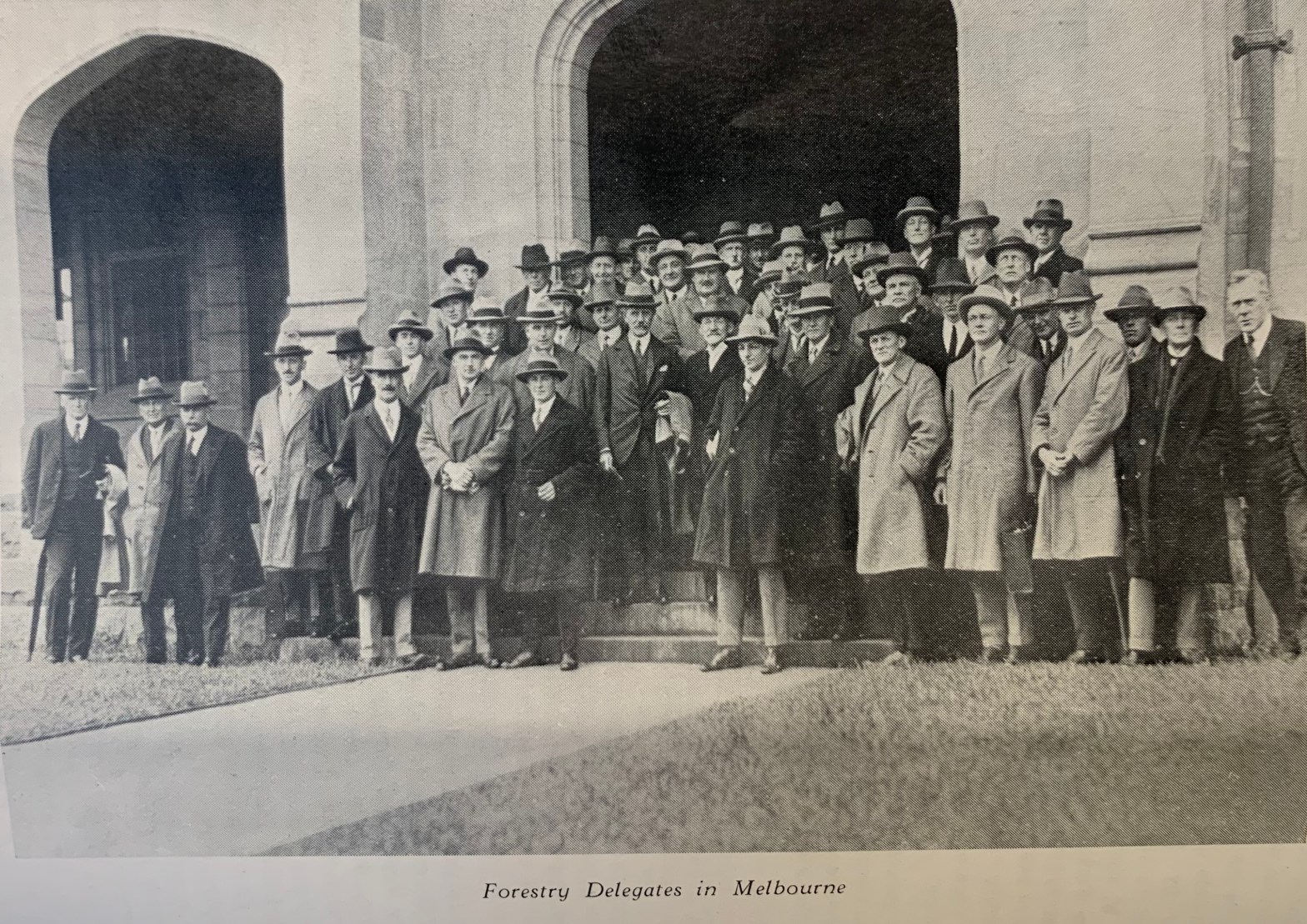
Following Federation in 1901, the States retained control of forests within their borders.
But within a decade, the heads of the various State forestry authorities were expressing interest in developing national policies and were given political approval and encouragement to meet and discuss them.
The first of what were to become regular interstate forestry conferences was held in Sydney in 1911. It was attended by New South Wales, Victoria, South Australia and Queensland along with the Government Botanist of Tasmania.
The Conservator, Hugh Robert Mackay, represented the Victorian State Forest Department. Resolutions covered a range of recurring themes, and he said in the 1911-12 annual report.
In November of last year an Interstate Conference on Australian forestry was held in Sydney, all the States being represented except Western Australia.
In addition to useful discussions on matters of forest work and management in detail, resolutions were passed calling the attention of the State Governments to the following important subjects :—
- The necessity of laws in all States of the Commonwealth for the conservation, maintenance, and planting of forests, together with the creation of permanent and inalienable reserves, controlled by a permanent authority with adequate powers.
- The foundation of a well-equipped forest school in the Commonwealth for the thorough training of students in forestry.
- The necessity of establishing plantations of trees of commercial value on large areas of waste land in the several States.
- The creation of an Australian association for the advancement of forestry, with the object of inducing the general public to take a deeper interest in forests and tree-planting.
- The necessity of concerted action in the establishment of coniferous plantations and in the maintenance of natural coniferous forests, in view of the approaching shortage in the world’s supplies of pine and fir.
- The inadequacy in all the States of legislation for the protection of forests from the ravages of fire.
- The preservation under forest law and strict control of forests on mountain watersheds, in view of their important influence on streamflow and water supply.
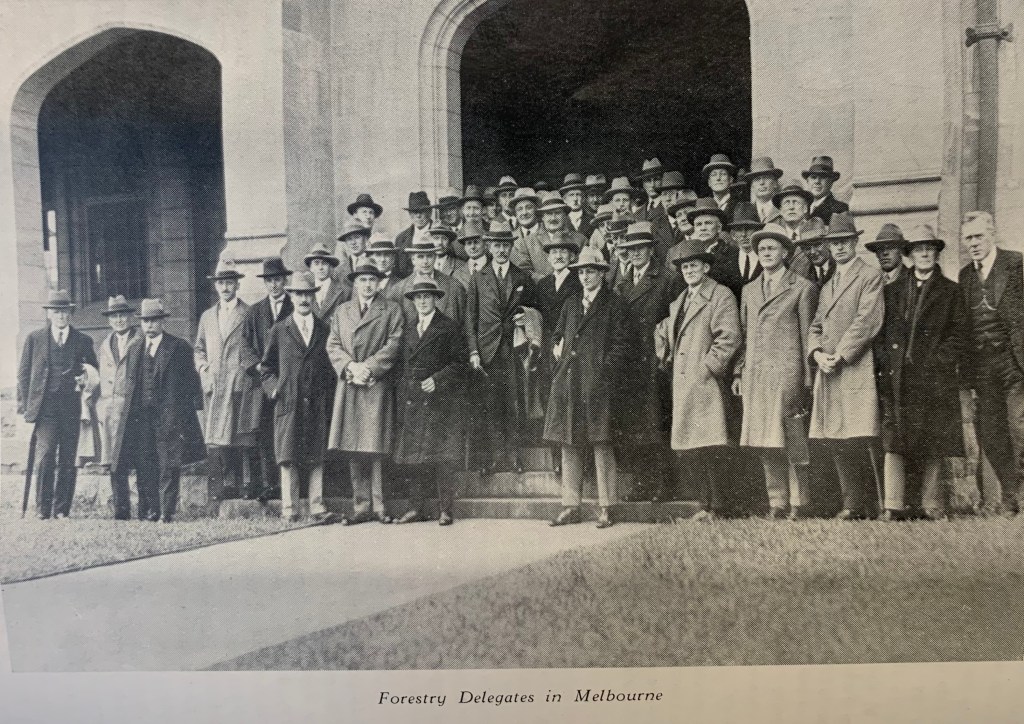
The second Forestry Conference was held in Melbourne and Creswick in 1912 with Mackay as the host. Representatives from the Dominion of New Zealand also attended. Mackay painted a depressing picture depleting areas of forests and of the ongoing neglect by Government. He recommended that each state reserve upwards of 10% of its area for forestry purposes.
The 1912 conference also recommended a program of action to establish uniformity in nomenclature of indigenous tree species. The establishment of the Australian Forestry League was also supported (item number 4 from 1911).
At the fourth conference in Perth in 1917, the visionary Commissioner for New South Wales, Norman Jolly, estimated that Australia would need 25 million acres of forest producing 10,000 million super feet per year for an eventual population of 25 million people.
The next (fifth) interstate Forestry Conference in Hobart in 1920 coincided with Australia’s first Premiers Conference that had “forest” matters on the agenda. The meeting concluded that 24.5 million acres nationally should be permanently reserved as forest to secure timber supplies. The Victorian component was to be 5.6 million acres.
The interstate forestry conferences continued until 1924 but were eventually replaced with broader Empire Forestry Conferences.
The first in a series of Empire Forestry Conferences commenced in 1920 and the third was held in Australia and New Zealand in 1928.
The 1928 conference, among other things, helped focus attention on the need for the establishment of more secure forest reserves. The Forests Commission was able to report.
- Total area of Victoria = 56,246,000 acres (approx.).
- Total area of agricultural and other non-forested lands = 42,259,000 acres (approx.).
- Total area under forest (exclusive of 1,920,000 acres of Mallee scrub) = 13,987,000 acres (approx.).
- Total area of reserved forest desirable as a margin of safety to meet the requirements of a growing population was 5,650,000 acres.
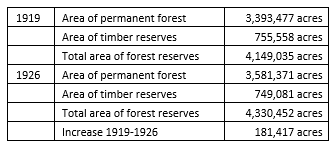
Despite a small nett gain of only 181,417 acres since the formation of the Forests Commission 1919, by 1926, the total area of Victoria’s forest reserves was 4,330,452 acres, (not including the vested MMBW water catchments) leaving the State approximately 1.3 million acres short of the agreed 1920 Commonwealth target.
But more importantly, a considerable proportion of the area of Reserved Forest was of little or no value for timber production, being native bush that was too steep, too dry, inaccessible or with poor soil quality. It was mainly reserved because it wasn’t suitable for agriculture and sale by the Lands Department.
Ever since its appointment in 1919, the Commission had drawn attention to this deficiency and urged the Minister and State Government to remedy it, but on every occasion, it was faced with strenuous protest and opposition from selfishly interested parties.
Efforts were also continually made to reduce and alienate the existing forest reserves for settlement.
The following figures show the slight gain of area of State forest and Timber Reserves from when the Commission took control in 1919 compared with the position in 1926.
Ref: Empire Forestry Conference (1928). Handbook of Forestry in Victoria.
https://drive.google.com/file/d/1HMh0T8wArE7qi73G-GNUDJ5hfu7WTFlJ/view

Source: A History of Innovation – eighty-five years of research and development at Forestry Tasmania. (2008) https://libraries.tas.gov.au/Digital/au-7-0095-01439_1
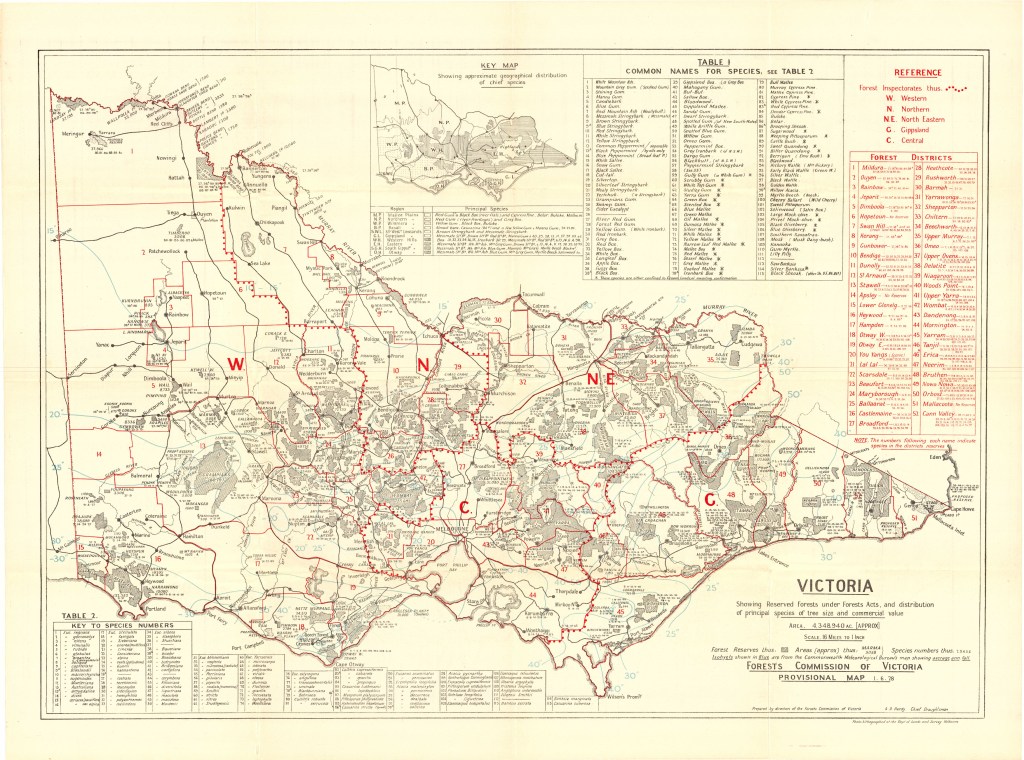
https://drive.google.com/file/d/1TZmR9Ona7h5kHjhZ5XGD0gmdSA0GD7FG/view
https://find.slv.vic.gov.au/permalink/61SLV_INST/ogp0nb/alma996591033607636
 Victoria’s Forests & Bushfire Heritage