In a lengthy policy speech to Parliament on 27 June 1918, the Premier Harry Lawson, detailed his government’s commitment create a separate and independent Forests Commission Victoria (FCV).
Lawson noted that the virtual cessation of timber imports during the war years had forced a major revaluation of Victoria’s forests and the importance of fostering a local timber industry.
He was also determined to stop rural labour drifting to the cities by means of a well-planned system of small forest villages where allotments for cottages and gardens would be granted to forest workers at low rents.
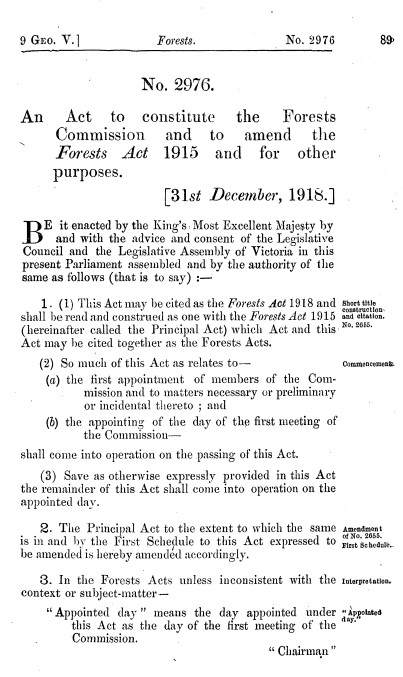
On the 31st of December 1918, just weeks after the end of WW1, a comprehensive amendment to the Forests Act (1915), number 2976, abolished the 1907 State Forest Department (SFD) and created the Forests Commission of Victoria (FCV) with three Commissioners to lead a new independent organisation
Lobbying for the bill by the Forests League and the Australian Natives Association (ANA) proved influential.
The legislation contained a number of major elements, with first establishing the three-man Commission. It was to be given sweeping powers to plan and implement all aspects of forestry and was modelled on similar Victorian water and railways boards.
The key principals of the 1918 Forest Act are thought to have been derived from the earlier 1907 legislation and include:
- conservation, development and utilisation of the native forests, based on sound forestry principals including working plans.
- establishment of adequate exotic softwood plantations to address the large Balance-of-Trade deficit resulting from timber imports.
- prosecution of essential scientific research work concerning the natural products of the forests, including native timber seasoning at Newport.
- revenue from timber royalties were to be calculated “in the round” to eliminate the wastage associated with the old “off the saw”. Revenues grew five-fold within the first five years.
- the need for an effective bushfire prevention and bushfire suppression organisation.
- professional forester training at Creswick.
Significantly, the new legislation also provided for the establishment of a Forestry Fund of a fixed sum of £40,000 per year, together with half of any gross revenue over £80,000 for the improvement and reforestation of the state’s forests. The Commission could raise also its own revenue and enter into loans to give it some capacity to implement its own policies and programs.
Importantly, the Commission was also authorised to recruit, employ and manage its own staff.
The first Minister of the Forests Commission was William Hutchinson which is often considered his greatest achievement.
The Conservator of the existing State Forest Department, Hugh Robert MacKay, initially acted as FCV Chairman while and international recruitment commenced.
The first FCV Chairman was a young English forester, and veteran of the Royal Flying Corp, Owen Jones, with the experienced William Code and Hugh Mackay as the two other Commissioners.
The legislation specified that Chairman shall receive an annual salary not exceeding one thousand pounds and each of the other commissioners shall receive an annual salary not exceeding eight hundred pounds.
The first Secretary was Alfred Vernon Galbraith (later to become long running FCV Chairman from 1927 to 1949).
The Commission first formally met at Treasury Place on 1 October 1919 due to delays with the arrival of Jones and his wife from the UK after the war. It’s said that Sir John Monash had intervened to bump a few officers off the ship’s passenger list to speed thing up.
It seemed a genuine attempt by the Victorian State Government to place forestry at arms-length, on a sound long term and more scientific footing.
However, the overall area of State forest continued to shift with ongoing political meddling and disputes with the powerful Lands Department over alienation and sales, but with a net increase of dedications over excisions.
Total area of State forests at commencement of the Forest Act (1907) was 4,016,995 acres. But much of this area was steep, inaccessible mountain country or low productivity foothills forests.
By June 1919, there had been a modest increase of only 20,729 acres, with the area of Permanent Forest standing at 3,393,477 acres, plus a further 755 558 acres of Timber Reserves.
A large portion of the State was unoccupied crown land (i.e. protected forest) and remained available for sale by the Lands Department. Foresters continued to advocate for an increase to least 6 million acres of productive forest reserved to meet Victoria’s future timber needs.
However, for the next 65 years the Forests Commission remained a relatively stable and independent authority responsible for management and protection from bushfire of a vast forest estate.
https://en.wikipedia.org/wiki/Forests_Commission_Victoria
 Victoria’s Forests & Bushfire Heritage