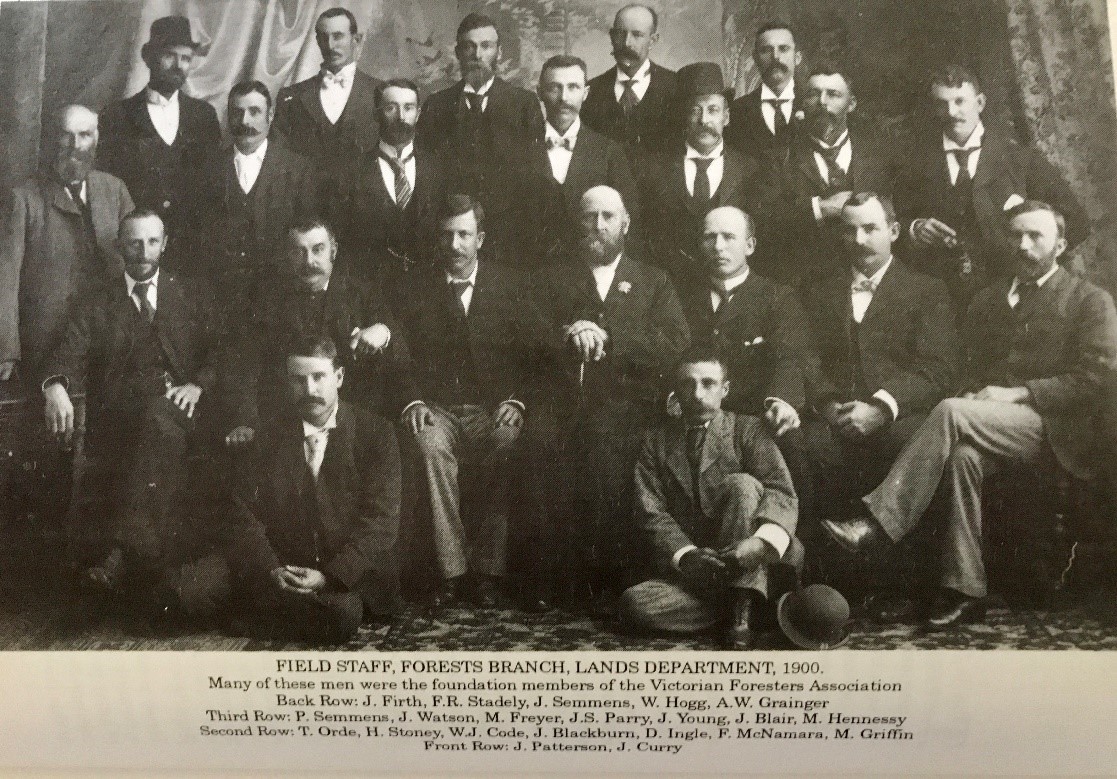
A major recommendation in the 14th report of the Royal Commission in 1901 was a detailed proposal for new forest legislation.
The political and social upheavals associated with the formation of the Australian Federation in 1901 probably interfered to some degree, but the forces of opposition within State Parliament from agricultural and grazing interests were strong enough to hold the status quo for a few more years.
So, it was not until 1905 when the new Government led by the infamous Premier Sir Thomas Bent that the proposal managed to gain enough political support, ironically via the mining lobby, to finally move towards new forest legislation.
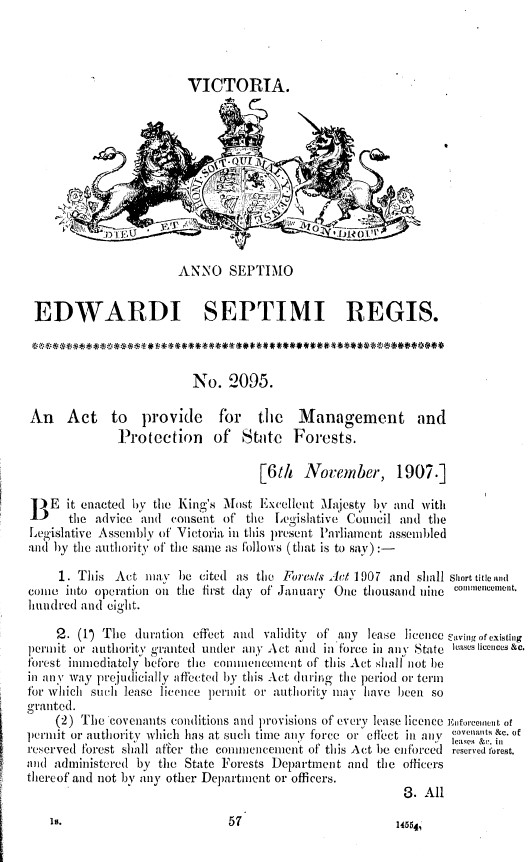
The Forest Act #2095, dated 6 November 1907, came into operation on 1 January 1908. A month later in February, a State Forests Department (SFD) under a Minister of Forests came into effect.
The creation of the State Forest Department represented the most significant institutional reform in Victoria’s history of forest management to that point.
The first Minister was Donald McLeod. He was born in Caithness in Scotland and arrived in Australia in 1847. In November 1900 he was elected to the Victorian Legislative Assembly for Daylesford, a seat he held until his death in 1923.
The first Secretary for the Forest Department was William Dickson, who was also Secretary for Mines.
The Forest Act provided for the appointment of a Conservator to head the Department with appropriate supporting staff. It also provided for the dedication of permanently reserved forest and for rehabilitation of forests after mining and logging, for control of forest produce on unoccupied crown land, for fire protection and for the collection of royalties.
Hugh Robert Mackay was appointed Conservator (on trial) in May 1908. Previously a Senior Inspector, he had been Secretary to the 1897-1901 Royal Commission and had compiled its reports and also drafted the Bill on which the 1907 Act was based.
The Chief Clerk was Augustus Warren Crooke, who had been appointed to assist George Perrin. He had acted as Conservator (in the Department of Mines and Forests) for a short time between 1905 and 1907, during the period between Perrin’s death and the creation of the new department.
Notably, the 1907 Forests Act diminished the area of the Crown land estate which had previously been controlled by the powerful Lands Department, and to a lesser degree the Mines Department.
The Lands Department continued to strongly resist the wholesale transfer of Crown land to the Forest Department.
Under Lands (and Mines) Department control, Crown land “reservations” were still not secure because they could be sold.
The challenges facing the new organisation were formidable, including protecting ecosystems about which little was scientifically understood, and responsibility for vast areas of rugged, remote country about which little was known.
The fledgling Forest Department had 66 staff on 31 December 1900 including, 1 Conservator, 1 Chief Inspector, 1 Inspector, 23 Foresters and 40 Forest Foremen but foreshadowed that it expected to increase over the years to come.
The next ten years saw a steady increase in the control of the output from the forest, considerable improvement work on the native forest which had suffered so much from indiscriminate cutting, the establishment of both hardwood and softwood plantations, and improved fire protection.
Minor additions and amendments to the Forest Act were made in 1910.
A major highlight was the opening of the School of Forestry at Creswick in October 1910 which commenced producing technically trained officers for the new service.
The State Seasoning Works were also opened on railway land at Newport in June 1911.
But the war years 1914-1918 had a major impact on the state’s forest and the operation of the new department.
Source: Brian Doolan (2018). Institutional Continuity and Change in Victoria’s Forests and Parks 1900 – 2010.
https://drive.google.com/file/d/1FLUEq_sQjfnU5KZp99qwLNu3-Eap_tT5/view
 Victoria’s Forests & Bushfire Heritage