
By the beginning of the 20th century Victoria’s forests were in a very sorry state following years of forest clearing and degradation.
The first five decades had been characterised by uncontrolled harvesting of forests by a powerful mining and sawmilling industry, a government desire to clear the land to establish a thriving farming sector which was overlayed by general community indifference.
But there had been a few, largely unheeded, calls for more protection and sound management of native forests from a handful of foresters.
Bushfires including the particularly devastating fires on “Black Thursday” in 1851 and “Red Tuesday” in 1898 had also damaged and destroyed large tracts of native forests.
The rate of clearing for farming was substantial. In 1855 the area under crop farming in Victoria was 98,800 acres. This increased by 74,100 acres each year for the following 59 years to reach the total of 4.45 million acres by 1914.
The identification of State Forest and Timber Reserves by Clement Hodgkinson, along with his early attempts to establish independent Forest Boards to control timber harvesting on Crown land had proved infective. The licencing system was grossly inadequate and the staff to supervise the system meagre. The forests also remained vulnerable to political interference.
Since 1851 and the formation of the Colony of Victoria there had been many Government inquiries, three independent reports from D’A. Vincent (1887), Perrin (1890), Ribbentrop (1895), the Royal Commission (1897–1901).
There had also been impassioned speeches and separate pieces of legislation been brought unsuccessfully before the Victorian Parliament calling for the conservation of the state’s forests and timber resources.
Meanwhile, the focus was elsewhere. The last decade of the 1800s was probably one of the most eventful in the history of the country.
Australia had suffered from economic depression, industrial strife, the Federation Drought, millions of rabbits, but saw the beginnings of great social and political reform.
The intense political activity culminated in the Federation of the colonies, with Edmund Barton as the first Prime Minister.
The first Victorian Premier in 1901 was Alexander Peacock, who is often credited with being responsible for the Forestry School at Creswick.
There had been good chance that the colonies could have remained split and even ended up as a number of separate countries !
Prior to political Federation in 1901, the colonies had, to some degree, been going their individual pathways. At Federation, these colonies became States of Australia, each still with its own government, each retaining some of its former powers, but surrendering others to the new Commonwealth Government.
Some of the functions transferred to the Commonwealth included defence, foreign policy, trade, immigration, national transport, coastal navigation, postal and telegraph services.
Forest management probably received very little attention during the federation conventions which were debating and drafting a new constitution.
The State Governments ended up retaining responsibility for their public forests and bushfire control within their borders. It had been a different story with the control of rivers which was a major subject of dispute.
However, some of the powers ceded at federation had unforeseen consequences and have enabled the Commonwealth Government to increase its influence and control over forest management in the States.
The most notably example was probably the annual tussle over the issue of export woodchip licenses by the Commonwealth Government during the 1970s and 1980s. Log trucks converged on Canberra in December 1994 to encircle Parliament House which led to the Regional Forest Agreement (RFA) Act (2002).
The Environment Protection and Biodiversity Conservation (EPBC) Act (1999) led to many legal challenges in the Federal and High Courts to forestry and bushfire practices.
The more recent Traditional Owner Settlement Act (2010) created the legal notion of “Aboriginal Title”, which is a new, and as yet not well-defined, form of third-party interest over Crown land and Crown leaseholds.
Meanwhile in 1901, the Royal Commission into Victoria’s forest was drawing to a close and was damming about the loss of State’s forests and the wastage of timber. The 14th report even contained draft legislation for a new Forest Act, which once again failed to get political support.
At the time of Federation, Victoria’s State forests were still commonly regarded by the general public, and by most of their parliamentary representatives, as the inexhaustible “wastelands of the Crown” and ready for disposal via alienation into freehold property for the purposes of agricultural settlement.
But despite spirited rear-guard opposition by agricultural and grazing interests, the State Forest Department (SFD) finally emerged in 1907 with legislation formally setting aside timber reserves and providing for an independent, long-term and scientific approach to forests and bushfire management.
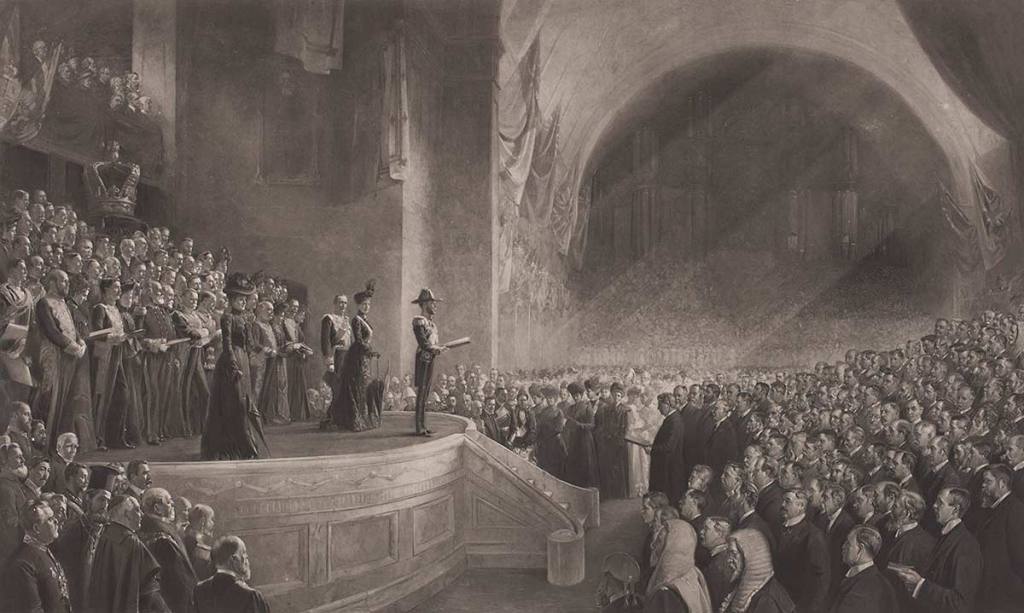
https://www.nma.gov.au/defining-moments/resources/federation

The first Victorian Premier in 1901 was Alexander Peacock, who is often credited with being responsible for the Forestry School at Creswick. c 1898. Source: Wikipedia
 Victoria’s Forests & Bushfire Heritage