Forest and bushfire management in Victoria in the 50 years between the discovery of gold in 1851, through to Federation in 1901, can best be described as chaotic.
Prior to European settlement it’s thought that nearly 88% of Victoria had been forested, with the remaining 12% made up of open grasslands, coastal and alpine heathlands, lakes and mallee deserts. By 2013, forest cover had stabilised at about 36%.
Victoria’s native forests were indiscriminately cleared by miners during the goldrush, by timber splitters, for new railway expansion and then in a mad scramble for land selection and agricultural settlement, as well as to create space for growing cities and towns.
During the 1800s, the state’s forests were still commonly regarded by the general public, and by most of their parliamentary representatives, as the inexhaustible “Wastelands of the Crown”, and ready for disposal via alienation into freehold property for the purposes of agricultural settlement.
Selling and leasing Crown Land was the State Government’s major source of revenue following the heady days of the goldrush.
Small rural municipalities also had little interest in preserving Crown lands and State forests from sale because they generated no rate revenue.
However, there were growing groups of concerned citizens and foresters. As early as 1865, the Argus Newspaper took up the cause of “protecting our forests”, arguing the substantial benefits of timber production, avoiding the wasting of soil, conserving natural streams, avoiding adverse climate impacts and beneficially distributing storm runoff.
In opposition to the policy of forest destruction, there was a small and persistent band of conservationists within government ranks, the first being the Surveyor General, Charles Whybrow Ligar, the Assistant Commissioner of Lands and Survey, Clement Hodgkinson, and the Secretary for Mines, Robert Brough Smythe, who in 1865 were acting as Commissioners to enquire into applications under the Land Act.
They quickly realised there was a “rapid and unnecessary destruction of forests”, and they recommended the extension of forest and timber reserves in the vicinity of certain mining centres, as well as the planting of trees.
On 16 September 1869, the first “Overseer of Forests and Crown Land Bailiff”, William Ferguson, was appointed by Clement Hodgkinson.
In 1871, Ferguson reported on the destruction of forests in the vicinity of the goldfields. He also wrote a similar report on the damage to Barmah forest along the Murray River.
In 1871, a Royal Commission was appointed by the Governor of the Colony, Viscount Canterbury, to examine “Foreign Industries and Forest Conservation”. The final report by Judge Samuel Henry Bindon expressed the panels strong opinion that prompt and decisive action should be taken to end the wasteful practices of timber cutting.
Also in 1871, the Australian Natives Association (ANA) was formed and joined the chorus and remained active on forest conservation matters for a prolonged period. The Field Naturalists Club of Victoria (FNCV) became involved later in 1881.
It is surprising, and perhaps ironic, that organised mining interests, including influential mining parliamentarians, were the early public advocates for forest protection, taking up the cause in the 1860s. Their advocacy was based more on the profitability of their mining interests than forest conservation. The miners wanted well-regulated state forest reserves to ensure a plentiful future supply of mining timbers at reasonable prices.
In 1871, local Forest Boards attempted to exercise some control, however the task of regulating wasteful clearing proved formidable and they were abolished in 1874.
There were also powerful forces at work by vested interests to maintain the status quo. The State Upper House of parliament was dominated by powerful mining, pastoral and grazing interests which had strongly resisted land reform.
Many of the “mining members” in the Victorian Lower House were among the most radical of parliamentarians, attacking the privilege of the Legislative Council, and giving support to land reform, tariff protection, and payment of members. Their long tradition of militancy could be traced back to the unrest on the goldfields which sparked the Eureka Rebellion in 1854.
Matters came to a head on Black Wednesday (9 January 1878) when the State Government sacked over 300 senior public servants and judges suddenly overnight without warning. The sackings were, in part, directed at the desire of the Premier, Graham Berry, to penalise those in the public service who constantly backed the intransigence of the Legislative Council which had resisted repeated attempts at reform. Berry’s election manifesto proposed a punitive land tax designed to break up the squatter class’s great pastoral properties where a handful of men owned most of Victoria’s grazing lands.
Over the decades, impassioned speeches and several separate pieces of legislation calling for the conservation of the State’s forests had all been brought unsuccessfully before the Victorian Parliament.
But the State Government only seemed to respond lethargically with inertia, inquiries and inaction.
In 1887, the Governor of Victoria, Lord Henry Brougham Loch, who had served in the Bengal cavalry and maintained a strong interest in forests, urged an external review. He had personally seen the results of forest management under the great European foresters, including Dietrich Brandis, Wilhelm Schlich and Berthold Ribbentrop.
The State Government subsequently invited Frederick d’Abernon Vincent to visit and make recommendations. At the age of 35, Vincent was well connected to British aristocracy and at the time had the role of Deputy Conservator of Forests within the Indian Forest Service.
Vincent was paid a substantial fee but only given a month to complete his task. It was winter when he arrived which severely restricted his inspections of the state’s forest lands. However, his 28-page report said in part –
- I am very unfavourably impressed with the state of the forests
- I am surprised that some effectual measures have not been taken to prevent further waste.
- The present arrangements with this view are quite puerile and so ill-conceived that they can scarcely be seriously discussed. In the first place the distinction between State Forest, Timber Reserves, and other Crown Land can only lead to difficulties.
He also recommended the establishment of a type of Commission that he was familiar with in India.
- That the Governor in Council be empowered to appoint a Commission, consisting of three members, for the purpose of administering the Act.
- That at least one of the Commissioners shall be a competent forest officer, and that the Chairman or Senior Commissioner shall have had proper professional education and training.
- That subject to the provisions of the Act, all Reserved Forests and Reserved Crown Land, proclaimed or notified as such, shall be deemed to be in the possession of the Commissioners and under their control.
To seek advice was one thing, but to take it was another, and while Vincent’s scathing report was available to subsequent inquiries and was eventually tabled in the House in 1895, it was so frank and outspoken that it was never fully published.
The first Victorian Conservator of Forests, George Perrin was appointed on 14 June 1888, a year after Vincent’s report, but his activities were greatly constrained within the powerful Lands Department.
Perrin fought strenuously for a proper system of forest control and produced his first report to Parliament on 30 June 1890. He clearly identified the issues and set out reforms to ensure Victoria would have a healthy, diverse and extensive forest estate.
It seemed that all the previous government inquiries and independent reports into the parlous state of Victoria’s state forests, including those from D’A. Vincent (1887) and Perrin (1890) had brought little result.
In 1895, Mines Department Secretary and notable bushman, geologist, explorer and scientist, Alfred William Howitt, reported to the Minister of Agriculture on the supply of Victorian eucalypts and the possibilities of a future export trade in timber. Howitt noted the continued reckless destruction of Victoria’s forests which had ensured the current dwindling timber supplies had given no margin for any substantial export trade in the foreseeable future. He also called for the immediate examination and permanent reservation of State Forests.
It seemed that all the previous government inquiries and independent reports into the parlous state of Victoria’s state forests, including those from D’A. Vincent (1887) and Perrin (1890) had brought little result.
But with forest conservation receiving more public and political sympathy, the new State government under Premier, George Turner, finally pursued a systematic and scientific approach to forestry.
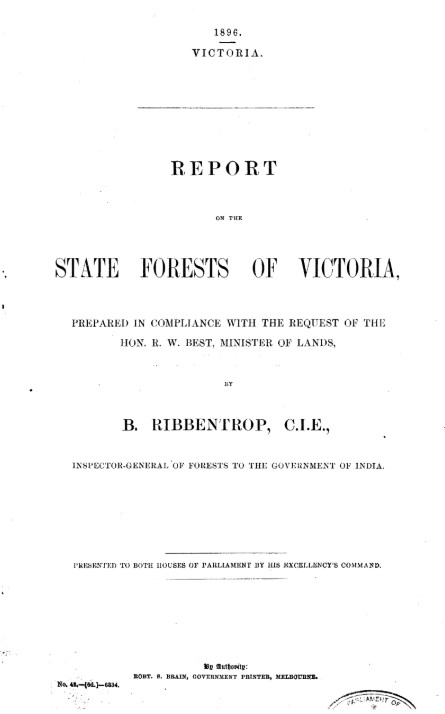
In August 1895, the Commissioner of Crown Lands and Survey, Sir Robert Best, invited Inspector-General Berthold Ribbentrop from the Imperial Forest Service of India to visit the new colony.
Ribbentrop quickly noted –
- the widespread and uncontrolled felling of trees associated with the goldrush period
- continuing poorly controlled timber harvesting
- increasing instances of illegal occupation of Crown Land
- pressures for alienation of Crown Land.
His 1896 report concluded –
- State forest conservancy and management are in an extraordinary backward state.
- The forest laws of the country are inadequate.
- The area of inalienable State forest has not been increased since Mr Vincent’s report of 1887.
- The protection of forests against fires has never ever been attempted, and neglect and waste in their treatment are now as rampant.
- The income from the forests is ridiculously small, and quite out of proportion to the large supplies drawn from them; and the money spent on their protection, maintenance and improvement is entirely inadequate.
- The reasons for the self-evident mismanagement of the forest property of the country are political, and centre in the public weal (i.e. the public good, the welfare of a country or community) where this clashes with the monetary profits of individuals or classes who can exert a direct Parliamentary influence.
In May 1897, the Surveyor General – Samuel Kingston Vickery and the Inspector of Forests – James Blackburne reported to Parliament in, on the “Permanent Reservation of Areas for Forest Purposes in Victoria”. They recommended and defined more than one hundred areas across Victoria, except for the Mallee, to be permanently reserved as State forest.
Ribbentrop’s scathing report finally prompted the Commissioner of Crown Lands and Survey, Sir Robert Best, to call a Royal Commission into the State’s forest and timber reserves which began in 1897 and produced 14 separate reports before closing in 1901.


Berthold Ribbentrop’s Report – 1896.
https://drive.google.com/file/d/1zsh52b9UR9Q55oei_xyhVAoL-3f4HTGV/view
Frederick D’A Vincent Report – 1887.
https://drive.google.com/file/d/1ZIDm66H8h97vNhenr5iSBeR6479WyYpX/view
George Perrin Report – 1890.
https://drive.google.com/file/d/1DbCppBtgE7enCppw037yq8p_egaalpRj/view
Vickery and Blackburne report to Parliament- 1897.
https://drive.google.com/file/d/1F-L_HRlmrzBb2Hv69tt6o5HguTG-NxRq/view
 Victoria’s Forests & Bushfire Heritage