
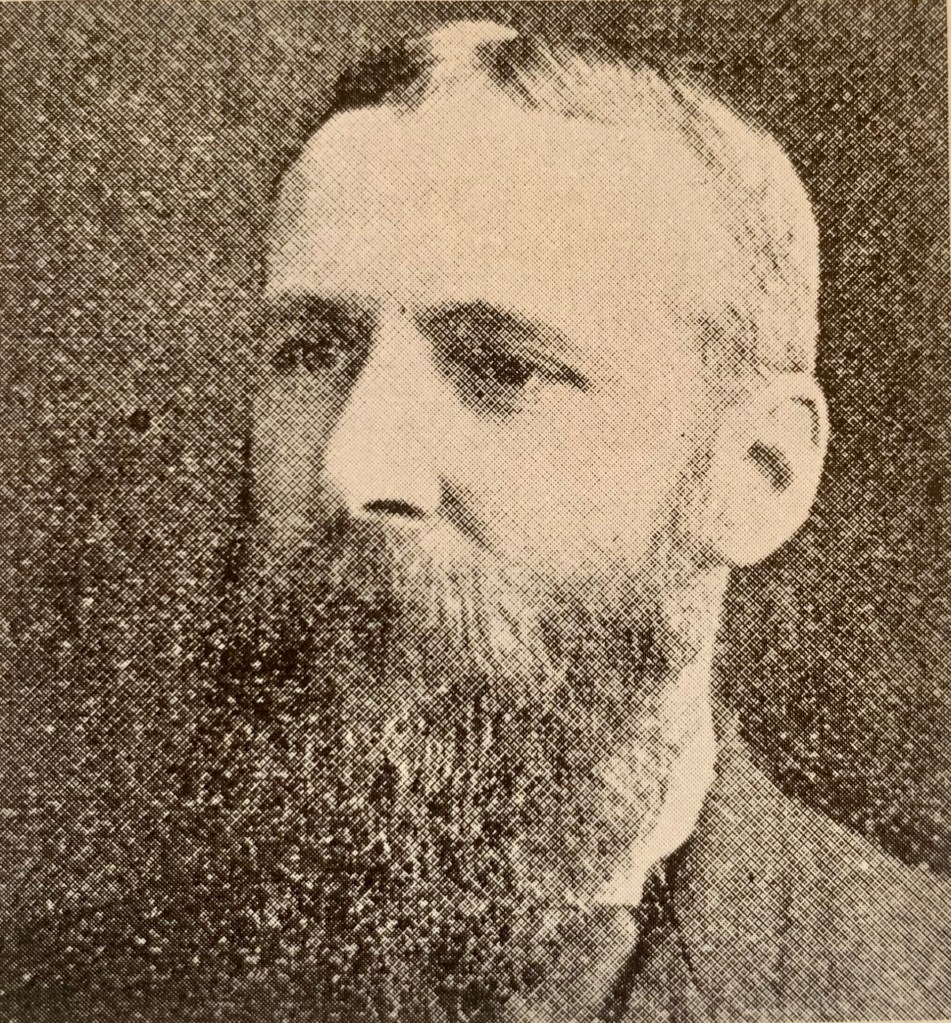
George Samuel Perrin was born England on 28 November 1849 and in 1880 became a forester with the Woods and Forests Department of South Australia. From 1886 to 1887 he was Conservator of Forests in Tasmania.
In 1888, the Lands Minister, John Lamont Dow, brought two bills before Parliament: a measure for the Conservation of Timber, and a less ambitious bill to promote Wattle Tree Cultivation. The first was stymied but the latter was finally passed.
On 23 June 1888 Dow recruited Perrin to a newly created position of “Conservator of Forests”, with a generous remuneration of £750 a year to implement the legislation and to form a Forests Branch within the Department of Lands and Survey.
Unfortunately, Perrin’s influence over forest preservation was not in proportion to his salary, and he constantly found himself at odds with the dominant ethic of the Government and the Lands Department to alienate land for settlement.
It took six months before “a suitable room was placed at the disposal of the Branch” and even then, Perrin had to share it with others.
Perrin also complained about the lack of clerical support, so in 1890 Augustus Warren Crooke, later to become a Forest Conservator, transferred from the Lands Department as Chief Clerk, to bring the number of staff in the Forest Branch to the grand total of three.
Up to the time of Perrin’s appointment, William Ferguson had been Inspector of Forests, but he was mainly confined to establishing the State Nursery at Macedon. Other nurseries included Sawpit Gully (Creswick), You Yangs, Havelock and Tintarra (Gunbower).
Despite having little power or authority, Perrin made headway and appointed a number of foresters over the next 12 years. They included John La Gerche at Creswick, William Code at Heathcote, Howard Stoney at Bairnsdale, Thomas Orde at Beaufort, McCann at Sandhurst and Leech, McNamara, Hennessy and Griffin. There was also Joseph Firth (Macedon), John Blair (You Yangs) and Love (Gunbower) as plantation officers.
Perrin recruited John Johnstone in 1898 from Maddingley Park at Bacchus Marsh. Johnstone was initially stationed at Macedon but moved to Creswick in 1900 and was instrumental, but largely unrecognised, for the establishment of the School of Forestry.
In 1889, Perrin reintroduced a limited royalty system on sawmillers. He boasted that –
“this new departure in the working of our forests marks an important epoch in the history of forest management in Victoria, and is likely to result in a permanent revenue, and at the same time conserve the forests and put a stop to the fearful and careless destruction going on everywhere.”
The mining and sawmilling groups weren’t pleased but felt that, although “overzealous”, Perrin was conscientious and fair. But it was also alleged that –
“the Conservator of Forests was a crank and would make Collins street a forest if he had his way”.
Controlling forest grazing as well as timber cutting, particularly in the red gum forests along the Murray River, was something that Perrin felt very strongly about. He said in 1894 that the Barmah Forests were
“one of the grandest public estates in the colony”.
Perrin delivered his first Report to Parliament on 30 June 1890 which contained a number of illustrations. His visionary report was vigorous and clearly identified the many issues in the forest estate. It also set out reforms to ensure that Victoria would have a healthy, diverse and extensive forest estate for years to come. His report included measures for training of foresters, thinning of forests, control of sawmilling, supply of mining timber, controlling the wastage associated with sleeper cutting, application of silviculture, protection from bushfire, major licence reforms and nurseries.
He was also at constant loggerheads with the Railways Department over the wasteful cutting of sleepers. He urged that sleeper hewer[s] should be excluded from the forest and made clear his belief that individuals hewing timber bore the majority of responsibility for the destruction of Victoria’s timber, not sawmillers.
He strove, but without success, to get the Government of the day to pass through Parliament a Bill which had been prepared to secure better control and protection of the reserves.
Unfortunately, it would seem he was continually undermined by the Lands Department bureaucracy and the politics of the time.
However, the State Government announced in June 1897 a major Royal Commission into the parlous state of Victorian forests. It had been a long time coming and the inquiry produced 14 separate reports before closing in 1901.
In a related move, the Premier Graham Berry also called for Perrin, along with the Surveyor General – Samuel Kingston Vickery and the Inspector of Forests – James Blackburne to identify Crown lands suitable for investigation as potential State Forests.
Working off the detailed County plans they identified nearly 4 million acres, excluding the Mallee country, but they remained mindful of the desirability of interfering “as little as possible with further settlement”, and at the same time gave particular attention to the needs of mining industry timber.
The most important areas the panel recommended for reservation were the Wombat Forest (Daylesford—Trentham) —145,000 acres, Otways — 140,000 acres, Croajingolong (East Gippsland) — 411,000 acres.
Their recommendations, of course, were not adopted in full at the time, but in 1898, an area of 118,000 acres was added to the reserve system.
George Perrin was on friendly terms with the Government Botanist Ferdinand Mueller and they shared knowledge of the Australian bush. Spinning gum, Eucalyptus perriniana, is named after him.
Perrin died unexpectedly on Christmas Eve 1900, at Craigs Hotel in Ballarat, aged 51, after a long period of failing health, and Augustus Warren Crooke was placed in temporary charge.
By the time of his death, Perrin had built a very respectable Forest Branch with one chief inspector, one inspector, twenty-three foresters, two acting foresters and forty other forest foremen and similar supervisory staff. Labourers were hired as required for seasonal work and ten trainees were posted across various State forests at that time.
His major legacy was undoubtedly a Forest Branch well positioned for the changes ahead associated with the release of the Royal Commission findings in 1901 and the subsequent bumpy ride to eventually pass the necessary legislation to create a separate State Forest Department in 1907.
https://trove.nla.gov.au/newspaper/article/206969286
 Victoria’s Forests & Bushfire Heritage