
The distance from Melbourne to Sydney often frustrated and delayed important government decision making when Port Phillip was still a reluctantly dependent outpost of New South Wales. It was one of the main reasons that Port Phillip residents passionately advocated for a separate and independent government.
A Separation Association was formed following a public meeting in Melbourne in 1840 to protest about the perceived indifference by Sydney administrators, as well as the unequal distribution of public infrastructure funding. The Association then petitioned the British Parliament in London. Maybe as an appeasement the Port Phillip District was granted minority representation in the New South Wales Legislative Council in 1842.
Finally, on 1 July 1851, after years of agitation, the District of Port Phillip separated from NSW to become the independent Colony of Victoria. Although the first meeting of the Victorian Parliament wasn’t until November 1856.
Meanwhile, there had been evidence of small quantities of gold in Victoria as early as 1849. The Black Thursday bushfires in February 1851 removed the thick undergrowth and opened up the forests, the rivers and outcrops of rock for eager prospectors.
The new Victorian Governor, Charles La Trobe, assembled a Gold Discovery Committee on 9 June 1851 which offered sizable rewards to anyone who found payable amounts of gold within 200 miles of Melbourne. The response was immediate because the precious metal had already been discovered, but the prospectors had kept quiet.
Within weeks of Victoria’s formal separation from NSW, news broke out about gold discoveries at Warrandyte and Clunes, and by the following month new finds were also made public about Castlemaine, Bendigo and Ballarat. Further discoveries were made at Beechworth in 1852, Bright, Omeo, Chiltern (1858–59) and Walhalla (1862).
Governor La Trobe visited Ballarat and witnessed a team of five men dig out 136 ounces of gold in one day and another 120 ounces on the following day. The richness of these finds was staggering.
Prior to the goldrush, Victoria was primarily a pastoral settlement with a European population of 77,345. But when gold was discovered, the population suddenly swelled. Three years afterwards in 1854, the population had tripled to 231,925 and by 1857 it had reached 410,766.
The economy deteriorated into a shambles for a time as people deserted jobs and farms to head to the goldfields. Vessels arriving with hopeful diggers at Williamstown in Port Phillip Bay were often left abandoned as the crews jumped ship.
The 1850s goldrush led to heady and unrestrained prosperity for the new colony, and the City of Melbourne became its financial capital. Many magnificent public buildings were constructed, and the rail system began to radiate from its centre.
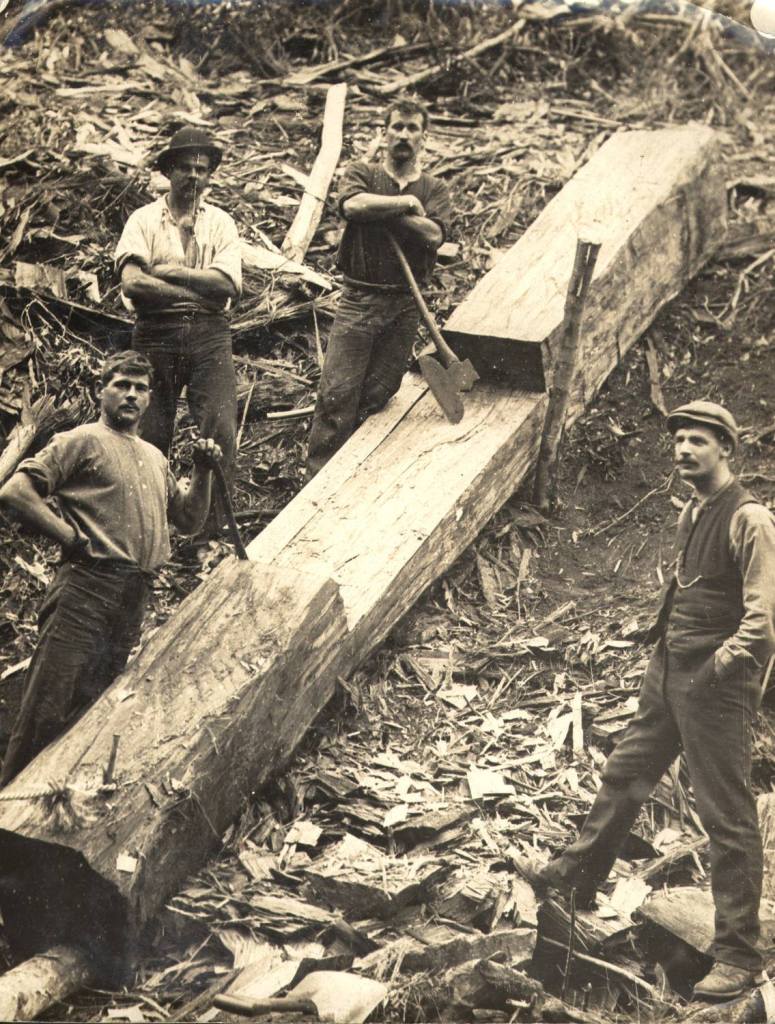
However, the urgent need for timber to feed the gold fields had a profound and lasting impact on Victoria’s native forests. They were being progressively and indiscriminately cleared, in ever-increasing concentric circles, for mining and building timbers.
The Government had become beholden to the needs of the mining industry and practically no restrictions were placed in the way of its easy and cheap procurement of timber.
No value whatever was given to the boundless forests, and it was only because of the necessity of going further and further afield for pit props, laths and other wood necessities for the mines that any thought was given to the conservation of forests.
The spirit of forest destruction engendered by the powerful mining community became a state characteristic for many years to come.
Power for sawmills and mines was primarily supplied by steam, and in 1873, it is estimated that some 1150 steam boilers in the gold mining industry were indiscriminately devouring over one million tons of firewood each year.
By 1859, there were 71 sawmills but during the 1860s, this number expanded to 141.
The gold mining frenzy not only devastated the native forests, but it also churned the soils, the landscape, and the waterways, which left scars that took decades to repair.
Indeed, gold made Victoria and Melbourne, but at a terrible cost to the native forests.


 Victoria’s Forests & Bushfire Heritage