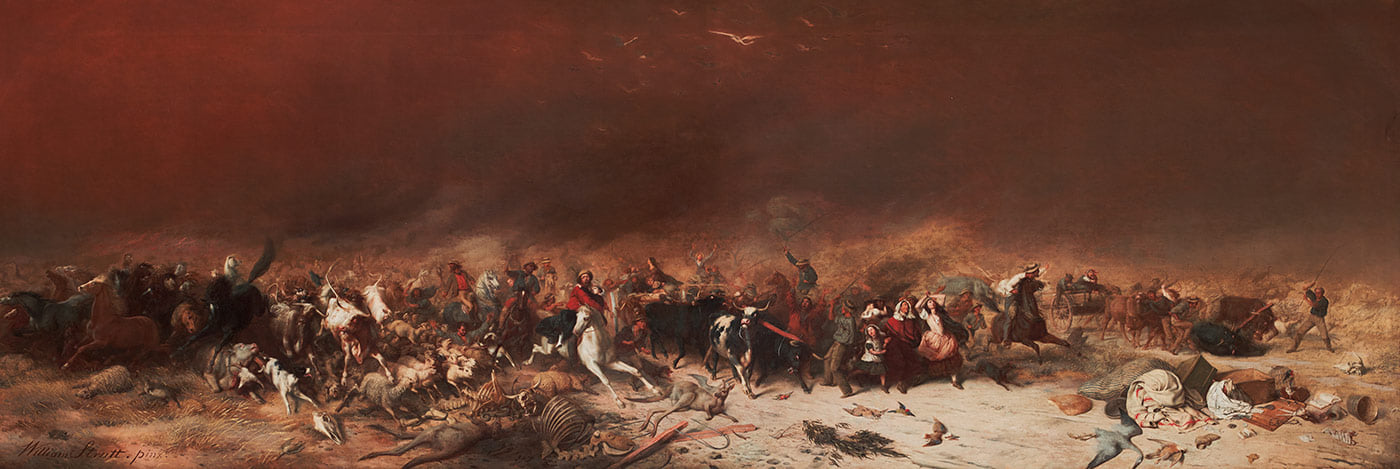
Victoria’s largest recorded bushfire occurred on Black Thursday, 6 February 1851, which is often claimed to have burnt up to 12 million acres (5m ha), or about a quarter of the State.
By comparison, the Victorian bushfires in 1939 burnt 2 million hectares, while Black Summer of 2019-20 burnt 1.5 million ha.
It must also be said that the 1851 figure is probably inflated and unreliable because of the sparseness of witnesses, the largely unpopulated rural areas, combined with somewhat sketchy but colourful newspaper reports.
Interestingly, later explorers, surveyors and foresters found remnant stands of very large and very old trees in the mountain forests of the Central Highlands, the nearby Dandenong Ranges, the Yarra catchments, the Otways and the Strzelecki Ranges in Gippsland, as well as the snow gums in the Alps. These forest types are very susceptible to bushfire, which points to a lesser extent of the 1851 bushfire.
We will never know…
But what is now recognised as a typical Victorian weather pattern was emerging.
Two years earlier in the winter 1848 there was heavy rainfall, which was followed by high temperatures over the summer of 1848–49, which began to dry out the forests.
During the following winter of 1849 snow fell in Melbourne with more heavy deluges and floods. This rainfall no doubt led to a build-up of fuel in the forests and grasslands.
The summer of 1850-51 was long and hot with many uncontrolled bushfires about the ranges fringing Melbourne.
Thursday 6 February 1851 was one of the hottest day the European settlers could remember, and a fierce wind increased throughout the day. The Argus newspaper later reported.
Thursday was one of the most oppressively hot days we have experienced for some years. In the early morning the atmosphere was perfectly scorching, and at eleven o’clock the thermometer stood as high as 117° in the shade; at one o’clock it had fallen to 109 ° and at four in the afternoon was up to 113°.
Similar temperature extremes in Melbourne were reached again during major bushfires on Red Tuesday – 1898 (107°F), Black Friday – 1939 (114°F), Ash Wednesday – 1983 (109°F) and Black Saturday – 2009 (115°F).
The hot north wind was so strong that thick black smoke reached northern Tasmania,
It was also later reported that the intense heat could be felt 20 miles out to sea from Portland where a ship under the command of Captain Reynolds came under burning ember attack and was smothered by a blizzard of cinders, smoke and dust.
Eventually, a typical south westerly breeze and light rain cooled the land.
It’s hard to know the source of the ignitions, but historians suspect it was settlers clearing the land and prospectors in search of gold.
Remarkably, there were only 12 known deaths, no doubt because of the relatively small population of only 75,000 Europeans at that point, with about one third living in Melbourne.
The impact of the bushfires on the indigenous population is not recorded. It’s also unknown to what extent the disruption of traditional aboriginal burning patterns by 1851 may have contributed to the build-up of understory fuel.
But the discovery of gold and the huge population surge was only months away.
http://handle.slv.vic.gov.au/10381/74159

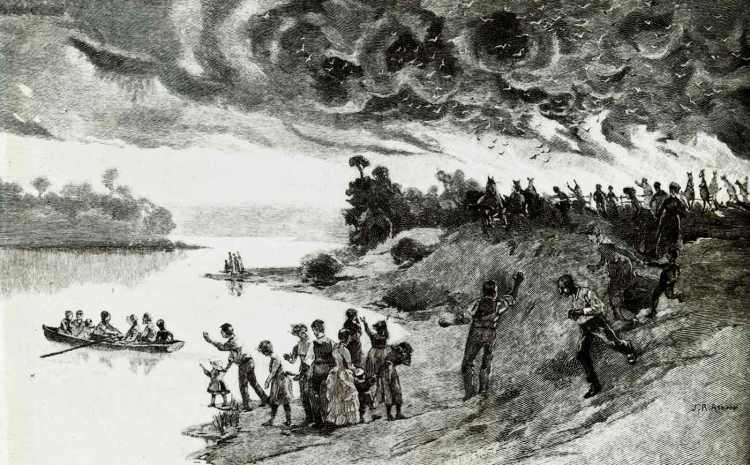
 Victoria’s Forests & Bushfire Heritage