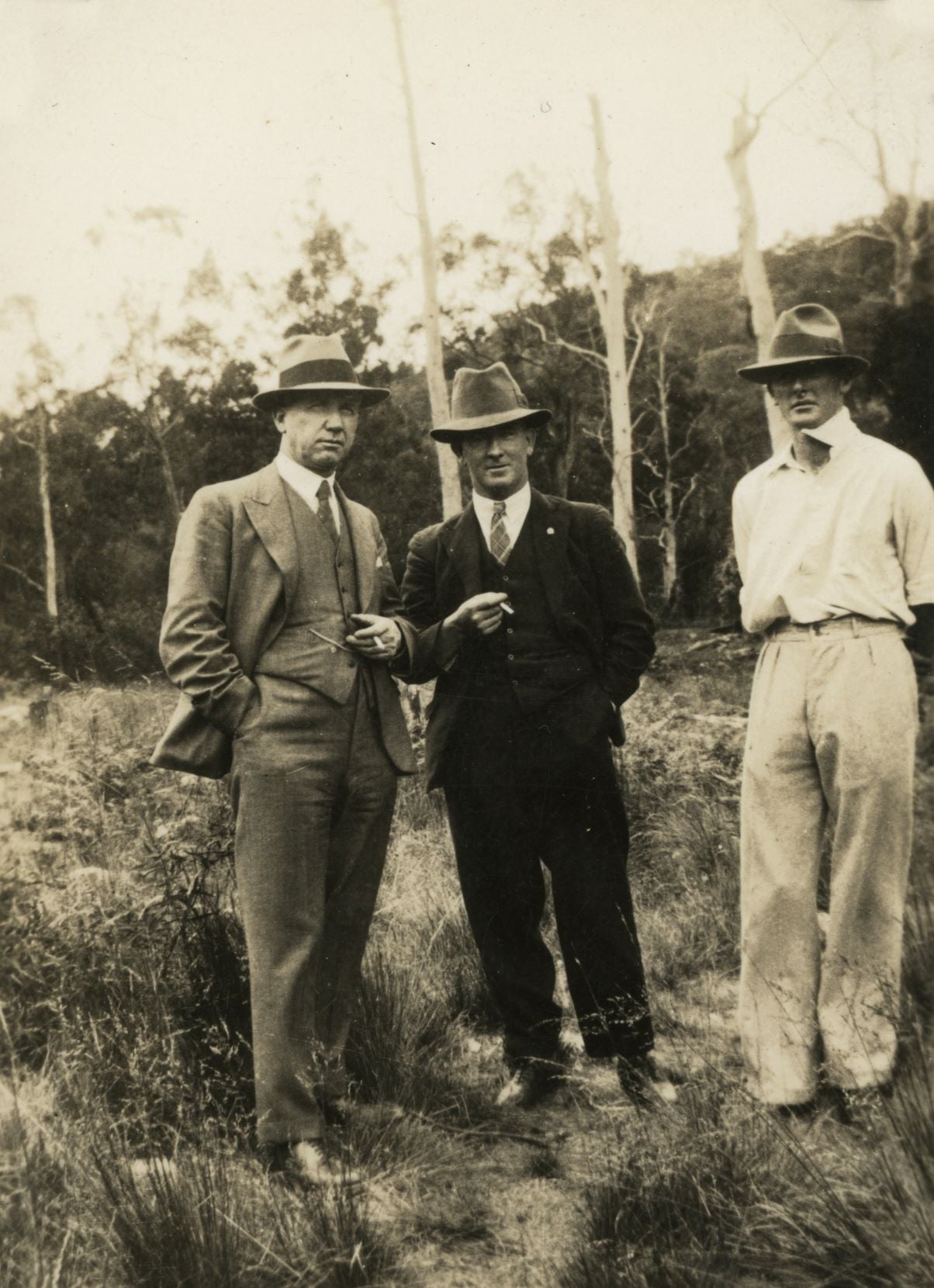
Finton George Gerraty was born on 23 September 1899 at Myrtleford. He entered the Victorian School of Forestry (VSF) at Creswick in 1915 and graduated two years later in 1917.
His postings with the Forests Commission Victoria included District Forester at Orbost in 1920, DFO Gellibrand in 1924 and then DFO Niagaroon (Taggerty District) in 1927.
Later in 1930, Finton was promoted as the Chief Forester at Powelltown, while only a short time later in 1935 he was elevated to the Inspector of Forests for the Central Division based at Healesville. He then moved to a similar role at Berwick in 1937.
Finton somehow found time to study towards a Diploma of Forestry (Victoria) and the topic of his thesis was “The regeneration, silvicultural development and utilisation of Eucalyptus obliqua – messmate stringybark”.
Never office bound, he is said to have personally measured a fallen mountain ash tree near Noojee after the 1939 bushfires at 338 feet and reported that “its top was tantalisingly broken off”.
Finton also took a strong interest in new technology such as the introduction of crawler tractors for logging at Marysville in the late 1930s, as well as the operation of Kurth Kiln at Gembrook to produce charcoal during the war years.
Finton Gerraty was considered by his peers as ambitious, keen, efficient and accurate. But he was sometimes described by his detractors as being a tough forester from the old hard school… whatever that means…
In March 1942, Finton joined the 12th Victorian Battalion of the Volunteer Defence Corps (VDC) with the rank of Captain. And during the latter part of the war, he was seconded to the Department of Army to examine and advise on the timber resources of the Northern Territory and then organise logging, transport and milling.
At the conclusion of the war in 1945, Finton assisted Associated Pulp and Paper Mills (APPM) in Tasmania to prepare a utilisation and roading plan for the company’s pulpwood procurement areas.
Within weeks of the end of the war, the Chairman of the Commission, A. V. Galbraith, outlined his vision for the future, or “Grand Design” as I prefer to call it. Then a quiet revolution began across Victoria’s forests and an epic story which took more than eighty years to unfold where several things were in play.
Undoubtedly, the main social and economic beneficiaries of Galbraith’s Grand Design were small rural settlements like Heyfield, Mansfield, Myrtleford, Bruthen, Orbost, Cann River, Colac, Alexandra and Swifts Creek which grew into thriving communities based upon the timber industry.
These communities became flourishing “Timber Towns” with jobs, decent housing, schools, shops, sporting clubs, public transport and health care. A more secure and safer place for families than the previous itinerant sawmills set deep in the bush, which was characteristic of the earlier period.
From May 1947, Finton was appointed as one of the three Forests Commissioners, and after the death of A V Galbraith in May 1949 he was elevated as Chairman. He then had the main task to implement the Grand Design that Galbraith had previously laid out.
In 1952, Finton travelled to England, Scotland, Norway, Sweden, Germany, Switzerland, Italy, Canada and USA investigating forestry practices and industries, particularly the economics of utilising lower grades of wood. And while he was away, he represented Victoria at the 6th Empire Forestry Conference at Quebec in Canada.
In 1956, the Commission’s Newport seasoning works closed under a controversial financial cloud. A situation made worse because Newport had barely ever been profitable. Newspapers accused the Forests Commission of “juggling the books” to turn a loss into a profit. There were also allegations of unexplained “leakage” of large quantities of valuable timber stocks.
Finton George Gerraty died suddenly of a heart attack at his home on 25 June 1956, right in the middle of the Newport crisis. The State Government was furious about the whole financial fiasco and there were calls for an independent inquiry and appointing an outsider to run the Forests Commission.
It took more than six months for the political and media dust to settle before Alf Lawrence was finally appointed as the replacement Chairman of the Forest Commission in December 1956. A role he occupied until his retirement in July 1969.
Photo: Looking more like mobsters than foresters. A.V .Galbraith, FCV Chairman, Finton George Gerraty, then Inspector of Forests and Herbert FitzRoy OIC Boys Camp at Rubicon. Photo: Allan Layton
 Victoria’s Forests & Bushfire Heritage