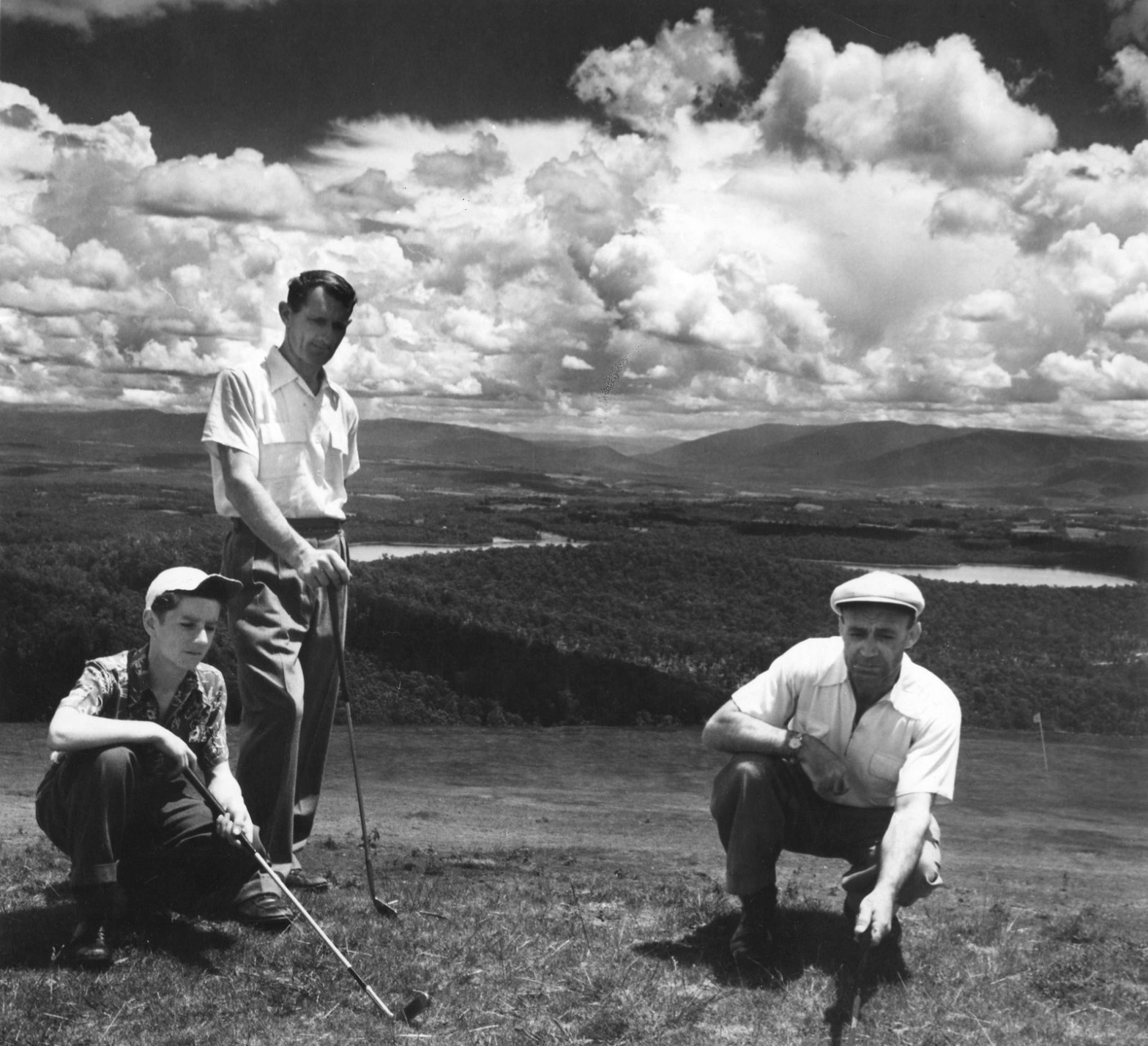
The suggestion of a golf club at Olinda in the Dandenong Ranges began circulating in 1905 and was revived again in 1931 as an idea to celebrate Victoria’s centenary.
The land was identified by the local community as a bushfire menace after the 1926 fires and many claimed that a well-maintained golf course would reduce the threat.
During the subsequent years several unsuccessful attempts were made to establish a golf course despite the amounts of monies raised. The Nicholas family of Burnham Beeches, Sir George Knox and Messrs Eric Leone, E J Gillies, W Brann and A P Dodd were active in public meetings and discussions with the Forests Commission. The Hon Gilbert Chandler also supported the project.
The first 9-hole course, occupying a 70-acre parcel of State forest, was proposed in 1933.
The Olinda golf club formed in 1934 and while some locals opposed the idea, the Forests Commission Victoria (FCV) granted a long-term lease over the State forest.
The course was laid out in 1936 but fell into disuse during WW2.
In January 1948, a licence for a public golf course on Reserved Forest was issued by the Forests Commission. A golf club had already been formed, and its members began preparing a 28-hectare area for the course.
In 1952, the club was revitalised under an affiliation with the Victorian Golf League and Mr A O Wilson was appointed as the manager following voluntary liquidation of original Olinda Golf Club.
In May 1956 the golf course declared as reserve under Section 56 of Forests Act. A month later in June 1956, a Committee of Management was appointed, with the original members including Mr & Mrs Dodd along with the District Forester, Mr Jim Westcott. The Committee then appointed Mr & Mrs Len Myers as Course “licensees” for operation and maintenance of the Course. A year late in October 1957 regulations were promulgated.
In July 1961, the Committee requested the Forests Commission for provision of a kiosk. In 1966 a temporary kiosk was built. In January 68, new tenants in kiosk, Jim and Pat Sanders, became course “licensees” and were appointed to manage and maintain the course.
From about 1964 onwards, the golf course was set aside as a Special Purposes Reserve and upgraded and extended at considerable expense to the Forests Commission. Pumps and sprinklers were also installed to keep the course green in summer.
After more bushfires in 1968, the Forests Commission entered into a renewed lease with a fledgling Olinda Golf Club.
The extended 18-hole course was opened in April 1970 by the Minister for Forests, Edward Raymond Meagher.
In May 1972 the Olinda Golf Club was given approval by Commission to build a new club house on course. In March 1975, The reserve was reduced to 35 ha with 16 ha added to adjacent Olinda Arboretum.
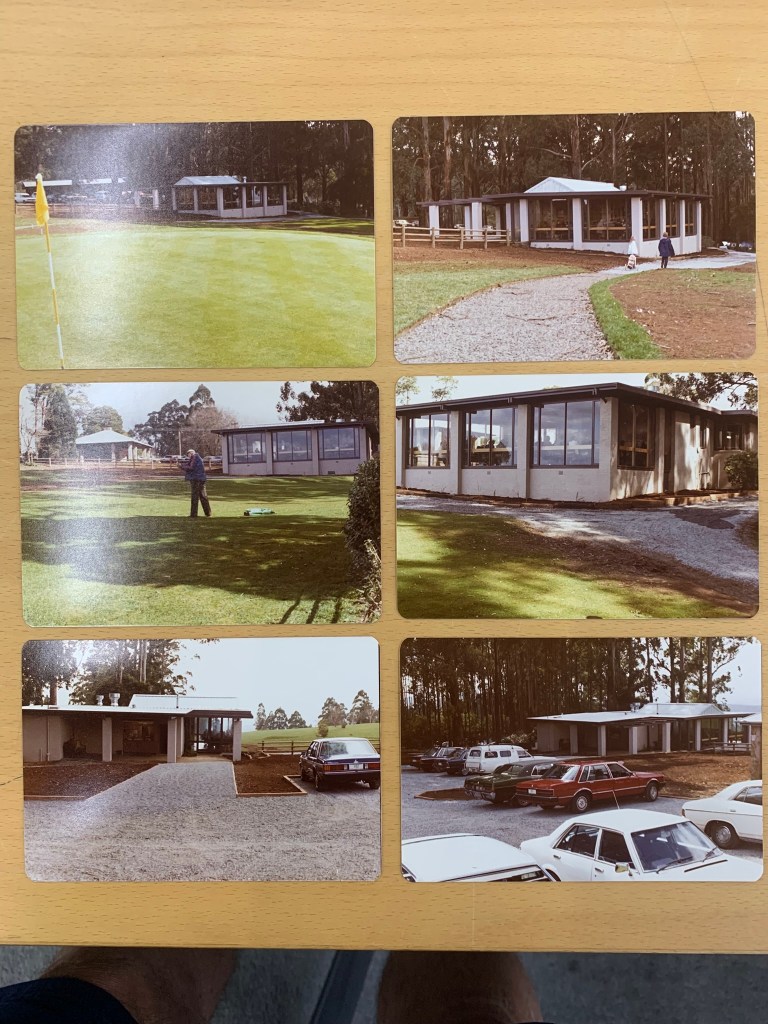
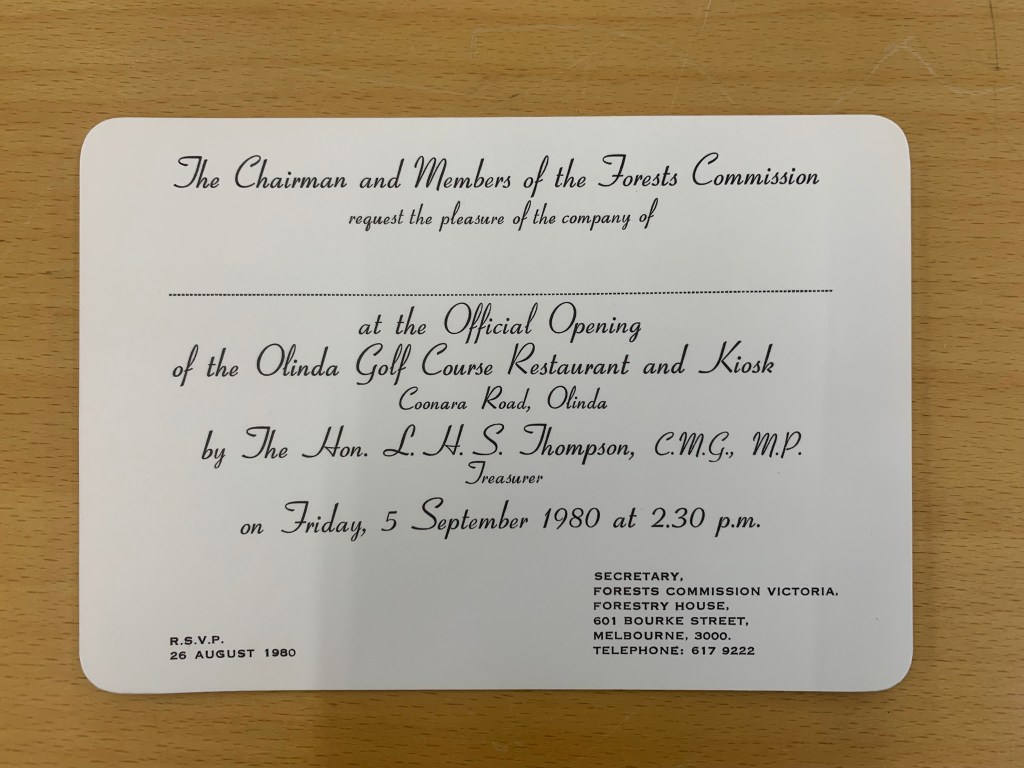
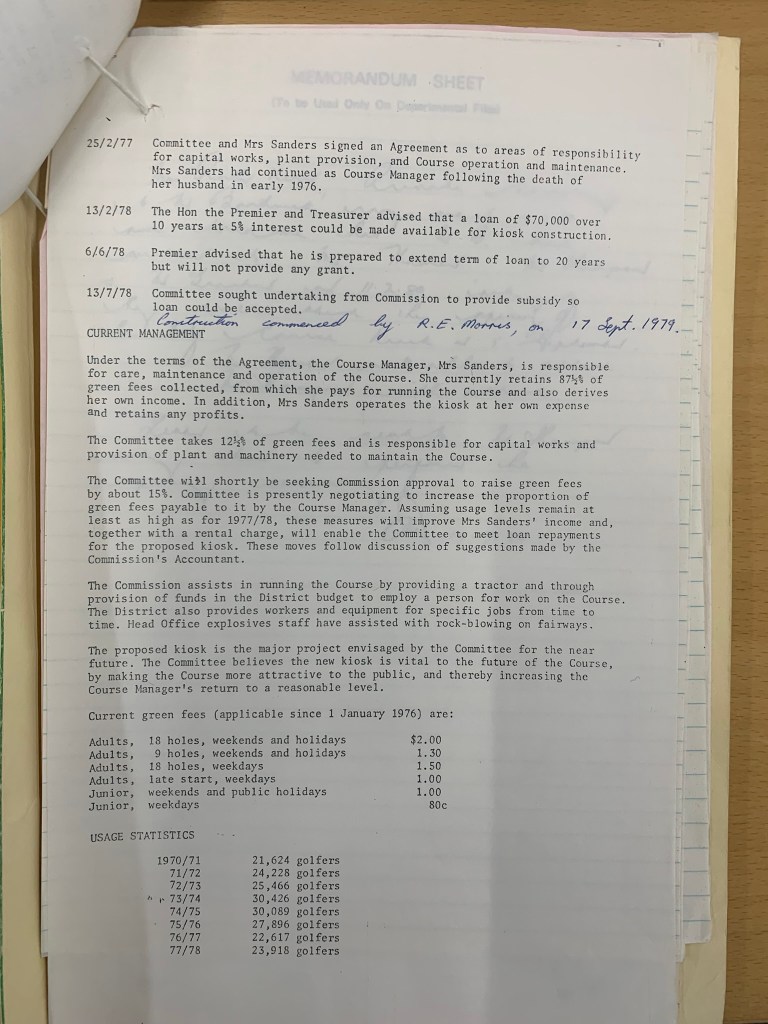
In February 1978, the State Government offered a $70,000 loan to the golf course at 5% interest which enabled it to build much needed facilities and clubrooms including the popular Bide-A-While restaurant which was later opened by Lindsay Thompson in September 1980. An ambitious proposal for a motel was also considered but rejected.
The District Forester from Kallista, Jim Westcott, and later Frank May, sat on the Committee of Management. This was an unusual arrangement. Olinda was the only golf course in Victoria where the Forests Commission took an active role.
The Commission assisted in running the course by providing a tractor and funds in the District budget to employ a person for work on the course. The District also provided crew and equipment for specific jobs from time to time. Head Office explosives staff also assisted with rock-blowing on fairways.
Strategic Firebreak.
In January 1962, there were major bushfires across Melbourne’s outskirts, including the Dandenong Ranges, which killed 33 people and destroyed more than 450 homes. The Olinda township was attacked on three sides and many houses were destroyed and forests burnt. Many people evacuated to the relative safety of the golf course, which was also partially burnt.
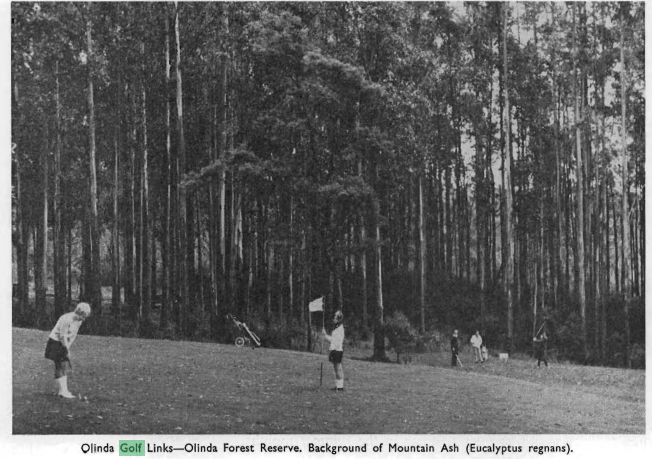
The newly established 100-acre National Rhododendron Gardens adjoined the golf course and burned as well. The rhododendron gardens were also on State forest and had been licensed from the Forests Commission in 1960. Most of the mountain ash (Eucalyptus regnans) were killed in the bushfire, and the present trees in the garden and carpark have regrown since that event.
The Forests Commission depot and residence on Chalet Road, occupied by overseer Charlie Chamberlain, was lost when the FCV softwood plantations near Silvan dam exploded in flames.
In the wake of the catastrophic 1962 bushfires there was considerable community outcry. The State Government, with the strong backing of the local MP Bill Borthwick, implemented a long-term buy-back scheme whereby the Forests Commission purchased private land and houses in high fire risk areas, mostly notably on the western face of the Dandenong Ranges.
As part of this planning process, the Dandenong Ranges Fire Prevention Committee (DRFPC) identified the Olinda ridgeline as a critical firebreak and buffer for the town.
Also, after the deadly 1962 bushfires, the DRFPC urged the construction of the nearby Olinda Swimming Pool to act as an emergency fire dam. The 100,000-gallon pool had six fire hydrants to fill CFA and FCV tankers and was located on 5-acres of State forest. The pool was opened by the Minister for Forests, Lindsay Thompson, on 30 December 1964.Furthermore, after a lengthy period of procrastination, community consultation and planning, local Forests Commission crews began replanting the 192 hectares of the old softwood plantation which were burnt below Chalet Road in 1962 with exotic and less-flammable species such as oaks and elms. The area also has a magnificent lookout over the Olinda forest towards Silvan Reservoir and was renamed the R. J. Hamer Arboretum in April 1977.
Importantly, the Olinda Golf Course was strategically positioned on the main ridge. It sat between the R. J. Hamer Arboretum, the swimming pool and the Forests Commission depot in Woolrich Road to the east, and the Olinda Recreation Reserve and the National Rhododendron Gardens to the west. These parcels of public land, all with significant local community use and tourism attraction, had reduced levels of flammable vegetation, and collectively acted as an effective east-west firebreak.
Parks Victoria took over the responsibility for the Olinda golf course in 1989 and issued a new lease, but club membership continued to decline, which was a common pattern among public golf courses across Melbourne. Olinda finally closed in about 2012 and the remaining club members shifted to Emerald.
The State Government announced that the land would not be reinstated as a golf course but set aside for other community uses. The redevelopment of the site has not been without local controversy.
The Olinda pool also closed for a time but reopened after community agitation.
While there are many other golf courses on the edge of small country towns across rural Victoria, which often operate on private land or under a variety of Crown Land leases and occupancy arrangements, the Olinda golf course was a showpiece for the Forests Commission as a unique example of passive fire prevention on State forest, as well as being a valuable asset for the local community.



 Victoria’s Forests & Bushfire Heritage