
On 5 April 1958, a fire was reported about 5 miles northwest of Wandilo, which is not far from Mt Gambier and the Victorian – South Australian border.
The Bluff firetower reported light smoke at 08.25 am on Saturday morning and by 11.40 am the fire was moving quickly and out of control.
It had been a dry autumn and the fire, which began in a dry swamp of dense t-tree, was fanned by strong winds, quickly spread into a mixture of native forest and pine plantations.
The cause of the fire was never officially determined, although most suspected it had escaped after someone was burning off on private land near an old disused railway line.
By midday the temperature reached 92 degrees Fahrenheit, and the Relative Humidity at Mt Gambier Airport dropped to 29% as a fire storm developed under a 40-mph north westerly wind. The FFDI was 33 (Very High).
As the conditions worsened, the fire began crowning through the pines and throwing spot fires up to 20-30 chains (600 m) ahead of the main front as it crossed Earls Road near the disused Medhurst railway station.
Several trucks with firefighters from the Department of Woods and Forests had been dispatched and they entered an east-west firebreak between two blocks in the pine plantation. The adjoining Pinus radiata and Pinus pinaster stands were about 24 years old and un-pruned.
Around 3.00 pm the firefighting crews were caught unprepared in a junction zone as two flanks of the fire passed over them and then swirled back to join.
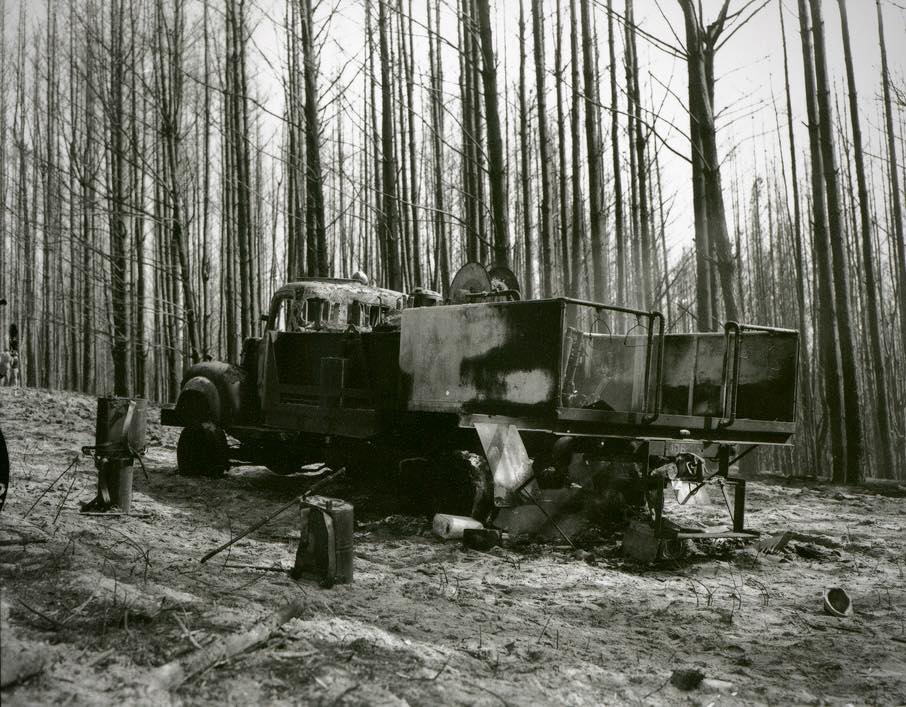
Two forestry trucks became bogged in soft sand when trying to evacuate while another damaged a gearbox and could not move, leaving 11 men to take cover in their vehicles.
Eight men died. The youngest was only 16.
– Remo Quaggiato
– Charles Dolling
– Bertram Wilson
– Victor Fensom
– Maurice Treloar
– Francis Burdett
– Walter Pearce
– Bernadus Damhuis
Three remaining men survived with moderate burns. Two sheltered in the cab of one of the trucks and emerged safely after the intensity of the bushfire had subsided even though their vehicle was well alight. One man survived by sheltering in a deep sandy wheel rut and covering his face with his coat.
Another party of men narrowly escaped as they drove their truck to safety pursued by roaring flames. The heat was so intense that the clothing of several of the men on the truck caught fire.
The Mount Gambier fire service received its first indication of the tragedy when it heard an emergency “mayday” call over the two-way radio. Grim-faced crews gathered around heard a dramatic call for “Police, a doctor and a priest.”
The 3300-acre fire was brought under control early the next day.
A public outcry followed, and the inquest found the men had been failed by their equipment, with vehicle fuel lines vaporising in the heat and truck cabins ill-equipped for survival situations. Firefighting tactics and equipment changed after the tragedy.
The Wandilo fire occurred at a time when bushfire behaviour research in Australia was in its infancy and years before methods were available to fire managers to quantitatively assess fire potential.
The legendary CSIRO fire scientist, Alan McArthur, published a review of the Wandilo fire later in 1966. It became a benchmark in understanding fire behaviour in pine plantations.
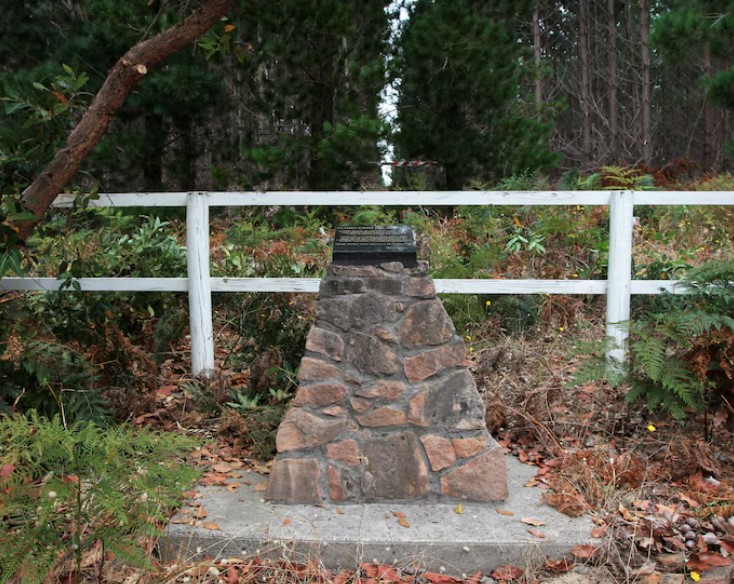
A small memorial marking the site of one of South Australia’s most tragic bushfire disasters sits in the midst of tall radiata pine trees, largely hidden away from public view.
https://trove.nla.gov.au/newspaper/article/91247121
https://victoriasforestryheritage.org.au/pinefire/McArthur_etal_1966_TheWandilloFire.pdf.



 Victoria’s Forests & Bushfire Heritage