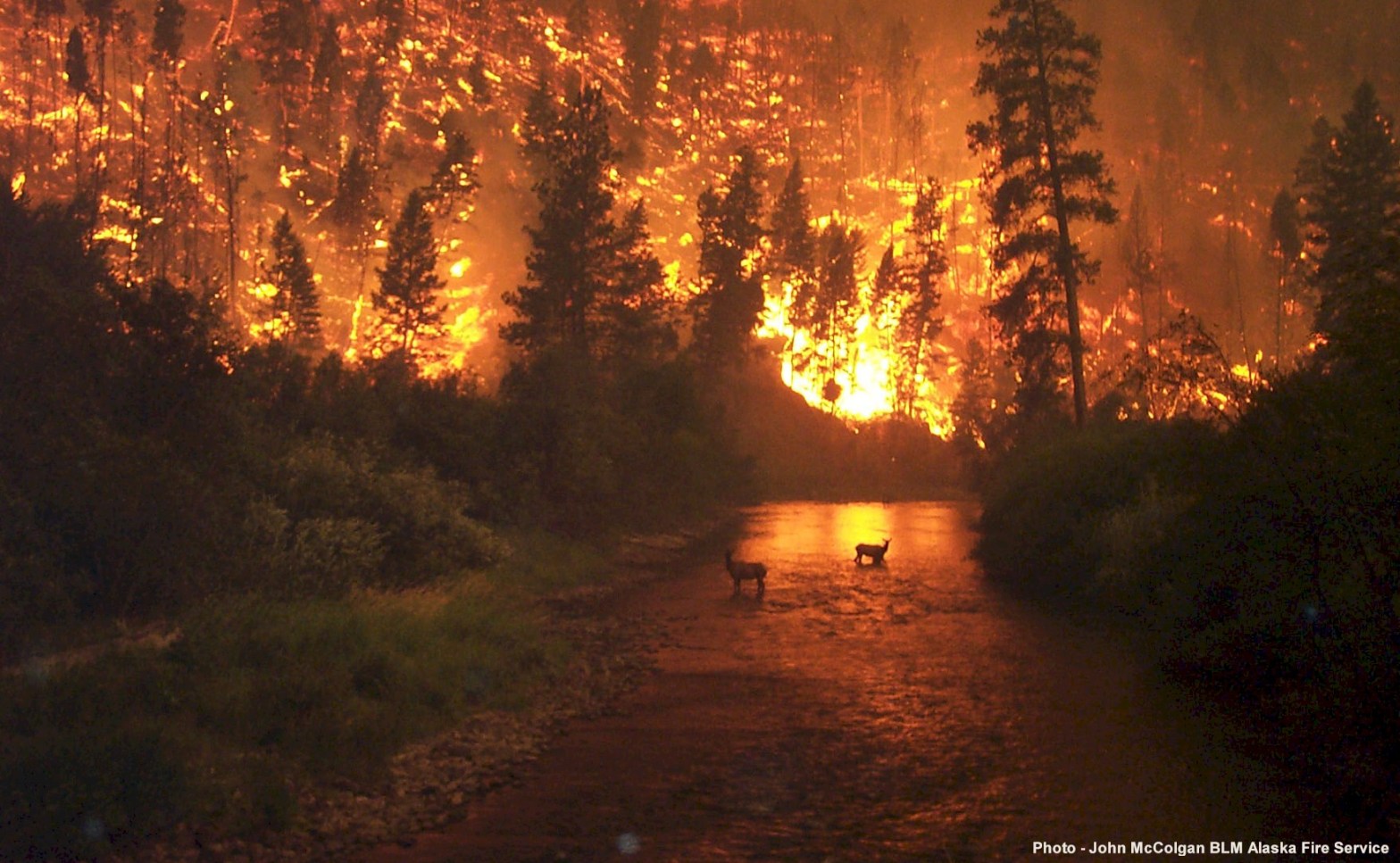
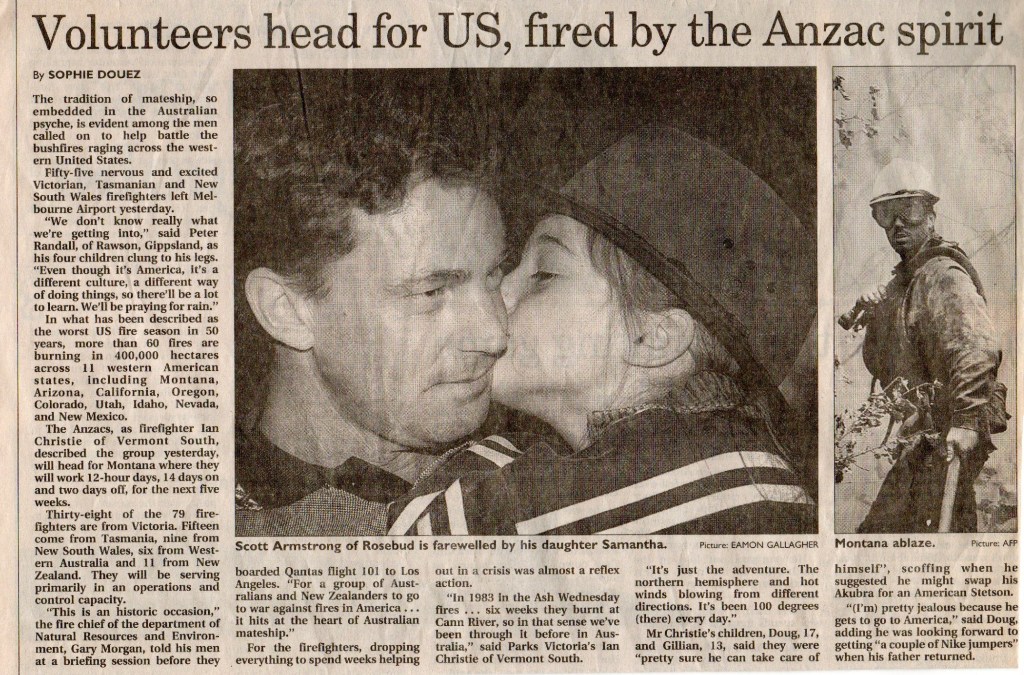
During August and September 2000, a total of 97 firefighting specialists from Australia and New Zealand were deployed to America.
This was the first time that a large number of operational firefighters had travelled from Australia and NZ to help their north American colleagues.
During the northern summer of 2000, America experienced one of its worst wildfire seasons. The situation was made worse by a long drought, severe fire weather and dry lightning storms which started thousands of new fires throughout the northern Rockies, into southern Idaho, Montana, Utah, Nevada and into the Sierra-Nevadas.
By early August 2000, over 15,000 firefighters from both America and Canada were fully committed, together with 700 tankers and 150 aircraft.
Conditions were expected to get worse and many fire experts thought it had the potential to rival the disastrous wildfires of 1910, which were on a scale similar to the 1939 Black Friday bushfires in Victoria.
It developed into a long and gruelling campaign, with crews engaged continuously for many months. By early August, all available forest fire control staff were either on a rotation or committed. There was nothing, or nobody, left to call. Many fires in remote locations were simply left to burn unattended.
Towards the end of October, nearly 86,000 fires had burned about three million hectares of land, destroyed hundreds of homes and structures and caused 16 deaths, including 12 firefighters.
Australasian Inter-Service Incident Management System (AIIMS).
Seventeen years earlier, in July 1983, only a few months after the catastrophic Ash Wednesday bushfires, the Forests Commission Victoria (FCV) ran a three-day staff workshop to review the bushfire season.
The formation of the Department of Conservation, Forests, and Lands (CFL) had only just been announced at the time of the meeting.
Speakers at the workshop addressed a wide range of issues and formulated actions on crew safety, management of resources, firefighting tactics, shift changes, equipment, skills training, communications, liaison with other agencies, logistics, use of aircraft for reconnaissance and firebombing, as well as weather and fire behaviour forecasting.
Included in the review was improving command-and-control arrangements at large bushfires.
Traditionally, District Foresters were responsible for any fire on State forests and National Parks and took overall control as “Fireboss”. It was an entirely normal arrangement to have a senior FCV Fireboss in the field directing operations.
While it had its advantages, the Fireboss role based in the field had some serious shortcomings too, particularly if the fire escalated or became fast moving and complex.
In Victoria, the Country Fire Authority (CFA), who are mostly volunteers, are responsible for bushfires on private land and operated independently from the FCV on separate radio frequencies and under a well-entrenched and familiar group structure.
Cross agency issues sometimes arose within the interfaces or “marginal mile”; so FCV and CFA liaison officers were appointed for joint incidents. This arrangement worked well enough for small events but was quickly overwhelmed during large and complex bushfires.
The Forests Commission had begun experimenting with new fire control arrangements from the mid-1970s based on shared experiences and long-standing relationships with the US Forest Service.
Different control arrangements had been trialled at Cann River and Warburton during the 1983 Ash Wednesday bushfires.
Following the 1983 review, the Forests Commission consciously shifted its approach to suppression of large fires on Victoria’s State forests and National Parks.
During 1984, Kevin Monk from the FCV’s Fire Protection Branch travelled on a Churchill Fellowship to California to study the United States National Incident Management System (NIMS). He brought back the NIMS documentation and developed a unique Victorian version, which became known as the Large Fire Organisation (LFO). Importantly, the LFO was designed to be scalable; from Level 1 for simple local incidents, through to Level 3 for complex multi-agency and campaign bushfires.
By the summer of 1984-85, the LFO was being progressively adopted with the establishment of dedicated Incident Management Teams (IMTs) complete with Incident Controllers, Operations, Planning and Logistics units. Staff were identified and trained within the new regions of Conservation, Forests, and Lands (CFL).
Athol Hodgson was appointed CFL’s first Chief Fire Officer (1984-87) and was a strong advocate for the new emergency arrangements. In 1984, he led a high-level delegation of Australian bushfire controllers on a study tour to the USA and Canada. Brian Potter, Chief of the CFA (1985-91), was on the tour.
The bushfires of January 1985 in the alps which occurred from Mt Buffalo to Mt Selwyn, were the first major test for the newly formed Department of CFL. It was also the largest deployment of firefighting aircraft in Australia up to that time, including 20 helicopters and 16 fixed-wing aircraft from the FCV, Australian Defence Force and National Safety Council of Australia (NSCA). The LFO was given a thorough test run at these fires.
Later Chief Fire Officers, Barry Johnston (1987-90), Rod Incoll (1990-96) and Gary Morgan (1996-2005) maintained the momentum for changes to command-and-control arrangements at large bushfires in Victoria.
Significantly, in 1986, the Victorian Emergency Management Act provided for a single controller to be appointed for each joint CFA/CFL bushfire.
Later in 1988 the Australian Association of Rural Fire Authorities adopted the principals embodied in LFO and NIMS.
The LFO became the forerunner of the Australasian Inter-Service Incident Management System (AIIMS) which was adopted nationally in the early 1990s under the newly formed Australasian Fire Authorities Council (AFAC) representing all Australian and New Zealand fire services, and land management agencies with fire responsibilities.
AIIMS was jointly adopted by the CFA and CFL in 1991 with the intent of bringing emergency services together under one control system with common terminology.
An Agreement was signed by the Chief Officers of the CFA and NRE (formerly CFL) on 14 November 1997 to give more detail on joint firefighting arrangements.
In addition to NRE, there were a couple of advocates, but it’s also fair to say there was strong resistance from some quarters to shifting from entrenched arrangements and adopting AIIMS, and it took many years to make the full transition for some agencies and jurisdictions.
The operation, training and slow uptake of AIIMS by the CFA were some of the key issues identified at the Coronial Inquest into the deaths of five CFA firefighters at Linton in December 1998.
After the Linton findings, Gary Morgan, the Chief Fire Officer of the Victorian Department of Natural Resources (NRE), and Richard Rawson, Director of the Forest Service, were strong advocates and eventually persuasive that all CFA volunteer forest fighters should undertake compulsory minimum skills training. They also urged the CFA to move away from its established group structure at fires involving both organisations.
The 2000 deployment.
The relationship between Australia and particularly Victorian forest firefighters and their north American counterparts was strong. Over many decades there had been high-level delegations and study tours to the US from Australia, and vice versa. The innovation and joint development of worldclass fire equipment at the Altona workshops and at Boise in Idaho is just one example.
After midnight on 3rd August 2000, Gary Morgan, was contacted by Rick Gale from the American Department of Interior asking for his help. This was a personal request from Rick resulting from a strong relationship forged after Gary’s earlier trip to make a keynote presentation in Canada.
Four days later, Tony Edgar, NRE’s Gippsland Regional Manager from Victoria, and Murray Dudfield from New Zealand, arrived at the National Inter-Agency Fire Centre (NIFC) in Boise Idaho to assess the need and offer the type of support that Australia and New Zealand could provide.
A formal request was then made through the American Embassy in Canberra to the Australian Department of Foreign Affairs and Trade.
The fire situation in America was urgent and things moved at breakneck speed, and by 10 August a new and unprecedented high-level agreement was signed with the Americans by Gary Morgan and the NRE Secretary, Chloe Munro, on behalf of all Australian and NZ fire agencies.
A taskforce of 79 experienced firefighters was hurriedly assembled and mobilised the very next day on 11 August 2000. They included field operations, aviation, IMT and logistics specialists.
Air travel, accommodation, passports and immigration clearance were mostly handled by NRE. Other essential requirements included passing a medical examination and a fitness assessment. The US embassy arranged a waiver of the normal visa arrangements for the incoming firefighters
All the firefighters needed to have AIIMS accreditation, so most were drawn from NRE and Parks Victoria where AIIMS had been in use for some time. Others came from New Zealand, Tasmania, NSW and Western Australia. Two personnel from a CFA Industrial Brigade (Myrtleford HVP) and ex NRE firefighters also went.
After orientation, issuing equipment and some training at Boise, the first taskforce was split into three groups and operated across bushfire theatres in Idaho, northwest Montana and southwest Montana.
There were a few hurdles the newcomers needed to quickly adjust to.
- Overcoming jetlag,
- Slight language, cultural and accent barriers,
- Learning some new terminology,
- Discovering about fire behaviour in different forest and fuel types.
- The sun was in the south at midday and the shadows moved the wrong way,
- Remembering old imperial measurements like acres, miles and gallons,
- Driving on the wrong side of the road,
- Prevalence of firearms,
- Using a national radio network,
- Stricter discipline during briefings,
- Sleeping on the ground in small tents,
- The work/rest cycle of 12-hour days and 14-day tours,
- Yellow school buses to ferry crews,
- The vast scale of the operations,
- Smoke jumpers and hotshot crews,
- Different hand tools such as the Pulaski, and,
- Learning how to deploy fire shelters (shake and bakes).
Despite these minor differences, mutual respect quickly developed, and the Australians and New Zealanders fitted right in, particularly for those familiar with AIIMS.
The first taskforce completed their assignment a month later on 15 September 2000, which included a short mid-tour break.
A second taskforce of 17 aviation and logistics experts was mostly deployed to Missoula in Montana for 21 days from 15 August to 5 September 2000.
Understandably, there had been few “speed bumps” and many lessons were learned, but this first deployment was judged a resounding success. A thorough review by Rick Sneeuwjagt from the Department of Conservation and Land Management (CALM) in Western Australia led to refinements for future exchanges.
The goodwill and gracious hospitality shown to the Australians and NZ firefighters by both US fire staff and the American community during their five-week deployment cemented some lasting personal and professional friendships.
The first reciprocal deployment to Australia of north American firefighters and Incident Management Teams was in early 2003 to the major alpine fires in eastern Victoria. This was also the first time that the Kiwis had helped in Victoria.
Without doubt, the common terminology and compatibility between AIIMS and American Incident Management Systems ensured smooth operations and interchange of staff.
Exchanges of Australian and NZ firefighters across the hemispheres are now regular and routine, but they were only made possible by the pioneering work done by the Forests Commission during the 1980s to develop AIIMS and continually advocate for its adoption across Australia, and across the ditch.
Thank you to those who contributed to this story including Gary Morgan, Tony Edgar, Peter West, Peter Ford, Lex Wade, Geoff Pike and Mike Leonard.
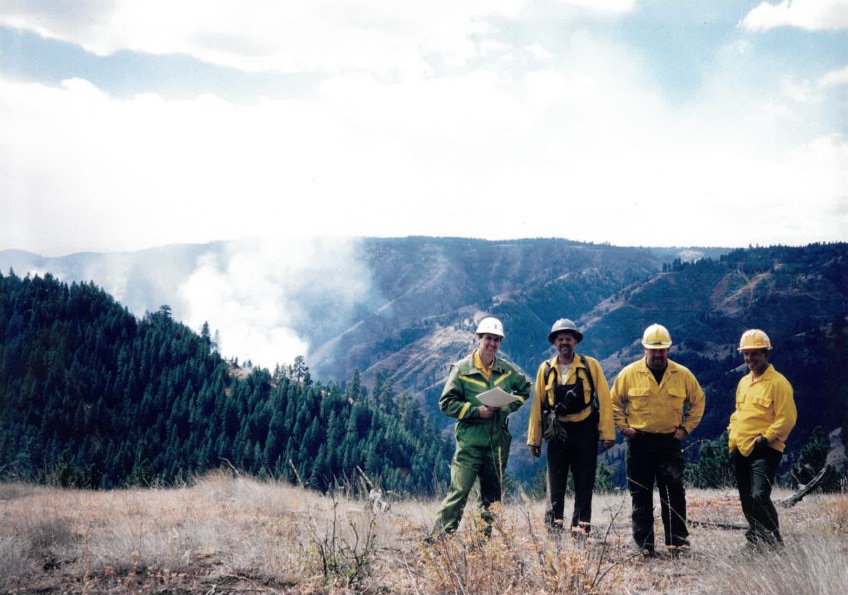
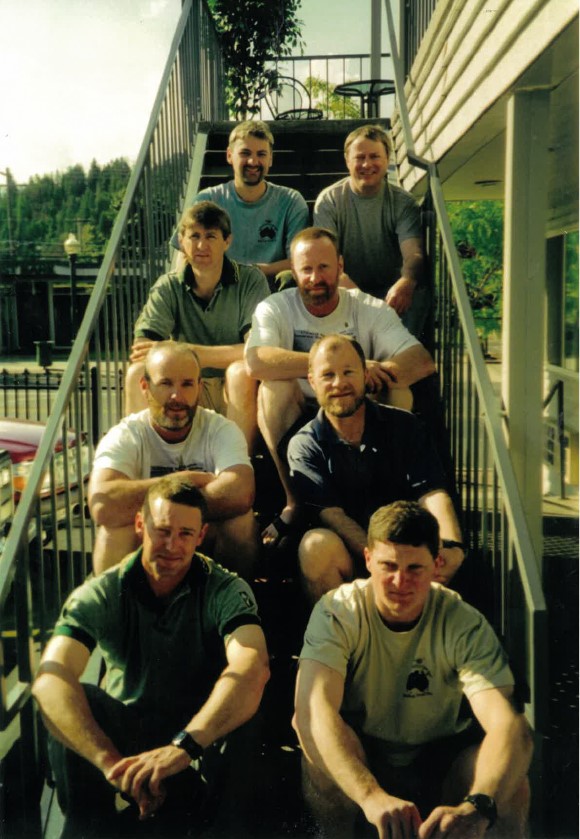

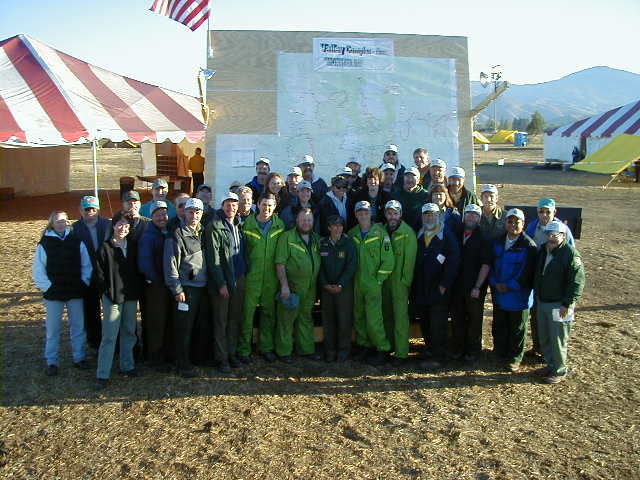
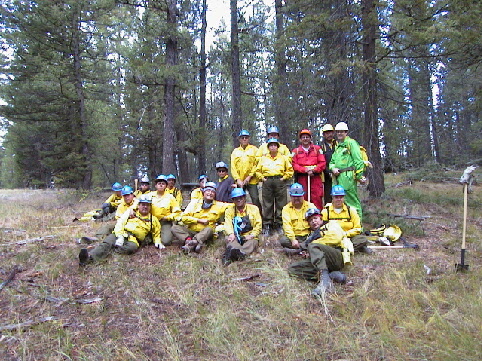


Front row: Leith Mckenzie, Mike Fitzgerald, Hayden Biggs, Jan Radic, John Appleby (Wombat), Rob Jarvis
Back row: Colin Smith, Stephen Walls, Paul McDiarmid, Jim Whelan, Richard Alder, Bryan Rees.
Andrew Matthews and Peter Cuthbertson remained in Boise to with the line scanners and Barry Marsden stayed with the equipment cache.
Photo: Stephen Walls, CFA

 Victoria’s Forests & Bushfire Heritage