
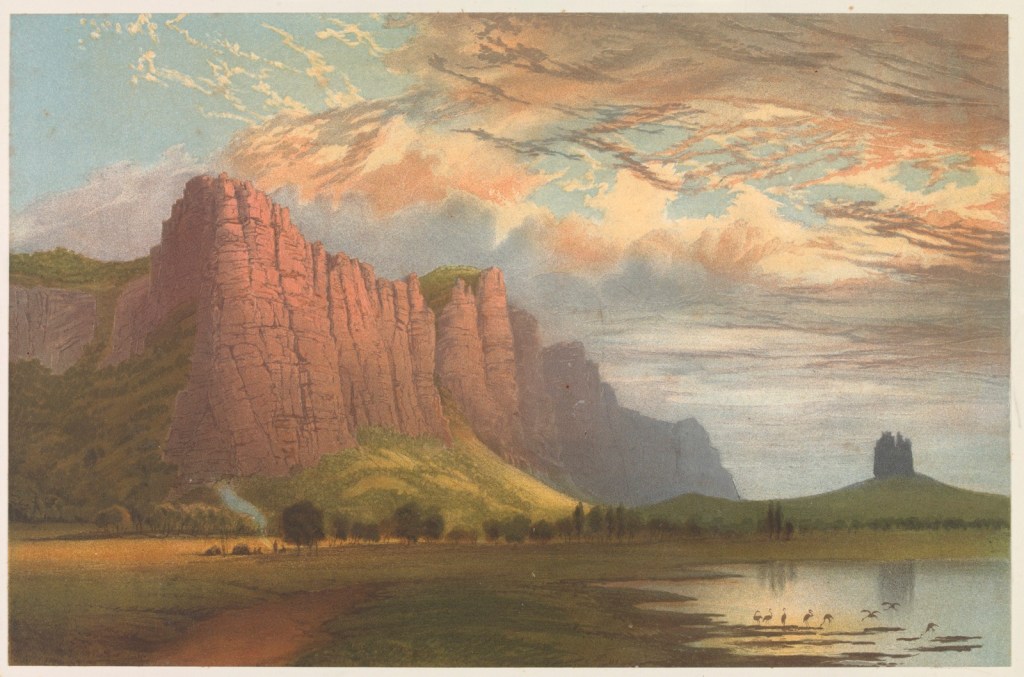
Mount Arapiles is an isolated sandstone outcrop near Horsham which rises 460 feet above the flat Wimmera plains.
The first European to see the mountain was Major Thomas Mitchell during his epic overland trek in 1836.
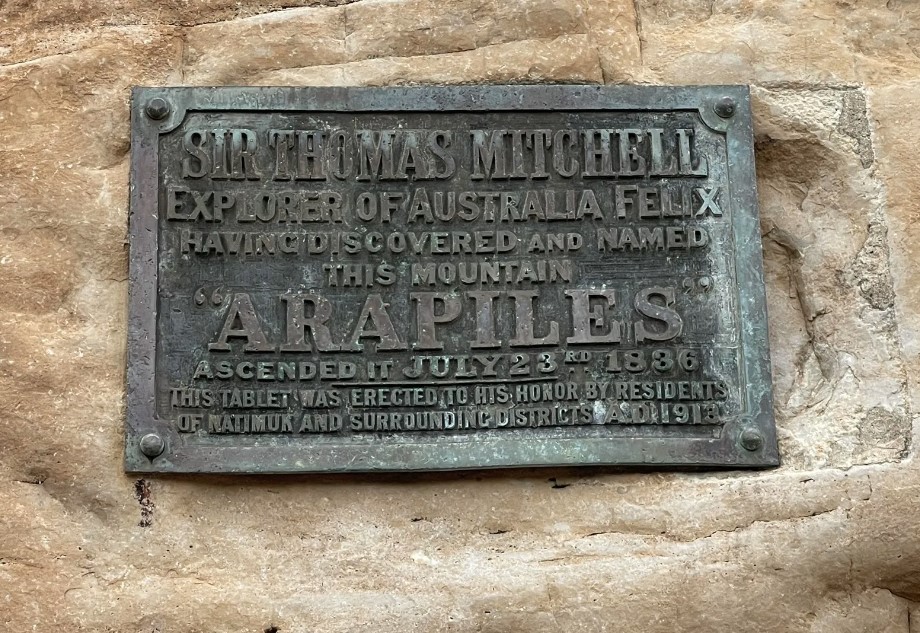
He named the landmark on 23 July 1836 after the Arapiles Hills near Salamanca in Spain. Mitchell had seen action as an Army Officer in the Battle of Salamanca during the Peninsular Wars in July 1812. An extract from Mitchell’s diary reads:
“I ascended this hill on the anniversary of the battle of Salamanca, and hence the name.”
When squatters moved into the area during the early 1840s, Mt Arapiles was included in the Vectis Run, which was taken up by the Wilson Brothers in 1844.
By the early 1870s, selectors had moved into the Wimmera from Hamilton and from across the SA border. Those that selected in the vicinity of Mt Arapiles were probably the first to use the area for recreation.
In 1897, Mount Arapiles was first gazetted as a 4653-acre Timber Reserve under the Land Act (1892) and then again under the new Forests Act of 1907.
In 1912, the Shire Council of Arapiles, which was formed in 1888, requested 18 acres of the Timber Reserve be excised and set aside for recreation. This was a unique request, and it became the first area of Reserved Forest to be formally set aside under the Forests Act (1907) for “natural beauty and interest”.
There were only a couple of options open to the Forests Commission under the legislation at the time.
- Section 16 provided for the excision of land from permanent forest, “…. which may be required for public use as mineral or medicinal springs, or for reservation for visitors to any waterfalls, caves or places of natural beauty or interest, or as health resorts ….”
- Section 24 provided for various types of leases, one of which was: “…. the Governor in Council may grant to any person for any term not exceeding seven years a lease of any Crown land within any reserved forest”.
The second option was adopted, and permissive occupancy was granted over 18 acres. But there was no provision in the 1907 legislation for the appointment of a Committee of Management and it had to wait until the Forests Act of 1918 before a legal committee could be formed.
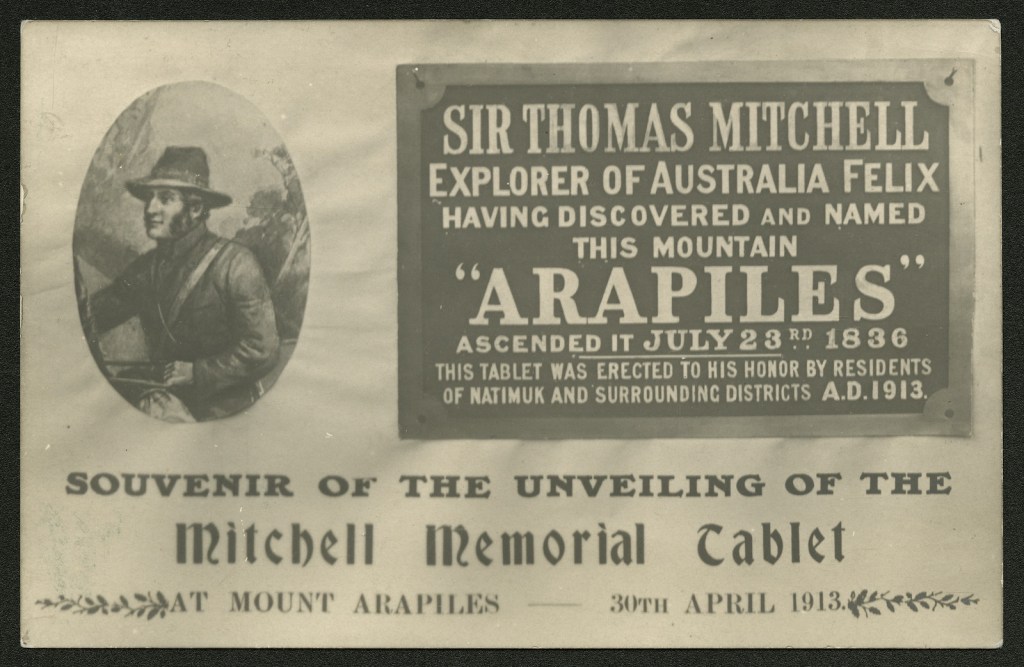
Facility development and maintenance was undertaken by the Arapiles Shire Council and the Natimuk Progress Association. A memorial tablet was unveiled in April 1913 to mark Major Mitchell having climbed and named the mountain in 1836.
In May 1933, the Arapiles Shire Council discussed the Centenary celebrations which were being planned for Victoria in 1935. These celebrations were to commemorate the 100th anniversary of the arrival of the first settlers in Victoria. It was suggested that a special stone gateway be erected at Mt Arapiles.
But it was decided to defer the celebrations until July 1936 to mark 100 years since Mitchell’s ascent of Mount Arapiles.
The Natimuk Progress Association sought approval from the Forests Commission to erect the gateway, to build a shelter shed and toilets and to plant trees in the reserve. The Association also indicated that they wished to name the picnic ground – Centenary Park. Other names such as Major Mitchell Park were considered.
The Forests Commission agreed and requested that a new list of nominees be forwarded so that a committee of management could be formed. They included L. Lang, R. E. Sudholz, R. G. McClure, A. G. Sudholz, G. Grant, H. Woolmer and A. W. Lockwood.
The official opening of the gates at Centenary Park on 23 July 1936 was a huge and festive event. The Horsham Times estimated the crowd at 3,000 and commented:
“It was a red-letter day in the Wimmera and attracted one of the largest crowds at a country function for years.”
The Melbourne Argus reported on 24 July 1936:
Advantage was taken of the opportunity which the centenary provided to establish what has been named Arapiles Centenary Park, comprising 18 acres granted by the Forests Commission.
One of the two larger pillars bears the inscription “Arapiles Centenary Park ” and the other ” To Commemorate the 100th Anniversary of the Discovery of the Mount”
Councillor R E Sudholz, president of the celebration committee, introduced Mr Scholfield, MHR, Mr Lamb MLA, Councillor P J Wilmoth (Major of Horsham), Councillor E Zerbst (president of the Arapiles Shire), Councillor L Ryan (president of the Kowree Shire), Councillor Smith (Wimmera Shire), Mr J W Gray (representing the Education Department), Mr A S Kenyon (representing the Historical Society, Anthropological Society and Field Naturalists) and Mr J E Menadue (Horsham High School), representing the Australian Natives Association.
The official opening of the gates was performed by Mr A W Lockwood, secretary of the celebration committee.
The discovery of the mount was re-enacted by a pageant, Mr F Woolcock impersonating Major Mitchell, accompanied by 25 horsemen.
The memorial gates are still there along with a few old pine trees in the campground.
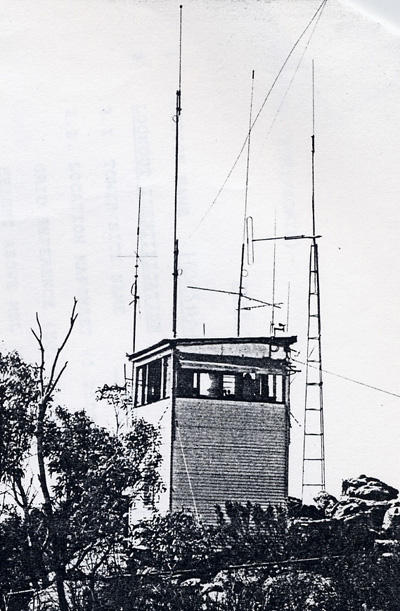
The Country Roads Board (CRB) built many of the major roads at Mt Arapiles in 1938 and the Forests Commission built a firetower on the summit in about 1955.
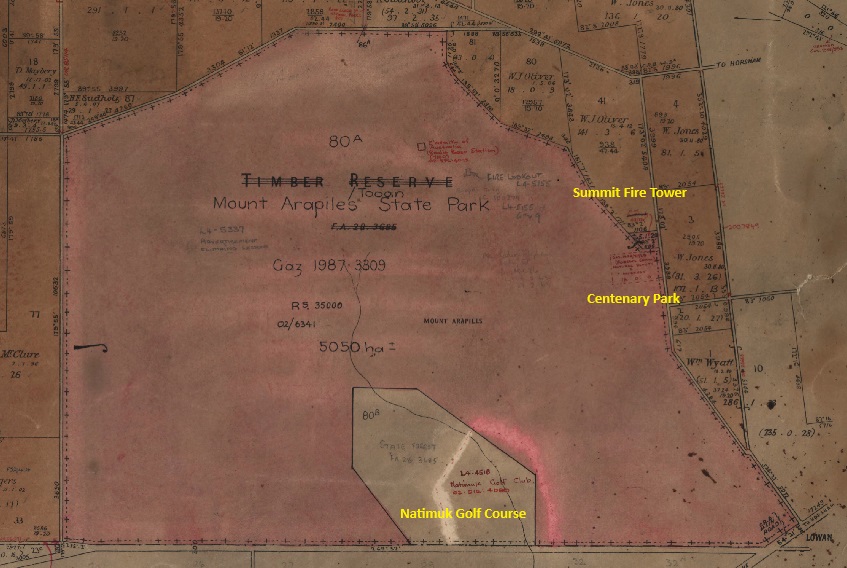
In the late 1950s, the Forests Commission used provisions in Section 50 of the Forest Act (1958) to set aside areas as Special Purpose Reserves. They included the 18-acre Centenary Park, along with a new 40-acre wildflower reserve to protect fairy wax flower, and another 40-acre picnic ground. The 18-hole Natimuk golf course was also licenced in the southern part of the Timber Reserve.
Mt Arapiles became popular for recreational rock climbing from the early-1960s and is now one of the premier climbing sites in Australia.
The Timber Reserve passed from the Forests Commission into the Mt Arapiles – Tooan State Park after the Land Conservation Council (LCC) made its final recommendations in 1982. The land was permanently reserved under the Crown Land (Reserves) Act and managed by the National Parks Service (now Parks Victoria).
It’s believed that the Shire relinquished its responsibilities over the small 18-acre Centenary Park in the mid-1980s.
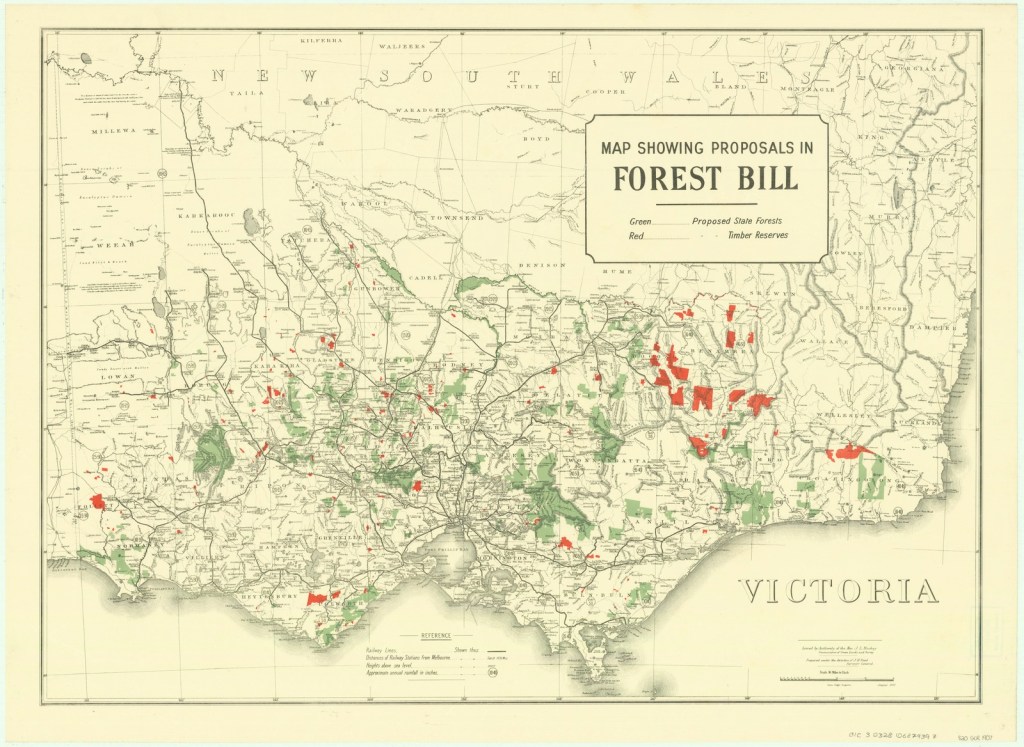
Mt Arapiles is just one of many areas of State forest across Victoria which were originally set aside as Timber Reserves and are now seen as worthy of being declared National and State Parks. Sherbrooke Forest in the Dandenong Ranges is another notable example.
Source: Tony Willett, Victorian State Foresters Association Newsletter No 48. December 1980.
https://drive.google.com/file/d/116mcQuf8so1-w2BbhiDMzZmVwKZcVQVs/view



 Victoria’s Forests & Bushfire Heritage