The first State forests nursery was established by William Ferguson at Macedon in 1872, while another was opened shortly after by John La Gerche at Creswick in 1887. Their main purpose was to grow trees to stabilise land damaged by gold mining.
The Royal Commission of 1897-1901 into the destruction and wastage of Victoria’s forests also identified the importance of protecting soils and forested water catchments.
In 1917, an Erosion Inquiry Committee was formed by the Minister for Public Works, but little seemed to come from its deliberations.
The State Rivers and Water Supply Commission (SRWSC) established its own River Erosion and Flood Protection Branch in 1931 to carry out minor river stabilisation works.
As early as 1922, Forests Commission had taken a strong interest in the protection of soils and water on forested catchments as well as private land.
And in the 1930s, the Commission took a leading role in stabilising soils in the desert country of northwest Victoria ravaged by drought and excessive clearing of Mallee woodlands for farming.
Revegetation works using Cypress Pine were carried out in the dry Hattah – Kulkyne forests in 1937-38 but it was severely hampered by large rabbit populations and the vagaries of the weather.
Soil erosion once again came into very sharp focus during the severe droughts of the 1940s across the Wimmera and Mallee deserts where the sand from bare paddocks drifted across railway lines, roads and into irrigation channels. And huge dust storms were common.
But the problems in the northwest were only the tip of the iceberg. Laanecoorie Reservoir on the Loddon River had been reduced by 47% of its capacity within 50 years because of siltation.
The Victorian State Government was slow to act, but finally in 1940, the Soil Conservation Board (SCB), headed by Chairman H G Strom was created.
The “Save the Forests” campaign was founded in January 1944 which rose from the ashes of the 1939 Black Friday bushfires. It was broad-based and included representatives from over 50 government and philanthropic organisations and boasted over 100000 members.
The campaign, which was led by the Forests Commission, had noble goals of improving forests, protecting them from bushfire and growing trees to restore farmland.
Its activities included operating native plant nurseries, community tree planting, programs for schools, seed collection, farm inspections and advice as well as organising a number of high-profile events including “Forest Week” at the Melbourne Town Hall.
By 1951, the campaign became the Natural Resources Conservation League (NRCL).
The momentum continued, and by the late 1960s the Forests Commission operated large nurseries at Mildura and Wail near Horsham growing nearly one million native plants each year to support the “trees on farms” initiative.
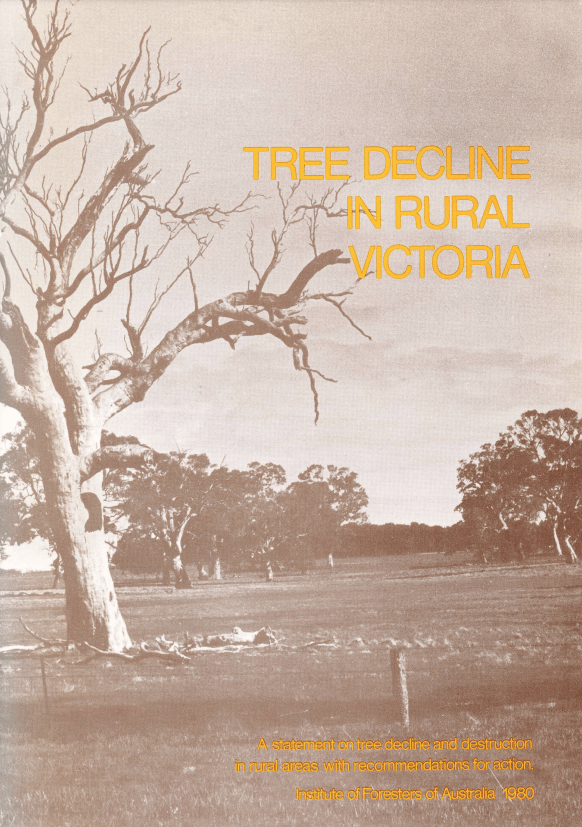
In 1980, the Institute of Foresters publication, “Tree Decline in Rural Victoria”, focussed attention on the problem, particularly in the north of the State.
This led to “Project Tree Cover” and the Focus on Farm Trees Conference held in Melbourne in 1980.
It was during this era the Forests Commission beefed up its role and formed an “Extensions Branch” servicing the tree growing needs of rural landowners. The Branch worked closely with many field staff to build relationships with landholders and rural communities.
From 1983 onwards, the newly formed Department of Conservation, Forests and Lands (CFL) brought together five disparate government agencies (the Forests Commission, National Parks, Fisheries and Wildlife, Lands, and the Soil Conservation Authority) which previously had overlapping roles and a track record of collaboration that was patchy at best.
The new CFL needed to work across private and public lands to tackle issues at a large scale such as erosion, salinity, pests and weeds, and they needed to involve the community.
The aggregation of these many ideas were the major precursors to the Landcare.
Joan Kirner, Minister for CFL and Heather Mitchell, President of the Victorian Farmers Federation (VFF), officially launched Landcare at Terry Simpson’s property at Winjallok near St Arnaud on 25 November 1986.
Not long after, in 1989, the national Landcare movement officially began with Rick Farley of the National Farmers Federation and Phillip Toyne of the Australian Conservation Foundation, successfully encouraging the Hawke Labor Government to commit to the concept.
This was followed in 1990, when the Prime Minister announced the $340 million investment in the ”Decade of Landcare”.
Within five years, Landcare had spread to involve more than one third of farming families — an extraordinary achievement on a relatively modest budget. There are now approximately 4000 Landcare groups across Australia.
 Victoria’s Forests & Bushfire Heritage