
As soon as the winter snows melted, the Treasure family traditionally drove cattle from their home at Castleburn up to the Victorian Alps and the rich grasslands on the Dargo High Plains.
The pioneering family could trace its pedigree on the High Plains back to 1878, where they held long-term grazing leases over about 100,000 acres of unoccupied Crown Land and State forest.
Clare Freda Treasure was born at Bairnsdale in 1922 as the only daughter of Harry and Clara Treasure. She had older three brothers – Don, Jim and Jack.
Freda, as she was better known, was initially educated by correspondence with the support of her mother but later, during the 1930s, at the prestigious Methodist Ladies College (MLC) in Melbourne.
Harry took all his children into the family farming and grazing business, among them his daughter Freda who helped on the family property. Her father later gave Freda a paddock at Castleburn, known as Bryce’s.
Harry and his sons built a substantial weatherboard homestead on the High Plains from local timbers.
The 1939 bushfires inflicted heavy losses on the family, as it did for many others. They lost 700 stock, miles of fences, several huts and yards, but they saved the homestead complex.
Harry made impassioned submissions to the Stretton Royal Commission regarding the causes of the 1939 fires and his views about the lack of burning in the high country.
He was also an Avon Shire councillor for over thirty years.
After the 1939 fires, Harry gave Freda a 28,000-acre bush grazing block, known as Jones’, where she lived in an existing hut and used the cattle yards. She stayed in the hut throughout the winter and was occasionally visited by her mother.
Freda was said to be a magnificent horsewoman who could shoot a rifle, whistle her dogs, and crack a stockwhip with the best of them. She camped out on the Dargo High Plains miles from anywhere on her own, and she knew the land better than any other Victorian woman. It was also said she was a keen and expert skier and had never been lost.
Freda became a bit of a celebrity and was often pursued by newspaper journalists and became known as the “Maid of the Mountains”, or ”Cowgirl of the Alps”.
In 1957, Freda married Wally Ryder from another pioneering high plains family, and the couple moved over the Great Dividing Range to a property at the base of Mt Bogong near Tawonga.
In 1959, there was some trouble brewing in Dargo over the establishment of a new sawmill in the town and the commencement of alpine ash logging on the high plains by the Forests Commission Victoria (FCV).
Relationships were strained. Freda’s older brother Jack Treasure and other cattlemen expressed concerns about the impact of heavy log trucks on the Dargo High Plains Road (DHPR) and particularly interference with their traditional use as a cattle route.
The ownership and maintenance of the DHPR was the responsibility of the Avon Shire and they were a bit grumpy too. They wanted it reclassified as a “Forest Road” under the 1943 Legislation #4953, and for the Country Roads Board (CRB) to take over the maintenance, but that never happened.
Meanwhile, Freda never lost her passion and interest in the Dargo High Plains. She had a reputation for being gentle and generous but, when required, she could be very forthright and direct. In early 1960 she successfully lobbied her local MP, Sir Albert Lind, to protect several strips of alpine ash, or woollybutt, (E. delegatensis) from timber harvesting along the family stock routes she so often rode.
Freda’s letter was forwarded to the Minister for Forests, Alexander Fraser on 24 February 1960, for consideration. The Chairman of the Forests Commission, Alf Lawrence, noted his suspicions about the motives behind the letter and the links to the disquiet from the Treasure family about the new Dargo sawmill.
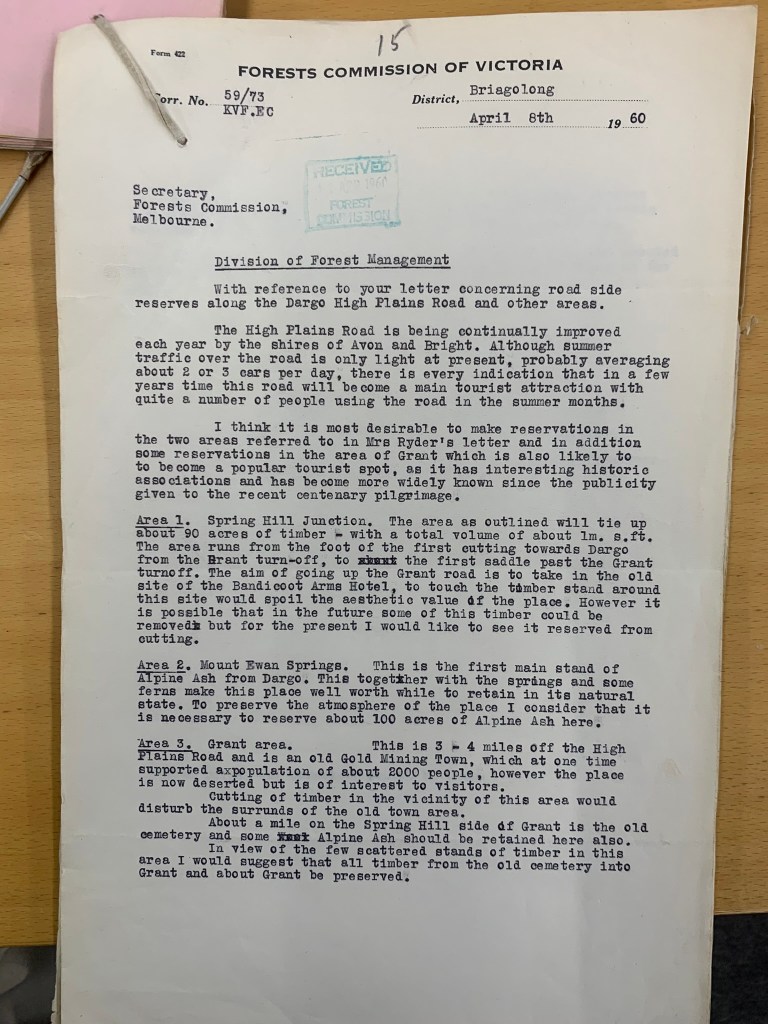
Despite the Chairman’s misgivings, Stuart Calder, the District Forester at Briagolong, was subsequently asked on 22 March to identify, map and assess the impact on timber resources for a possible new reserve.
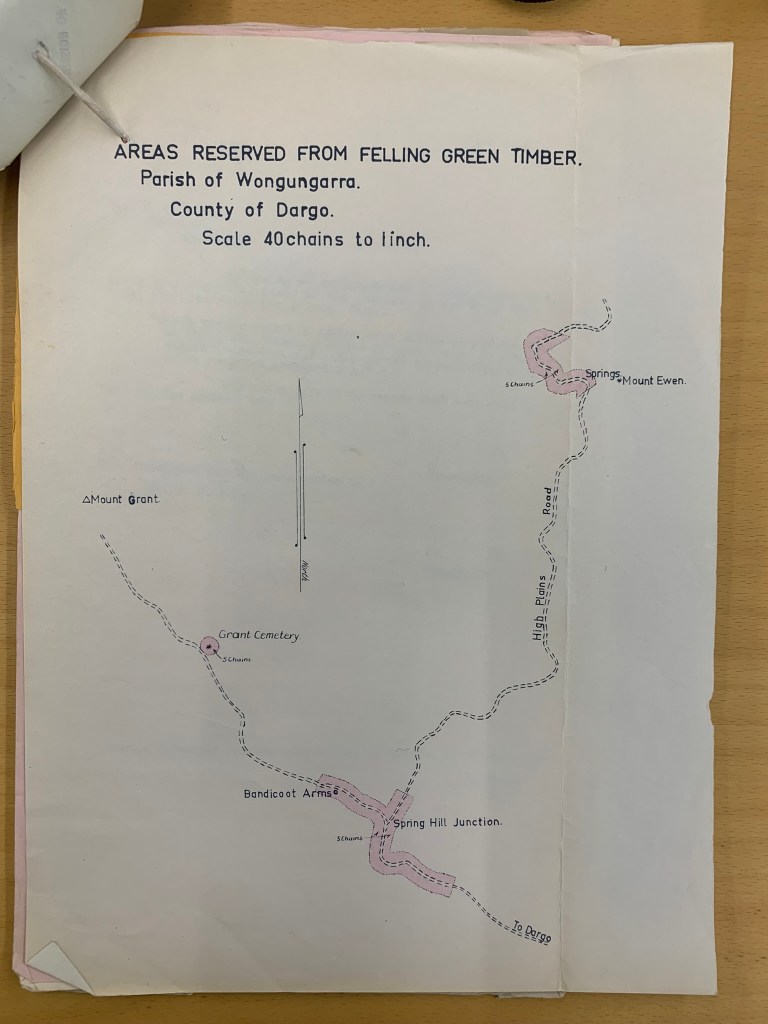
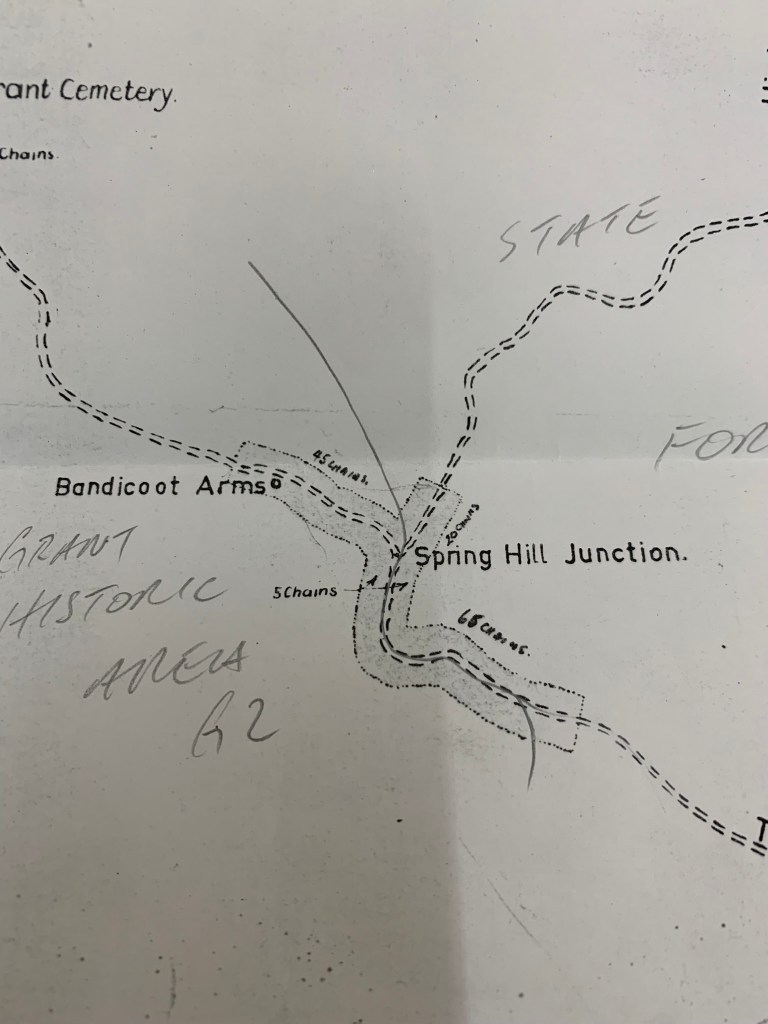
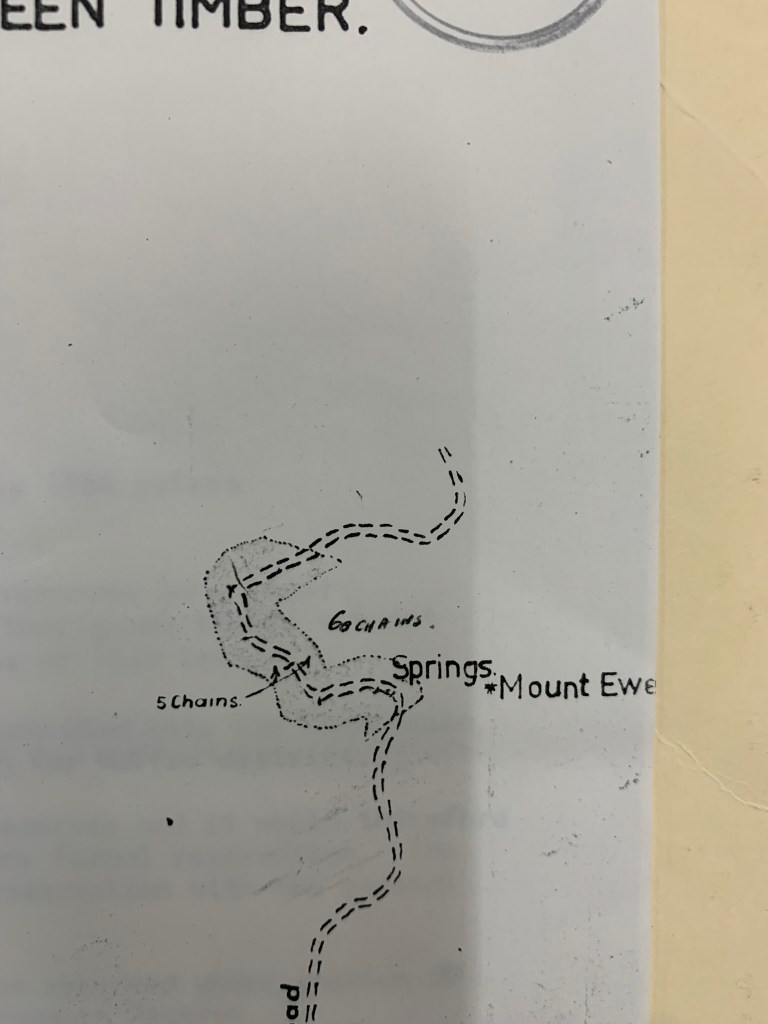
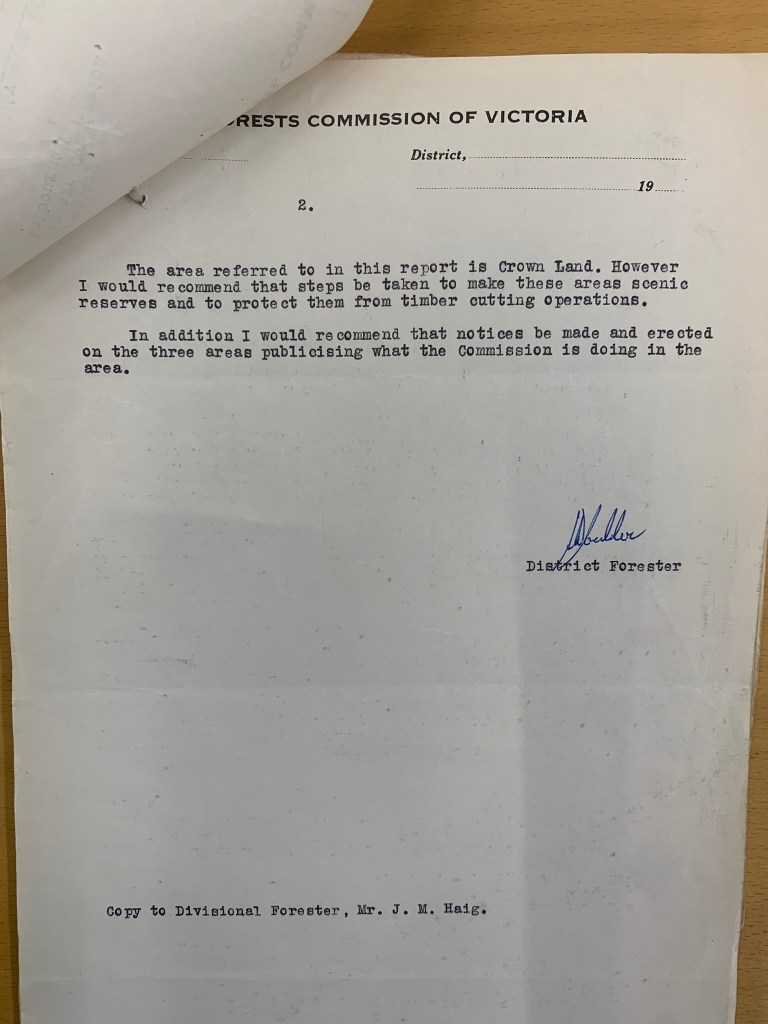
Stuart dutifully responded on 8 April 1960 recommending a new reserve on State forest, 5 chains (100m) wide on each side of the DPHR (200 m total) in three parts –
- The first area near Spring Hill junction set aside 90 acres of bush with a total length of 133 chains. It also covered the old Bandicoot Arms Hotel site on the road to Grant.
- Another 100 acres of alpine ash was identified on a stretch of 60 chains further north near Mt Ewen springs.
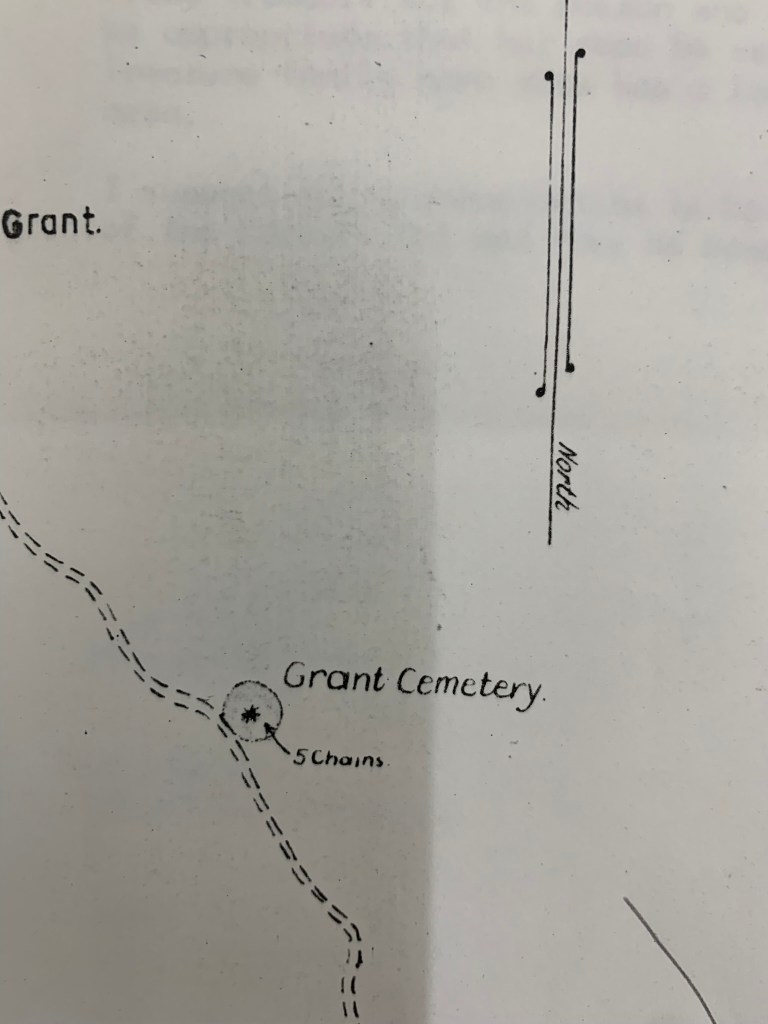
- A 5-chain buffer around the old Grant Cemetery was also recommended.
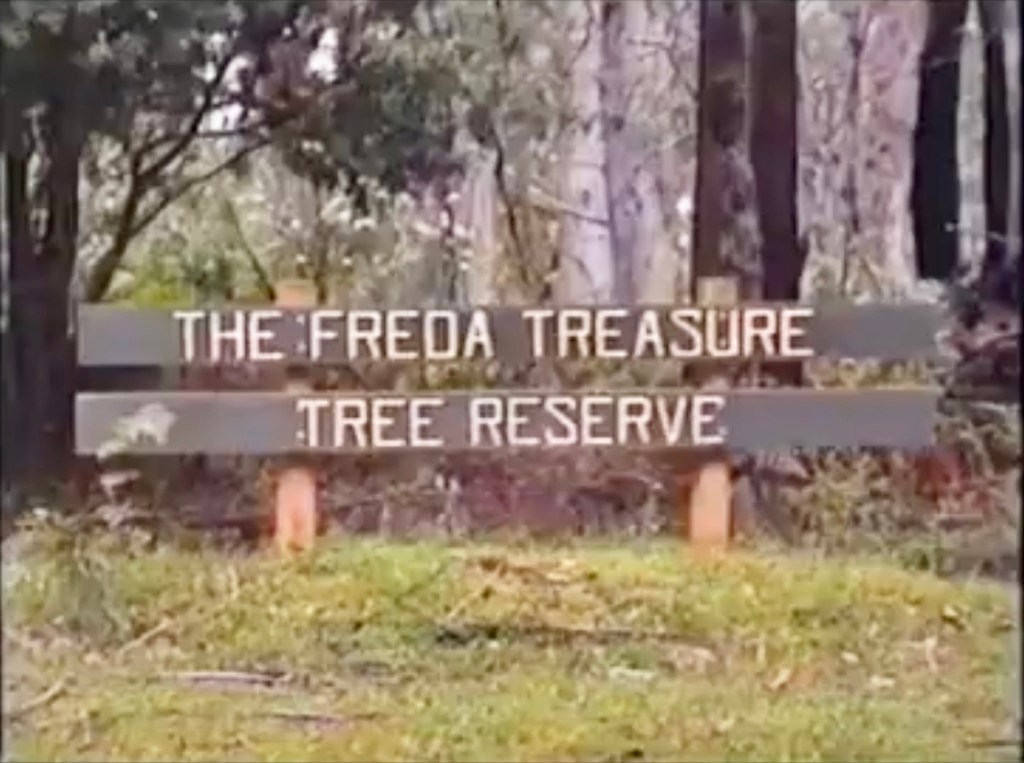
The Freda Treasure Tree Reserve, as it eventually became known, was subsequently excluded by the Forests Commission from logging along the edges of the DPHR. The manager of the Dargo sawmill, W. D. Downey, was subsequently advised.
But despite recommendations from the District Forester the Commission decided not to formally set the land aside as a Scenic Reserve under Section 50 of the Forest Act (1958).
However, a very clear instruction was issued to FVC staff in June 1960, not to organise logging within the strip, and this arrangement worked very effectively over the subsequent decades.
The Land Conservation Council (LCC) conducted a review of the Alpine Area in 1979, but the long-standing arrangements with the reserve were somehow overlooked.
In 1984, the Shire of Avon wrote to Graeme Saddington, the District Forester at Maffra, seeking clarification of the status of the land and suggesting it become known as the Freda Treasure Reservation. Local Commission staff once again supported the proposal, but there was still no action on a formal Section 50 Reservation, probably because the Forests Commission was going through a major disruption at the time to create the Department of Conservation, Forest and Lands (CFL).
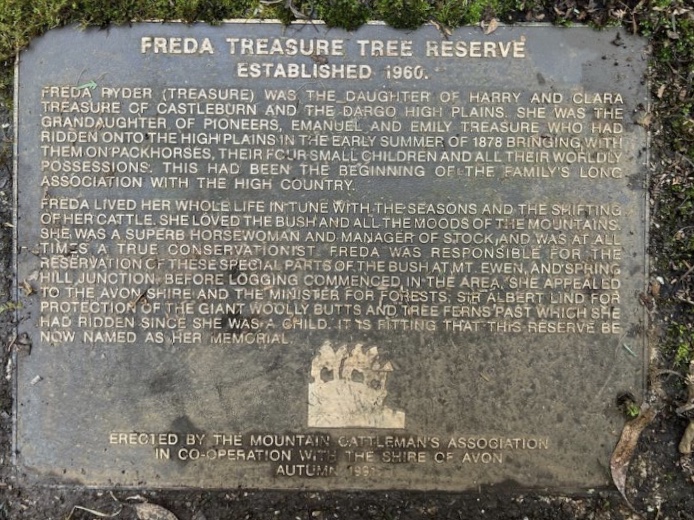
Freda died on 25 April 1988, and just seven days later her husband Wally died too. On 8 December 1991, a plaque dedicated to Freda’s memory was unveiled in the bush near Spring Hill by the Mountain Cattlemen’s Association.
The original 1960’s Freda Treasure Tree Reserve was subsequently incorporated into a Special Management Zone (SMZ) during the Central Gippsland Forest Management Planning process in 1998. An extended reserve stretches along most the DHPR which was later ratified in the Federal Regional Forest Agreement (RFA), signed in March 2000.
https://www.highcountryhistory.org.au/wp-content/uploads/sites/7/10015.pdf
Main Photo: November 1951. https://trove.nla.gov.au/newspaper/article/265582324

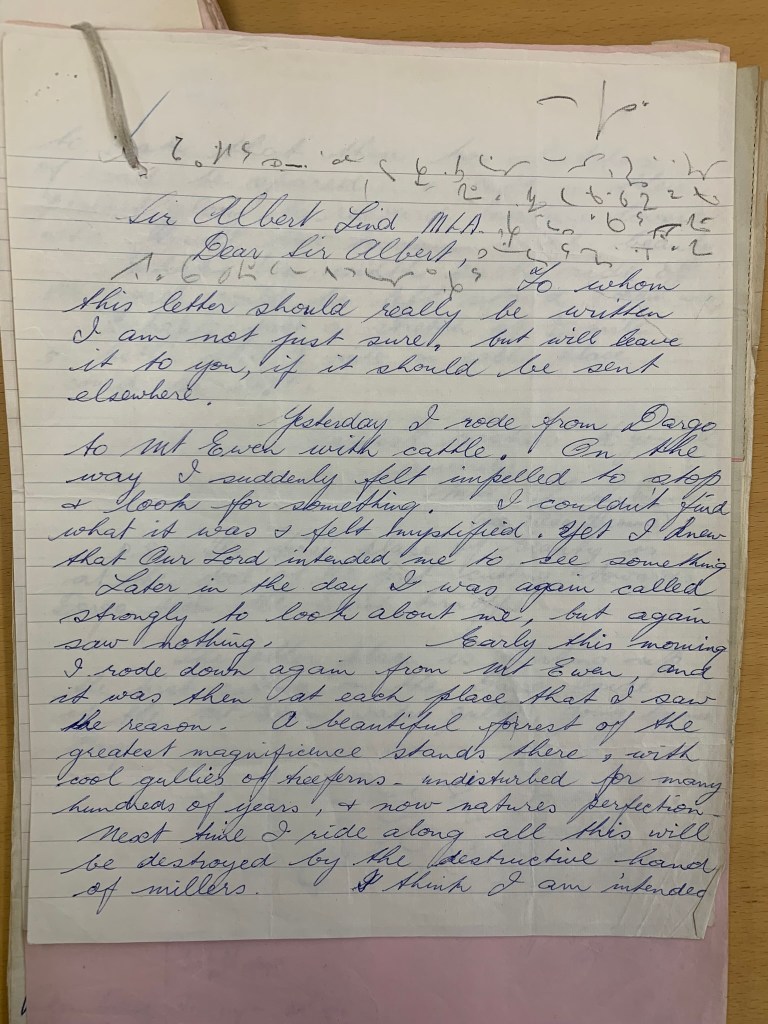
Sir Albert Lind, MLA, Dear Sir Albert
To whom this letter should really be written I am not just sure, but I will leave it to you if it should be sent elsewhere.
Yesterday I rode from Dargo to Mt Ewan with cattle. On the way I suddenly felt impelled to stop and look for something. I couldn’t find what it was and felt mystified. Yet I know that Our Lord intended me to see something.
Later in the day I was again called strongly to look about me, but again saw nothing. Early this morning I rode again down from Mt Ewan, and it was then at each place that I saw the reason. A beautiful forest of the greatest magnificent stands there, with cool gullies and tree ferns – undisturbed for many hundreds of years, now natures perfection.
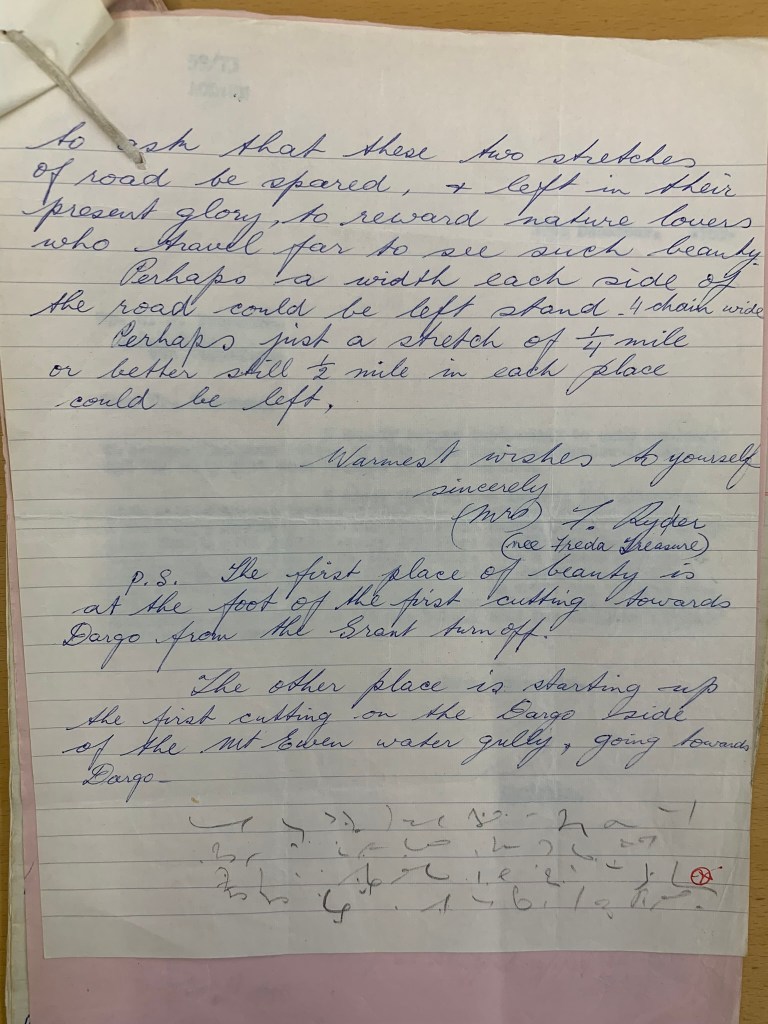
Next time I ride along all this will be destroyed by the destructive hand of millers. I think that I am intended to ask that these two stretches of road be spared and left in their present glory, to reward nature lovers who travel far to see such beauty.
Perhaps a width each side of the road could be left stand. 4 chain wide.
Perhaps just a stretch of ¼ mile or better still ½ mile on each side should be left.
Warmest wishes to yourself, sincerely, (Mrs) F Ryder (nee Freda Treasure)
P.S. The first place of beauty is at the foot of the first cutting towards Dargo from the Grant turnoff.
The other place is starting up the first cutting on the Dargo side of the Mt Ewan water gully going towards Dargo.
The letter has illegible pitman shorthand markings written in pencil, and I suspect these were made by the Minister’s Secretary in preparing a response.
Albert Lind then wrote to the Minister for Forests, A J Fraser MLA, on 24 February 1960 asking that Freda’s proposal be considered.

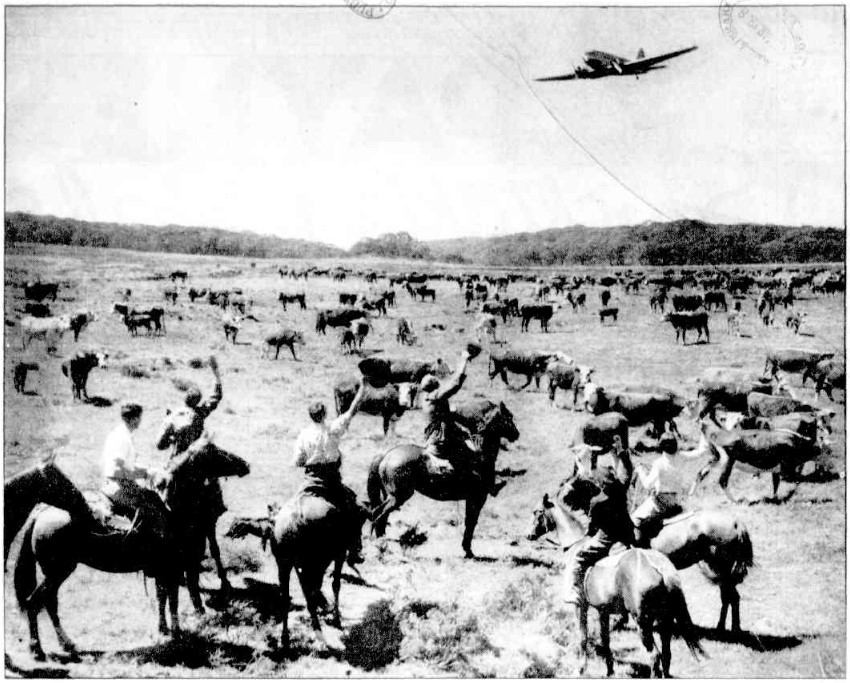
Sadly, the same aircraft crashed just a few months later into Mt Dandenong, killing all on board.
https://trove.nla.gov.au/newspaper/article/244593502
 Victoria’s Forests & Bushfire Heritage