The first “road” to be built in Victoria by European settlers was on Phillip Island, more than two centuries ago.
The “project manager” was the Commander of HM Brig Lady Nelson – John Murray – who was surveying the Bass Strait area in 1801 on behalf of Victoria’s first road authority – the Government of New South Wales.
The New South Wales Government continued to oversee the development of Australia’s south-eastern corner until 1851, when Victoria was proclaimed a Colony in its own right.
But by 1851, Victoria’s roads were in a parlous state and the new government tackled the issue as a matter of priority. It was spurred by the huge increase in traffic fuelled by the gold rush, and in 1853 an Act for making and improving roads in the Colony of Victoria was passed.
A Central Road Board, as well as several District Road Boards, were established, the former responsible for main roads and the latter for local roads.
The State Government financed the main roads and contributed half the cost of local roads, while maintenance was partially funded through tolls.
The Central Road Board was a great success, but nonetheless was abolished in 1857 and its responsibilities transferred to a new Board of Land and Works. These were days when rail travel was in the ascendancy, taking up much of central government’s time and money.
The responsibility for building and maintaining roads was increasingly devolved to local municipalities. And here, local interests often prevailed over the greater good, leading to patchwork development of the Colony’s road system.
But roads were to undergo a resurgence, not surprisingly, driven by the ever-increasing popularity of the motor car at the turn of the century (the first motor vehicle in Melbourne appeared in 1897).
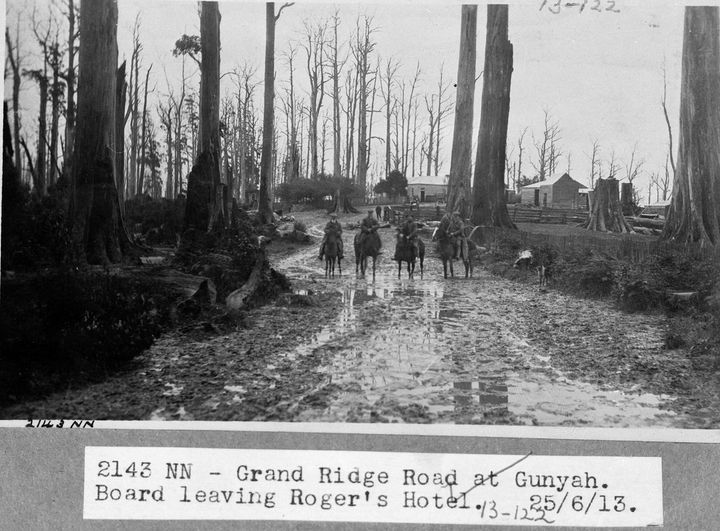
The earlier period of 1851 – 1857 had shown the value of central direction on road management and, in 1913, the Country Roads Board (CRB) was established – the heir of the Central Road Board and a parent of the current VicRoads.
Civil engineer William Calder was appointed the first Chairman of the Board, and he took an important role in guiding the development of the Great Ocean Road until his death in 1928. Calder, after whom the Calder Highway is named, often inspected roads on horseback.
The new Board began by conducting a two-year investigation of Victoria’s roads (which it found to be “anything but satisfactory”, according to its first annual report).
The Board, in its first year, also approved contracts for works amounting to 94,876 pounds.
Interestingly, the first annual report also commented on matters such as the false economy of cheap construction, poor maintenance methods, the need to set road standards, conservation and aesthetics.
With its first investigations completed, the CRB hoped to begin major construction work. However, this was set back by the start of the First World War in 1914.
From 1918 to 1943, the CRB’s brief expanded to include many other classes of road. The most significant was State Highways, which were developed and maintained by the CRB to relieve municipalities of providing for long distance “through traffic”.
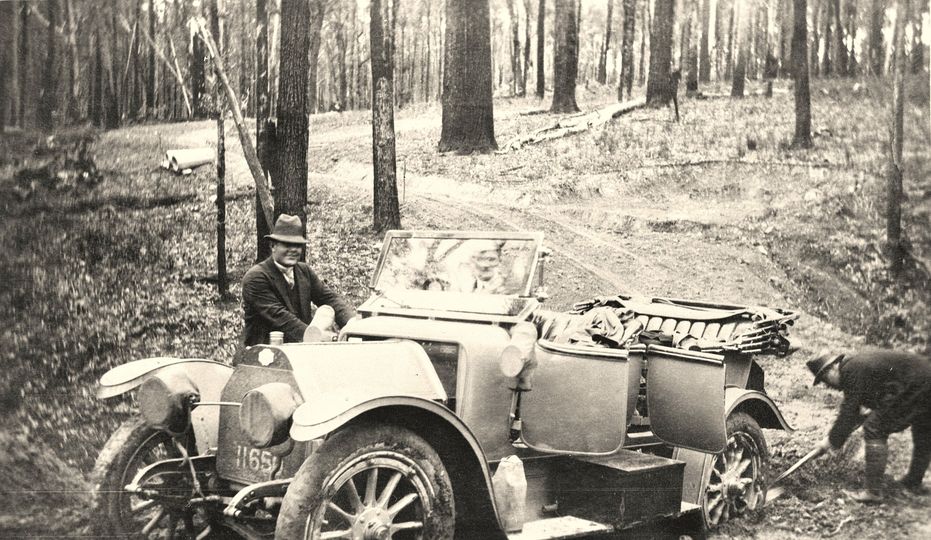
Meanwhile, after the 1939 bushfires, the Forests Commission was busy building over 50,000 km of forest roads and tracks. The two organisations always had a close working relationship because of the need to transport logs from the forest to sawmills in nearby towns, and then move sawn produce to markets.
The CRB obviously worked to different engineering standards, but the two organisations shared knowledge and sometimes equipment. CRB crews and their machines were always handy at bushfires.
VicRoads was formed in 1989.
The Roads Act (2004) help to delineated road ownership between VicRoads, municipalities, and the Department.
https://www.vicroads.vic.gov.au/about-vicroads/our-history
Photo: Members of the newly formed Country Roads Board on their inspection of roads in the Strzeleckis – 25 June 1913. CRB Collection, Public Record Office, Victoria. VPRS 17684/P0003/108, 13_00122_A


 Victoria’s Forests & Bushfire Heritage
Peter,
I enjoyed this article.
John
LikeLiked by 1 person