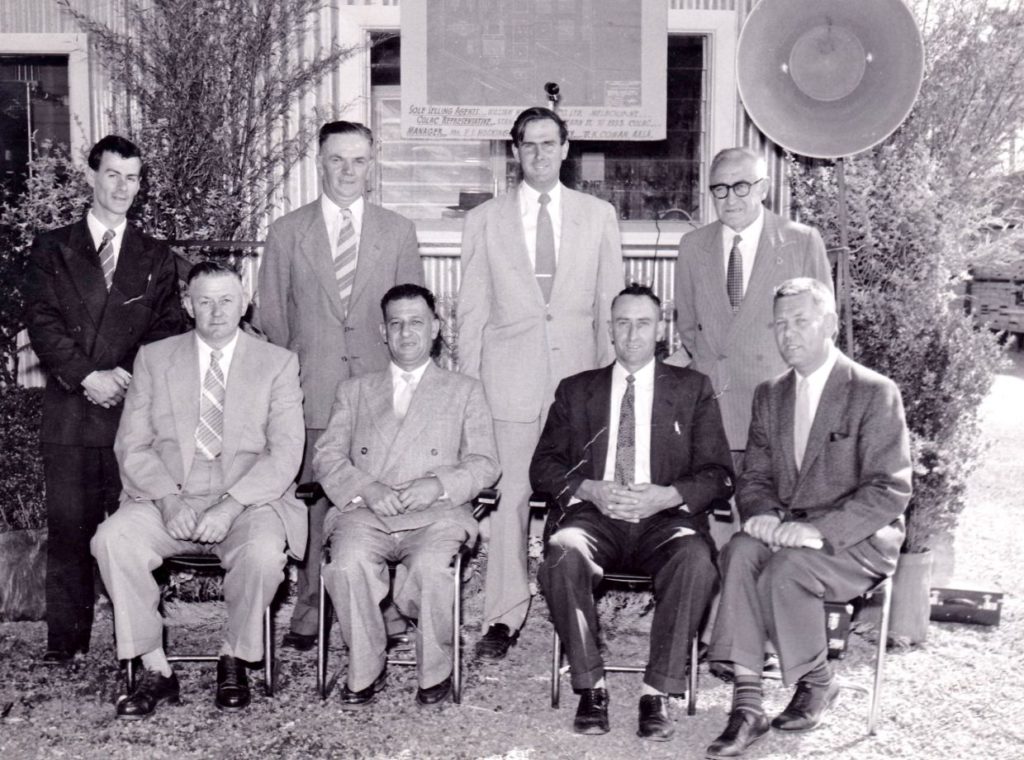
Associated Kiln Driers Pty. Ltd., or AKD Softwoods, was founded in 1955, with its Head Office based at Colac in western Victoria.
The Otway State forests to the south of Colac had supplied hardwood timber since the earliest days of European settlement with small sawmills cutting timber for housing, construction, railway sleepers, case timbers for food packaging, and for fencing.
But there was little or no value adding, drying, or machining at these small bush sawmills, although a couple of hardware stores and timber yards in Colac made picture frames, doors, windows, architraves as well as mouldings.
The War Service Homes Commission built a mill at Gellibrand in the early 1920s to cut weatherboards, while Hayden Bros established a seasoning kiln and planing mill at Barwon Downs in 1933, which ran until 1944.
When the Second World War ended, the housing boom kicked in, and local Colac sawmillers became concerned at a potential loss of their markets. They were seeing their green sawn timbers leave the area for Geelong or Melbourne only to be kiln dried and dressed before coming back to Colac and being sold at a profit by others.
In 1948, local sawmillers George Bennett and Stan Inglis together with timber merchant Harry Stephens tossed around the notion of value adding kiln dried hardwood timber.
The technology had become available at reasonable cost to kiln-dry wood but none of the local businesses were large enough to make it viable, so the idea of a joint venture, or co-operative, started to take hold.
Nothing much came of this idea until early 1954 when the Forests Commission Victoria (FCV) started making noises about future timber supplies from the Otways.
There were lingering concerns about Melbourne based sawmillers moving in, so the local branch of the Victorian Sawmillers Association (VSA) was stirred into action and began canvasing other local sawmilling companies about the co-operative idea, but with a variable response.
At the same time, the CSIRO Division of Forest Products was engaged to assess the feasibility and begin planning for a new seasoning kiln while the Commission examined how to allocate logs under a co-operative licencing arrangement.
And so it came to pass, that on Melbourne Cup Day, 2 November 1954, George Bennett, Stan Inglis and Tom Prosser formed a new company to carry out kiln seasoning of local hardwoods at Colac.
And that was the start of AKD.
Membership of the new co-operative was open to any registered VSA sawmiller in the Southwest Branch who agreed to contribute sawn timber to the kiln for seasoning. Seven sawmill companies formally entered at a foundation Board meeting held on 5 August 1955, and George Bennett was voted the inaugural Chairman.
The company then purchased a parcel of land at Colac east, an irregularly shaped block near the railway line, within an existing sawmill precinct. The plans and specifications for the new works were devised by the CSIRO’s Division of Forest Products under the guidance of Hal Roberts.
Construction tenders were called which were awarded to Todd & Kerley in association with Kiln Installation and Equipment Pty. Ltd. and work commenced in March 1956.
There was an official opening on 28 February 1957 by the Hon Gordon McArthur, MLC and Minister for Forests.
Together, the shareholders commanded around 16,500 cubic metres of hardwood sawlogs, all of which were coming from FCV allocations in the Otway State forests. The select grades of sawn timber were delivered into the AKD yard at Colac, principally as 6 x 1 inch boards.
Earlier in 1949, the Commonwealth Forestry and Timber Bureau proposed an ambitious national planting program of pine trees to make Australia more self-reliant in timber after the shortages experienced during the second world war.
However, the big leap for Victoria came in 1961, when the Chairman of the Forests Commission, Alf Lawrence, attended the World Forestry Conference in São Paulo Brazil, and upon his return took a bold decision to commit to a massive softwood expansion program which initiated nearly four decades of plantation establishment.
The Commission decision created a new wave of momentum and private investment optimism. The softwood plantation area eventually reached a threshold where manufacturers could confidently establish major processing plants.
Also, from 1961, the Forests Commission began to implement its foreshadowed cuts to hardwood log allocations from the native forests in the Otways.
Commissioner, Ben Benallack, had warned AKD from the very outset that there was no strategic future in hardwoods and that it should move into softwoods.
The writing was on the wall, so in August 1957 a test consignment of 100 m3 of pine from the Forests Commission’s Aire Valley plantation was dispatched for processing to the new Colac plant, but with disappointing results. Pine was re-examined again in 1959 with a better outcome.
The late 1950s period marks AKD’s strategic shift away from native forest hardwoods and was the lever to full dependence on softwoods. But the transition to sawing, drying, processing and selling pine was not without its bumps and hurdles.
The long-term security of raw materials was always a major concern for AKD. Initially, logs were supplied from FCV plantations, some private sources, as well as farm logs.
AKD began acquiring land for its own plantations in 1972 and calculated that it needed to plant about 80 ha per year, every year, well into the future. By 1976 AKD held 1,000 ha and was aiming for 3,700 ha. After some strategic purchases, it now owns a 12,000 ha radiata pine estate.
The company at Colac draws wood from the “Green Triangle” which spans the border area between South Australia and western Victoria. Other major private growers include Forestry-SA, Auspine, Hancock Victorian Plantations (HVP), Timbercorp and ITC.
The green triangle region grows around 160,000 ha of mature softwood plus another 110,000 ha of short-rotation hardwood plantations, which were mostly established from the mid-1990s.
Victoria now has 382,600 hectares of privately owned and managed plantations, making up nearly a quarter of the national total.
In the decades since its formation in 1955, Associated Kiln Driers grew steadily and diversified to employ over 1100 people. The company owns a large plantation estate, as well as six large scale sawmills across Victoria, New South Wales and Queensland processing nearly 1 million m3 of logs. It also has three post and preservation businesses, an export operation in Geelong and its own transport fleet.
A major regional success story by any measure.
Photo: Founding members of AKD.
Norm Haughton (2016). The AKD Softwoods Story: 1954 to 2016. Unpublished.
https://drive.google.com/file/d/1XRlXE6U8e57ilO9C9u6GJd9W8ial_FsW/view
 Victoria’s Forests & Bushfire Heritage